
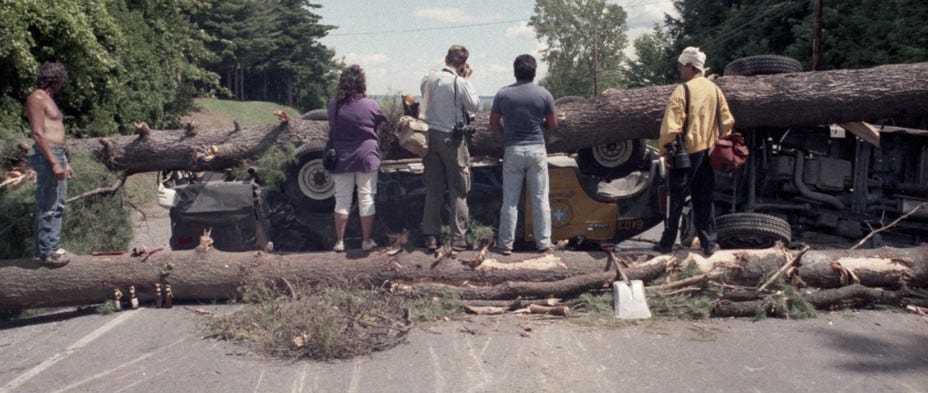
A Photojournalist joins several Mohawk people on a barricade in the Pines, summer 1990.
(©Robert J. Galbraith, courtesy Kanien’kehá:ka Onkwawén:na Raotitióhkwa Language and Cultural Center)
In 1991 Prime Minister Brian Mulroney established a Royal Commission on Aboriginal Peoples (RCAP) with a mandate to investigate and propose solutions to the challenges affecting the relationship between Indigenous peoples, the Government of Canada, and Canadian society as a whole. Its final report was published in 1996. The report centred on a vision of a new relationship, founded on the recognition of Aboriginal peoples as self-governing nations with a unique place in Canada. It set out a 20-year agenda for change, recommending new legislation and institutions, additional resources, a redistribution of land and the rebuilding of Aboriginal nations, governments and communities. Recognizing that autonomy is not realistic without significant community development, RCAP called for early action in four areas; healing, economic development, human resources development, and the building of Aboriginal institutions.
RCAP essentially called for the government to commit to a new set of ethical principles respecting the relationship between the Indigenous peoples and the state. These principles require acknowledging and respecting Indigenous cultures and values, the historical origins of Indigenous nationhood and the inherent right to Indigenous self-determination. As is common with Royal Commissions, most of the recommendations from RCAP have not been implemented.
Major Recommendations from RCAP included the following:
Legislation, including a new Royal Proclamation stating Canada’s commitment to a new relationship and companion legislation setting out a treaty process and recognition of Aboriginal nations and governments;
Recognition of an Aboriginal order of government, subject to the Charter of Rights and Freedoms, with authority over matters related to the good government and welfare of Aboriginal peoples and their territories;
Creation of an Aboriginal parliament;
Expansion of the Aboriginal land and resource base;
Recognition of Métis self-government, provision of a land base, and recognition of Métis rights to hunt and fish on Crown land;
Initiatives to address social, education, health and housing needs, including the training of 10,000 health professionals over a ten-year period, the establishment of an Aboriginal peoples’ university, and recognition of Aboriginal nations’ authority over child welfare.
Today, 30 years have passed since the issuing of the RCAP report. It can be said that progress has been made on several fronts and major steps forward have been made. Notwithstanding, we do not have a clearly defined set of principles that establish precisely what the relationship ought to be between the Canadian government(s) and the Indigenous people. As a result, we see slow progress on some fronts like the negotiation of modern treaties (to establish self-governing structure and settle comprehensive land claims), the clear definition of Aboriginal Rights and the division/sharing of powers between Indigenous nations and the Canadian government.
There are several barriers to achieving the kind of progress one might have hoped could have been accomplished over the past forty-year period. Philosophically, in a liberal democracy like Canada, one of the fundamental tenets is the equality of individual human rights. If everyone is equal then no group or set of groups can command greater rights than any other. In addition, while the proportion of the population of Canada that is Indigenous varies significantly from province to province (and territory to territory) overall, Indigenous people make up just 5% of the people living in Canada. Some Canadians struggle with any notion that such a small group ought to be able to command greater rights in any way.
However, it has long been a foundational concept in many circles advocating for reconciliation that Indigenous people should enjoy rights as “Citizen’s Plus”. This concept was originally coined in the 1966 Hawthorn Report (A Survey of the Contemporary Indians of Canada), and later championed in Harold Cardinal’s 1970 Red Paper, a response to the federal government’s infamous 1969 White Paper. The concept of Citizens Plus suggest that Indigenous peoples should possess the standard rights and duties of Canadian citizenship, plus additional rights, protections, and privileges due to their history and historic relationships established with King of England.
This concept proposed in the Red Paper is actually a fundamental departure from the basic tenets of liberal democracy and hence remains controversial. However, makes sense as a means to acknowledge the unique nation-to-nation relationship between the Canadian state and each of the many and various groups of Indigenous people who share this land with the settler society, it is essential to recognize that we are not dealing with a singular state but rather a true federation of many nations that share a common land, common resources and a common destiny.
In struggling with this concept of Citizens Plus we end up in a contradictory position where we both accept the rights of Indigenous groups in some cases and deny the rights of some Indigenous groups for fear that acknowledging their rights will somehow convey unto them a set of greater rights in others. This paradox has, at times, paralysed progress.
An important case in point is the very controversy that was the impetus for Prime Minister Mulroney to establish the RCAP in the first place – the Oka Crisis of 1990, which has become known as the Kanesatake Resistance. It was a 78-day standoff (July 11 - September 26, 1990) between Kanyen’keha:ka (Mohawk) protesters, the Quebec provincial police (Surete du Quebec), the RCMP and the Canadian Army, in the community of Kanesatake, near the Town of Oka.
There is a long history preceding the crisis at Oka. The Kanyen’keha:ka (Mohawk) had been pressing for recognition of their right to the land in dispute since 1761. Almost immediately after Britain conquered New France (Quebec), the Mohawks of Kanesatake wrote to government officials in Britain. They described living under unfavourable rules that threatened their livelihood. They contested their right to the land and asked to be freed from the authority of the Sulpicians, a Roma Catholic order that had been granted the land by King Louis XV in 1717. The Sulpicians had also begun selling the land to white settlers. The British ignored these demands.
The Kanyen’kehà:ka continued to contest their right to the land over the next 150 years; each attempt was rejected. In 1851, they petitioned Lord Elgin the Governor General of Canada at the time, asking him to recognize their right to the land. Again, the request was denied. In 1859, the Province of Canada gave the Sulpicians official title to the land. In 1868, the government of the new Dominion of Canada went further and denied that the Kanyen’kehà:ka original land grant reserved land specifically for them.
The Mohawks of Kanesatake’s case over land rights was heard by the Quebec Superior Court in 1910; in 1912, it was heard by the Court of King’s Bench and finally by the Judicial Committee of the Privy Council - Canada’s highest appeals court at the time. The Judicial Committee ruled that official title to the land was held by the Sulpicians. However, ownership of the Kanyen’kehà:ka common area, known as “the Pines,” remained unresolved.
Subsequently, the Kanyen’kehà:ka asserted Aboriginal title to their ancestral lands in 1975. But their land claim was rejected on the grounds that, since they did not hold the land continuously from time immemorial, their Aboriginal title was voided. They filed a second land claim with the federal government in 1977. It was rejected in 1986, on the grounds that it did not meet the full legal criteria. These decisions reflect rigid technical interpretations that do not acknowledge the fundamental nature of the relationship between the Crown and Indigenous peoples. Rather these decisions rely on strict legal interpretations that decidedly ignore Aboriginal law, indigenous rights and historic realities.
In 1961, a nine-hole golf course was built on the Pines, despite the fact that the land came very close to infringing on a traditional Kanyen’keha:ka burial ground, and despite protests from the Kanyen’kehà:ka. In 1989, the mayor of Oka, Jean Ouellette, announced a plan to build a townhouse complex and expand the golf course into the Pines and over the Kanesatake ancestral cemetery. This sparked the Oka crisis.
During that 78-day period in 1990 a police officer with the Surete du Quebec was killed in a gun fight and several blockades were established by Mohawk Warriors that caused significant economic disruption. Inevitably the resistance was broken by the intervention of Canadian soldiers from the Canadian army1.
While the crisis led to the establishment of RCAP and helped increase government awareness of the duty to consult and the need to resolve long festering claims, in reality much remains unresolved. The golf course expansion was cancelled and the federal government purchased some of the land for Kanesatake. In 2001, the Kanesatake Interim Land Base Governance Act confirmed that the land was to be reserved for the Mohawks of Kanesatake. However, it did not establish the land as a reserve, and there has since been no organized transfer of the land.
Forty-six years after the crisis in Oka, forty years after the Royal Commission on Aboriginal Peoples Report was published, the matters that led to the initiation of the Commission remains unresolved. The Commission’s recommendation have largely been ignored. So, while a small group of Mohawks were in an instant able to capture the attention of all of Canada and to compel the government to take some action, inevitably the system has been able to slow the evolution of the relationship between Indigenous people and the state to a crawl. Awareness and understanding of the long history is important for us all to know in order to continue to move forward. Despite slow change, this event did accomplish a lot. RCAP is a profoundly important influential document. We cannot forget the history and events and what it has taught us about our relations.
Thanks for reading Canadian Indigenous Facts, Stories and Learnings! Subscribe for free to receive new posts and support our work.
Thanks for reading Canadian Indigenous Facts, Stories and Learnings. This post is public so feel free to share it.
More images and references to films and documentaries regarding this Crisis found at: https://thecanadianencyclopedia.ca/en/article/oka-crisis
See https://thecanadianencyclopedia.ca/en/article/oka-crisis for details on the events during the resistance.
Comments
Nothing yet. Say the first thing.
Sign in to join the conversation.