
Time speeds up as one gets older. I have been quite busy, and so speeches, podcasts, writing and videos quickly disappear into the fading digital diary, and into my already-over crowded memory bank. Which is why I intend to post talks, discussions and interviews given recently, right here - for subscribers to enjoy at your leisure, as well as to remind me of all my past commitments!
I will also include articles written for other outlets, most of which are copyrighted and so cannot be reproduced in full. I will try and restrict links to those that are open, or provide short-term access.
I am generous with my time, but increasingly recognise that spending time on my own podcasts and videos would be more beneficial. However making good quality podcasts and videos requires both expert technical help and funding - the one cannot begin without the other. So thank you to those making a paid contribution to this work - and please consider taking out a paid subscription if you have not done so already.
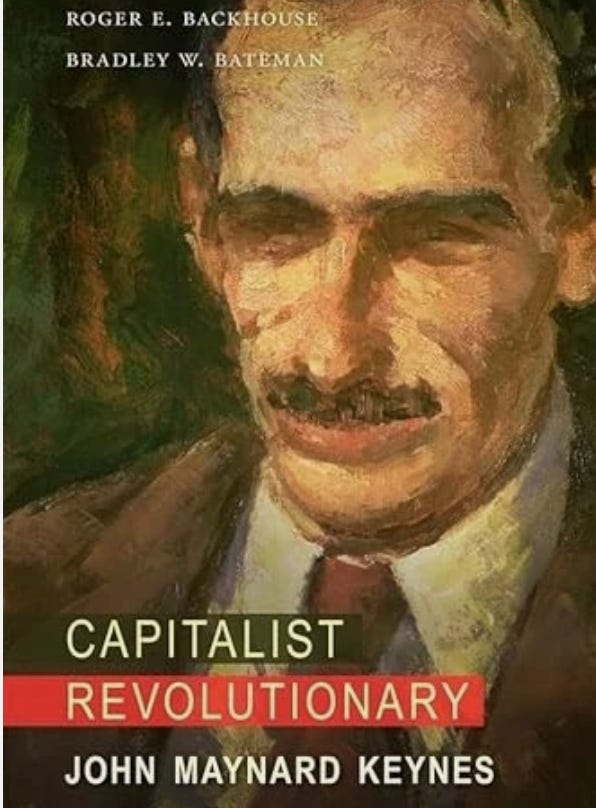
That dangerously radical John Maynard Keynes
The first offer is of a film - produced and directed by the impresario, composer and author Adrian Munsey - and now available on YouTube. In it, I and Professor Robert Skidelsky, speak at some length on the work of Keynes - that great radical, liberal socialist. Sadly Robert Skidelsky died in April this year, and so did not live to see it produced. He was the author of a magnificent biography of Keynes, a friend and a colleague of the Progressive Economy Forum of which I am a member.
The movie begins with a health warning to viewers, a warning that refers to my contribution:
John Maynard Keynes had radical views about the arrangement of economic affairs, which can continue to shock.
Contemporary Keynesian economists have ideas that are controversial and which remain shocking. Some of these views are expressed in this programme.
I am not alone in my appreciation of the radicalism of Keynes’s economic theories and policies. The conservative right - and the world’s financiers and speculators - fully grasp the nature of that radicalism and never hesitate to condemn him. He had, after all, called for “the euthanasia” of a whole class of capitalists: the speculators or rentier class - dominant today in the grossly unequal, global economy. Hence the near-constant attempts to distort and betray Keynes’s economic theories.
Keynes’s contributions to modern, radical art and culture are also sadly neglected - as are his relationships to the artists of his day, including his wife, the ballerina Lydia Lopokova. Amongst other endeavours in the arts field, he founded and arranged for the funding of both the British Arts Council and the Royal Ballet.
Geoff Tily’s book: Keynes Betrayed: The General Theory, the Rate of Interest and ‘Keynesian’ Economics - explores the great man’s legacy. In virtually all interpretations, Tily explains,
Keynes is protrayed as concerned only with government expenditure as a means to cure economic crises. Yet Keynes’s central aim was the prevention of economic crises, for which he prescribed monetary, not fiscal policies.
The late, great James Crotty, (1940-2023) Emeritus Professor of Economics at the University of Massachusetts Amherst, wrote in the introduction to his book: Keynes Against Capitalism.
It is almost universally believed that Keynes wrote his magnum opus, The General Theory of Employment, Interest and Money, to save capitalism from the socialist, communist, and fascist forces that were rising up during the Great Depression era…This was not the case with respect to socialism.
“Keynesian” economists (like the influential Paul A. Samuelson one of the founders of neo-Keynesian economics and a seminal figure in the development of neoclassical economics) misinterpreted crucial parts of Keynes’s economic theory, misunderstood many of his policy views, and failed to realize that his overarching political objective was not to save British capitalism, but rather to replace it with Liberal Socialism.
So I am proud of that health warning. Take courage, buckle up and watch the colourful, insightful and in some parts intensely personal, Keynes, The Secret Architect of the Modern World here:
No posts
Comments
Nothing yet. Say the first thing.
Sign in to join the conversation.