
I have much to say about today’s convergence of crises: the debt crisis in financial markets triggered by AI mania, the climate breakdown crisis, and now the crisis of the global economy as the Yen weakens and threatens the US, and with it the global economy. (Global economic crises have a habit of blowing up in August.)
All three crises reflect a broken global economy, a broken ecosystem and broken political systems.
I will therefore write a series of posts on the issues arising.
But first. The climate.
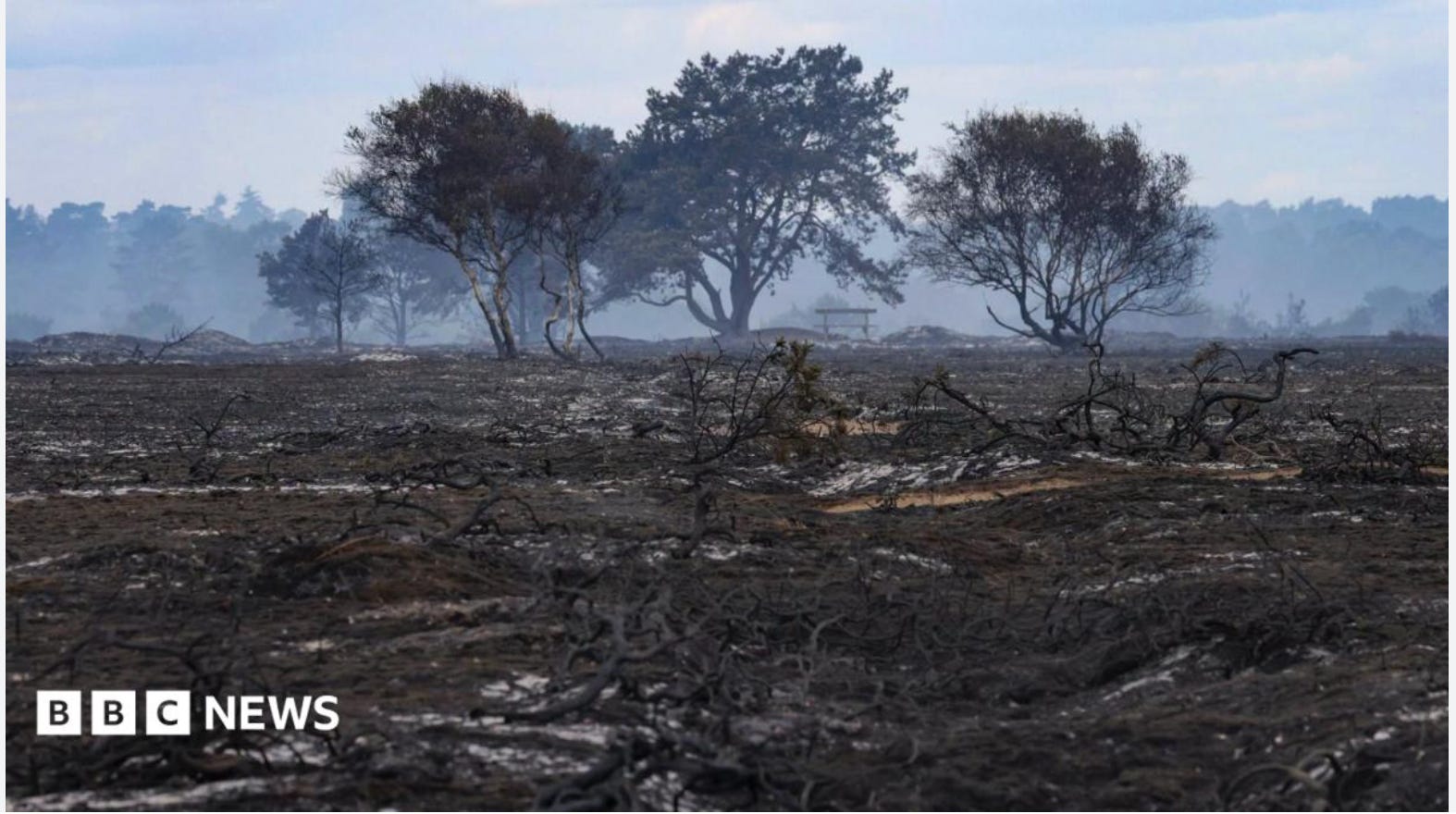
Wildfires reached my quiet corner of the world when smoke wafted into my house this week. It was from the nearby ‘apocalyptic fire’ in Suffolk that destroyed an important habitat of wild heathland. While I suffered no immediate loss or damage, as a bird-watcher Dunwich Heath is a place I love and frequently walk.

Dunwich Heath was one of the last remaining lowland heaths in England, representing a 92% decline of the habitat over 120 years. Dunwich supported ground-nesting birds including nightjars, woodlarks, and Dartford warblers. The devastation of the wildfire has left me depressed, sad and furious at the complacency and impotence of political leaders.
Millions of people and thousands of habitats have suffered much worse. Wildfires have reached the unlikeliest of places - not just rural Suffolk, but also Scotland - and soon floods will follow.
The people, fauna and flora of France, Spain, Tunisia and the unreported suffering of countries across Africa and South Asia must be unbearable. The pain and losses of the Assam floods in India ("The floods took everything from us" ) are unspeakable. Wildfires across Europe, Russia, Australia, Indonesia and the 1000 fires raging across Canada make clear what so many have denied: climate breakdown and climate-led species collapse is destroying humanity’s life support system - the biosphere. It is inflicting droughts, failed harvests and floods on millions of people - even before the latest El Nino has peaked and will worsen temperatures, droughts, floods and storms while it degrades ocean life and agriculture.
Is it any wonder an intense, broiling anger is erupting worldwide?
Here in Britain’s our leaders are deaf to that fear and anger, and to the insecurity brought on by climate breakdown. They seem not to have yet grasped the scale of the climate threat. Or if like Trump they do grasp it, they have chosen to treat the crisis as yet another opportunity for looting both nature and society’s collective wealth.
Political leaders have sold valuable public assets for mere pence. Because the private sector is unwilling to take on the risk of nuclear power, here in Suffolk our political leaders are majority owners of the new Sizewell C nuclear power plant. As such they have permitted private construction companies to acquire by compulsion vast swathes of Suffolk land, and to strip that land of trees and hedges for construction infrastructure, transport links, and wider roads. (No, I don’t understand what all that has to do with building a nuclear power station either.)
The tragedy is this: Suffolk’s demolished trees and hedges are living pumps in the water cycle. They absorb groundwater through their roots, and then release vapour that turns to rain. For large parts of the county - and for Dunwich Heath - those tree pumps are now lost.
Elected politicians and governments appear indifferent to such consequences. Most are captive to the oligarchical power of Finance and Fossil Capital - the forces that, with the help of deregulatory ‘mainstream’ economists, now govern our fossil-based economies from their strongholds on Wall Street and the City of London. Oligarchs that use their power to dictate policies to the state. Private wealth permitted to hollow out democratic power and to exercise political power over all of us - rendering our elected representatives weak and powerless.
A data center in the heart of historic Brick Lane
In Britain today the most concrete example of this power is the decision to site a new datacentre in the heart of one of the poorest and most densely populated districts of London - Brick Lane. The plan is to use that limited space to extract - or in plain language, loot - water and energy to drive the City of London’s high frequency trading desks
allowing a huge volume of financial transactions in the City of London to take place within a fraction of a second. The proposals show the datacentre’s peak output would be 5.2MW, enough to power about 15,000 homes, according to campaigners..
For two years citizens across east London have protested against the proposal. The elected and accountable local authority - Tower Hamlets Council - rejected the plans in July last year. That rejection was ignored by the Starmer administration, and overriden by Angela Rayner MP, minister for housing and local government in the new Burnham government.
Instead under the Labour government
Brick Lane is just one of scores of datacentres being planned across the UK. In February, Ofgem (the regulatory body) said about 140 proposed datacentre schemes were in the pipeline and could require 50GW of electricity – 5GW more than the country’s current peak demand.
This experience reinforces our view that the British government cannot be trusted to defend public wealth - the interests of our communities and ecosystems. Instead, once again, private interests prevail.
It is high time for society to rise up and storm the gates of Private Power.
As Anton Jager has argued in his new book, Hyperpolitics - there’s been a remarkable increase in the willingness of today’s citizens - across the world - to take political action. But unlike earlier periods, that political action is not ‘institutionalised’. In other words, it is not mobilised behind a progressive political organisation.
The far right stands ready to provide organised vehicles for channelling public anger and disillusionment - but far right institutions are not disciplined and organised. In Britain, as in the United States they rely too heavily on corrupt financial elites for the maintenance of their power and influence.
For the people to lead requires an organized and disciplined progressive insurgency. Protests alone are not sufficient. Social movements are not designed or organised to confront private political power. Only political organization and mobilisation can challenge the private finance and fossil oligarchy.
Political organisation alone can provide a vehicle for the expression of public anger and disillusionment with the way in which our economy is governed and our ecosystem looted and devastated.
Political organisation alone can give effective expression to the anger we feel about the Gaza genocide.
Far from channelling and responding to that anger, the British Labour government has attacked it. Roger Hallam the farmer founder of Extinction Rebellion was jailed for five years (later reduced to four - the longest sentence ever given for non-violent protest) for wanting to just stop the burning of fossil fuels. Protesters are arrested and jailed as ‘terrorists’ for expressing anger at the Gaza genocide. Foreign progressive advocates for change were banned by Starmer’s Labour government in a decision deemed ‘Kafakaesque’.
Those are just some of the reasons the three crises - ecological, economic and finance - require an organised political insurgency. As a model for such an insurgency we can turn to the disciplined and well-organised political organisation that is the Democratic Socialists of America. Alongside the leadership of Senator Bernie Sanders, they are already fighting the oligarchy and winning major electoral victories.
The British Left lags behind
While both Britain’s Labour and Green parties could become vehicles for organised political and progressive change - both are failing to do so.
Because Starmer’s Labour effectively expelled progressives leaving ‘centrists’ in charge, Labour cannot serve as a channel for challenging private political power.
And the Green Party is not yet an organised and disciplined political party. While the party did well to defeat both the far right and the Labour party in the Gorton and Denton by- election, it fell behind the right wing Reform party in the recent Manchester mayoral election. The party appears too reliant on a charismatic leader. Instead what is required is the sense of a united collective delivering disciplined communication strategies, undertaking the hard graft of repeat canvassing, door knocking, phone banking and other forms of political engagement. Deep organizing that would begin to address both the economic, financial and climate crises facing the British people.
As we argued back in the days of the Jubilee 2000 campaign, it is high time for the people to lead so that politicians can follow. In doing so we must not forget that we are the many. They are the few.
It is time for the many to storm the gates of private political power in the fight to defend our life support system - a system in which Dunwich Heath has played a vital part.
No posts
Comments
Nothing yet. Say the first thing.
Sign in to join the conversation.