
I quickly realized that Ira didn’t have the kind of money that underwrites foundations, but perhaps he would finance my long-held dream of opening a first-rate contemporary art venue in Taos, one with exhibitions, panels, films, and lectures, a hub for the town’s art community. I knew that Taos was home to a number of excellent artists but felt they deserved a better space for exhibitions than the local museum and the art galleries, most of which followed a gift-shop esthetic: Just slap it on the walls and see who buys.
And I wanted to bring in some new energy from other parts of the the West and Southwest.
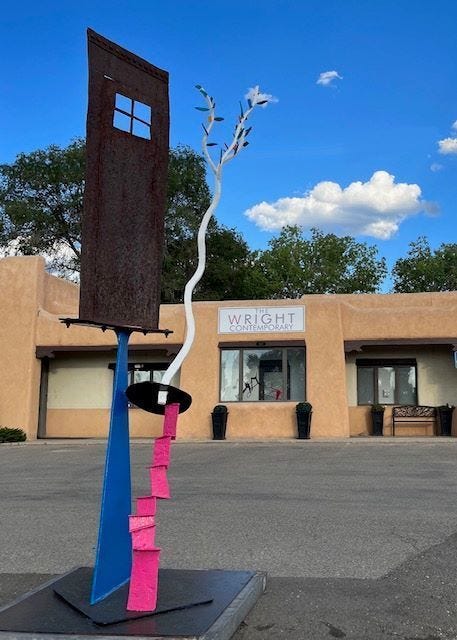
Ira liked the idea, and promised a trust to keep it going, We tossed some numbers back and forth and eventually agreed on a name: The Wright Contemporary. And then came the process of looking for real estate. Surprisingly it didn’t take long before we found a space for lease on the Paseo del Pueblo Sur, the main drag leading to the center of town, about 2,000 square feet, easily divided into two galleries plus an office and a “project space,” in a building that was once a gas station and auto-repair shop. The interior was painted Pepto-Bismol pink with vomit-green trim, but the exterior had a sturdy adobe façade, and there was plenty of space for parking. The landlord promised a complete paint job on the interior and new carpeting if we paid a year’s rent in advance.
Then came the lawyers and the bankers and the mountain of paperwork to apply for signage, a business permit, tax identification numbers from the state and feds, and on and on. The lawyer determined we should be a limited partnership instead of a nonprofit and advised in all the other minutiae of legalizing a start-up operation. I hired a savvy local business-expert to guide me through the filing process and made a long-time friend my assistant director.
To make Ira feel part of a community, I wanted to introduce him to the artists around town, and so we did studio visits and took people to lunch. Sometimes he would sit next to me and start playing with my hair; I swatted his hand away. Other times he would try to kiss me on the lips when we parted, and I would smoothly slide my mouth to peck him on the cheek. At lunch one day, he passed me a note, scrawled on the back of a deposit slip, which said, “Will you be afraid of my unbridled lust?” On the other side, he had written in capital letters “CASTRATION” with a double underline. I scoffed and shook my head, but folded the note and slipped it in my purse.
Most of his japes, which seems a good old-fashioned word to use in this context, could be passed off as geriatric silliness. “I wonder what Sunny looks like naked?” he asked one day. Sunny, my assistant, was a big woman with a sizable gut. “I don’t think you want to know.” For business meetings he often dressed in paint-stained shoes and clothes, which could easily be dismissed as the eccentricities of an artist, but in one instance, faced with financial documents in which we needed to put down our occupations, he wrote “bum.” I was furious. When the bank manager slipped off for a few minutes, I hissed at him: “You can’t pull these sorts of pranks here. These are serious, literal-minded people. They won’t get your jokes.” He crossed out “bum” and contritely wrote down “artist.”
At the end of one of our meetings in Taos, he handed me a four-page typewritten letter. “Now we are involved in a major project together: we are going to make your vision become a reality,” he wrote. “You will be the director and lecture host, etc. and I will be benefactor. Your interest is in bringing art and culture to Taos, and an opportunity for artists to show the work in a good setting. I will be involved, but in a secondary role….A considerable sum of money will be required and I am glad to provide it. But I feel the need of some kind of bonding between us, some kind of ritual, or private ceremony that’s ‘real.’”
And then came the kicker, in the form of an imaginary (I presume) conversation with his doctor in the hospital the previous summer. “Doctor D says, ‘Now, how can I help you? Let me guess, you wanna live long enough to screw your girlfriend, right?’
“No,” he answers “I just want to touch her….I want to hold my friend in an embrace for about a minute under the covers without any clothes on….I just want to bond with her before I go, just want to exchange a few molecules, feel some warmth in this cold world….”
My stomach was churning. I was revolted. Was this the quid pro quo for the Wright Contemporary? I called Brook, who told me to calm down. “You’re almost there. Be patient, laugh it off. He’s just a lovesick old guy who’s been through a horrible time.”
Was it possible, at the age of 70, that I was getting my first taste of #MeToo sexual harassment? From a man nearly two decades my senior, old enough to be my father? All through the accounts of abuse leveled at Harvey Weinstein, Matt Lauer, James Levine, and countless others, I marveled that I had been spared this kind of treatment from any of the men I’d worked for or with, from any of my professors in college or grad school. I felt almost left out—a comely young woman that no old lech really wanted to pursue. The only thing that came close was a brief encounter with a prospective landlord when I was in my early twenties. I had my first job with a book publisher in Midtown, was living in a total dump on the Upper West Side, and I wanted to get out of the ‘hood and into safer lodgings. I saw an ad in The Village Voice for an apartment on the then-fashionable Upper East Side, in a doorman building, advertised at some ridiculously low sum. I answered to a P.O. box, giving a few specifics—what they were I can’t remember. But the landlord or owner must have had a way of weeding out prospects, and so he summoned me to his lair.
When I arrived at the apartment, the door was answered by a pretty Scandinavian woman, who I assumed was the present tenant. She mumbled something about its being a nice place to live but there were some “trade-offs.” Then the owner/landlord arrived. A big beefy guy with a full head of curly black hair. The Swedish girl retreated to the kitchen as he showed me around. We came to the bedroom and suddenly he scooped me up and tossed me on the bed (I vividly recall a fake-fur bedspread). I was pushing him away in astonishment when he suddenly peeled off his “hair,” revealing a well-polished dome. “How do you feel about bald men?” he asked.
At that point I could only gasp and giggle hysterically. Needless to say, I did not get the apartment.
But this escalating weirdness with Ira felt different, and I had a lot more at stake. How much would I have to put up with before the deal was done and we opened our doors? Or after we opened our doors?
There followed nearly two years of nonstop low-level harassment, haranguing, pleading, complaints, self-pitying revelations in emails and texts that wore on my nerves and possibly made me sick. A few themes emerged: He was horribly lonely in his fourth marriage and felt put upon by Rosa and her children (both in their late 50s or 60s), who regularly hit him up for money. He usually had Sunday brunches with the “spongers,” as he called them, and generally dropped about $500.
He complained incessantly about what a cold cruel world this is, and how desperately he craved affection and approval. Within the space of a few days he texted: “I have no future the present is everything to me, that is why I love you so ardently” and “I can’t sleep anymore. I am dying of loneliness. There is no true love, it is not to be found in sex or money or in most people’s hearts.” Every day seemed to bring some new avowal of hopeless love or boundless despair, to which I tried to respond, basically, Get a grip! “You put emotional demands on me that are hard for me to fulfill. So it is exasperating….But can you not please behave like an adult and a partner in this venture? I’m human too. I feel like I am dealing with an unhappy boyfriend who is not getting what he wants so he decides to punish me. I thought it would be exciting for you to have a new adventure in your life and get away from Rosa. I guess I was wrong….”
Not too long after that exchange, he claimed Rosa suffered from dementia, and that living with her was absolute hell. No matter how much I wanted to keep a professional distance between us, I was getting further and further sucked into his unhappiness. Years earlier, he had bought Rosa a house on a lovely quiet street in Taos, which we briefly considered as a base for the Wright Contemporary and where her son was living for a time. As it was empty while we launched the gallery, I urged him to spend more time in Taos. Set up a studio, get away on weekends. “I feel protective toward you and worry about you,” I texted.
He responded: “Sending you love in a cloud of ejaculate.”
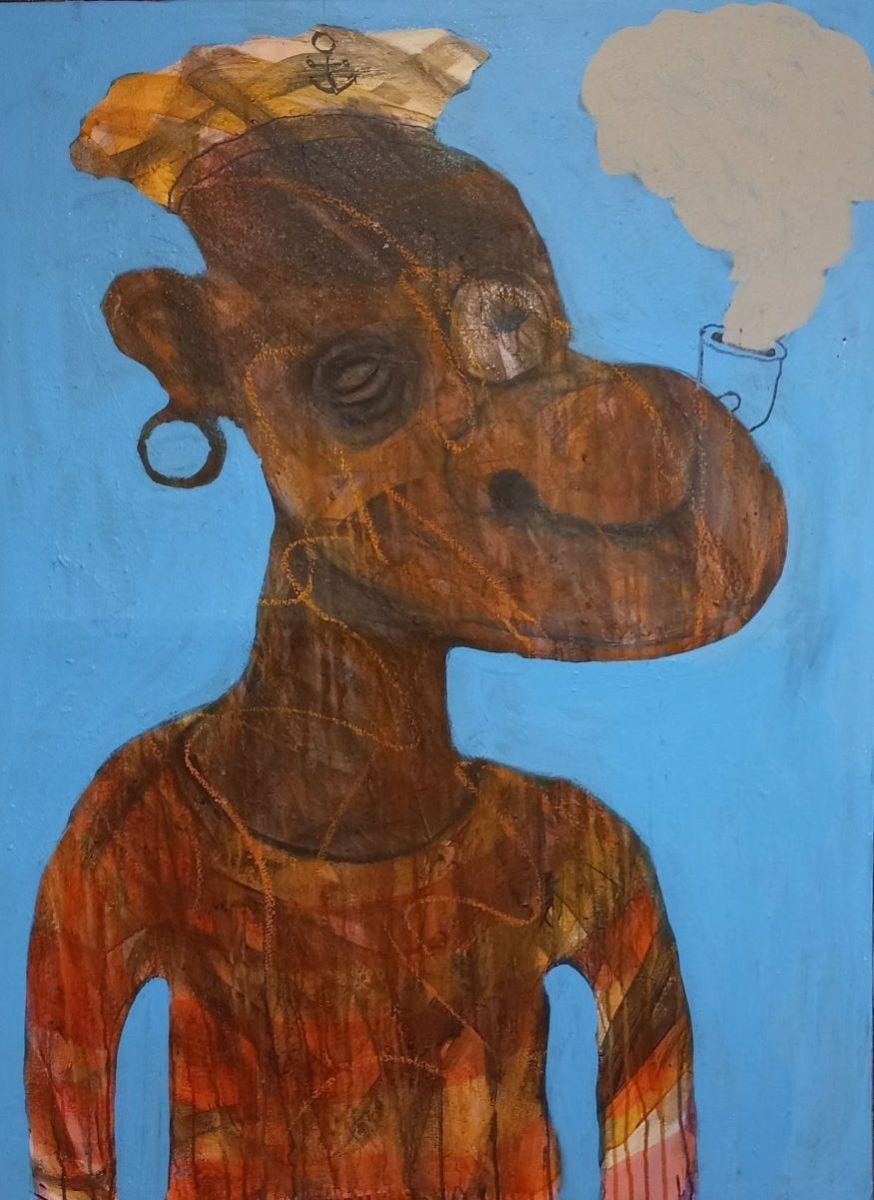
The flip side of all his lovesick confessions was the deep attachment that nonetheless existed between him and his wife. He drove her to a doctor in Taos, he cooked dinner for the two of them every night, and he was there to help when her kids had medical emergencies. I asked him to a dinner with a pair of artist friends one night a couple of months before we opened, and she sent several texts, the last demanding that he drive home at 8 p.m. before we’d finished eating. And he did.
If I suggested that he demonstrate more affection toward her, he exploded in fury. I didn’t understand what it was like to be truly in love. I’d been mistreated by so many men before him that I couldn’t recognize what a formidable partner he could be. “Maybe someday you will love me more than just halfway and we can make a home together. I have never felt like calling anyone darling until I met you.”
Was this sexual harassment? He never physically assaulted me other than to occasionally push for a kiss on the lips when we parted, but the incessant declarations of infatuation and the comments about my physical attributes ground me down: you look like Lauren Bacall, sculptors would die to carve the slope of your belly, and “lots of tall beautiful women have loved little ugly old men.”
I tried to keep it light, reminding him that he was old enough to be my father and calling him “Papi.” But day after day I lived in dread of some new deranged lovelorn text or email.
Comments
Nothing yet. Say the first thing.
Sign in to join the conversation.