
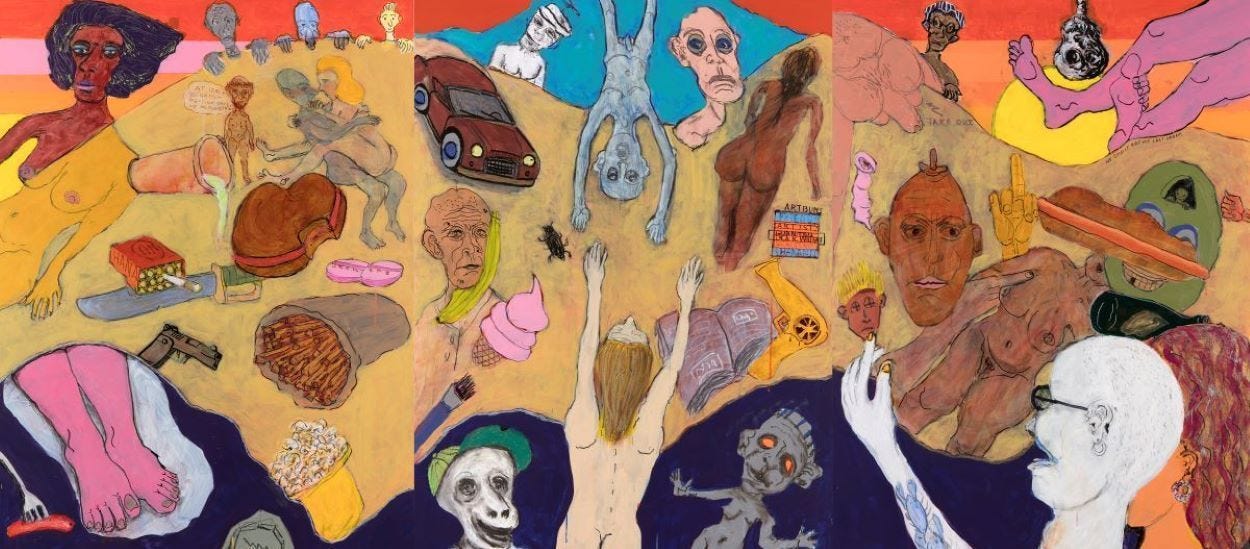
My greatest fear, of course, was that Ira would withdraw support for the gallery, but the funds came through and we opened on schedule with a boffo exhibition of nonobjective painting called “Explosive Abstraction.” Ira showed himself to be a real charmer, thoroughly at ease in groups of people and good at small talk, though he claimed to be painfully shy. There were only a few awkward public moments in those first few months. At a dinner after the gallery hosted a panel of art dealers, he dropped a comment about his “18-inch penis,” which I hope only I heard. When I showed a couple of episodes of Simon Schama’s documentary “The Power of Art,” he brought Rosa with him and she told the few people who attended that “my husband owns this building and we’re buying all the art on the walls.” By October, when we were launching our third show, he wrote, “I am so impressed by what you’re doing, and to think I had the audacity to think you could fall in love with me.” It seemed an apology, of sorts.
Yet the lunatic exchanges continued. In the fall and winter of 2022-23, he wrote: “I don’t want to be privy to your chastity. I just need minor affectionate contact” and “I have lost confidence in our relationship” and “you don’t know how many times I’ve tried to quit, but every time I see you I fall all over again.” There were points when I simply got fed up and told him to back off completely: “Why do you treat me like this? I have established a beautiful venue in your name, sold a dozen of your paintings, and you send me obscene and inappropriate correspondence. You behavior has upset me enormously…. You have treated me with contempt and inappropriate comments about my sexuality.” When I told him his texts and emails amounted to borderline harassment, he responded: “Is saying I can’t stop loving you harassment? Even ugly sugar daddies get a kiss once in a while?”
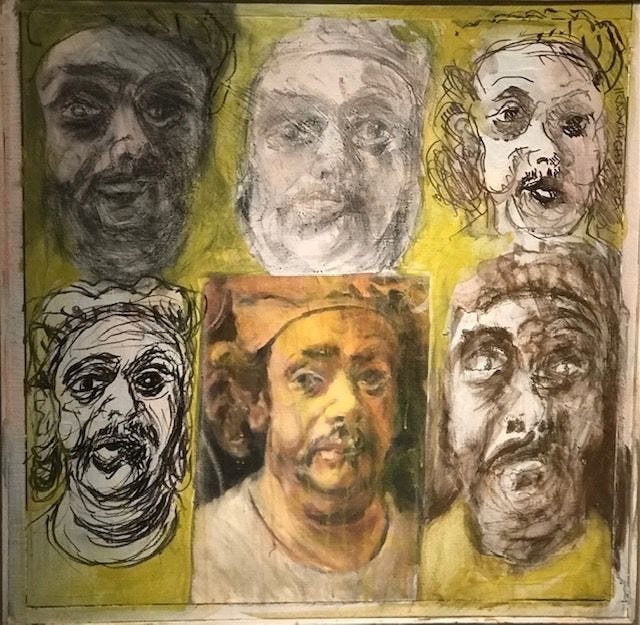
And then in late April of 2023 I came down with a raging case of Covid, which morphed into the long Covid that still plagues me. Early in the summer, I suffered stabbing pains in my right eye and was diagnosed with a detached retina that eventually required two surgeries and caused severe loss of vision. Ira reacted to my illness with typical self-absorption: “I hope and pray that someday you will be well and you can find it in your heart to love me as much as I do you. This is a cold, lonely, selfish, dumbed-down world and we need each other!”
Yet he was soon afflicted with medical trauma of his own, and in early June texted that he was seeing a doctor about back pain; tests had been ordered for cancer. Later in the month he mysteriously disappeared, presumably hospitalized for several days, and on July 9th wrote “I’m able to read, housebound with urine bag, O2 machine, fighting depression, etc.” In late July we met for lunch in Santa Fe. A few days later, Hannah—the young woman I had hired to curate a show of his drawings—drove him to Taos for an early dinner. While she was in the ladies’ room, he turned to me and whispered that he’d been diagnosed with liver cancer. He had no idea how much time he had left but he intended to refuse chemo. He looked so well and had always proved so resilient that I had trouble believing the diagnosis was terminal.
Nonetheless, no matter what his health, Ira turned 90 in August and it was imperative to get a trust in writing and a show of his works on the calendar for the gallery. Early in 2022 he had written, “I am ready to commit as much as $1,000,000 to it in a trust fund.” I didn’t expect that kind of money, but had put together a budget and pushed for an agreement on paper. “It is my understanding from our meetings with Jake [our lawyer] that you are offering a ten-year commitment to The Wright at a budget of $120,000 a year, to be paid out in two installments per annum,” I had written to him in March. “It’s important that I get this annuity/trust confirmed before I renegotiate our lease for next year and revise the budget I gave you in January.” In late September, he emailed me the pages from his last will and testament specific to the trust, but the terms were for five years contingent on approval by a trustee, his daughter Pam.
So it wasn’t a decade, but it was still generous.
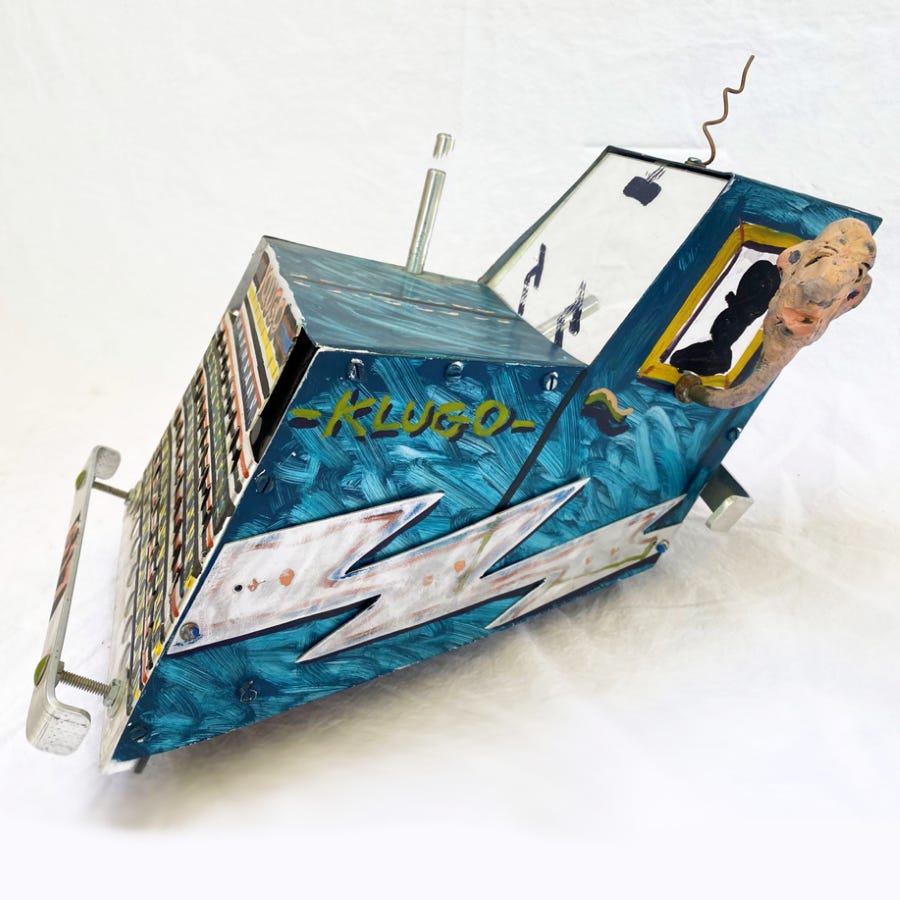
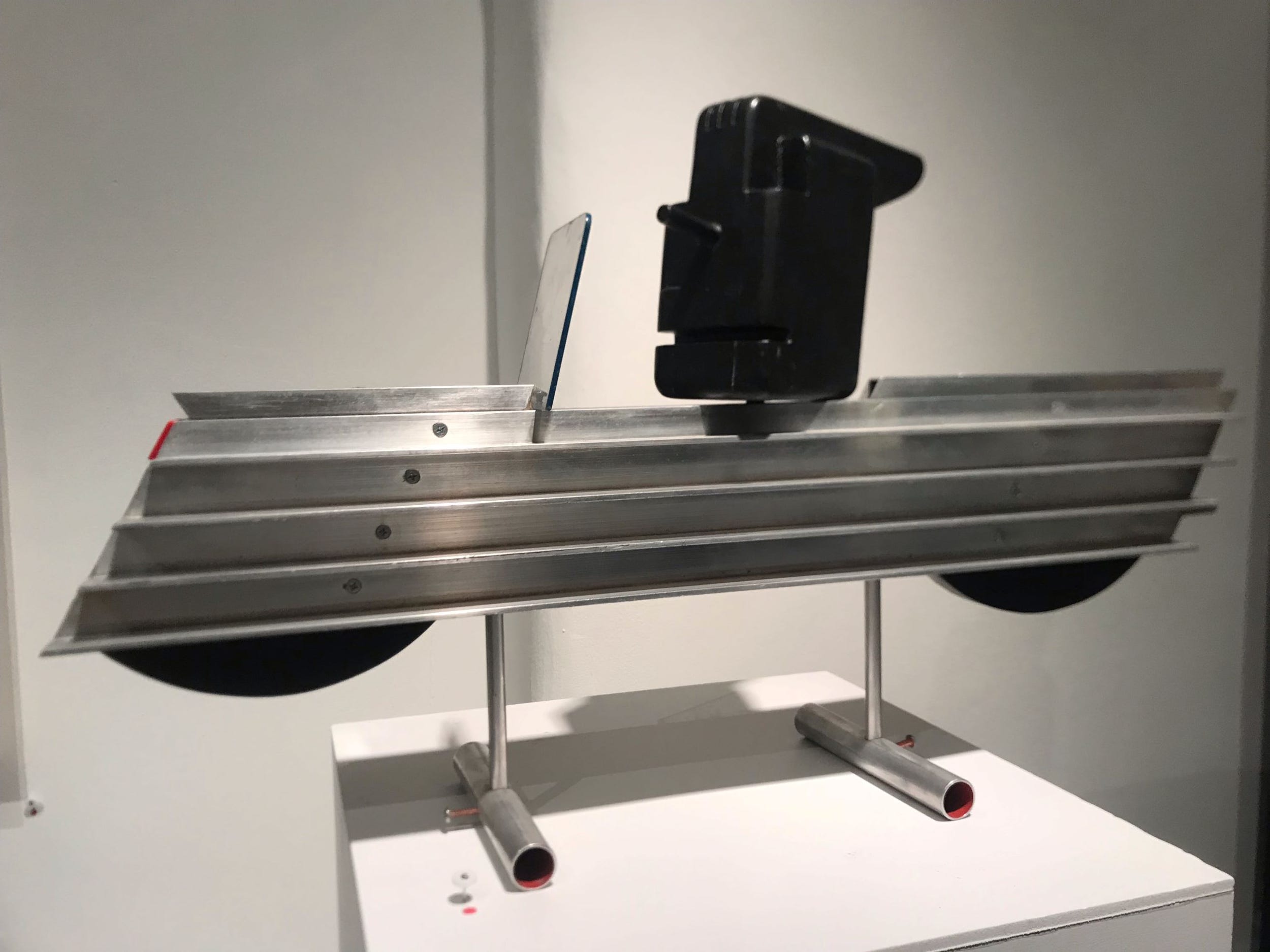
In the meantime I put Hannah in charge of pulling together a show of his works from five decades because she lived only fifteen minutes away from his studio and could also act as his assistant. I hired her—a whip-thin slip of a woman with mousy brown hair and an open childish face—largely because she was the partner of a sculptor whose works I’d admired for more than a decade. She’d also put together an excellent show of Ira’s drawings and sketchbooks for the gallery’s Project Space and seemed to know what she was doing.
In more ways than one, as it turned out. Reviewing the correspondence with Ira, I realized that his ardor for me trailed off about the time he started working with Hannah as he transferred his boundless affections from me to her. At one point that fall, when his daughters were trying to track him down, my friend Brook, who always stayed in close touch with him and was instrumental in keeping a lid on my anxieties, discovered that the two of them had run off to Silver City, a cute little college town about five hours south of Santa Fe. Did her boyfriend go with them? We never found out, but Ira did confess to Brook, “I can’t help it. I’ve fallen in love with her.”
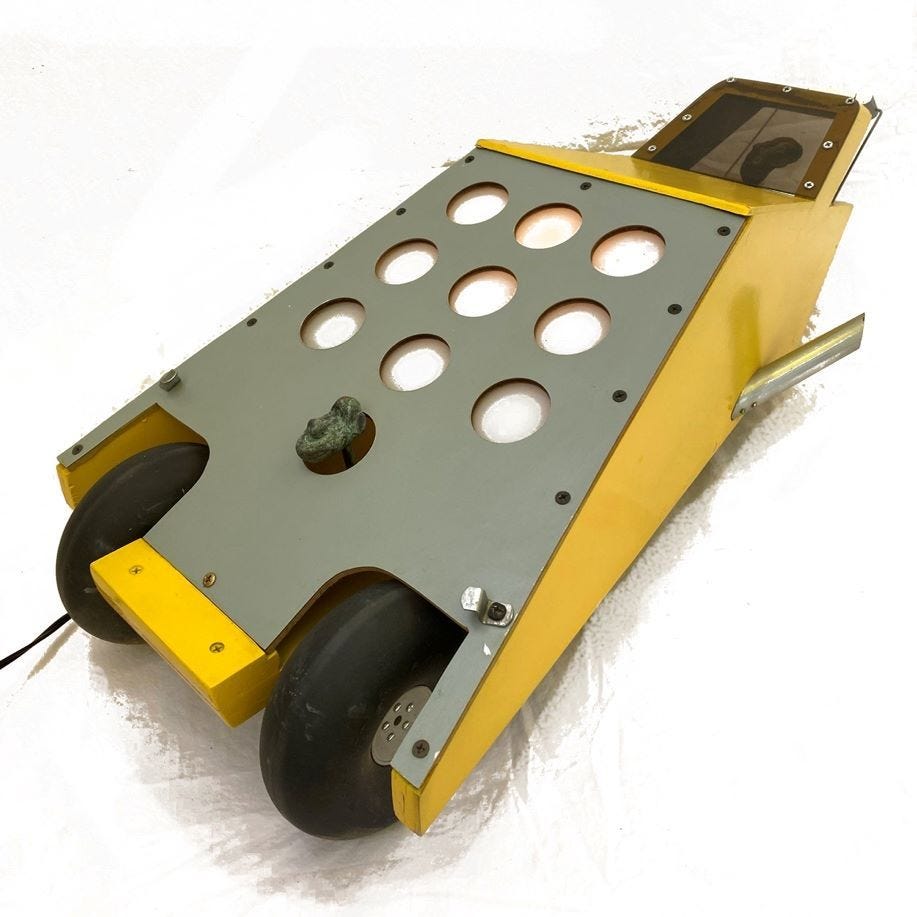
She was less useful as a curator than as a romantic transfer point. Her choices for his show included too much of his worst work, recent slapdash paintings in which he seemed to be losing control of the medium. To her credit, she did unearth a series of delightful cartoony “car constructions,” small mixed-media sculptures made from scrap metal and found objects. These seemed to me one of the high points of the show, but they arrived coated in grime and dust and took my assistant three hours to clean. Hannah had planned to display them on a large table, constructed by the sculptor boyfriend, but it was badly chipped and crudely painted, and we shoved it out of the way in a storage room. Fortunately, Hannah quit before I could fire her and in the three days remaining till the opening, my regular curator, Michelle Cooke, managed to pull together a sensational show by adding several works we had on hand in the gallery.
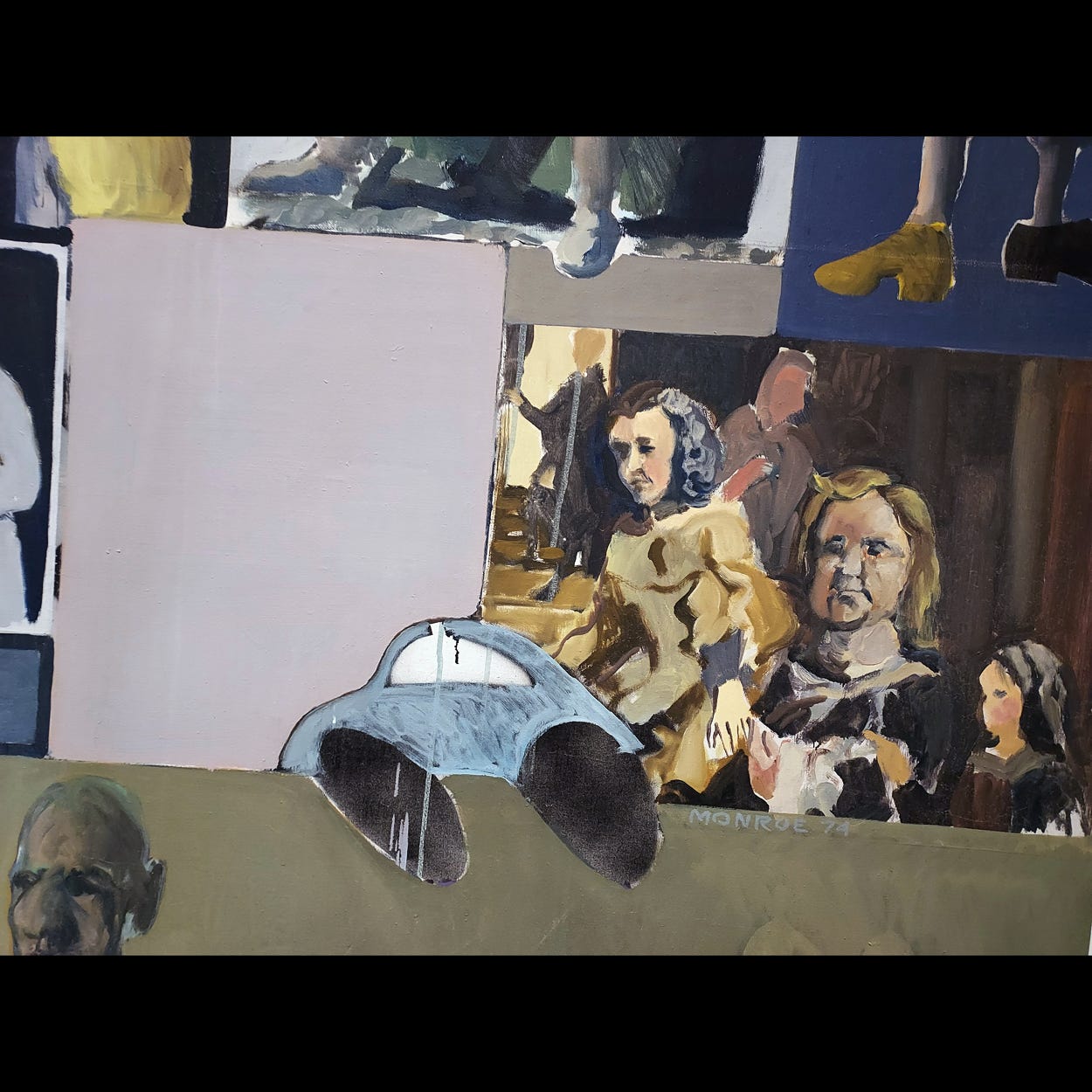
The exhibition, which opened in early December, was a smash on all fronts, with all the works acquired that first night by a local collector who had fallen in love with Ira’s highly original vision at his debut in Taos nearly three years earlier. Ira’s health was still robust enough that he could enjoy his status as man of the hour, and his thee kids all flew in from different parts of the country. The only sour note was when his tiny wife, nearly oozing venom, cornered me and exploded: “You have no right to sell my husband’s work. He has very few of those car sculptures left and they belong to the family.”
I mumbled words to the effect that he’d consigned the works to the gallery, and so, yes, I did have every right to show and sell them.
From that point on, his health declined steadily, and in time his pain kept him at home, fiercely guarded by Rosa. Even his son and two daughters, who all flew in for a final visit, were allowed only a few hours with him. Nonetheless he kept on painting, and Brook stayed in touch and posted photos of him at the easel on his Instagram page. Finally, in early March, when I was on my way to an audiologist’s appointment in Santa Fe, she called while I was driving and urged me to stop by his house immediately. “I mean now.This is the end.”
I’d been terrified of encountering Rosa but determined that I would barge in if necessary. She was surprisingly docile, if not exactly welcoming. Ira was in a wheelchair in the den, neatly dressed, but wrapped in a blanket, his head nearly fallen to his chest. He barely recognized me, only once showing a glimmer of a response as I stroked his hand and summoned a few words of good-bye. One of his dogs, a large black lab mix, yapped and snarled throughout my attempts at conversation. I asked Rosa to take him outside, but she sat placidly, occasionally stroking the mutt’s head.
After 20 minutes I left and two days later he was dead.
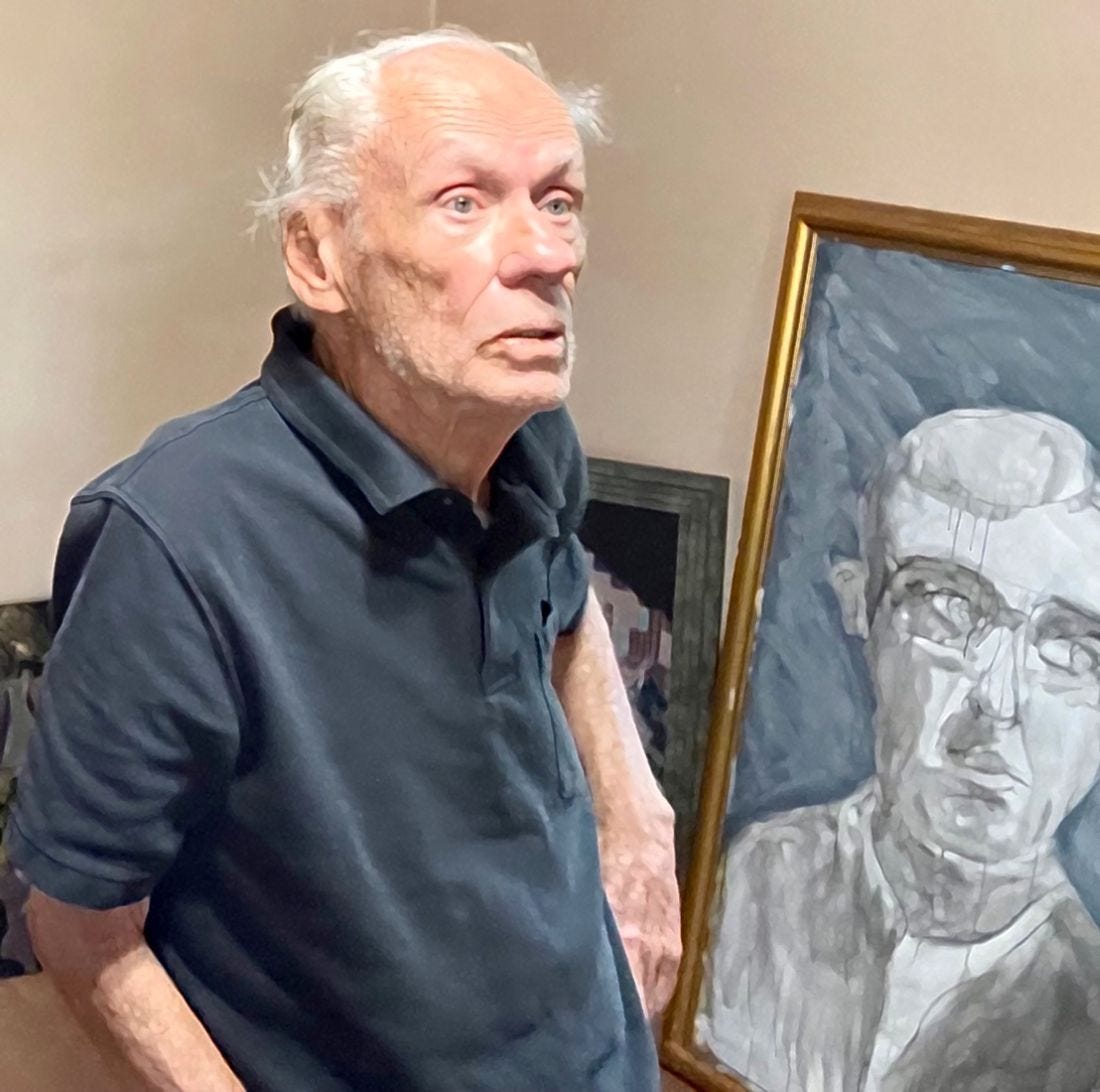
I wrote an obituary for the local paper and kept in close touch with the daughters, offering the gallery for a memorial service (though who would have attended I have no idea). A couple of months later, they sent a copy of an “amended trust agreement,” naming the two daughters as his trustees. This version, dated two days after the closing of his show at the gallery, cut our funds in half. I have no idea why, or at whose suggestion, and I didn’t protest much since I was wary of alienating his heirs. I worked with them on doing a full inventory of his work and suggested ways of keeping his legacy alive through shows and partnerships with other galleries. But because of the truncated financial agreement, and because my bout with Covid morphed into debilitating long Covid, I realized that I couldn’t continue the Wright Contemporary in Taos beyond the end of our lease. (Ira knew it could take years to establish a viable business, and never expected us to depend on sales.)
It was an adventure, an exhausting and often infuriating partnership with a terrifying and infantile tyrant who had poor impulse control and no respect for boundaries. But in the end perhaps Ira found some comfort in Hannah. One of the sisters reported that they had to stop payments on checks to her because he was overdrawn on his account. Go figger.
No posts
Comments
Nothing yet. Say the first thing.
Sign in to join the conversation.