
I look back over my long career, pursuing a vocation that was basically art-related from the time I was on staff at ARTnews in New York in the 1990s, through my move to Taos, fifteen years ago, which required some deft reshuffling due to circumstances beyond my control. Never in all that time did I dream of opening and running an art space, until I met a wizened and horny little creature named Ira Wright (aka Stephen Monroe).
For my first few years in Taos, I was steadily employed by ARTnews and The Wall Street Journal, supplementing my income with the occasional catalogue essay. Then ARTnews changed hands, the new broom swept clean of long-time contributors, and the WSJ, which once flew me to many places—including Los Angeles, St. Louis, Chicago, Milwaukee, and, weirdly, Wausau, WI, for the annual exhibition of birds in art—cut back on assignments. And so I decided to start my own online magazine, for mid-level mid-career artists, who are an underserved part of the creative community. I raised about $50K in my first round of funding and kept it going for six years through subscriptions.
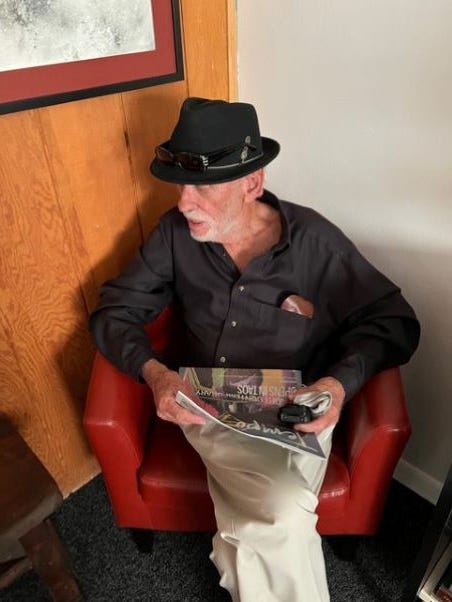
In my fifth year of the website, I encountered a painter named Ira Wright who had seen my site, Vasari21.com, and a photo of me on the contributors’ page of a local art magazine. He wanted to drive up from Santa Fe to meet, and I agreed to drinks at the Taos Inn. He was in his late eighties, short and slight with a pronounced dowager’s hump, milky blue eyes, and a corona of white hair that gave his bulbous face an angelic aura. He told me about moving to the Southwest two decades earlier to pursue his calling as an artist—not an unusual story in these parts, and one I didn’t take too seriously. The high desert is full of reborn creative types.
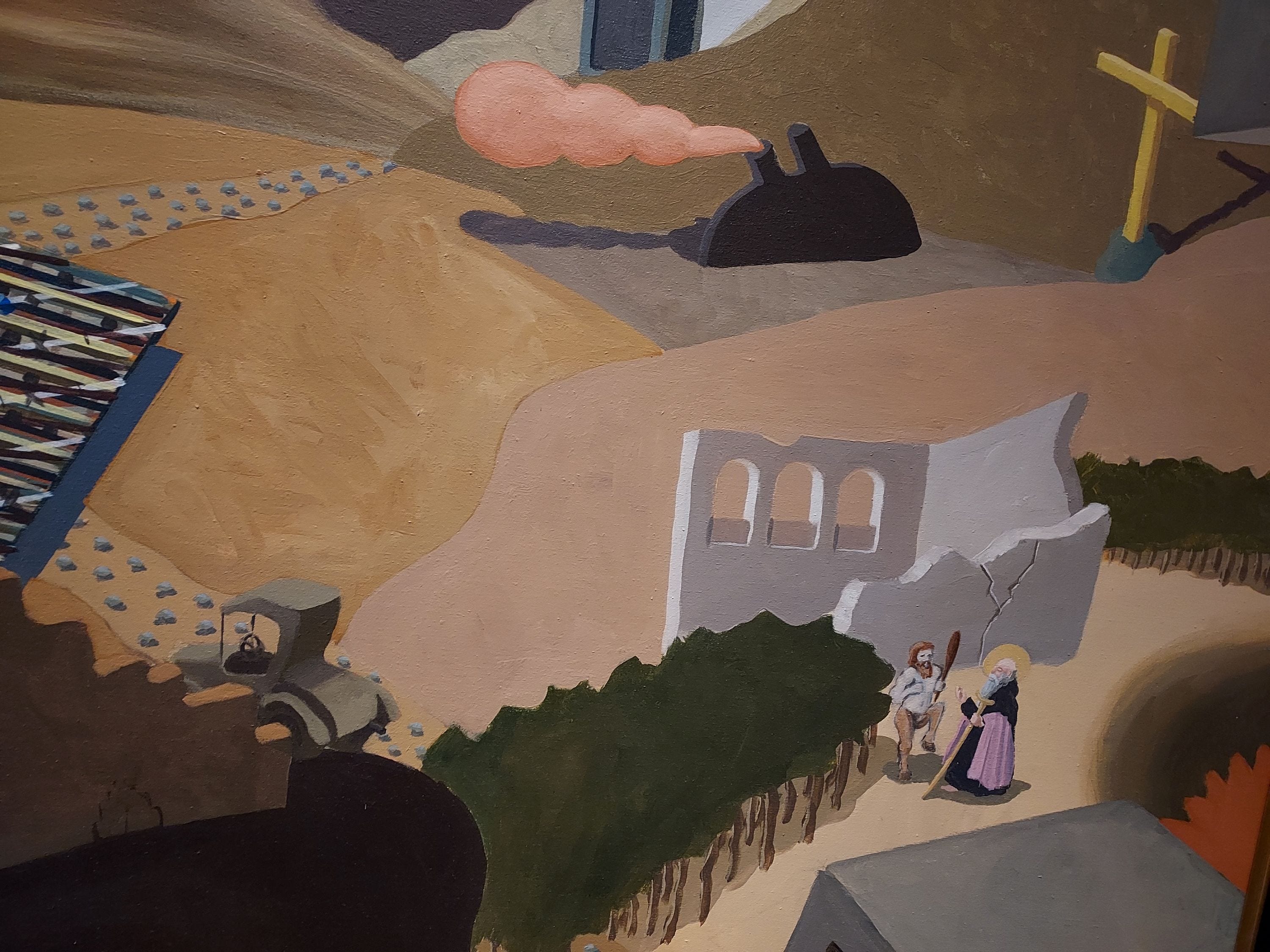
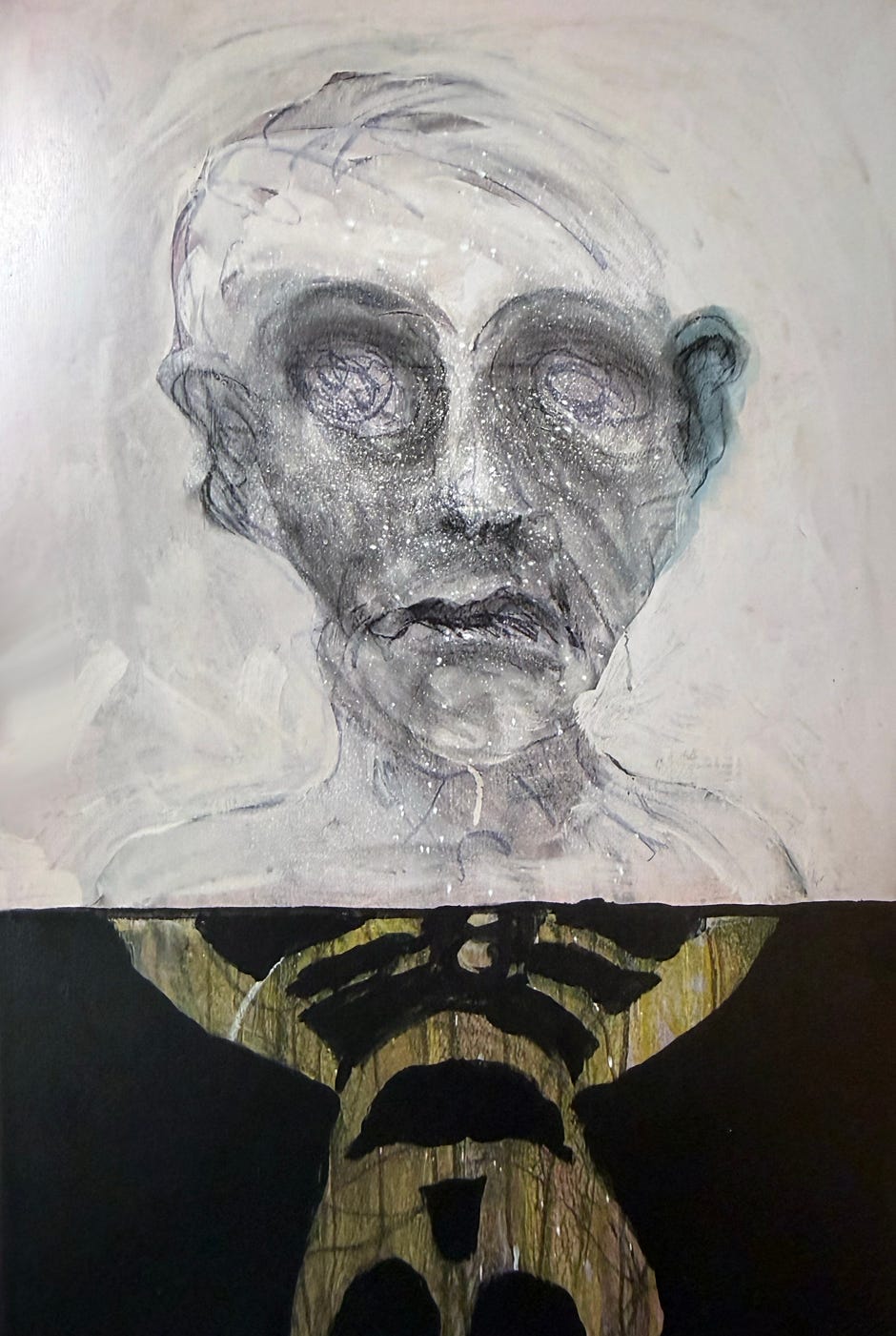
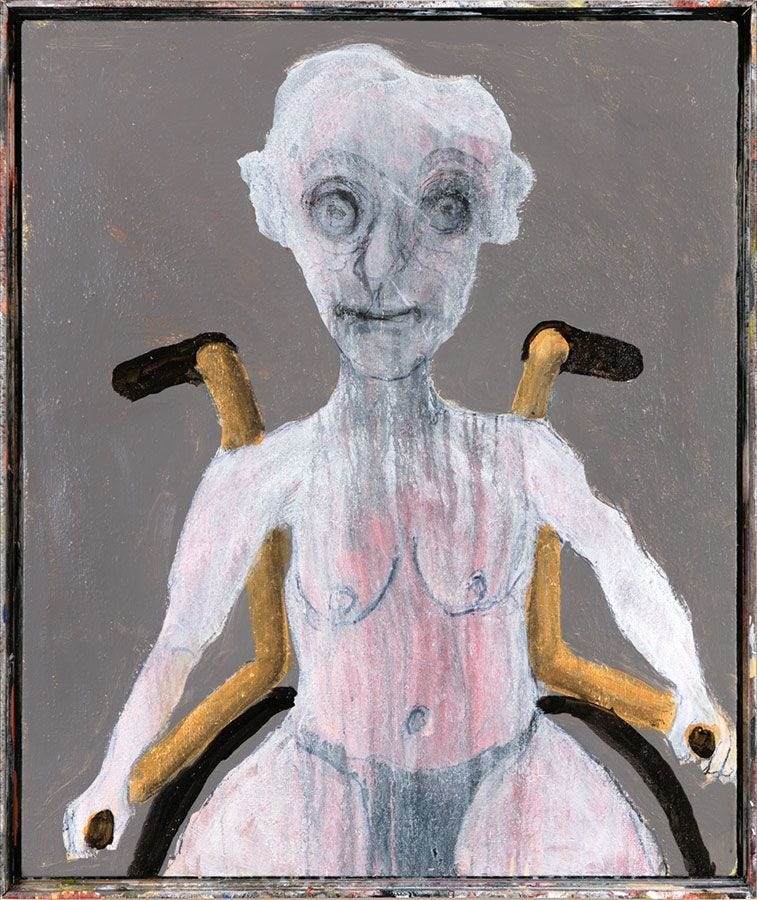
But almost immediately on returning home, he sent a 500-dollar donation to Vasari21. That I took seriously. He did not yet have a website, so I agreed to a studio visit next time I traveled to Santa Fe, which is about an hour and a half to the south. He lived in an unpretentious adobe house in an upscale neighborhood, but the studio was the typical artist’s chaos of half-finished paintings, a messy table holding jars and tubes of pigment, and a small blizzard of sketches. It was hard to gauge the work in that context, though there were a couple of big tableaux that stood out. In his living room, he had pulled together a more organized roster of the work, and I found much of it impressive, wildly inventive and savage in a manner reminiscent of German Expressionism. Tortured portraits and group scenes, sometimes with graffiti scrawled across the surface. Some had a sardonic religious subtext, allusions to Medieval and Renaissance altarpieces, including The Last Supper, and others were cartoony portraits and self-portraits.
I said I would think about writing a profile of him for the site, but also asked my friend Brook, an accomplished artist who lived a few miles away, to have a look and tell me what she thought. She agreed that he really had something going for him and like me was astonished that he did not have a gallery and wasn’t better known.
I returned with a tape recorder and did an interview. In the course of a two-hour conversation, I learned about his unhappy childhood in Michigan, his failed marriages, his life as a single father of three, his obsession with Mickey Mouse, and his love for the Italian quattrocento. He was smart and well educated, impish and shy. I got the sense no one had paid much attention to him in years. In Santa Fe, he’d changed his name from Stephen Monroe to Ira Wright, but I was never quite clear on how he’d chosen that particular nom d’artiste.
After the profile was published, I suggested he let me curate a show for him at a local gallery, a sprawling space with great light just north of town. We picked out about 25 paintings, and in spite of the pandemic, we had a good turnout for the opening. His fourth wife was on hand, a petite and stylish woman, also in her 80s, and she beamed throughout the evening, frequently stroking his face.
“Rosa seems like a sweetheart,” I said to him.
“Don’t be fooled,” he replied grimly. “She’s hard as nails underneath.”
The show was a modest success, with several works sold to a prominent contemporary artist and others to out-of-state collectors. I took no commission but asked for a small curating fee. And after that, we stayed in touch, occasionally for lunch in Santa Fe, mostly by email. In early spring, Ira asked me if I’d like to go to Chicago to check out the Art Institute and other venues, after he’d paid a visit to his sister in Kalamazoo. He would spring for our airfare and a first-class hotel. By then I was getting the sense that he was fairly well off, though I had no idea of the source until later. It seemed an innocent enough busman’s holiday for us both, especially since his daughter arranged for the flight reservations. But when I discovered that he had booked a double room, with a lake view, I balked. “No way are we sharing a room.”
“Okay. So I’ll sleep in the boiler room.”
And I was thinking, This is ridiculous. He can’t be having designs like that on me. I’m almost 20 years younger and five inches taller and 30 pounds heavier. I could deck him with one hand tied behind my back. He did nothing about changing the room reservation, and I politely declined.
Later that summer he was at a family reunion in northern Michigan when he fell off a staircase and broke his hip. I was able to text him and got most of the details of his injury from Brook, because she was able to speak to him when I had a tough time with him on the phone: his voice was too raspy for me to understand.
I sent flowers and a get-well note to the hospital, as I would to any friend in those circumstances. Later he texted me that he held the note over his heart as they wheeled him into surgery. He underwent rehab for three or four weeks near his daughter’s home in Montana, during which his wife did not once visit. When he returned home, I suggested we have lunch as soon as he was well enough.
The man who greeted me when I picked him up on a fine early fall day was gaunt and ashen-faced, his corona of white hair reduced to a stubble; the skull beneath was pink and scabby. The expression “death warmed over” easily applied. And yet he was getting around with a cane, and it seemed a miracle a man his age could mend so quickly from a broken hip and fractured vertebrae.
“You take good care of him,” admonished his wife, as we left her at the door.
“Yeah, like she does,” he muttered under his breath.
“I sure will. I’ll have him back all in one piece.”
At the restaurant, he was smiling and relaxed, making jokes about his mortality. “The reaper almost got me that time.”
“But not yet,” I said. “You are one sturdy old bastard.”
“That I am, that I am,” he said, visibly pleased.
Toward the end of lunch, he asked me for a slip of paper, and after I pulled a page from my notebook, quickly scrawled on it, folded the paper and passed it back across the table. I opened it to find a number range in the low millions.
“What am I supposed to think of this?” I asked.
“That’s what I’m worth,” he said.
“Holy cow. I’m assuming you didn’t make that kind of money from painting.”
“Nope. Grandpa was a robber baron. Railroads. Some of the funds eventually came my way.” He leaned across the table, and grabbed hold of my hand. His grasp was cold and papery, like being encased by a pair of fallen leaves. “I want to help you.”
“Well, that’s very nice—”
“Maybe you could start a foundation or something.” He patted my hand. “Think about it.”
Comments
Nothing yet. Say the first thing.
Sign in to join the conversation.