This page did not load. You can still read it on the original site — the toolbar below keeps your place in the directory.
We celebrate an abundance of useful plants through the year supported by the local community
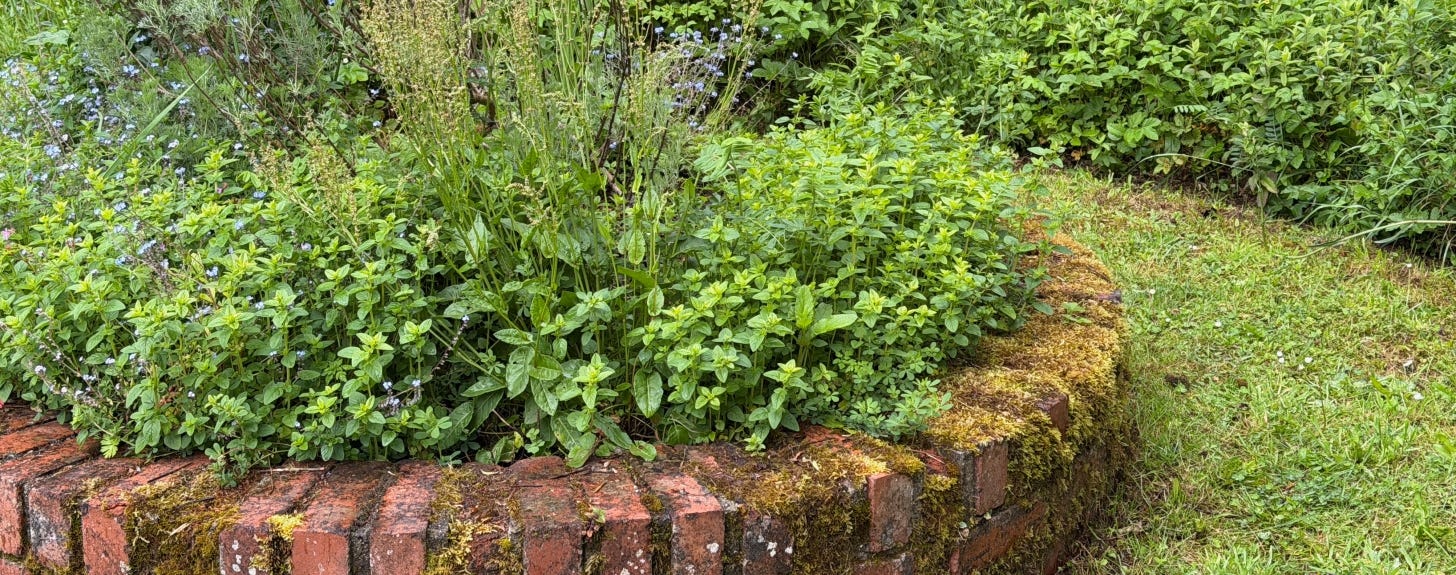
The centre of the Herb Garden at Sandford
In this post I describe the Herb and Forest Garden on the Millennium Green at Sandford in Devon. Here I outline some of the ongoing developments supported by volunteers along with myself as a medical herbalist. As a community resource the Garden offers a delightful haven of diverse useful plants and I explain some of the issues in maintaining and developing it as well as possibilities of harvesting fruits and medicinal bark.
Medicinal Tree Woman is a reader-supported publication. To receive new posts and support my work, consider becoming a free or paid subscriber.
Origins and Funding of Sandford Millennium Green
I was fortunate to be in at the beginning of planning this space some 25 years ago! Sandford Millennium Green is a community space at the southern end of the village of Sandford in mid Devon. This site began to be established back in 2000, originally it was a 12-acre field south of the village of Sandford, a meadow of grass with streams running through and alongside. Bids to the National Lottery and elsewhere were successful in gaining funds. The funding also enabled a foot path to be built linking the village of Sandford with nearby Crediton. The Green area has been developed as a community resource and offers plenty of green space, seats, community orchard, flower meadow, pond and wildlife haven, herb and forest garden and more. A number of local residents form the Sandford Millennium Green Committee and meet regularly to oversee maintenance and work days. At the northern end of the Green close to the village there is a Herb and Forest Garden area which is maintained by volunteers and a medical herbalist (that is me!) on a regular basis.
What is the Herb and Forest Garden?
The garden offers a biodiverse site managed for harvesting and learning about culinary, medicinal and useful plants from trees to shrubs and herbs. It is intended to be bird and insect friendly too. The more formal Herb Garden is based on a pattern of circular paths and beds lined with brick, and a central raised brick bed. In the beds are a range of interesting herbs from annuals to perennials. Some are harvested for culinary uses such as mint and oregano. Other herbs can be cut and dried for making herbal teas such as lemon balm. The less formal Forest Garden with winding paths was originally designed with a variety of trees and shrubs including both native and introduced species. The plant species were selected for a permaculture design incorporating layers from herbs to shrubs and trees, making the most of the light available. The path loops around the trees and shrubs and is maintained with wood chip and mowing. As a medical herbalist I was involved with the initial design which included medicinal trees and shrubs. We have regular herb morning sessions where people can learn to identify and safely harvest these herbs.
Renovation and Developments: Biodiversity is Key
Unlike some other herb gardens ours does not appear as a tidy space! Rather it is deliberately abundant and diverse. The site can become waterlogged in winter. As some areas become flooded this has limited the range of plant species that can do well. Herbs that need well-drained soil can struggle to stay alive through the winter. Some of the original planting has not survived, such as lavenders and rosemary. Since the establishment of the Forest Garden some trees have become overgrown and so we have had to think about management through pruning and other means. Regular coppicing or pollarding is one way to keep vigorous plants in check, such as the cramp bark and willow. Alongside the clearance of parts of the site we have been able to add some new features to extend the range of possible planting areas. These include a herb bank raised above a boggy area. There is a short 8-minute video on YouTube summarising some of the renovation activity over 2021 and 2022, here…. Our latest acquisition is a large bench handmade to celebrate one of the founders of the Millennium Green.
Extending the Range of Useful Plants
In addition to culinary and medicinal uses there are many native plants around the Millennium Green to support insects and pollinators as well as providing seeds for birds. Plenty of plants have appeared naturally and we have added more by extra planting in the Herb and Forest Garden. The trees and shrubs include birch, buckthorns, cornelian cherry, elder, guelder rose, hazel, hawthorn, juniper, lime, oak, plum, quince (flowering), willow (purple, violet and white), witch hazel and yew. And there are lots of smaller plants and climbers including borage, chicory, chives, comfrey (2 kinds), dock, elecampane, evening primrose, fennel, feverfew, gypsywort, hyssop, ivy, Jacob’s ladder, knapweed, ladies mantle, lemon balm, mallow, marigold, marjoram, mint (4 kinds), mullein, oregano, primrose, purple loosestrife, Saint John’s wort, salsify, sorrel, southernwood, tansy and yarrow. A few plants are invasive and tend to smother less vigorous neighbours, so our management approach is to pull out or cut these down before flowering, aiming to exhaust the roots and prevent further seed dispersal. Plants that are especially happy here include bramble, meadowsweet and nettle and they have to be regularly cut back to give more space for others! Hemlock water dropwort is another invader from damper areas and abundant along waterside edges. This is a highly toxic plant and regularly cut down in the herb garden in spring to avoid further spread of seed.
Fruits of the Forest
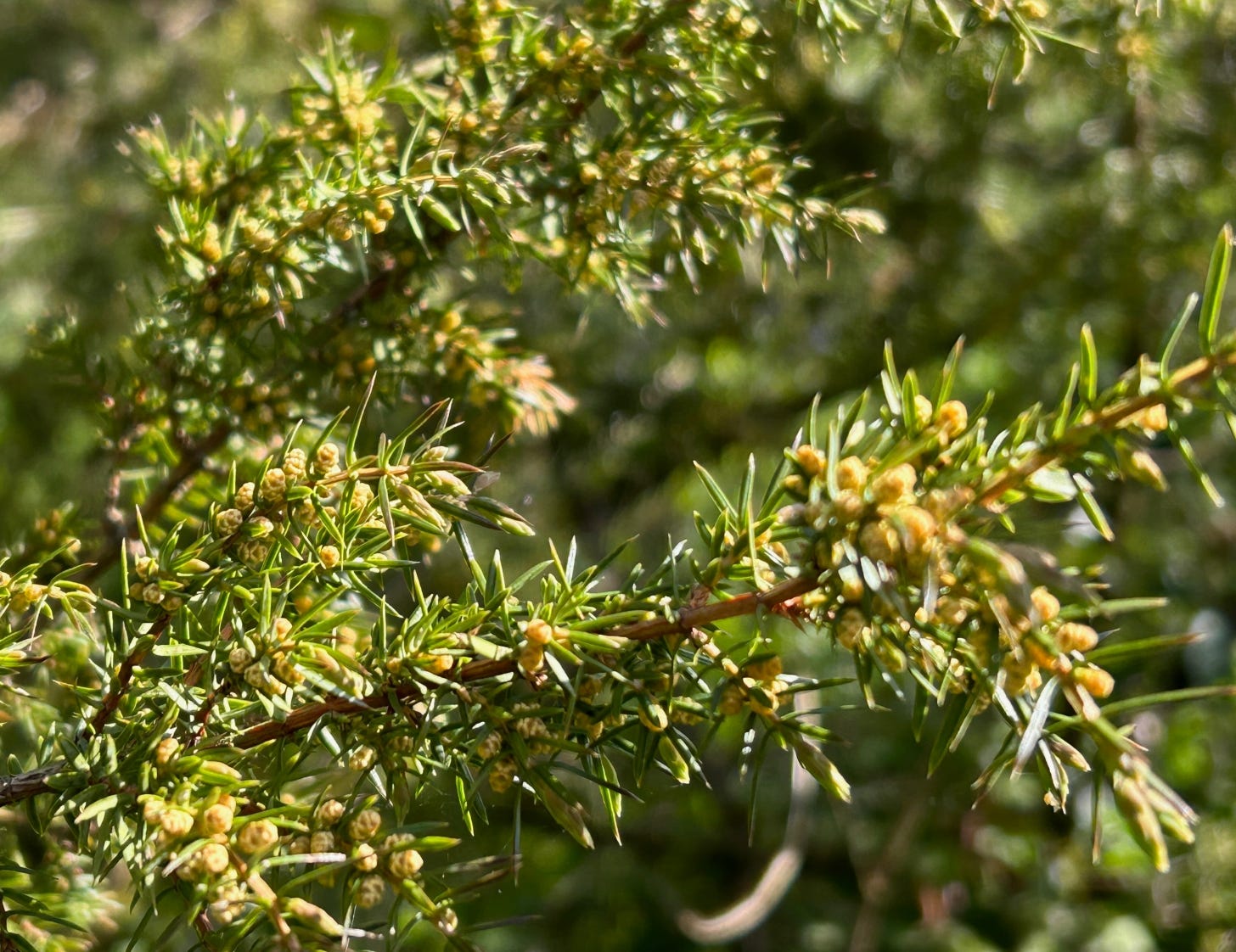
This male juniper needs a mate!
Fruiting trees and shrubs include elder, medlar, quince, cornelian cherry and have all been productive. There is a general policy that people can harvest for their own use. The exception is the apple orchard where a sizeable harvest is converted into apple juice to be sold to raise funds for the Green. A number of nut trees around the Green are still maturing. Although juniper has survived surprisingly well the plant we have is a male, so we have acquired several others to try and get both sexes. It is early days to know if we will succeed in obtaining juniper berries! Meanwhile we have an ornamental flowering quince that seems to like its damp site and produces huge fruits ideal for making quince jelly.
Recipe for Quince Jelly
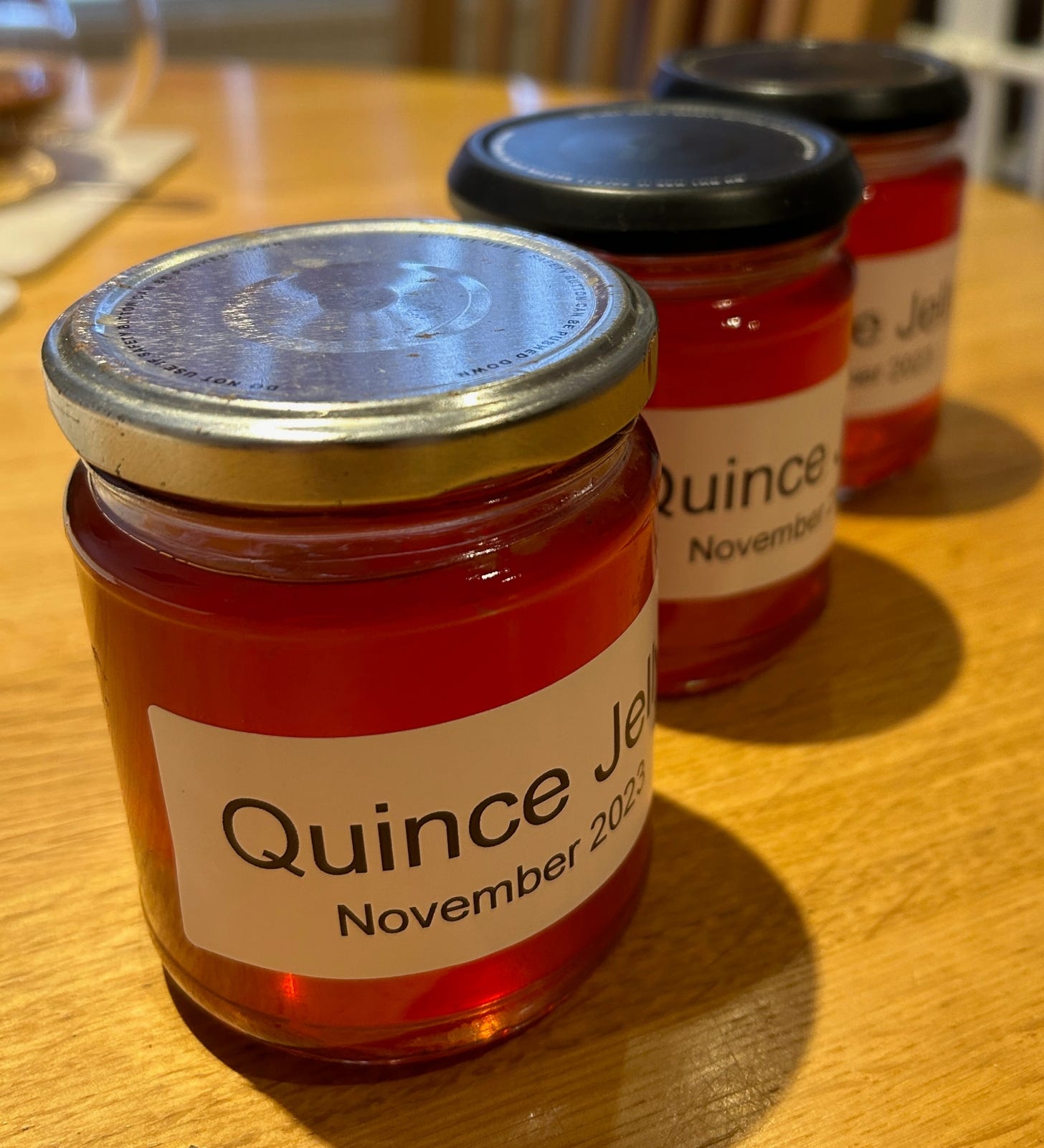
Rose-coloured quince jelly tastes amazing
1.5 kg ripe quinces
1 lemon
sugar
Wash and chop the quinces, seeds and all, and place in a large pan. Peel the lemon zest and juice the lemon and add both peel strips and juice to the chopped quince. Cover with water (about 2.5 litres) and bring to the boil. Simmer for 1-2 hours until the fruit pieces are soft making a runny mash (add more water if too thick). After allowing to cool a little pour the fruit and liquid mixture into a jelly bag or muslin-lined sieve. Leave for 8 hours or overnight and then discard the pulp. Measure the remaining liquid and add 400 g sugar per 500 ml liquid. Heat gently while stirring to dissolve the sugar, then bring to a boil until jam setting point (105 degrees C). Remove from the heat and pour into clean jars, seal and label. Keeps well for a year and delicious with cheese, meat, savoury items, even porridge! I have written more about the medicinal aspects of quince see here...
Harvesting Medicinal Species Through Coppicing
Keeping some of the plants in check in the Herb and Forest aligns well with plans to harvest them! In a rather soggy field area we expected that cramp bark (Viburnum opulus) would do well. This species is native to the UK, a deciduous shrub often known as guelder rose, or snowball tree. It provides a bark which is antispasmodic, rather useful for muscular cramps and period pains. An area was planted up with these shrubs in a circle around 1 metre apart. Each year one or two of the larger shrubs can be cut back and the young stems shooting up provide a good source of fresh bark for use in tinctures or dried and powdered for capsules. This bark can be made available to local herbal practitioners or other users for self help. You can see more about medicinal use of cramp bark here...
Helping Out on the Millennium Green
At present the volunteers working on the Herb and Forest Garden get together on the second Tuesday morning of each month. We regularly keep the grassy paths cut, clear the herb bed edges, and remove overgrown or invasive plants. And we usually walk around chatting about the plants we find, harvest some plants and have a couple of projects under way. Our aim has been to extend the diversity of planting in a sustainable way so that the beds and other areas are easier to manage. More volunteers are welcome. Do get in touch if you are interested to help in the Herb and Forest Garden on a Tuesday! There are also regular Sunday opportunities to get involved with the wider Millennium Green from helping to harvest the apples in autumn to maintenance of the footpath leading to nearby Crediton.
Help, the Pond is Choking Up!
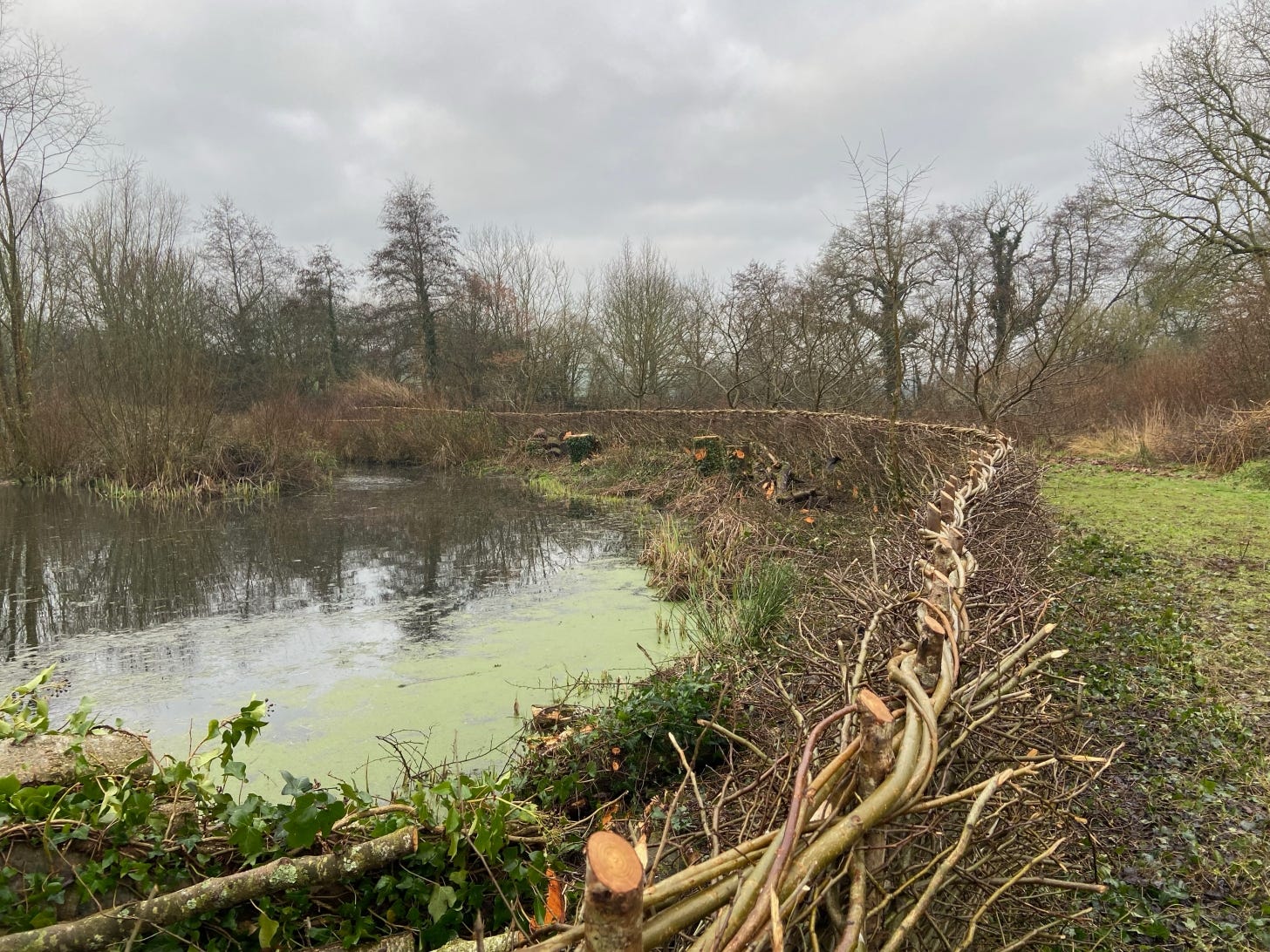
Sandford Millennium Green pond
Right now the people supporting Sandford Millennium Green are fundraising to fix the pond. Surveys have told us that the pond is a vital part of the ecosystem and home to tadpoles, beetles, dragonflies, herons, bats and hedgehogs but years of silt build-up are suffocating it. Repairs can fix this and prevent future silt accumulating. There is a plan for restoration but it will take an investment of at least £4000. Any help to raise these funds will be very much appreciated, see Sandford Millennium Green on Facebook, here…
Please note...
A forest garden can provide useful remedies for common complaints BUT PLEASE NOTE that if you are on prescription medication we recommend consulting a qualified herbal practitioner for advice on suitable herbs.
Finding Sandford Millennium Green
Sandford Millennium Green is open to the public and visitors are welcome. It is on the southern edge of the village of Sandford in Devon neighbouring the road towards Crediton, OS map reference: SS 8289 0212.
By car: There is a small layby for car parking. Park and go through the wooden gate into the Millennium Green and a noticeboard shows a map of the whole Green. For the Herb and Forest Garden turn right. Follow this path towards Sandford village and look for the Herb and Forest Garden entrance path on your left, shortly before another entrance gate back onto the main road.
By bus, bicycle or foot: Bus number 369 from Exeter Bus Station to Sandford goes past the Millennium Green, approximately 30 min journey. There is a well-kept footpath from Higher Road in Crediton to the Millennium Green, about a 35 min walk. Stagecoach number 5 buses run frequently from Exeter to Crediton.
Thanks for reading Medicinal Tree Woman! This post is public so feel free to share it.

Comments
Nothing yet. Say the first thing.
Sign in to join the conversation.