
I have been thinking a lot recently about men.
No, it’s not my hormones. Behave yourselves.
Besides, in modern Scotland you’re only allowed to think about men if you’ve first completed the appropriate training module, reflected on your positionality and agreed to speak exclusively in the language of emotional regulation.
The crisis is visible across much of the Western world, but Scotland has a habit of turning trends into warnings and warnings into catastrophes.
Whatever is happening to men in the modern West seems to arrive here first, stay longer and leave deeper scars.
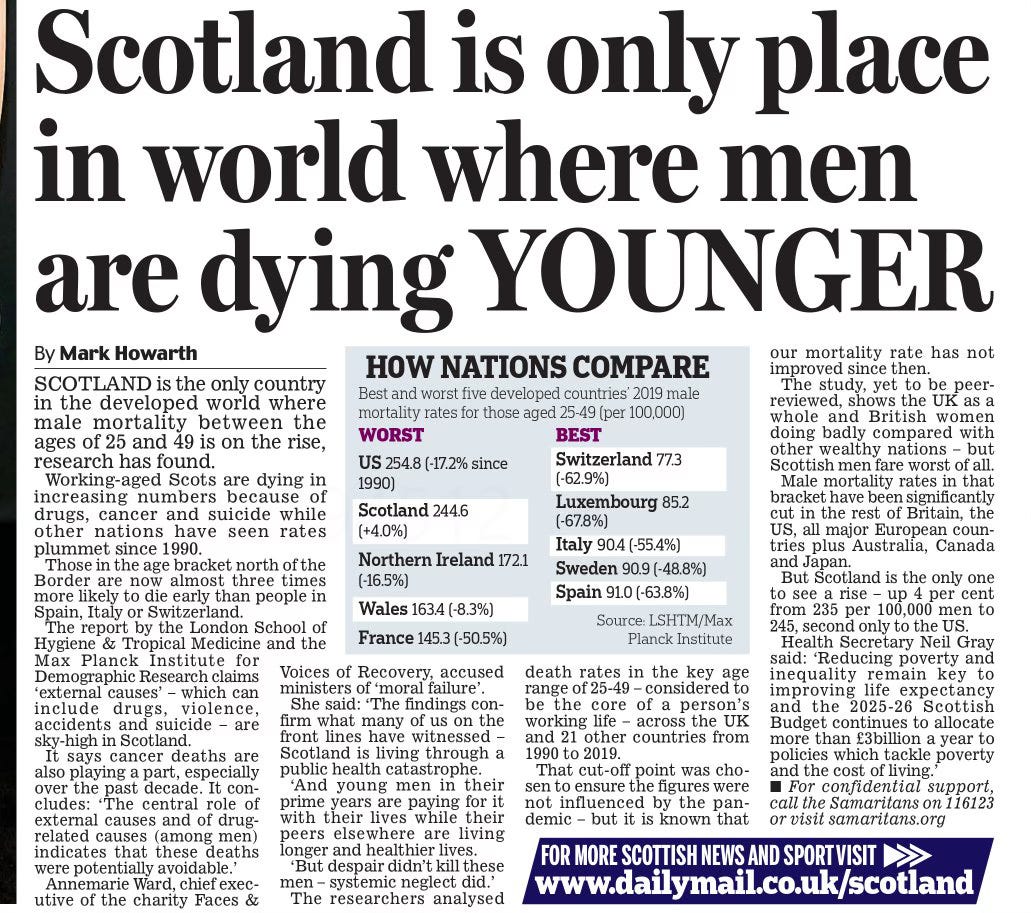
We are now the only country in the Western world where men aged between 25 and 49 are dying younger.
Which is a remarkable achievement for a nation that never stops talking about wellbeing.
Everywhere you turn there are campaigns, frameworks, strategies, interventions, awareness weeks, support pathways and public health initiatives. We have enough therapeutic language to fill the Forth and Clyde Canal.
Yet somehow the men keep dying.
Not because there is suddenly a shortage of people talking about them. Quite the opposite.
There are podcasts about masculinity. Conferences about masculinity. Government strategies about masculinity. Mental health campaigns about masculinity. Arts festivals discussing masculinity. Entire shelves of bookshops dedicated to masculinity.
Scotland’s elite ecosystem of thinkers, practitioners, consultants, campaigners, facilitators, lived-experience leads and public-health professionals has become extraordinarily interested in men.
Which makes it all the more remarkable that Scotland is now the only developed nation on earth where men aged between 25 and 49 are becoming more likely to die rather than less.
Let that sink in for a moment.
Across Europe, North America and much of the developed world, men in their prime working years have generally become healthier and longer-lived over the past three decades.
In Scotland, the trend reversed.
While countries such as Switzerland, Spain and Italy have seen mortality rates in working-age men fall dramatically, Scotland stands almost alone in moving the other way.
We are not merely doing worse. We are travelling in the opposite direction. Not plateauing. Not improving more slowly. Actually going backwards.
Every time I come across that statistic it stops me in my tracks.
Because if you had asked me to design a country likely to produce that outcome, it would not look much like modern Scotland.
We are constantly talking about wellbeing. Constantly talking about trauma. Constantly talking about vulnerability. Constantly talking about support.
The language of care is everywhere. And yet the outcomes increasingly suggest that something has gone badly wrong. The more I think about it, the more I wonder whether Scotland has become so fluent in the language of suffering that it is beginning to forget the language of purpose.
Modern Scotland can explain suffering. It seems increasingly uncertain how to explain purpose.
Once you notice it, you start seeing it everywhere. The same institutions. The same conferences. The same public health panels. The same podcasts. The same advisory groups. The same government-funded organisations. Different logos perhaps. Different mission statements. Different varieties of ethically sourced coffee.
But beneath it all there often appears to sit the same basic worldview.
A worldview that can tell you exactly why a man has fallen apart but becomes strangely nervous when asked what kind of man he should aspire to become.
That sounds harsh, so let me explain.
If a young man is angry, we talk about trauma. If he is addicted, we talk about trauma. If he is violent, we talk about trauma. If he is isolated, disengaged, self-destructive or hopeless, we talk about trauma.
Now before anyone begins furiously drafting an email, trauma is real.
Some of the men I have had the privilege of walking alongside over the years, men I still seek counsel from and proudly call my brothers in recovery, have endured horrors that would break most people. The sort of suffering that many middle-class professionals could scarcely imagine, let alone survive. Trauma matters. It matters enormously.
But human beings are more than the worst thing that happened to them.
And increasingly I find myself wondering whether Scotland has become trapped inside a conversation that can explain almost everything except what a healthy man is supposed to look like.
We have become very good at discussing wounds. We seem far less comfortable discussing virtues.
Duty. Responsibility. Courage. Self-command. Sacrifice. Service. Fatherhood. Brotherhood. Stewardship. Fidelity. Honour. Discipline. Perseverance. Integrity.
Even writing those words feels faintly rebellious. Mention virtue at a public event and people look at you as though you’ve proposed reopening the workhouse, banning antibiotics and bringing back rickets. Yet these were once qualities communities consciously tried to cultivate in young men.
Not perfectly. Not always successfully. Lord knows there was plenty of hypocrisy and failure. But they at least understood that the purpose of a society was not simply to stop men becoming dangerous. It was to help them become good. The old question was simple. What kind of man are you becoming?
The modern question is more likely to be: What services are you connected to? What support pathways are in place? What interventions have been attempted? What risk factors have been identified?
I know that sounds unfair.
Many people working within these systems genuinely care and often do difficult work under impossible circumstances. I know many of them. Some are friends. Good friends. But good intentions do not exempt ideas from scrutiny.
Because sometimes I cannot shake the feeling that Scotland has built an entire ecosystem around understanding social breakdown while becoming strangely hesitant about overcoming it.
We have become experts in diagnosis and amateurs in formation.
And what fascinates me is how self-reinforcing the system has become. Every worsening outcome generates another consultation. Every consultation generates another strategy. Every strategy generates another funding stream. Every funding stream generates another organisation. Every organisation generates another report explaining why the previous reports have not worked.
The one thing rarely generated is fewer funerals.
Nobody intends this. Most people involved genuinely care. But systems develop incentives of their own. And increasingly Scotland resembles a country where social breakdown has become an employment sector.
One question keeps nagging away at me.
What if we have quietly replaced the formation of character with the management of risk? Because the institutions that once shaped men have been weakening for decades.
Families. Churches. Workplaces. Apprenticeships. Trade unions. Neighbourhoods. Sports clubs. Community organisations.
Whatever their faults, these places asked something of men.
They expected contribution. Discipline. Responsibility. Commitment. They were not merely places of support. They were places of formation. They helped answer one of the oldest questions any civilisation can ask.
What kind of man are you becoming? Modern Scotland increasingly asks a different question. What support does he receive? What intervention has been attempted? What service is he connected to? What risks does he present? What outcomes can be measured?
Notice what has happened.
The focus quietly shifts from character to condition. From formation to management. From virtue to vulnerability. From who a person might become to what has happened to them.
Recovery communities understood this long before policymakers did.
Recovery was never simply about understanding why somebody used substances.
It was about becoming somebody different. A better father. A better neighbour. A more honest man. A more useful member of society. Recovery assumes transformation is possible. But increasingly I am not sure Scotland’s governing culture does.
Instead it offers support. Stabilisation. Harm reduction. Sometimes those things are necessary. Sometimes they save lives. But without a clear pathway towards responsibility, recovery and reintegration they become something else.
Not transformation. Containment. The management of decline rather than its reversal. Modern Scotland knows how to tell a young man what not to become. Don’t be violent. Don’t be toxic. Don’t be reckless. Don’t be harmful.
What it increasingly struggles to tell him is what he should become.
What does a good man look like? What is worth building? What is worth carrying? What is worth sacrificing for? What is worth serving? A civilisation that cannot answer those questions eventually produces young men who go looking elsewhere for answers.
And often they find bad ones. Because human beings need more than safety. Especially young men. A young man can survive for a surprisingly long time without comfort, status, money or certainty.
What he cannot survive indefinitely without is meaning. Without some sense that he is needed. That somebody expects something of him. That his life matters. That there is a standard worth striving towards. That there is a purpose beyond simply avoiding harm.
This, I increasingly suspect, is where Scotland’s lost boys are getting lost.
Not because nobody cares. Scotland has never employed more people whose job title contains the word “care”. The problem is that care is not the same thing as meaning.
You cannot build a life around a wellbeing framework. You cannot sacrifice yourself for a stakeholder engagement exercise. Nobody lies awake at night dreaming of optimal behavioural outcomes. Human beings need something bigger than themselves. They always have.
And perhaps that is the real crisis hiding underneath all the statistics.
Not simply that our young men are dying.
But that we seem increasingly uncertain what we are calling them to live for.
We have become experts in the diagnosis of wounds and amateurs in the cultivation of souls.
And a society that forgets how to form men eventually finds itself trying to manage the consequences.
Scotland is spending billions doing precisely that.
No posts
Comments
Nothing yet. Say the first thing.
Sign in to join the conversation.