
After a recent interview on SiriusXM’s LIFT with our guest, fintech billionaire Jenny Just, who founded a program that utilizes poker to help girls with confidence and decisionmaking, I’ve been thinking a lot about risk—and how women approach it.
Despite what we’ve been taught to believe, research suggests that women are not inherently more risk-averse than men. In many cases, they take similar risks. The difference lies in what happens next.
In a 2024 study, Laura Kray, Jessica Kennedy and Margaret Lee found that women with MBAs were as likely—or more likely—than men to negotiate (54% vs. 44% on salary; 64% vs. 59% on promotions). Another study showed that women in corporate settings are less likely to be promoted early in their careers, a gap that just compounds over time.
So here’s what happens: Men are more likely to be rewarded for risk-taking—with promotions, recognition or financial upside. Women, by contrast, report more negative consequences for the same behavior, from reputational penalties to stalled advancement.
Over time, those outcomes shape future decisions. When risks pay off, people take more of them. When they don’t—or when the social cost is high—they adjust.
Part of the dynamic is cultural. Risk-taking, especially in its most visible and assertive forms, is still often coded as masculine. When women operate in that milieu—ambitious, direct, unambiguous—it isn’t always welcome. For us, there’s a narrow margin of error.
Which helps explain why some of the most consequential risk-taking by women today is happening outside traditional structures. Why? Traditional workplaces have fostered gendered social norms that are deeply ingrained.
Entrepreneurship offers women a different set of rules. The feedback loop between action and outcome is often clearer. There’s no bullshit. The constraints are fewer. And that’s why, despite studies that show that less than 2% of venture funding goes to women, the founders in this population are some of the most impressive people I’ve ever met.
Lauren Dunford is one shining example of someone I spoke with recently who embodies this.

Ms. Dunford is the founder and chief executive of Guidewheel. Her work focuses on manufacturing—an area long overlooked in Silicon Valley despite accounting for roughly a third of global emissions.
Her path began not with a leap, but with a series of small awakenings. After studying at Stanford University, she worked in food manufacturing, where she encountered a problem firsthand: critical operations were still being tracked with pen and paper, even as the broader economy digitized.
The inefficiencies were costly—and, in some cases, consequential. “I had to stand in a parking lot and call customers to tell them we were going to miss their delivery again,” she said. The issue wasn’t lack of demand. It was lack of visibility.
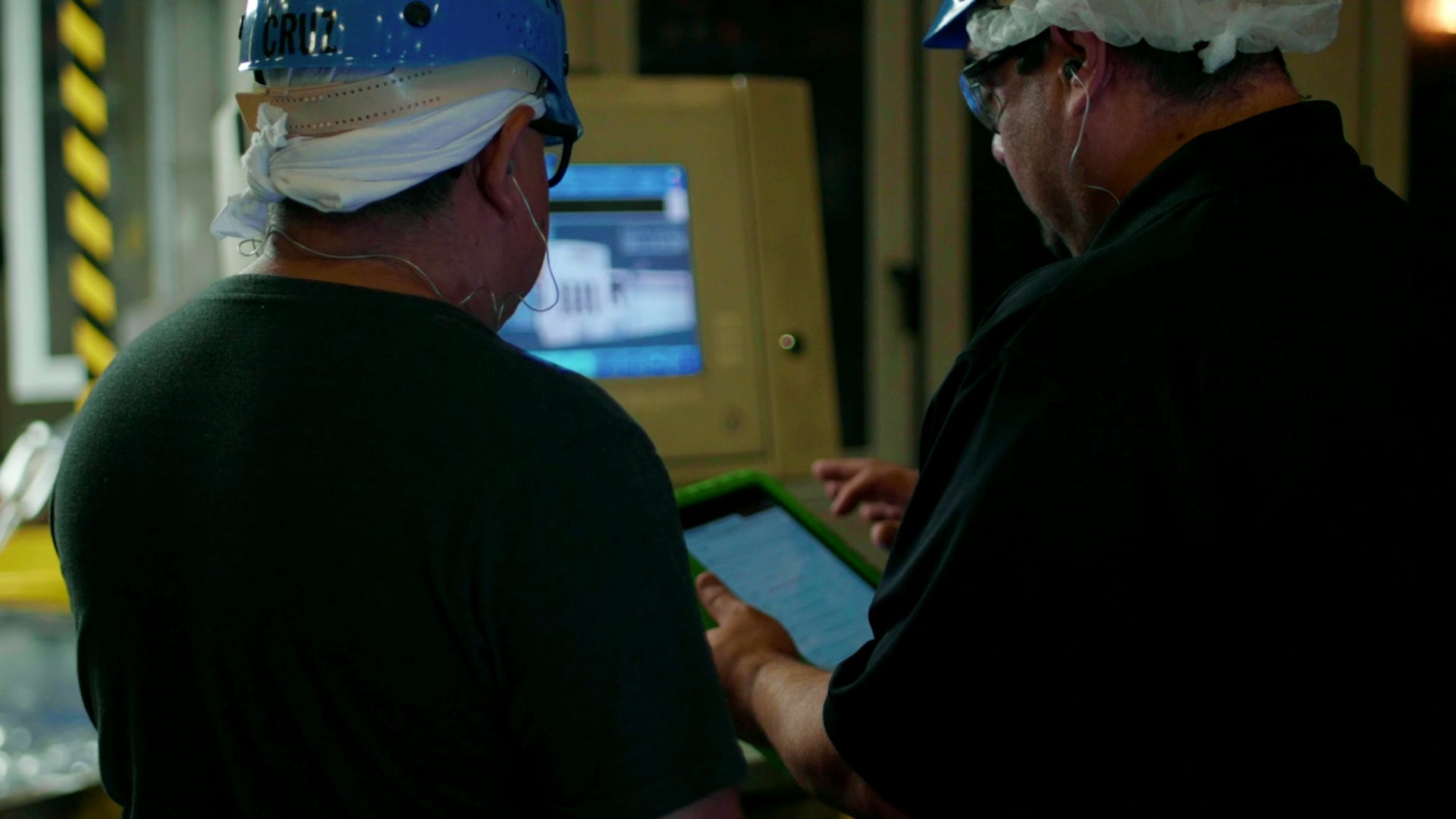
Rather than accept those constraints, she began exploring how data—and eventually AI—could be applied to physical operations. The result was Guidewheel, which uses software and sensors clamped onto machines to track how factories are performing in real time. This, in turn, helps companies increase output and reduce waste.
The data flows into a cloud-based system, creating a live picture of the factory floor—one that allows operators to respond more quickly, run equipment more efficiently and reduce downtime.
At its core, Guidewheel is built on a simple premise: factories cannot improve what they cannot see.
Many manufacturing operations still run with limited real-time visibility into how their machines are performing. A line may be down, underutilized or producing below capacity, but the information often arrives too late—or not at all. Managers rely on manual checks, delayed reports or instinct.
Research from McKinsey & Company shows most manufacturers still lack real-time visibility into operations, a gap that helps explain why unplanned downtime costs the industry an estimated $50 billion annually, according to Deloitte.
Guidewheel aims to change that by creating a continuous stream of data from the factory floor. Sensors attach to existing equipment and read what Dunford describes as the “heartbeat” of each machine, capturing when it is running, when it is idle and how it is performing. That information is translated into a real-time operational dashboard.
The immediate benefit is not abstract. It is productivity.
In many factories, nearly half of potential output is left on the table—a gap that can translate directly into lost profit. Typical utilization rates often sit between 50% and 60%, meaning machines are idle a significant portion of the time. Even a modest improvement can have an outsized effect: a 10% increase in utilization can drive 20% or more in profit margin, because fixed costs remain largely unchanged. That’s a significant increase in output without adding new equipment or labor.
The company’s early insight was that while energy efficiency and emissions reduction were important, they were not the primary motivators for customers. What factory operators wanted first was a way to make more with what they already had.
“If you lead with energy savings, the team on the plant floor doesn’t use the product,” Dunford said. “If you lead with productivity, they do.”
That distinction shaped the company’s strategy. Rather than position itself primarily as a climate solution, Guidewheel built around operational performance—and sustainability follows.
In manufacturing, the two are closely linked. Producing more efficiently typically means using less energy per unit of output, reducing waste and lowering emissions. The model aligns financial incentives with environmental outcomes.
Now, the longer-term ambition is even broader.
Guidewheel is working to build a system of intelligence across the physical economy—connecting machines, factories and eventually entire production networks. As more data is collected, the system becomes more predictive, identifying problems before they occur and helping operators make faster, better decisions.
In that sense, the company sits at the center of a larger shift: the application of AI to industries that have historically lagged in digitization.
For Dunford, the appeal is both practical and expansive.
Manufacturing is vast, fragmented and essential. Even small improvements, applied at scale, can have outsized impact—on productivity, on cost and on emissions.
Her own path reflects the same pattern seen in the research on risk: not a single defining leap, but a sequence of decisions made with imperfect information.
She tested the idea in classrooms, then in factories. She built in emerging markets before returning to the U.S. She followed customer behavior rather than original assumptions.
Each step carried uncertainty. None guaranteed an outcome.
But over time, the accumulation of those decisions—tested, adjusted, repeated—began to look less like risk, and more like a way forward.
-0-
No posts
Comments
Nothing yet. Say the first thing.
Sign in to join the conversation.