
Greetings, readers! As you can see, the site’s title has changed. We are pausing on publishing Microstories 微故事 to bring you a new novel!
Huburg Hutong: A Novel in Both Chinese and English 《胡堡胡同: 中英文双语小说》 tells the fictional stories of the descendants of the Hú 胡,Lín 林 , and Wáng 王 families, Chinese immigrants to the eastern United States in the 1950s.
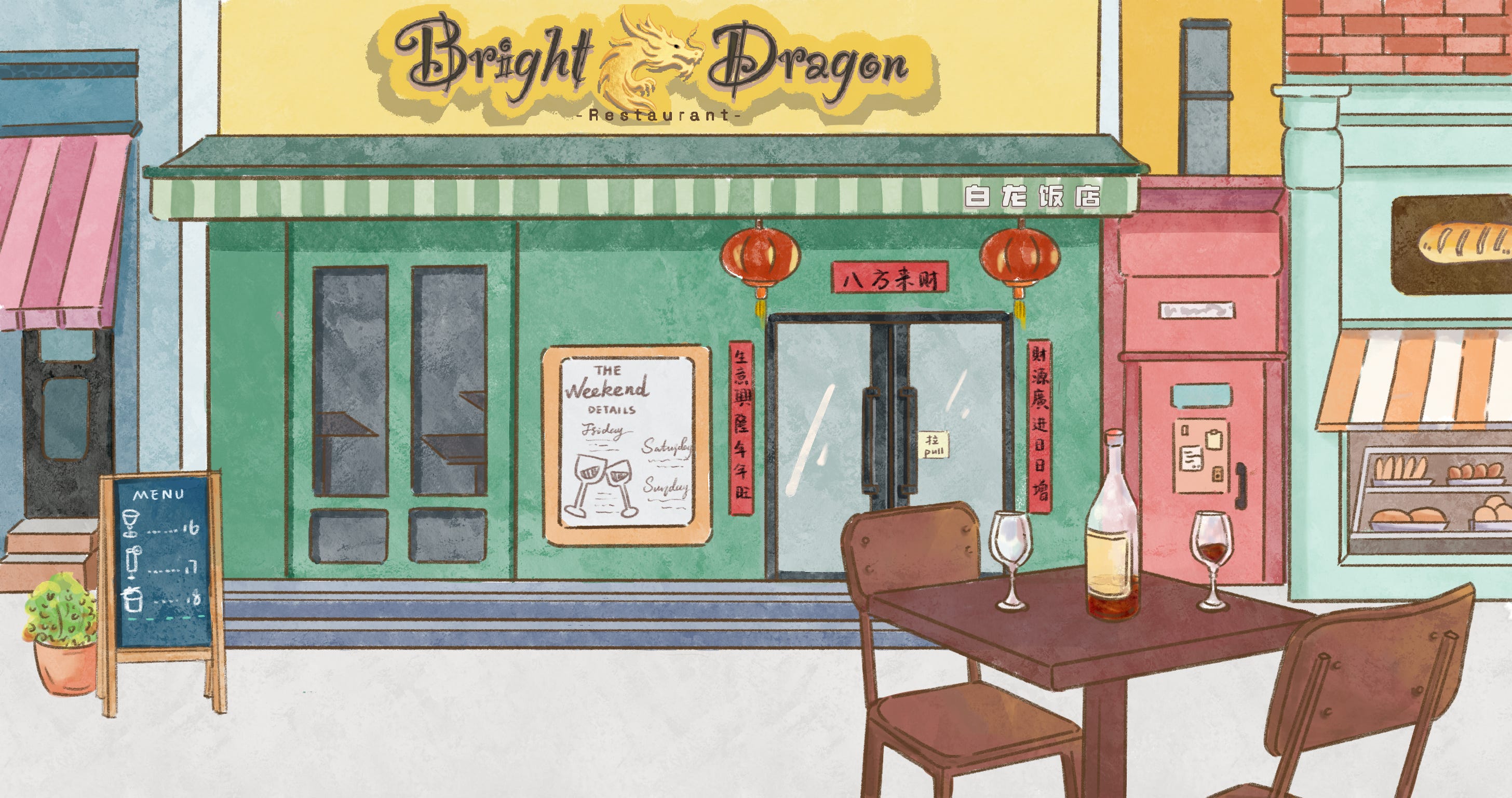
When the Hu family’s eldest son is admitted to college in America, Boss Hu, his wife, Ma Hu, and their children accompany him. Within walking distance of the college in Brightsburg 白堡 Báibǎo, Boss Hu starts Bright Dragon Restaurant 白龙饭店 Bái Lóng Fàndiàn. He buys a farmhouse and land in a nearby mountain hollow.
Boss Hu invites friends in China to join him in America to help run Bright Dragon Restaurant; they become Manager Lin and Chef Wang. Together, the three families form a community in Hu’s mountain hollow. Other immigrants from China arrive. The area is known as Chinatown to Brightsburg residents, but as Huburg Hutong 胡堡胡同 Húbǎo Hútòng to the people who live there.
Huburg Hutong 胡堡胡同 is a serialized novel written at the intermediate level in both Simplified Chinese characters and in English. Chapters are published weekly. The novel is written by Anne 安妮 Giles, edited by 侯慧颖 Hóu Huìyǐng “Mary,” and illustrated by Lear.
“儿子想忘,孙子想记。”
“What the son wishes to forget the grandson wishes to remember.”
- Marcus Lee Hansen. The Problem of the Third Generation Immigrant. Rock Island, Ill.: Augustana Historical Society, 1938, p. 9
Notes
1. “Hutong” 胡同 hútòng means “alley.” The Twig 枝丫 stories, written by Anne 安妮 Giles and edited by 侯慧颖 Hóu Huìyǐng “Mary,” are works of fiction set in a contemporary, alternate universe in an unnamed Beijing hutong. Modern hutongs are communities of residences and businesses lining alleys formed by courtyard residences 四合院 sìhéyuàn.
2. A hollow, 山沟 shān gōu, is a small, narrow valley between hills or mountains, often with a stream running through it. Hollows are common in the mountainous regions of the Mid-Atlantic United States, especially in the Appalachian Mountains, including parts of Pennsylvania, Maryland, West Virginia, and Virginia. Anne Giles consults with E. Don Croy, born in 1931 in McCoy, Virginia, an area surrounded by hollows.
3. “The first Asian student to graduate [from Virginia Tech], in 1924, was Tien Liang Jeu…Few, if any, students of Asian ancestry enrolled at Tech at any one time before the 1940s. Then a small wave of Asians and Asian-Americans came to Blacksburg…”
- Virginia Tech Magazine. (1998). Feature 3 (Spring issue). Virginia Tech.
4. The author attended Virginia Tech in Blacksburg, Virginia, U.S.A., where she studied Chinese history under Wong Young-tsu. Her father, Robert H. Giles, Jr., attended Virginia Tech as a member of the Corps of Cadets.
5. In Mandarin Chinese, the “Hu” in “Huburg” is pronounced somewhat like the “Who” in “Whoville,” a fictional town in Horton Hears a Who by Dr. Seuss, 1954.
6. As writer and editor, Anne and Mary try to create synergy 协同作 in both Chinese and in English. A note from Anne about the translations:
Since each Chinese character is distinct, although one Chinese character may have more than one meaning, and many characters are comprised of components, some of which also carry meaning and some of which began as oracle bone script over 3,000 years ago, I consider each block containing a Chinese character a barely contained explosion of meaning, even if it’s part of text written at the intermediate level, as is Huburg Hutong.
I also write the English at the intermediate level, but try to add layers of meaning that a literal translation of the Chinese would not. Mary’s proficiency in English also adds breadth and depth to the English text.
The best writing I have read on translation is by R. F. Kuang in Babel, or The Necessity of Violence: An Arcane History of the Oxford Translators’ Revolution, Harper Voyager, 2022.
7. Some words are intentionally repeated in hopes of offering language learners the 3 to 17 exposures (number of times a learner encounters a word in different contexts) that may be needed to learn a new word.
8. We hope our work may serve as short reading and discussion texts for busy adult language learners of Simplified Chinese Characters and/or English.
9. Illustrations are by Lear.
Disclaimer
Huburg Hutong: A Novel in Both Chinese and English 《胡堡胡同:中英文双语小说》is a work of fiction. All names, characters, businesses, places, events, and incidents are either the product of the author’s imagination or are used in a fictionalized manner. Any resemblance to actual persons, living or dead, or to actual events is coincidental.
References to real locations, including Blacksburg (黑堡 Hēibǎo), Virginia and Virginia Tech, are used fictitiously. The depiction of these places, and of any institutions, communities, or people associated with them, is not intended to represent actual conditions or people.
To the author’s knowledge, no hutong resembling the one described in Huburg Hutong: A Novel in Both Chinese and English 《胡堡胡同:中英文双语小说》has ever existed in or near Blacksburg, Virginia.
Huburg Hutong: Main Page
Huburg Hutong: Places and Characters
Thanks for reading Huburg Hutong 胡堡胡同! Subscribe for free to receive new posts.
Comments
Nothing yet. Say the first thing.
Sign in to join the conversation.