
When I’m working on a problem, I never think about beauty. I think only how to solve the problem. But when I have finished, if the solution is not beautiful, I know it is wrong.
—R. Buckminster Fuller
Sometimes we don’t realize what we’ve learned until we’ve already known it for a very long time. Writer Ann Patchett says:
Coming back to something can help you see how all the dots in your life are connected, how one decision leads you to another, how one twist of fate, good or bad, brings you to a door that later takes you to another door, which, aided by several detours—long hallways and unforeseen stairwells—eventually puts you in the place you are now.
For me, one of those “somethings” was a tole project.
***
The most exhausting part of motherhood is the fact that for 99.9 percent of the various needs, you can’t simply decide to “opt out,” or even put them off until later; a child preparing to run into traffic takes precedence over anything else. It is the loss of the smallest measures of mental freedom and self-containment, the ability to pay attention to oneself when needed at that moment(!), that carries the most impact on our lives, energy, and sense of self.
At home, I painted in the hours before dawn, before daytime demands. As I worked, the room changed from black to gray as Oregon’s oft-hidden sun announced a new day beginning. On Thursdays, a widow neighbor watched the children. I took a paint-filled tackle box to the University library. Using Jim’s faculty status to reserve a small study room the size of a closet, I would set up my paints and lose myself in a landscape or still life. It was a routine very similar to my Whittier study carrel days. The difference was at Whittier I looked at the paintings tucked around me; in Oregon I painted them myself.
***
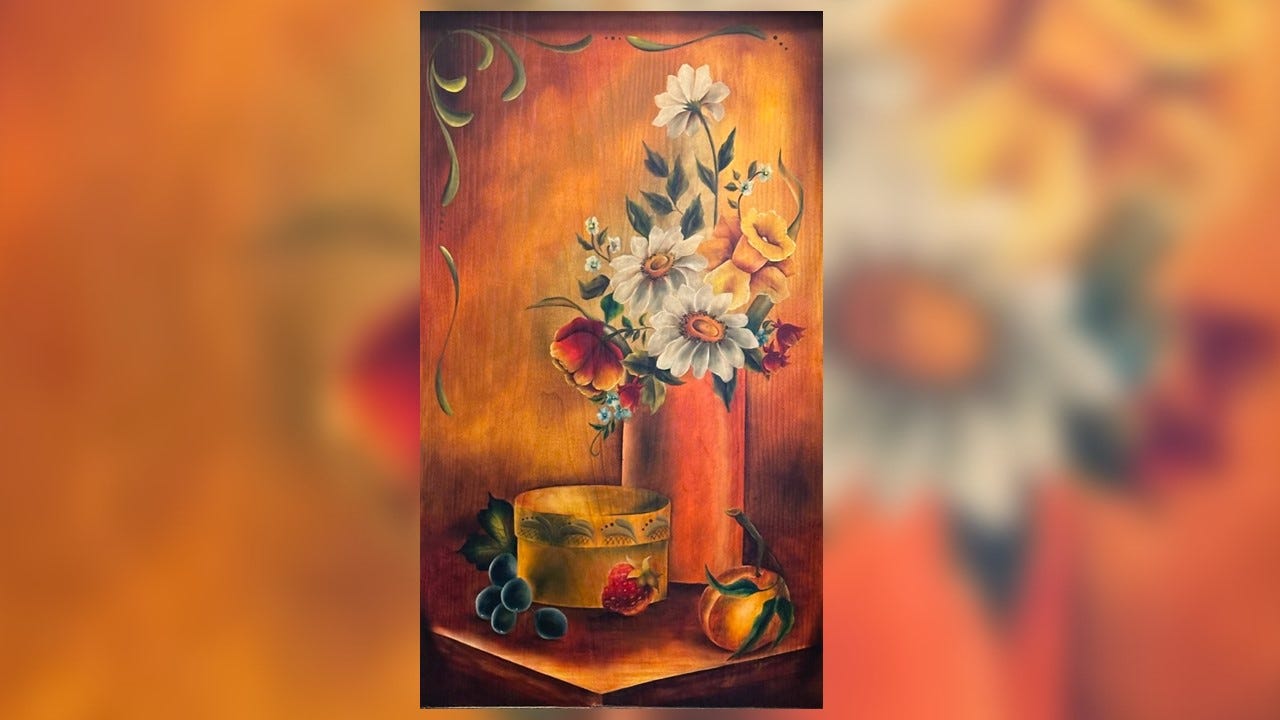
The National Society of Tole and Decorative Painters held an optional certification examination once a year. Submitted projects were evaluated on a long list of criteria, from brush control, to composition, to color choices, to wood preparation and finishing. I decided to apply. I spent months on my submission. The subject, chosen by the association, was a formal still life. A copper cylindrical vase with daffodils, daisies, and poppies cascading out stands on a shadowy table. To the left grapes, strawberries, and a ripe peach surround a small oval-decorated box. Muted yellows and reds filter through the background. I imagined it sat in a prosperous colonial dining room. It came to life in the bowels of the university library.
I wrapped the 11-by-17” piece as though it were glass instead of wood and sent it off to New York. Two hundred points was the qualifying score. I had been painting for some years and knew it was the best piece I had done. I was sure I would qualify. If there was anything I was good at, it was taking tests. When the critique arrived some weeks later, I tore the envelope open. “We regret to inform you…,” it began. As I scanned the evaluation grid, phrases floated by, “needs more contrast... deepen shadows...doesn’t shimmer.” My score: 188. Close. Not close enough.
***
I jammed the project in the back of the winter coat closet—too discouraged to look at it for weeks. Never mind all I had learned in the process—the happy hours I spent in classes and in the library carrel, the people I met. It is disappointing even now to remember how disappointed I was then. I wasn’t as resilient as life requires. Time taught other lessons that made this failure seem insignificant. But not then.
Dave Henderson was a Boston Red Sox backup player in 1986. He hit a home run that defeated the Angels in the seventh game and got the Sox to the World Series, where they lost to the New York Mets. Later Henderson said, “I actually won a World Series in 1989, but the one I think about most is ‘86. It hurts more to lose than it feels good to win.” Yes, it does.
***
I continued painting and began teaching a beginning evening class at a large local craft supply store. Joyce Steece, the wife of another professor, was my first student. An English teacher, she was like me, not teaching in Oregon, looking for ways to keep learning. We talked about breaking painting into manageable parts and how similar that was to teaching someone to compose an essay. Before I completed a second submission, we left the Northwest. The Steeces returned to USC and Joyce to a long career, as did I. I often began my lessons on expository writing by painting a simple apple for class. It helped my students. I wonder if she did the same.
Today the colonial still life hangs on the wall. It looks the same as it did three decades ago—but the young woman who painted it is gone. I occasionally study it through the lens of the present. Three things stand out:
Although I met the technical requirements, the painting looks stiff. Still lifes aren’t still. My porcelain teacher says, “Make your work sing!” Though my project wasn’t porcelain, it wasn’t singing either. It was humming.
The time I spent with other amateur painters was as important as the painting. After all, amateur descends from “amator,” which is Latin for lover. Throughout much of its history it has also been used to refer to people who engage in an activity for love rather than money. Having enjoyed community concert bands and local theaters that dot the landscape, I know how useful a role the serious amateur of all kinds plays in community life.
Most important, just because things hadn’t gone the way I planned didn’t mean they had gone all wrong. I became a better teacher and a better painter than I would have otherwise been. And because I was so unaccustomed to failure in competitive settings, it was a step toward becoming a better human being… or at least a more compassionate one.
***
Living has taught me, since those days, that there is a balance between getting what you want and being open to the things that actually come your way. There are many more important challenges than painting certifications—but in its time and place it was important to me. Today I think certification would have been terrible. Life is not about getting certified. It is about remaining curious, staying open, trying not just one day…but every day. The real trick is to let life, with all its missteps and regrets, be always more alluring and mysterious than its end.
“It hurts more to lose than it feels good to win.” Yes, it does.
The 12 points I didn’t earn gave me a chance to rethink something I thought I knew. The quiet cylindrical vase became a touchstone. When family issues loomed large, or teaching became overwhelming, I would sometimes stand in front of the wooden picture and think.
From a painting perspective, my still life is quiet… barely “humming,” in fact. From a life perspective, I hear it singing. It’s a melody I recognize.
I wrote it myself.
River Journeys is a reader-supported publication. To receive new posts and support my work, consider becoming a free or paid subscriber.
Comments
Nothing yet. Say the first thing.
Sign in to join the conversation.