
How does one even start a project proposal? Where do ideas come from? And how can you avoid the scary moment of staring at a blank page, not knowing how to begin?
I’ve been using a trick for a while that allows me to never have to face a blank page, even when starting something new: working with a digital note-taking system built around the “second brain” idea, an external system for organizing and storing your thoughts, notes, and plans.
I mentioned in an earlier post that I used Obsidian to prepare my ERC grant application: a digital note-taking system that follows this “second brain” approach. It’s called a second brain because it allows you to gradually store your thoughts and keep them accessible and connected to other ideas, instead of worrying that you’ll forget something important. Obsidian is my platform of choice (it’s free and simple) but there are other similar knowledge-management systems out there.
I started using Obsidian a few years ago, and you can see the current state of my “second brain” below. This graph view shows all my notes as dots, connected by topic and color-coded by type. I chose what the colors mean; for instance, red marks the projects I’m currently focusing on. The nodes (dots) are connected into clusters of ideas and readings. It’s like a map of my own research thinking. And honestly, I love this graph view option: your knowledge system at a glance!
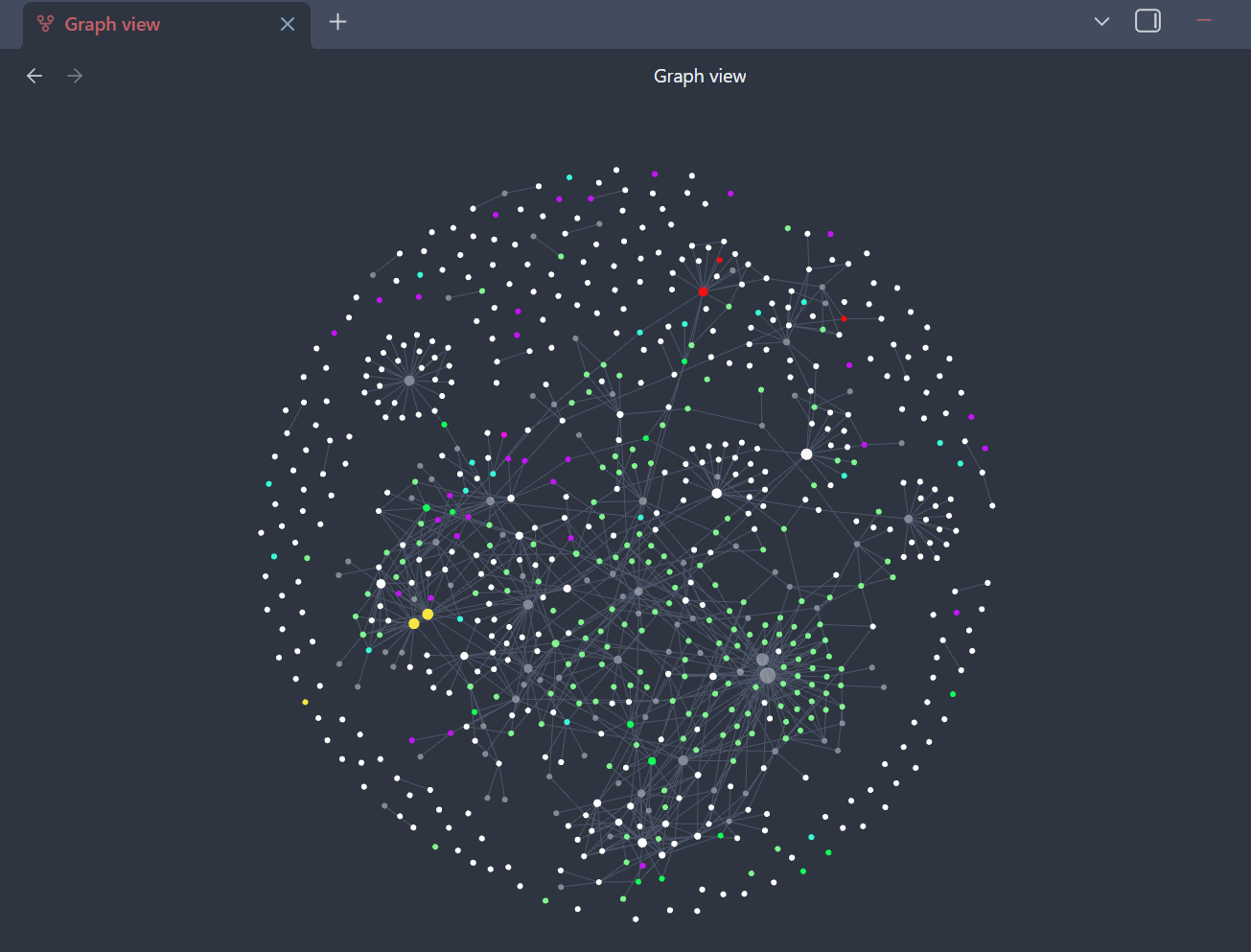
My Obsidian is not the most populated; I’m not obsessively transferring all of my notes there. But work ideas, references, and literature that I think could be useful in the future I usually enter directly into Obsidian. I’m actually typing this Substack post draft in Obsidian right now. I have my own system for organizing and retrieving information that works for me, and it’s convenient to start writing here, where I can easily access links, thoughts, and relevant literature.
When I first started using Obsidian, I already had a sizeable library of digital notes — reading notes, lecture notes, and other materials I had accumulated over my grad-school years. I kept them in OneNote, which is fine for storage but less convenient when you want to make connections and retrieve information by association. I transferred these notes into Obsidian and spent some time organizing, linking, and revisiting them. This helped me build a populated version of my second brain. I can imagine it takes time to build one from scratch; it only really becomes useful once you already have something in it.
Here’s how this digital system helped me develop my ERC Starting Grant idea from scattered reading notes to a coherent proposal.
When I read something interesting in an academic journal or book, I usually take quick notes in Obsidian, creating a file for each reading, tagging it as “literature note,” and assigning topics to link it to my own classification of subject fields (for example, I have collections on “Social Movement Outcomes,” “Gender in Social Movements,” and so on).
As I read about activism and mental health, in academic literature, but also in the news and on social media, I began tagging notes with “Care.” Over time, this new tag started linking with my older, denser cluster on social movements. In the graph view, I could literally see a new idea forming: a bridge between two fields I’d never combined before. This was when I realized there was something there.
To organize this growing web of notes, I used Obsidian’s Canvas: a digital board where you can drag ideas, connect them with arrows, comment, and rearrange until patterns emerge. In the picture below, you can see a very zoomed-out view of that canvas I created for my project idea. Different blocks are snapshots of my existing notes as well as my comments (for example, “How is this groundbreaking?” — a note to self marking an area I needed to think and write more about at the time).
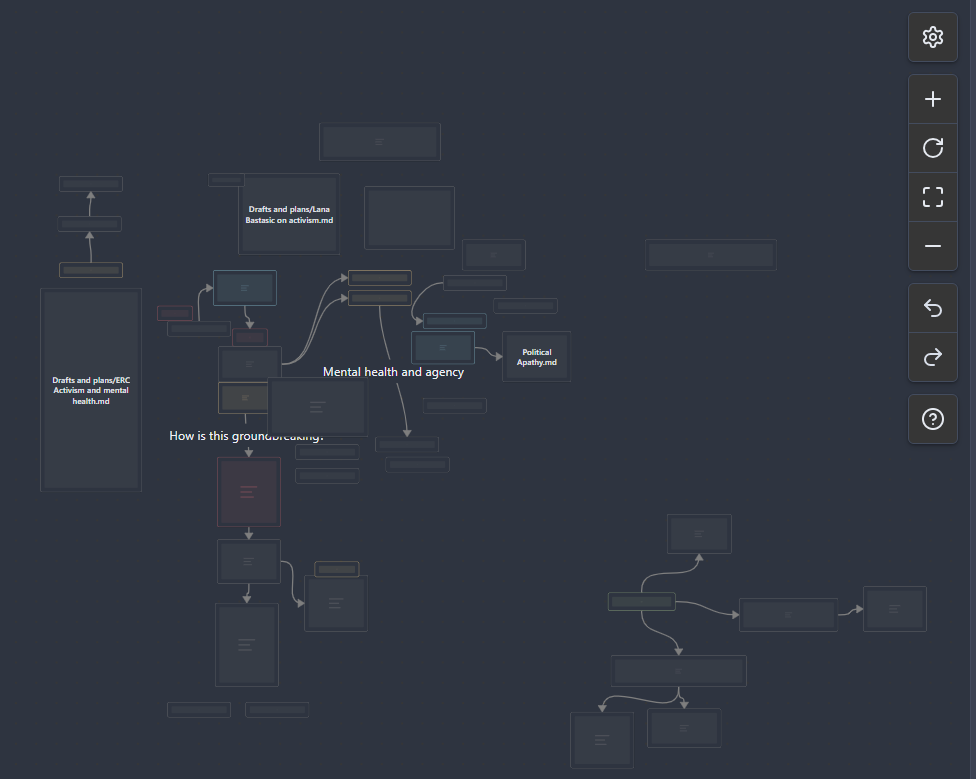
When this canvas felt complete, I realized I was ready to start writing the proposal. As you can see, I almost never had to start from a blank page: I had connected notes, my graph view, and some material ready to be thrown onto a canvas.
Growing your note-taking system does take time. But it’s also a rewarding and creative activity: figuring out a structure of topics, tags, and connections that will work for you and help you find what you need when you need it. Once you’ve invested a bit of effort, the system starts to work for you. It keeps a record of your thoughts, the connections you made in the chaos of information, and shows them to you in a convenient way. I obsessively emphasized “you” in this passage because, even though it’s a digital tool, it’s very customizable, and you have full control over what’s going on there. It’s simply a way to grow and enhance your creativity.
Comments
Nothing yet. Say the first thing.
Sign in to join the conversation.