
There are different priorities in research today. Some scholars, institutions, and funding bodies prioritize social impact and immediate relevance; others focus on studies that can be turned into a commercially successful product. But there are still pockets in academia interested in fundamental, curiosity-driven research.
In this post, I want to reflect on the language often used to describe what funding bodies are looking for in research proposals: the language of scientific “breakthroughs,” “groundbreaking” research, innovation and novelty. I want to state from the start that I’m in no way an insider in the ERC decision-making apparatus, or any decision-making apparatus for that matter. What follows are my reflections and my way of thinking about the spectrum of terms describing scientific ambition, potentially helpful for someone writing a proposal. These thoughts are based on my own process of trying to make sense of this spectrum while writing my proposal, and on my participation in preparatory workshops organized by the Research Support Office of my university.
Excellent research?
The ERC funding schemes (the Starting, Consolidator, and Advanced grants) are specifically designed to support “frontier,” “pioneering,” and “excellent” research. These grants don’t dictate topics nor require applicants to come up with immediate applied or commercializable results. They are meant to support “investigator-driven” or curiosity-driven research.
But what they are looking for is novelty.
You might say: well, all funding bodies, as well as publishers and journal editors look for novelty. No one wants to support research that does not add anything to what we already know about the world. Still, there are different approaches to what counts as new, and different words used to describe what these funding schemes are looking for.
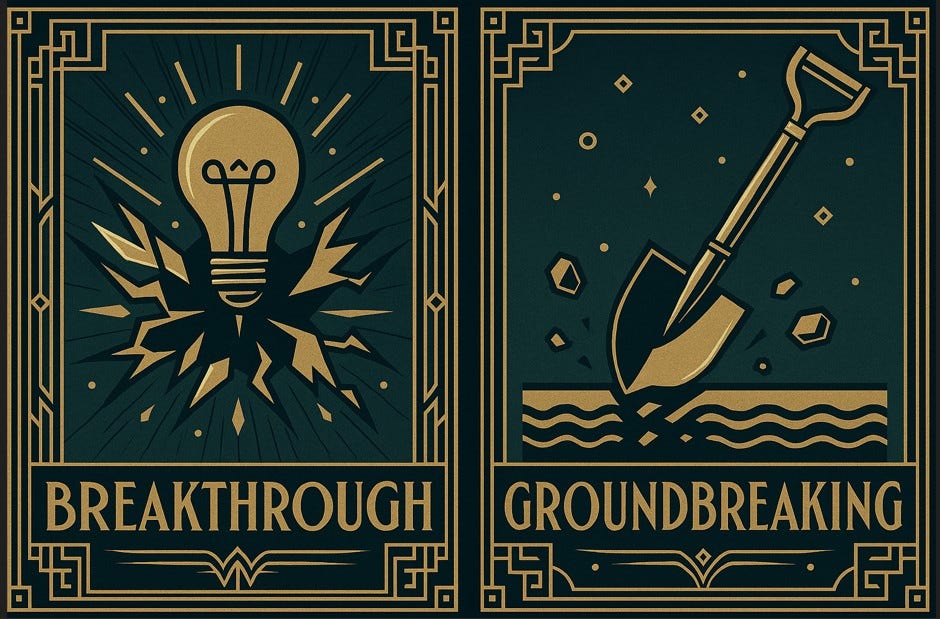
For ERC grants, your research should aim for scientific breakthroughs and/ or be groundbreaking; and as I learned from the Research Support Office at my university, these are not the same. So, how does one make sense of novelty when writing a grant proposal of this type? And who decides what counts as novel or groundbreaking?
At my university, the Research Support Office organized various events to help potential applicants make sense of the requirements and expectations of the ERC grants, and here are some ideas on novelty that I took away from them.
ERC is looking for great ideas, and excellence is the only criterion
This means that the quality of your idea weighs more that its potential policy or market applications. It should sound good and promising, and excite the panel. The readers, all of whom are in your broader field of science but not necessarily experts on your specific topic, need to be inspired by your topic and curious to know the results. So “no pressure” (sarcasm): as I learned in the workshops, you simply need to sound inspired and passionate about your topic, and also spark similar feelings in your readers.
In addition to sparking joy, your proposal should be very clear on how exactly you’re innovating. A “pioneering” proposal could create a new research field or contribute to an emerging field of science.
The holy grail is the scientific “breakthrough:” an important discovery that will change the way we understand a particular domain of life. These breakthroughs are as coveted as they are elusive. I believe everyone on the ERC panels understands that not all good science will achieve these breakthroughs.
Then there’s the “groundbreaking” research, which brings about significant shifts in particular domains of science, adding something to the way we understand things. I understand the difference between the “breakthrough” and the “groundbreaking” research as the one of scale, but the logic is the same: you need to contribute to a shift in how scholars see things or solve problems in your particular field. In other words, it should be impactful - within your specific field (groundbreaking) or in, let’s say, social sciences generally, if you’re very ambitious and are going for a breakthrough.
For example, an ERC Starting Grant can shift a perspective on a field of study (offering a new way to look at things, new angles, new concepts) or suggest a completely new direction for the field. What sets this logic apart from a general novelty logic in scientific research is the scale and ambition. So, collecting empirical data in a new setting but not offering a new conceptual way of looking at a problem, in my understanding, can be novel for your field, but not groundbreaking enough to fit the bill of the ERC funding schemes. My proposal, Care2Act, was deemed “groundbreaking” by the panel: I suggested a new angle, a new concept that could change how the existing field of studying activism incorporates the attention to activists’ well-being.
In practice, one way to ensure that your project is at least “groundbreaking” (it looks funny when put on paper: “at least” groundbreaking), is to think about your research objectives and make sure that each of them is innovative in its own right. I thought about them as possible smaller-scale projects that could generate interesting results even separate from the larger and more ambitious whole. In grant-writing lingo, this means they were designed to individually “go beyond the state of the art.” My overall goal was also to propose a new perspective on the existing field by connecting previously unconnected strands of research; that’s the second practical way I found helpful in claiming novelty.
Some critique of the “groundbreaking” pressures
While I generally understand why this language exists (“bold,” “groundbreaking” and “breakthrough” research), I have some personal reservations. Of course, it is important to support scientific ambition, and I like the idea of research that tries new and risky stuff that may or may not pay off. And I enjoyed the process of writing the Starting Grant proposal precisely because I could let my imagination run free and think about what I really wanted to do when not constrained by humility or risk aversion. It led to a proposal that I really like myself and look forward to making it a reality.
However. I kept thinking: what is the role of fashions and buzzwords in making something sound attractive and spark joy and enthusiasm? And what does the panel really consider worthy of funding: something very unusual and risky, or something based on considerable existing evidence and research, implying a necessary, but incremental innovation? Despite funders’ ambition, normal science still needs to exist and be funded. Also, what are the odds of real breakthroughs?
The reality of academia today isn’t very conducive to true ambition: publication and funding pressures stretch our innovation capacities thin, making scholars chase quantity often at the expense of quality and depth. We also sometimes exaggerate the promise of our work, and those who are better wordsmiths can wrap their overall normal research plans in very promising texts. And, personally, I don’t like what the advice to “show passion” can sound like: when a scholar simply wants funding to keep their normal scientific pursuits going when faced with academic precarity and scarce research funding, the requirement to express positivity can feel cynical. Not a problem when passion is actually there, but I hear from too many colleagues emotionally drained by the demanding jobs. This is just an observation; I don’t know how to improve the situation.
Final thoughts
I like being excited by science, and I genuinely enjoyed writing my ERC Starting Grant proposal, imagining what I could do with the resources the grant might provide. Sometimes, though, we write proposals under all kinds of pressures, and that joy gets lost. In those moments, I think it’s important to reconnect with the meaning and promise of what you’re trying to do - and let that come through on the page.
Comments
Nothing yet. Say the first thing.
Sign in to join the conversation.