
Everyone who writes professionally knows this feeling: you agreed to write something, you have a deadline, you put reminders in your agenda — and you still don’t do it.
You find ways to (productively) procrastinate: in the time you’ve allocated to work on the thing, you end up doing something else. Arguably, also important — but something that could have waited. Meanwhile, the deadline for the thing is inevitably approaching.
I find it very hard to work on big writing tasks — including proposal writing — when I have other competing tasks during the day.
My writing needs mental space. I know there are people who can, and even recommend, writing at any moment between tasks — even if the available time is only twenty minutes. I can only do that at later stages, when writing becomes technical: editing, polishing, checking references. But for the more creative stages — developing structure and argument, finding the best way to present evidence clearly — short bursts don’t work for me. I need to catch something like a flow, and competing tasks or divided attention disrupt it.
But even when I manage to arrange a sizeable block of uninterrupted writing time, the flow doesn’t always come. For such moments, I’ve listed a few things that help me move toward it.
Reading your way back in
One practical thing I can do is just look at the relevant literature. I have my citation manager Zotero; there’s always Google Scholar or Research Rabbit to identify key texts. Re-reading, taking notes, highlighting — these help bring me back into the topic. It’s important not to overdo it, though: reading what’s already written can become a rabbit hole. At some point, I stop and try to arrange my random notes and quotes into something resembling an outline — maybe a short paragraph for the literature review or introduction. This way, I create something that replaces the blank page.
Note-taking — and revisiting notes
A couple of years ago, I started assembling all kinds of notes in Obsidian — a free note-taking software that connects ideas via links and tags. I keep literature notes, event notes, and random thoughts there. When stuck, I revisit them to see what I’ve already written about the topic. Again, this helps me drag earlier ideas or references into my new file — avoiding the paralysis of the blank page.
I think I could make a separate post about Obsidian and how it changed my writing process — let me know if you’d be interested!
Thinking on paper
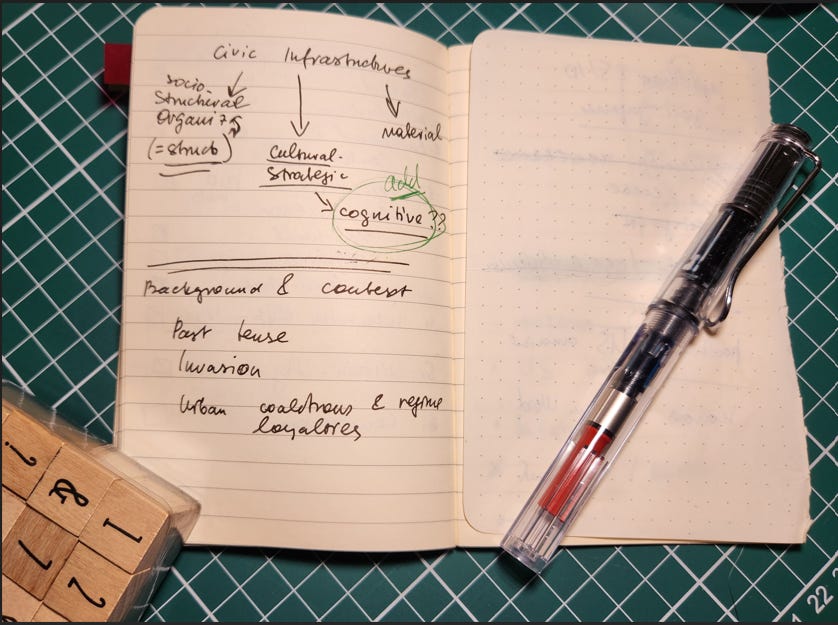
Another trick that often helps is going back to pen and paper. I wrote earlier about using charts and diagrams while developing my ERC Starting Grant proposal; this is one example of thinking on paper. Diagramming and mind-mapping can help clarify concepts and argument structure. But even simple bullet points, random lists, or alternative outlines — annotated with your own comments about what should or shouldn’t be included — can restart your thinking.
Freewriting
When I was a graduate student, I participated in an academic writing workshop that I found overall annoying and useless. But one thing they taught us there stuck with me forever — and since then it has been one of my favorite methods to get unstuck.
Freewriting — writing non-stop, whatever comes to mind, relevant or not, well-phrased or not — is often seen as a way to remove the fear of the blank page. For me, it’s also a way to refresh how I think about the issue, discover new ways to arrange ideas or examples, and notice unexpected connections. It feels good because you don’t have to use it, but you can edit it later.
Micro-goals
I really like this one, because if you don’t feel inspired or can’t find the flow, it’s still possible to do small things: paste in relevant references, or write a few bullet points about what could go into a particular section. Nothing much — low-stakes, no commitments. But still, you have something on paper! And maybe after that, you keep going and feel more inspired.
Reconnect with meaning
Finally, as someone who has written not only grant applications but also research plans for job applications, I know that writing on a deadline can start feeling like a chore — something you simply must complete. That mindset is detrimental to inspiration and to the quality of the writing itself.
What helps me then is going back to the roots: reminding myself why I started this project, idea, or career in the first place. We usually begin for meaningful reasons that can get lost in the grind of academic pressures. But it matters — it has meaning — and when inspiration runs dry, that’s where I return.
🗳️ A quick question for readers
This post is a little different from my usual ERC series — it’s about writing more generally. I’m curious to hear what you think:
Comments
Nothing yet. Say the first thing.
Sign in to join the conversation.