
Across the country, companies are racing to construct massive data centers to power AI systems, cloud computing, cryptocurrency operations, and other high-performance computing services.
But while developers are moving quickly, communities are increasingly pushing back in a bi-partisan manner.
New lawsuits are being filed against data center developers which leaves the fate of the industry in the hands of the courts.
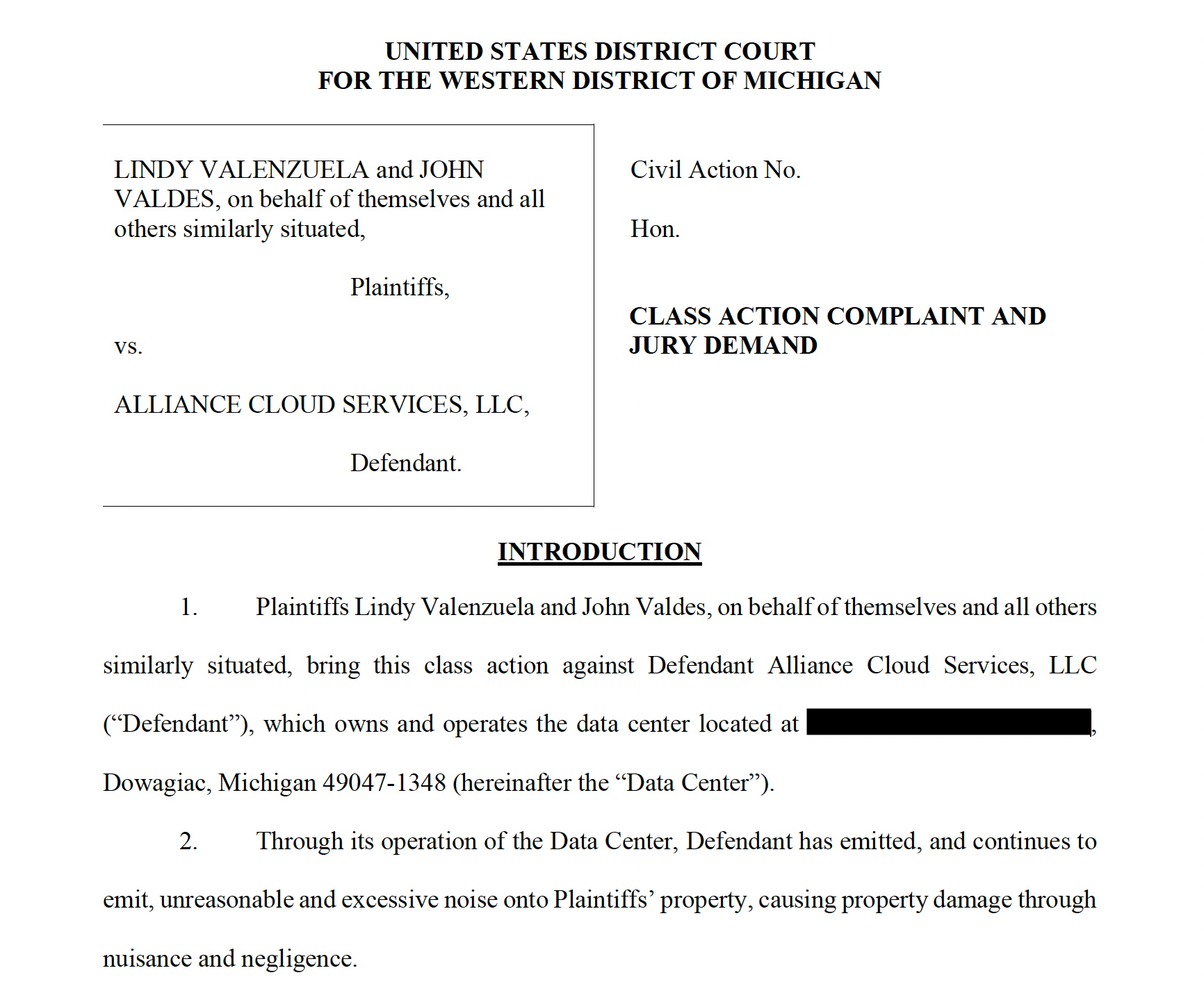
On May 26, 2026, residents in Dowagiac, Michigan filed a federal class action lawsuit against Alliance Cloud Services, the operator of a local data center that provides AI, cryptocurrency mining, and hosting services. The lawsuit alleges that Alliance Cloud Services, “has emitted, and continues to emit, unreasonable and excessive noise onto Plaintiffs’ property, causing property damage through nuisance and negligence.”
According to the complaint, plaintiffs claim the noise is generated by the facility’s cooling systems, HVAC equipment, and backup generators that operate around the clock. Accounts from residents are documented in the complaint with some saying they can no longer comfortably open their windows, spend time outdoors, or enjoy their properties due to the constant noise. Some claim the sound can even be heard over televisions inside their homes.
The lawsuit seeks class action status on behalf of homeowners and renters living within one mile of the facility. Plaintiffs further allege that Alliance Cloud, a foreign owned company, failed to take steps to reduce the noise the center generates.
This all comes at a time when the company is looking to dramatically expand the facility’s capacity from 30 megawatts to 340 megawatts, which according to the lawsuit, is an amount of electricity roughly equivalent to the power consumption of 200,000 to 300,000 homes. While this plays out in court, local officials have simultaneously adopted noise ordinances to protect residents.
The Dowagiac case is far from unique.
In Birmingham, Alabama, residents recently filed a class action lawsuit before the construction of a project began. They seek to stop construction because they argue the project never went through the proper public hearing process and fails to meet existing zoning rules.

Not only are lawsuits flooding in over noise complaints and improper processes, but from alleges failure to do environmental studies. Environmental organizations and local residents have filed lawsuits arguing that governments failed to properly evaluate environmental impacts before approving major data center developments.
As residents see elected officials allow these developments against the public’s wishes, communities are increasingly seeking judicial intervention.
The significance of these lawsuits extends far beyond any single community. The outcomes of these cases could shape the future of data center development nationwide.
Courts may ultimately be asked to decide what level of environmental review is required, what constitutes an unreasonable nuisance, how much authority local governments have over these projects, and what obligations data center owners have to surrounding communities. Depending on court opinions, projects could either be green-lit across the nation or halted altogether.
The challenge is that these questions are unlikely to be resolved anytime soon. Major lawsuits often take years to move through trial courts and appeals. By the time definitive legal precedents are established, many of the facilities at the center of these disputes may already be built and operating.
For now, communities, developers, utilities, and policymakers are navigating largely uncharted territory. The AI boom is moving faster than the legal framework governing it.
In fact, we’ve seen this many times before. Government often pushes through policy without fully understanding the health and safety impacts until it’s too late to reverse course. This happened with mass fluoridation of public drinking water and forced flammability standards. As the legality of data centers is questioned in court, we can still use the tools at our disposal - elections, recalls, public hearings, and advocacy for stricter laws.
No posts
Comments
Nothing yet. Say the first thing.
Sign in to join the conversation.