
Hello dear readers,
Here goes the March newsletter! I’ve been obsessed with illustration, recipes, and food history long before I started this Substack: one direct result of that obsession is my kids’ book Tasty Tales, nominated for the Week Junior Book Awards and a UK Literacy Award. I made it because I couldn’t stop thinking about the origins of ingredients and the things we take completely for granted.
Like this: there are over 5,000 potato varieties in the world, and most of us eat maybe five. Five! And I say this as a Dutch person, which should be embarrassing as the Netherlands is one of the world’s great potato nations. Van Gogh thought so. We have the Bintje for frying, the Eigenheimer for stamppot, the Nicola if you want something firm enough to hold up in a salad. And yet most of us just grab whatever’s on offer at the Albert Heijn supermarket that week. No shade. (Well, nightshade.)
Meanwhile in the Andes, farmers grow purple potatoes, yellow potatoes, potatoes with names that sound like poetry: Papa Amarilla, Huayro, Peruanita. And here I am back home in Gouda, back from my Chilean trip (if you read last month’s dumpling newsletter, you know), thinking about how this tuber traveled from the Andes to become one of the most consequential crops in human history.
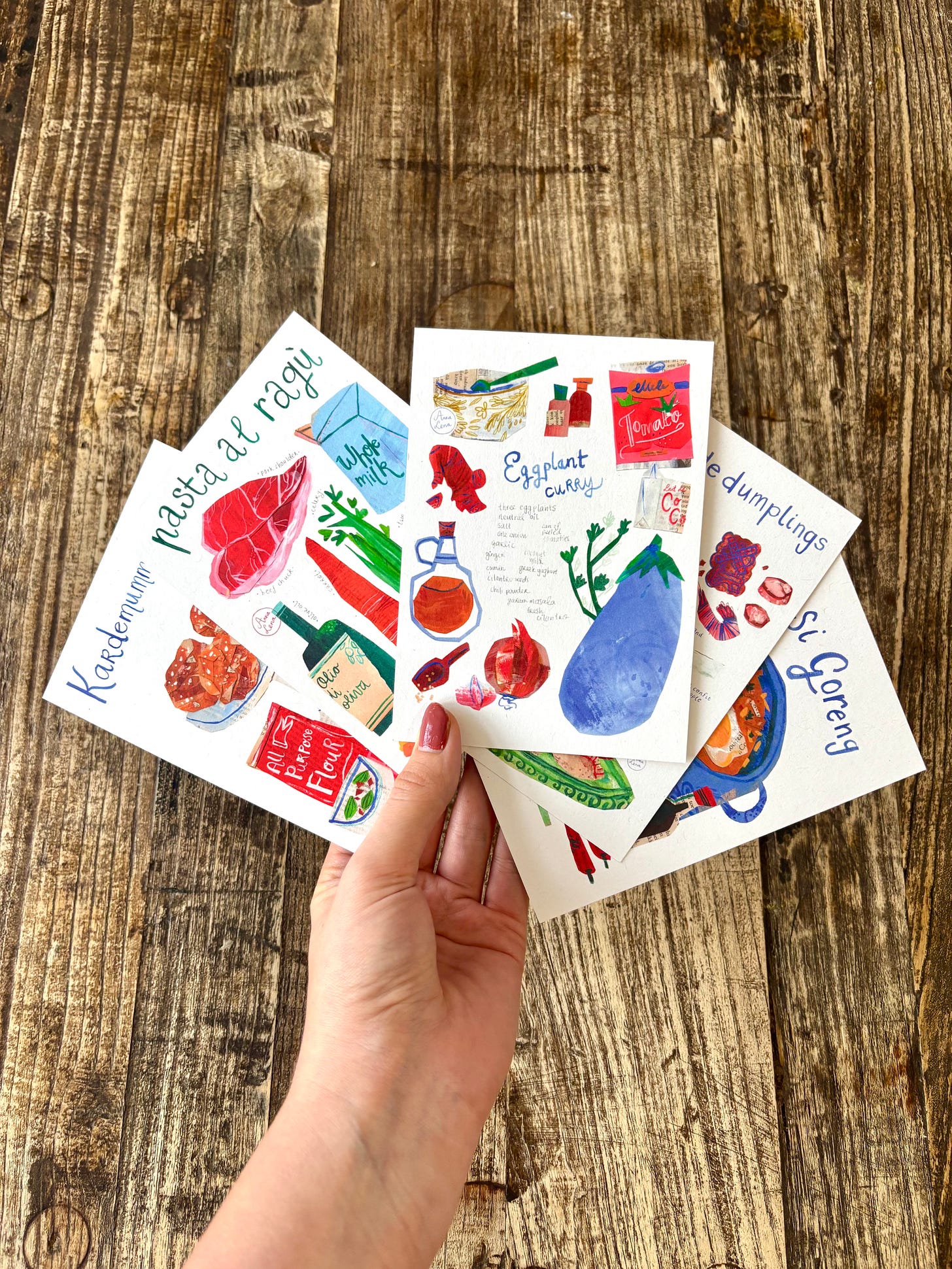
Before I take an info-dive with you, I wanted to mention that I’ve just updated a new fun thing on my Etsy shop! You can now get illustrated recipe postcards in combination with my hand-illustrated mini cookbook “This Better Pan Out.” I also offer commissions for illustrated family recipes.
If you want to get creative yourself, check out my online course in Floral Collage Illustration! It may be just what you need to feel like a person in a world that’s gone bonkers: make stuff! Cook a dinner, collage a flower, and invite a friend to go on an errand.
Food systems have always been shaped by the powerful: colonial land grabs, trade monopolies, governments deciding whose hunger matters. What’s changed is the visibility. Food is never just food. It is policy, power, and politics made edible. There's a word for the alternative: food sovereignty, the idea that people should have the right to define their own food systems and grow what actually feeds them. Easy to ignore when shelves are full, but impossible to ignore when the powerful make it impossible to ignore.
Look at coffee in 2025. Prices spiked 33%, hitting a record high of $8.41 per pound by July. Climate disasters in Brazil and Vietnam were already damaging harvests, then Trump imposed a 50% tariff on Brazilian imports. The US government collected an extra $1.5 billion in tariffs on food and agriculture in just four months, a 647% increase over the year before. By November, Trump reversed course after Democrats swept off-year elections on economic anger and the White House rebranded the retreat as a pivot to affordability. Coffee was eventually exempted, but Brazilian exports to the US had already collapsed 46% in a single month.
And the egg shortage? In France, shelves were empty at the start of 2026, with out-of-stock rates hitting 18%, nine times the norm. Across the EU, prices are 50-60% higher than a year before. Not scarcity, not some abstract market force: bird flu tearing through a system that packed millions of birds into facilities where disease could spread like wildfire. You see the effects of monoculture plus a single point of failure, because the whole thing collapses.
In Gaza, famine was officially confirmed in August 2025, the first time in the Middle East on record, with over 500,000 people in catastrophic food insecurity and 98% of cropland destroyed. In Sudan, 21 million people face acute hunger driven by siege and conflict. Nearly 300 million people faced food insecurity globally in 2024. The broligarch with the tariff pen and the general with the siege strategy are using different tools toward the same end: food is leverage, just as much as scarcity is power.
What about potatoes? Their story will feel familiar, and history shows exactly how high the stakes can get. I came up with a recipe that might appease your rage at the state of the world just a bit. But once you’ve settled your stomach, there are things you can (and should) actually do. Read on!
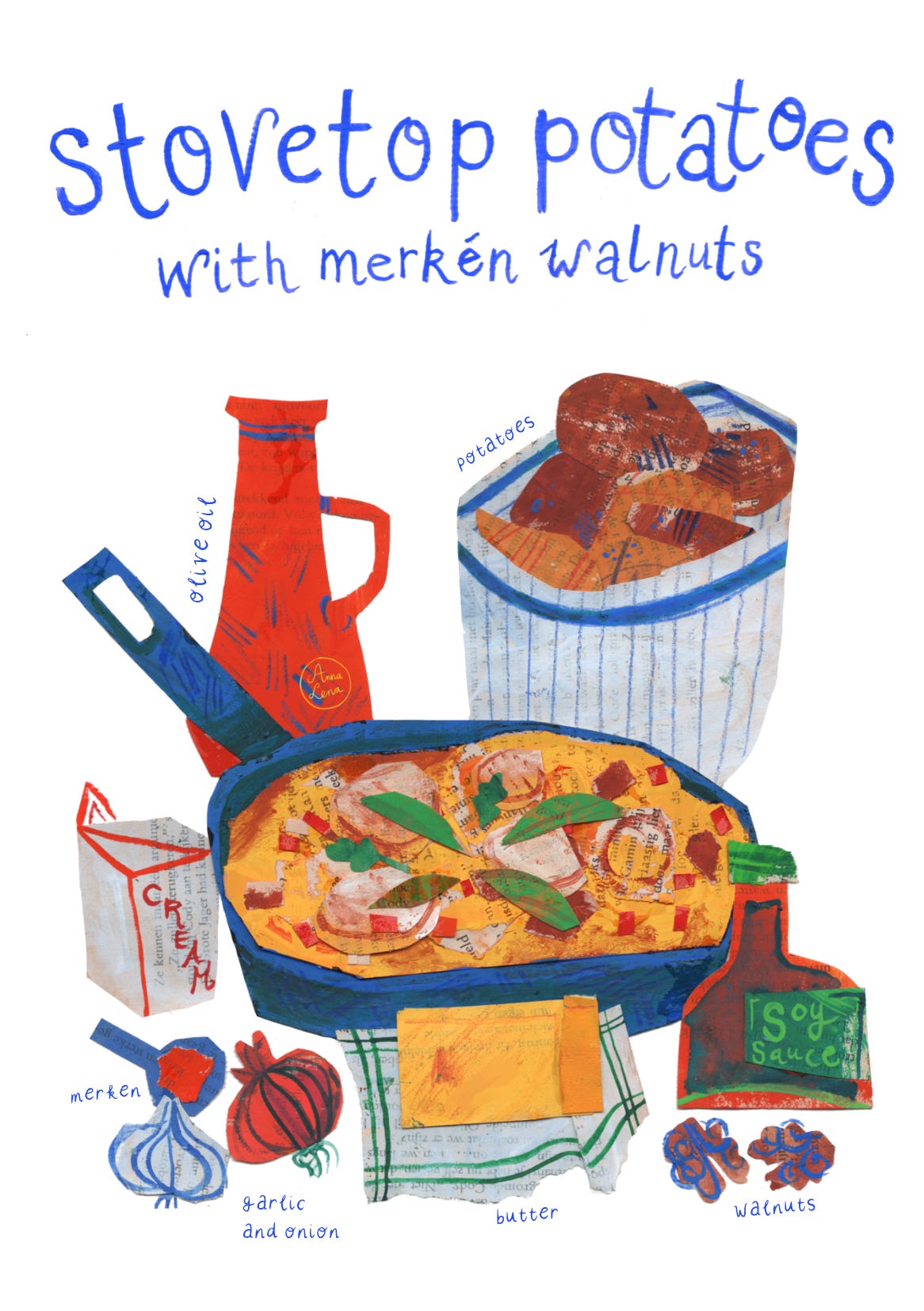
Serves 6
For the walnut mixture
200g walnuts, roughly chopped
2 tbsp olive oil
1 medium onion, finely diced
4 cloves garlic, minced
2 tsp merkén (spicy, start with 1 tsp if you’re cautious)
1 tsp cumin
3 tbsp tomato paste
2 tbsp soy sauce
120ml vegetable stock
Salt and pepper to taste
For the gratin
1.1kg potatoes, mixed varieties if possible
420ml cream
2 cloves garlic, finely grated
3 tbsp butter
1 tbsp salt
Black pepper
100g grated Manchego
For garnish
1 red bell pepper, diced
Fresh cilantro
Sliced avocado
Pickled red onions (slice 1 red onion, pour over ½ cup vinegar + 1 tsp sugar + pinch of salt, leave 20 minutes)
Steps
Preheat the oven to 200°C (400°F).
Slice your potatoes very thinly, about 2-3mm, with your sharpest knife. Be careful!
Toast the walnuts in olive oil in a large, cast-iron skillet over medium heat for 3-4 minutes until fragrant and slightly darkened. Add the onion and cook until soft, about 5 minutes, then add the garlic and cook 1 minute more. Add the merkén and cumin directly to the skillet and stir for 30 seconds… your kitchen should smell incredible. Merkén is smoky and genuinely spicy, so taste before adding all of it at once if you’re not into heat. Add the tomato paste, soy sauce, and stock. Simmer for 5-7 minutes until thick and saucy. Remove from the pan, keep in a bowl on the side, you’re needing it for the potatoes next.
Once your oven is hot, toss 1/3 of the potato slices in olive oil and a pinch of salt and spread them on a baking sheet with space between each slice. Roast for about 20 minutes or until golden at the edges, take them out once they start to look this way. These go on top of your gratin at the end.
In the same skillet you used earlier, combine the cream, grated garlic, 1 tbsp butter, salt, and black pepper. Bring to a simmer, then turn off the heat and steep for 5 minutes. Your cream will turn slightly reddish from the merken!
Add the remaining 2/3 of the potato slices to the cream and spread into an even layer. You want the cream just at the surface of the potatoes, a little more if needed, but resist the urge to drown them. Keep a spatula moving across the bottom every couple of minutes: this is not a step to skip.
When the potatoes have softened and the cream has thickened, spread the walnut mixture over the top. Toss the roasted potato slices with the diced bell pepper and arrange on top. Cover everything with Manchego. (My favorite part.)
Transfer to the oven and bake uncovered for 20-25 minutes until golden and bubbling.
Rest for 10 minutes before serving. Top with fresh cilantro, pickled red onions, and sliced avocado.
Notes: Using mixed potato varieties isn’t just pretty, it’s a small act of hyping up biodiversity. Ask at your farmers market what heirloom varieties they have. Waxy ones hold their shape, floury ones soften more into the cream. In a gratin, that’s a feature not a bug: you get layers with different textures, just check for doneness before pulling it out. The pickled onions cut through the richness and are, genuinely, the whole point.
Thanks for reading The Illustrated Kitchen! This post is public so feel free to share it.
The potato traveled from the Andes to feed the world, and somewhere along the way we narrowed it to a monoculture, let a famine kill a million people while food was being exported from the country, and handed seed sovereignty to a handful of corporations. None of that was bad luck. It was policy: made by people with power, and reversible by people with power. I wrote A LOT more on this history in the paid section of this newsletter, which is also how you can support what I do!
The rest of this story is for paid subscribers: the full historical and political deepdive, behind-the-scenes collage process, a downloadable illustrated goodie, and studio notes on the books and references behind this research.
And fun facts. Illustrated. BOOM.
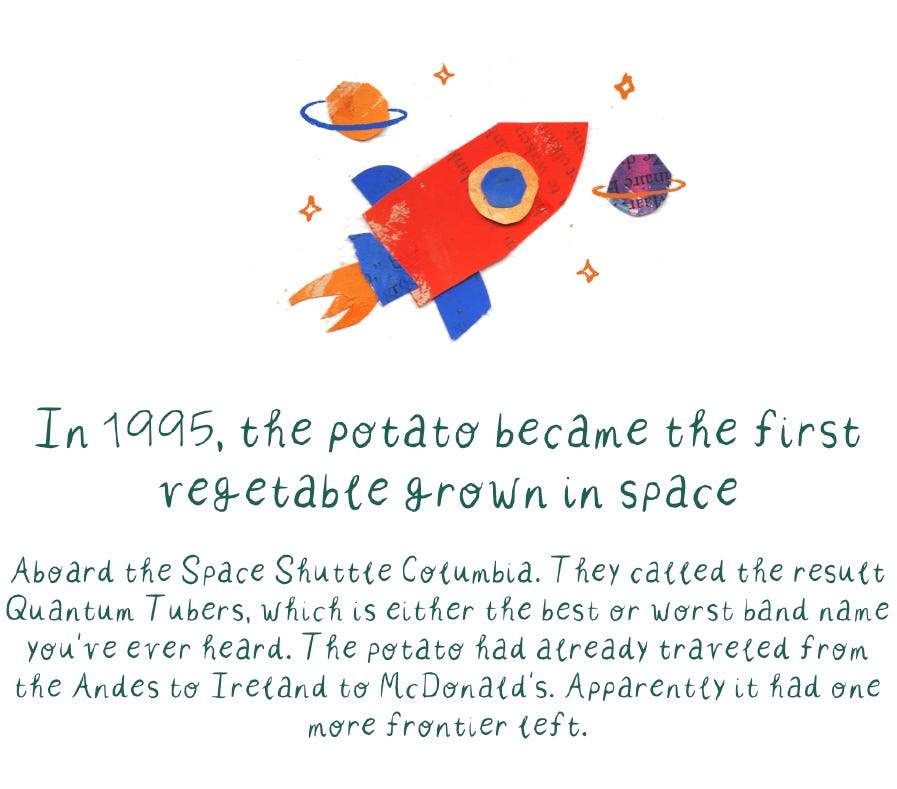
Paid subscribers get all of that every month, plus a year-end illustrated cookbook with all 12 recipes if you’re a founding member. It’s the price of a good baked good a month, and you’re very welcome to try it.
Want more? Mini cookbook This Better Pan Out → Get it here Recipe prints and kitchen goods → annalenamakes.etsy.com Floral Collage Course → Start creating Kids’ food history books → Browse books
If you can swing a paid subscription, it means I can say yes to fewer commercial projects and yes to more time drawing water cooperatives and researching farming systems. But free subscribers are just as valued, because the recipe artwork will always be for everyone!
Whatever feels right, I’m glad you’re here reading about food justice and making potato gratin with me.
x, Anna Lena
Comments
Nothing yet. Say the first thing.
Sign in to join the conversation.