
Hello, lovely readers!
Choosing this month’s recipe was harder than usual, while new book pitches and client work has been keeping me busy, which left precious little headspace for creative decisions. But I got there in the end, and I think it was worth the wait. (The wait was just for me and my own impatience. You got it pronto.)
While I had you in mind, I also updated my portfolio, which now brings together all my children’s nonfiction and food illustration work in one place. Take a look if you’re curious: www.annalena.nl/portfolio
As for the recipe: the first time I encountered okonomiyaki, I was pregnant and on honeymoon in Canada, eating my way through the Richmond Night Market with very clear priorities. I wasn’t thinking much about food history that evening, mainly I was thinking about getting fed. It was only later, once the fog had lifted a little, that I started digging into the stories behind the dishes I’d been eating that night.
Which brings me to one of my favourite things about okonomiyaki: the name literally means “grill what you like,” and it means exactly that. There are infinite variations, shaped by region, season, and whatever happens to be in the kitchen. But underneath that flexibility is a more complicated history: one that involves American foreign policy, a city rebuilding itself from rubble, and a wheat agreement signed in Washington that most people have never heard of. I’ll get into all of that in the newsletter proper.
A dish rebuilt from the rubble
You probably know that Japan is a deeply rice-centric country, and has been for centuries. But here’s something you might not know: Japan’s relationship with wheat didn’t happen by accident. There was some… American involvement. And I’m not just talking about the atomic bombs.
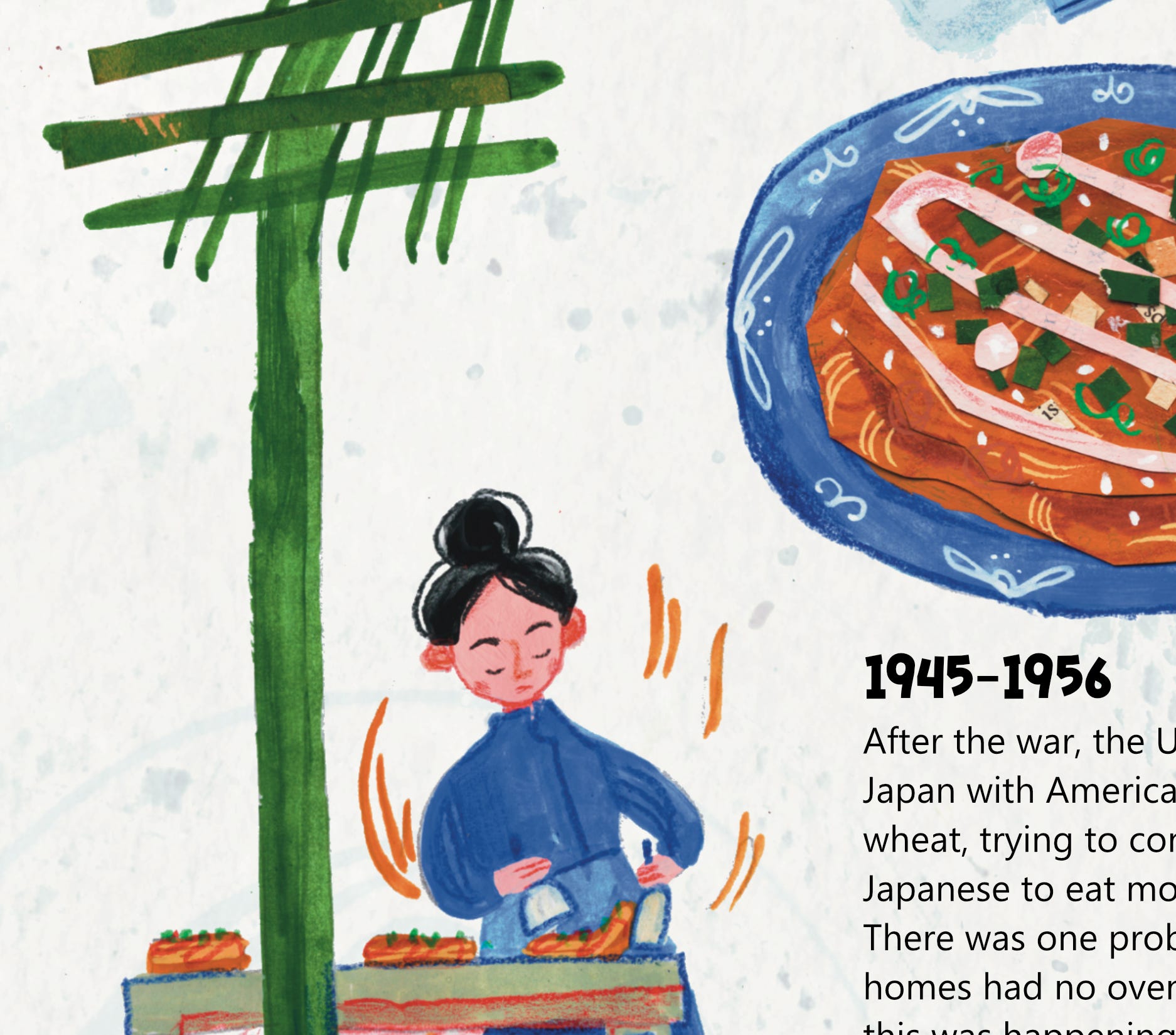
After the bombings of Hiroshima and Nagasaki, the US shipped enormous quantities of wheat flour into Japan as food aid, and quietly used school lunch programmes to reshape the eating habits of an entire generation. An entire generation of children grew up eating American-style bread rolls as their main school meal. The programme was so effective that the US kept supplying free wheat for it even after the occupation formally ended.
The result is dishes like okonomiyaki. In the years after the bombing of Hiroshima, when the city was still in ruins and ingredients were scarce, people gathered around hot griddles and made do with what they had. Flour, water, and whatever vegetables were available. Out of that hardship came one of Japan’s most beloved dishes. Okonomiyaki didn’t just feed people… for many, it was part of how the city held itself together.
That’s the beginning of the story. What issen yōshoku tells us about post-war Japan, why wheat conquered a rice nation, and what it means that the pancake in your pan is partly US foreign policy made edible: that’s waiting just below for paid subscribers.
Along with: the full illustrated food history timeline (sneak peek below 👇), the behind-the-scenes collage process, fun facts on other Japanese wheat dishes, and your illustrated recipe PDF.

It’s the price of a good baked good a month. And if you can swing it, it means I can say yes to fewer commercial projects and yes to more time researching farming systems and drawing food history timelines I absolutely did not need to make but could not stop myself from making.
For now though: recipe first.
Upgrade for full story & recipe card
Osaka-style okonomiyaki
Serves 4
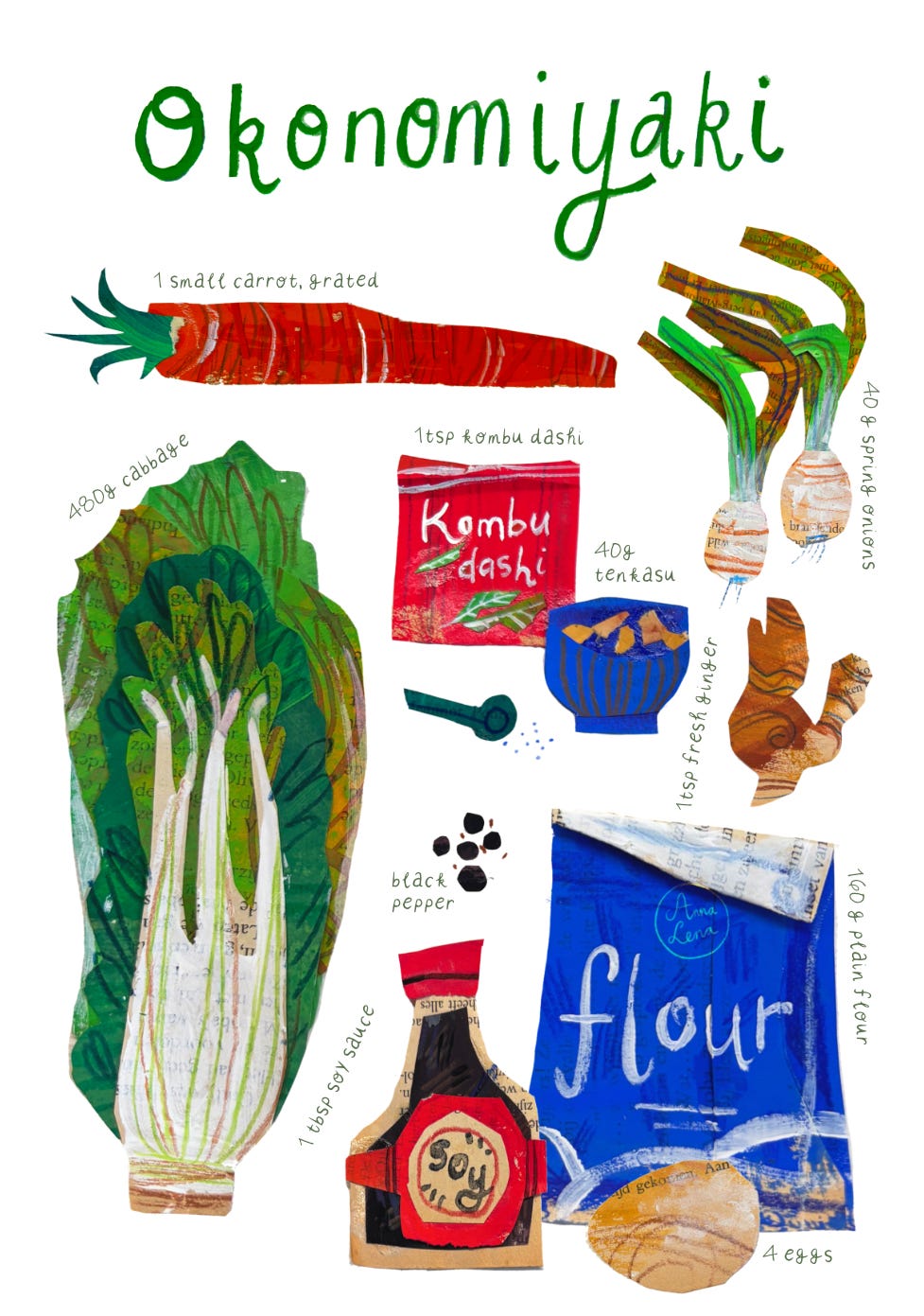
Ingredients
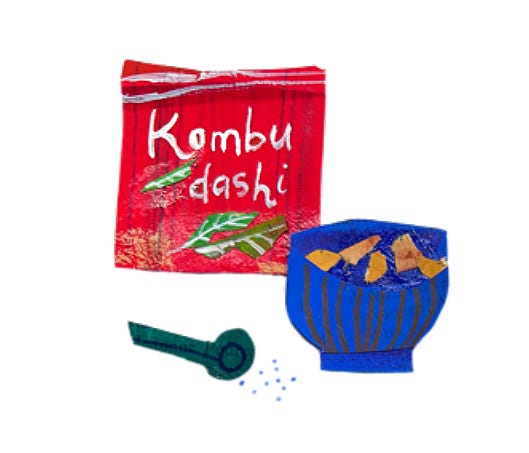
1 tsp kombu dashi powder
200 ml water
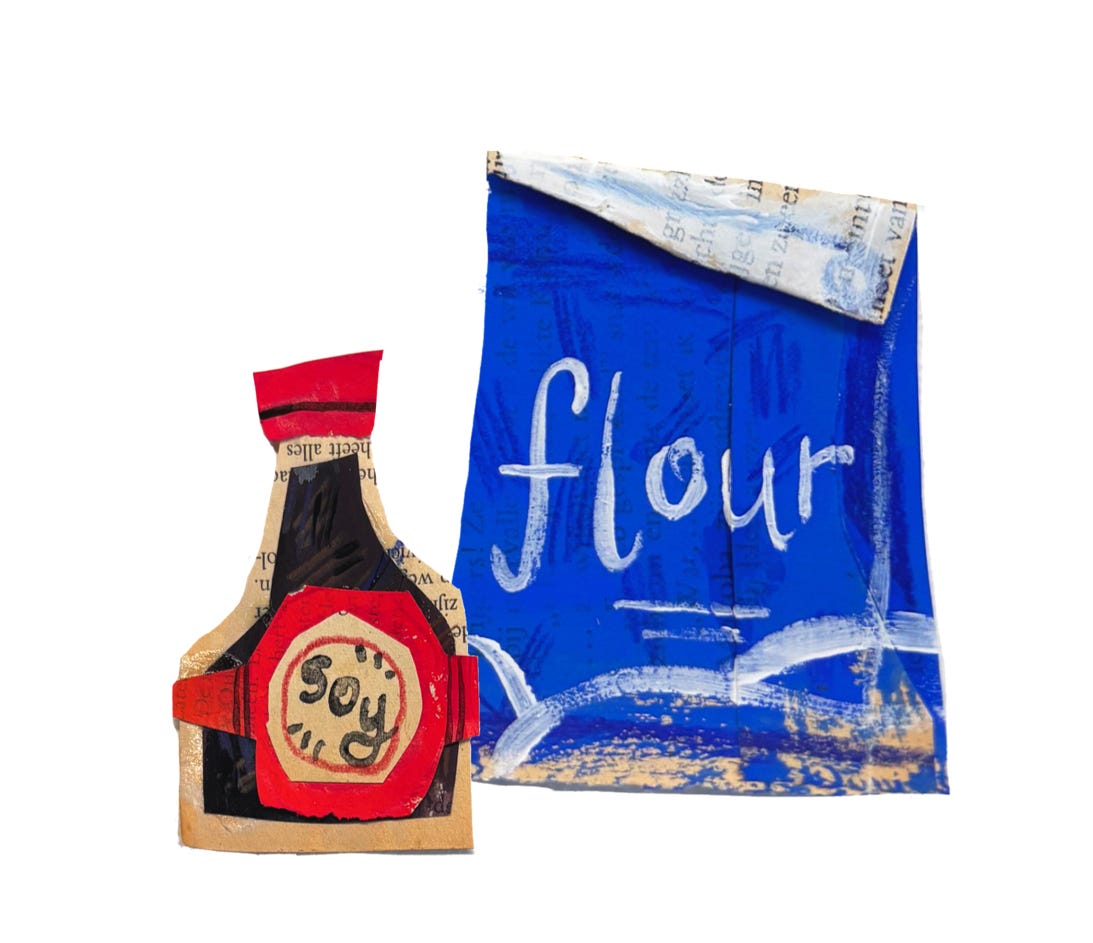
160 g plain flour
1 tbsp soy sauce
1 tsp fresh ginger, grated
black pepper
480 g cabbage, very finely shredded
40 g spring onions, thinly sliced, plus more to serve
40 g tenkasu (tempura bits)
1 small carrot, grated
4 eggs
neutral oil, for frying
To serve
okonomiyaki sauce or mayonnaise
sriracha
aonori (dried seaweed flakes)
pickled ginger (beni shoga)
Instructions
Dissolve the dashi powder into the water and let it sit for a moment: this is your stock, and it’s doing a lot of quiet work for you! Whisk the flour into the dashi until smooth, then stir in the soy sauce, ginger, and a very generous amount of black pepper.
Add the cabbage, spring onions, tenkasu, and carrot and fold everything through. The vegetables will look overwhelming relative to the batter, but trust it, as this is a cabbage pancake rather than a pancake with cabbage in it.
Divide the mixture into four equal portions. Just before you cook each one, crack a single egg into that portion and mix it in. This is important: you want each pancake to bind separately, not all at once.
Set a wide frying pan over medium heat and coat it lightly with oil. When the oil shimmers, add one portion and press it gently into a blob about 2 cm thick. Don’t touch it again! Cook for 4–5 minutes, until the edges have set and the underside is a deep, confident golden brown.
Flip the pancake using two spatulas — one to lift, one to guide — and cover the pan with a lid. Cook for another 3–4 minutes. The steam does something important here: it finishes the inside without drying out the outside. When you press the centre gently and it springs back, it’s done.
Repeat with the remaining three portions, wiping out the pan and adding fresh oil each time.
Serve immediately. Brush each pancake generously with okonomiyaki sauce or mayonnaise (or both), drizzle with sriracha, and scatter over spring onions, aonori, and a tangle of pickled ginger. Eat it while it’s hot!
And that’s the recipe. Make it on a slow weekend morning, eat it straight from the pan if you so desire, and think about everything that had to happen politically, historically, across an entire ocean, for this particular combination of ingredients to end up in your kitchen.
If you’re curious about that story, it’s right below.
There is more Illustrated Kitchen
The rest of this story is for paid subscribers: the full historical and political deepdive, behind-the-scenes collage process, a downloadable illustrated goodie, and studio notes on the books and references behind this research.
Paid subscribers get all of that every month, plus a year-end illustrated cookbook with all 12 recipes if you’re a founding member. It’s the price of a good baked good a month, and you’re very welcome to try it.
Want more? Mini cookbook This Better Pan Out → Get it here Recipe prints and kitchen goods → annalenamakes.etsy.com Floral Collage Course → Start creating Kids’ nonfiction books → Browse books
If you can swing a paid subscription, it means I can say yes to fewer commercial projects and yes to more time drawing water cooperatives and researching farming systems. But free subscribers are just as valued, because the recipe artwork will always be for everyone!
Until next time, when I share a new recipe and as always a story that will leave you thinking about it while you’re sharing it with family or friends.
Free or paid, you make this worth making.
Anna Lena
Comments
Nothing yet. Say the first thing.
Sign in to join the conversation.