
Following on from the previous post…
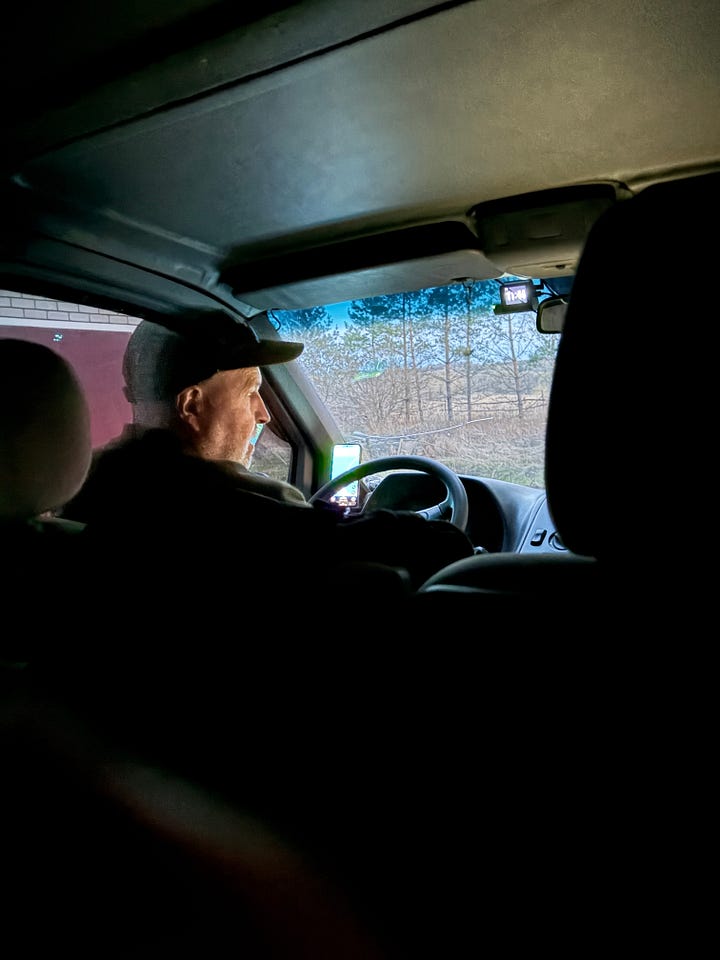
We’re still heading to the rural house currently occupied by the Company Sergeant Major and we are not quite lost in a field. We are pausing to take stock.
The serious thing is, you don’t have to be fully lost for there to be a problem. The roads are so bad that if you aren’t 100% certain where to proceed to, it can be best not to proceed, because you might get stuck in the mud – within Russian drone range. Part of Masha and Jack’s considerable experience is knowing when and how to take sensible precautions well before any crisis arises. Though as they are a classic double act, these precautions have to be accompanied by the Ukrainian frontline volunteer equivalent of sibling bickering.
We were told 4x4s were getting stuck, and to wait, but they also knew that the longer we waited the smaller the drone-free window of time would get. Jack decided to go for it because he knows the track, and Masha has full confidence in his driving so she agreed, but that doesn’t stop her from narrating her doubts and counter-arguments now. “Is it OK if I blame you [to 72nd Brigade], Jack? Normally I wouldn’t ask, but this time Anna’s here to interpret for you.”
Eventually Jack seriously scratches up Zhorzhik driving him under a tree – but we’re covered from drones, and the CSM is able to come get us in his 4x4. We’re staying overnight at his house for a barbecue.
While we still had phone signal, the poetry magazine Lincoln Review sent me the proof for my poem ‘foreign volunteers at the night checkpoint’, which is about foreign volunteers and checkpoint guards who are all knackered and want to go home (spoiler: they/we can’t). This provides me with some entertainment at least. I start mentally writing a poem entitled ‘We are Stuck in This Field’.

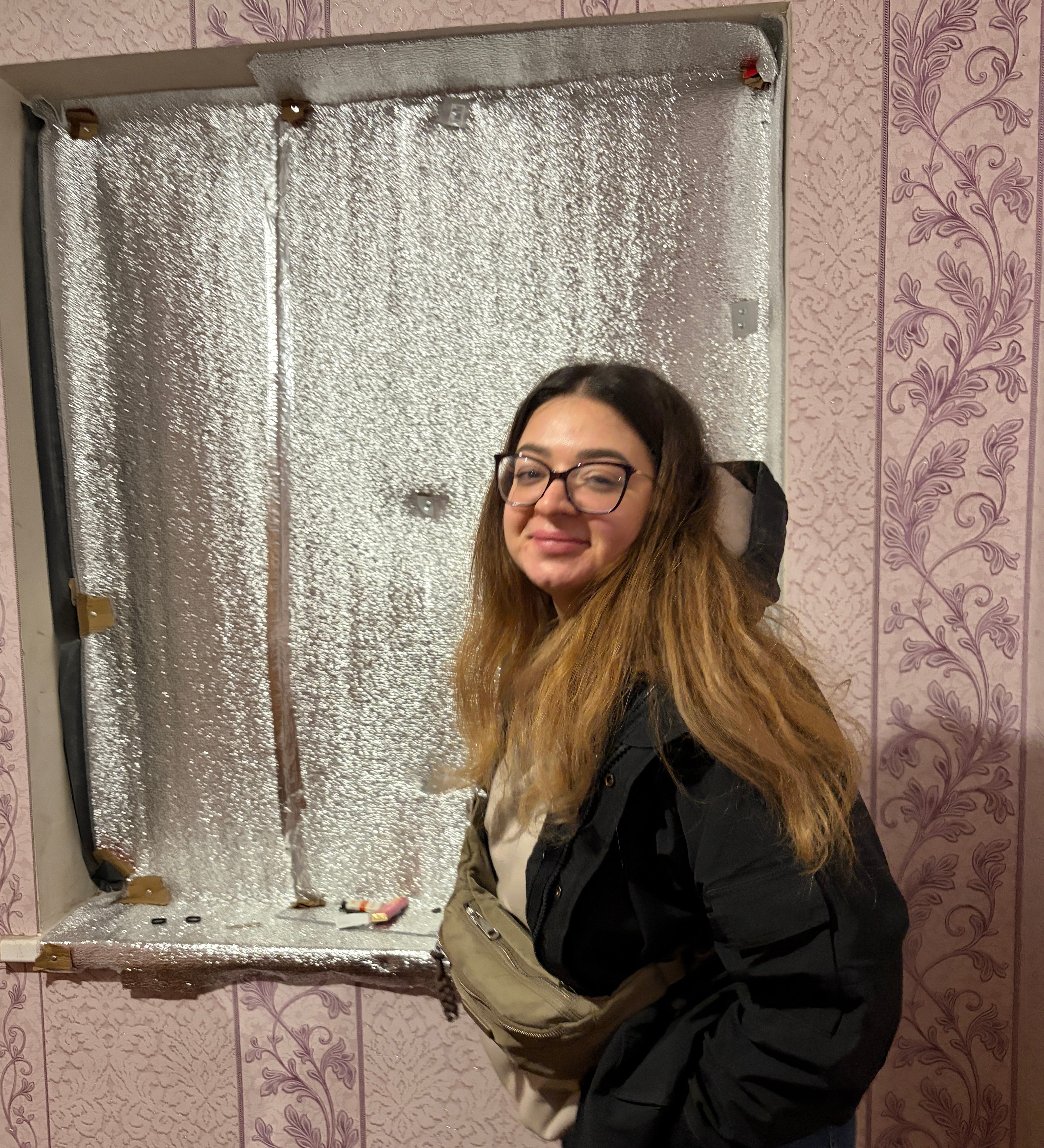
The CSM’s house is in unusually good condition. One interior pillar is wrapped in clingfilm because, it looks like, the owners were in the middle of grouting the tiles when they had to leave, but not only are the windows intact and a generator installed, but the rooms are well decorated. A family home. No running water, but you can’t have everything.
Unless everything is made of potatoes. We have all the potatoes, and barbecue meat. Masha stopped to buy some on the way but it turns out the lads – if that’s the term to use of a CSM and a deputy commander – already have some. We’re already full by the time the lads head outside to barbecue the meat with some brothers-in-arms. Then they come back in for a chat with Masha.
These two are from the far west of Ukraine and they talk fast. Sometimes I conduct a great interview and am myself fascinated to discover what it involves when I play back the recording afterwards, and that is clearly going to be the case here. It’s not that I don’t understand half of what they’re saying – it’s just that that half consists almost entirely of the word ‘blyad’, a general-purpose vulgar exclamation. It’s overused by most soldiers, but the CSM in particular is going for gold.
Fortunately Masha is on hand to keep things on topic. And, when necessary, summarise conversations for clarity.
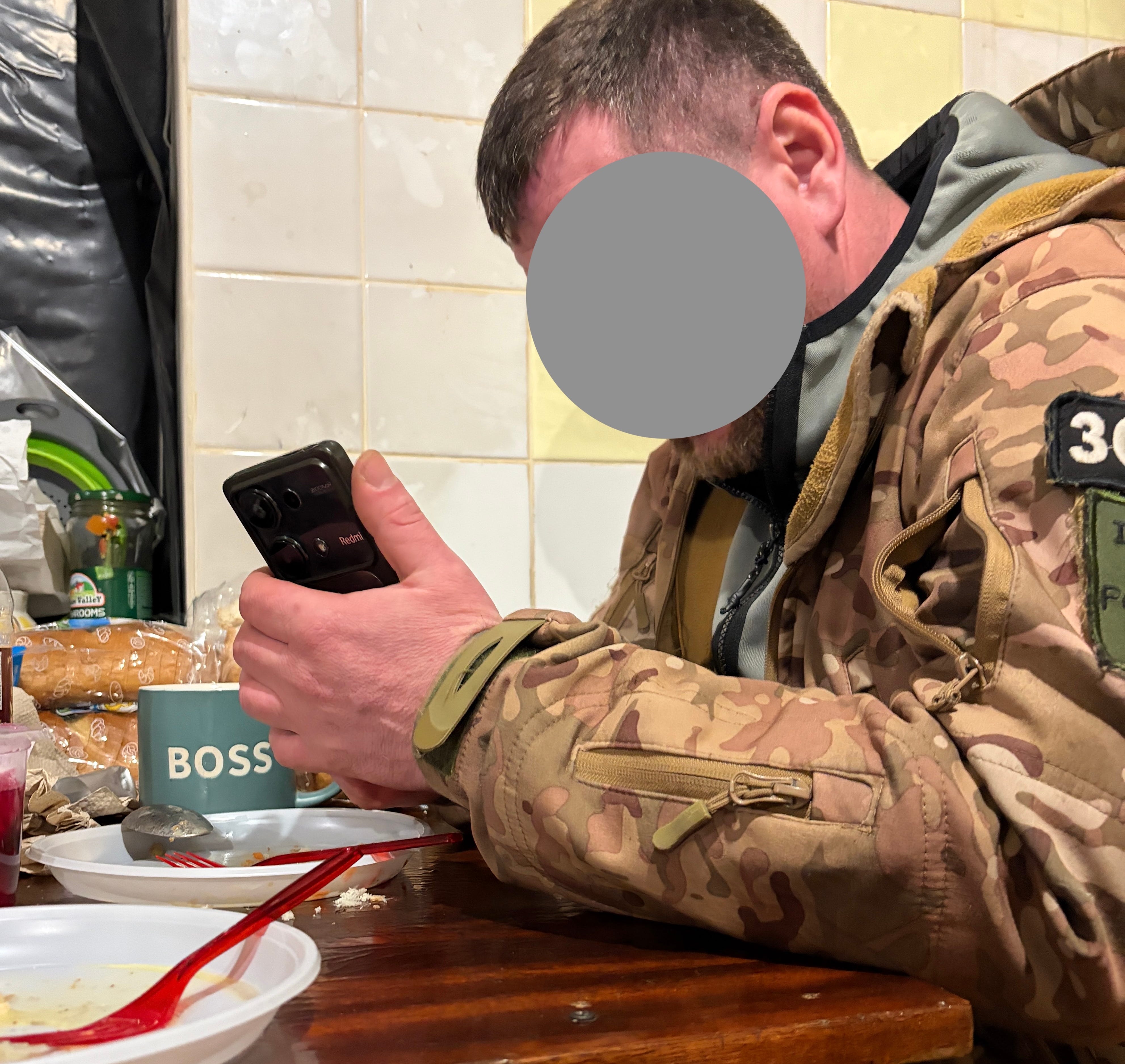
Masha: They’re talking about how to rotate guys out of the positions. It’s too dangerous to come out of the position [because of Russian FPV drones], so infantry just sit in the dugout and don’t go out. They only fight if Russians come to attack them. This has happened in the last six months.
It’s good, to be honest, because we don’t have a lot of infantry. In the current situation in Ukraine, you might have five infantry soldiers in the whole village. Meanwhile drone units work outside. We have many, many of them. They just look, hit, look, hit.
For example, 93rd Brigade, working in the Dobropillia direction, just live on the zero line, underground. Some of them get parcels from drones and they only go outside to get the food and water parcels. So for me it’s no surprise that the infantry don’t want to change position.
I also talked with 127th Brigade two weeks ago and they said that for the last two months none of their infantry have been killed in the Kharkiv region. And the guys are talking about how the Russians [don’t bother with] infantry either, because what can they do?
For our units and Russian units, the priority is to kill drone pilots, because they do the most important job. All infantry can do is sit underground, though it’s a different situation for assault units, I don’t know much about that.
What is your day like?
CSM: My day? A good day is when no one calls me! Especially at night. When someone calls at night, I immediate know there’s a fuckup.
Well.. I wake up, drink coffee, read 56 text messages. How many drones [have been spotted], where they’re going, some nonsense, drone reports, updates. I check everything. I memorise it so I don’t forget by evening. I read more messages about what needs to be done urgently. Go talk to the guys, hear what problems they have with vehicles. They mention spare parts. I call the service station, try to arrange repairs, because there are long queues.
And who will take the car in? Everyone is busy. Then the mechanics call, say ‘I have a slot tomorrow’, and I say, ‘What do you mean, tomorrow? I need it now.’ Some lads call and say they have a problem with the EW equipment, it’s stopped turning. I go check it, and something’s got jammed. We go into the forest, hook it to a tree, try to pull it out with a winch [like this one]. We’re standing there winding thirty metres of cable for two or three minutes. Eventually we fix it, go to a welder, repair it so it can be mounted again.
That’s just the morning. Then I realise I have to go to the service station in person because nobody is answering the phone. Everyone is busy. You have to go there and negotiate face to face. That’s just the morning.
I sit around keeping a logbook. They say the army is going paperless but you still fill out paperwork. Then people start calling saying I need to go here, or I need to go there. And I’m trying to figure out who goes where. One guy needs to go to pick up drones from air defence and asks how he’s getting there. I say you’re going on a horse at this rate.
There was a Range Rover somewhere but it’s already gone. The commander sent it somewhere. Then I remember we have another vehicle but it’s being repaired. I go to the service station to arrange repairs in person […] We spend hours there. They show us the bill and there’s a slight problem: we don’t have any money.
Then another call, about jammed brakes. I ask for a photo. They keep sending the wrong photo. I realise it’s a mess and drive there myself. We check the car, realise the brake caliper is stuck. We fix it so it can at least reach the service station. I call different service stations… and it just continues.
Jack: There’s always something going wrong [in armies]. But these guys deal with the top end of the extreme level.
Jack proceeds to tell me a lot of fascinating but unprintable details of life in the British army and police. Meanwhile the commander is showing Masha images of one of the two 72nd Brigade cars that have been destroyed in the last two days. There is a burnt corpse in the back.
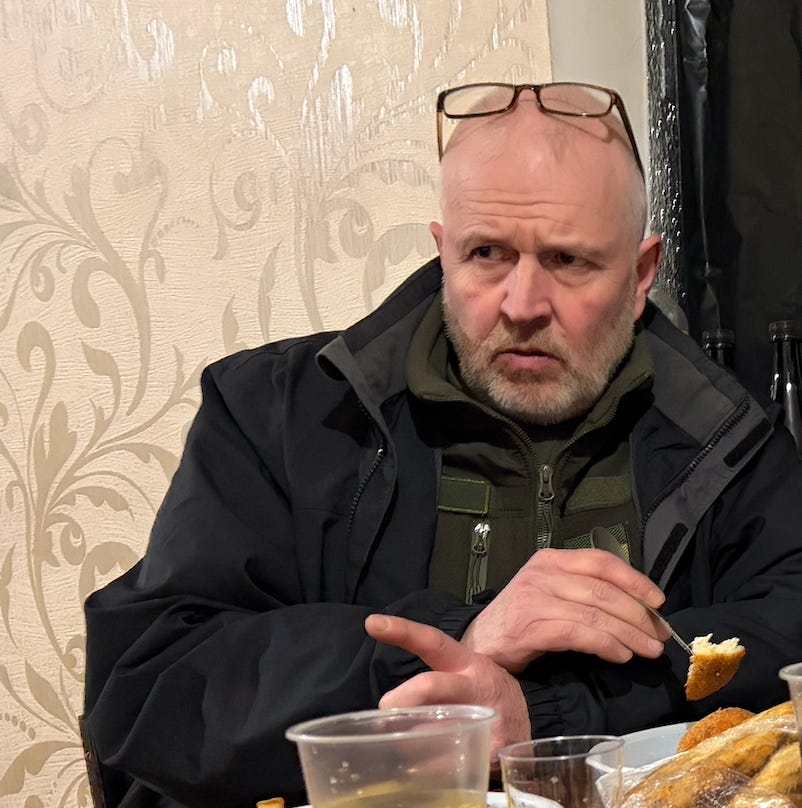
No serious conversation about a person’s job can be held without covering the most important topic: problems with management And that is a particularly important issue in a military context. In the Ukrainian army, some commanders have extensive education but no combat experience, while others like these two rose from the ranks of the infantry. The two groups don’t always get on. Likewise, people with higher education are often more likely to end up in drone units, but infantry are still needed. Ukraine is forced to use the resources it has, which means many common soldiers have a history of crime or other complex behaviour.
So officers like the CSM and the Deputy Commander have to form a bridge between those who are overeducated and lacking in experience, and those who lack education but have a lot of very colourful experience. I won’t go all into the details of what the officers said, but here’s one story from the Deputy Commander.
DC: I was platoon commander of a technical company and I worked alongside the lads. I always compare then and now… Then was better [sighs]. I was in the positions then, and now I’m a leader. When I was a soldier and worked with the others, it was easier. I didn’t have to do a lot of thinking, know a lot of things. I was just given a task, a shovel was put into my hand. And now things are a bit different, though I guess there are interesting moments.
I have experience working with units of the Shkval battalion [which is made up of former convicts]. I had some under my command. Top brass basically go, ‘Take them, whatever. They’re useless to society.’ They’re treated as outcasts. Some commanders really do take that approach. Others don’t.
Some [of the people with difficult pasts who join the army] are motivated. Some come to ‘redeem themselves before the motherland’. That’s the main reason for many.
In my case, these Shkval guys basically saved me. They’re all dead now, because higher command gives them tasks that are just impossible to carry out. ‘Hold the first, second, third, fourth defensive line,’ whatever. You can’t even understand how you’re supposed to do it.
But as far as I’m concerned, these people were the best. [In a difficult battlefield situation] they gave me the chance to regroup my forces, create combat tasks that were achievable. I’m grateful to them. I won’t say a single bad word about them. Whatever their flaws, they were still people. They held the line.
I remember hearing over the radio: ‘Commander, we need water, we need 10 medkits.’ I said, ‘Ten? What the hell are you doing with them?’ Someone next to me said, ‘There are casualties there.’ I said, ‘I can’t send ten, I’ve got six. I’m sending them now.’
Then the enemy showed up and started firing. I said, ‘Add four more.’ And they reported, ‘Commander, we don’t need your medkits any more – we’ve got theirs now, and they’re better.’
We realise that at midnight the ceasefire was officially over! Masha turns to me and says, ‘Oh no! A war’s started!’ This is the funniest thing anyone has ever said.
Masha: But [the CSM] said a month ago that he doesn’t know what he will do when the war is over. He said he doesn’t want it to end. A lot of people think that way. They aren’t even afraid to say it. I don’t know what I’m going to do either.
Me: Me too, at this point…
We retire to bed, Masha and I on camp beds set up in the CSM’s room – an immaculate pink haven containing the two beds, a desk, a battalion flag and a rifle which he warns us not to touch (I had not intended to). The business of war requires two staplers, four pen pots, five fat A4 files and a large capitalised threat.
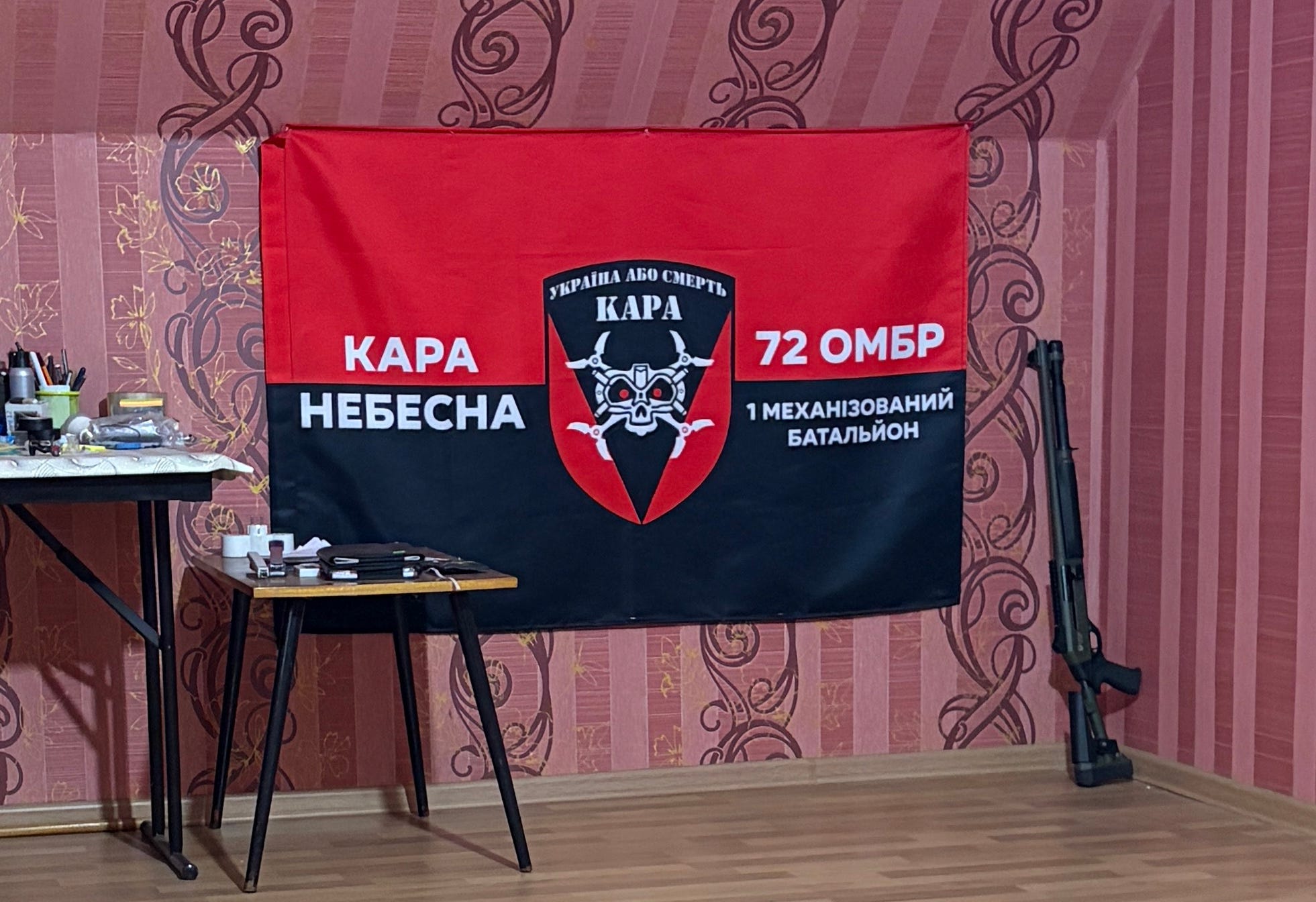
We’ve lucked out: there are more men than there are houses, and there were plenty of slippers near the front door, belonging to men hoping to come back to them. Some nights the house is full of soldiers checking, washing and repairing their kit for the next rotation. But tonight, most of the unit is at their forward positions.
I’m not very good at sleeping in new places. So I’m awake when the CSM comes in in the middle of the night and settles down on a pallet he’s made for himself in a corner. Why is he still on his damn phone?!
Another car has been destroyed.
Donations are welcomed at at Jack’s buymeacoffee page or Masha’s PayPal at kabanetsmariya@gmail.com. All money goes on supplies for the front line, or the logistics to get them there.
Comments
Nothing yet. Say the first thing.
Sign in to join the conversation.