
कराग्रे वसते लक्ष्मीः करमध्ये सरस्वती ।
करमूले तु गोविन्दः प्रभाते करदर्शनम् ॥
Karaagre Vasate LakshmiH Karamadhye Sarasvatii |
Karamuule Tu GovindaH Prabhaate Karadarshanam.
0:00
-0:19
On the tips of the hands resides Lakṣmī, the Goddess of Wealth; in the middle of the hands resides Sarasvatī, the Goddess of Knowledge; and at the base of the hands resides Govinda, Lord Vishnu. Therefore, one should look at one’s hands in the morning and remember them.
At first reading, this can be confusing. How can gods and goddesses reside in our hands? Yet even at a simple level, we can sense that the shloka is telling us that our hands are precious, even divine.
When, we understand these names are symbols of knowledge, wealth, and sustenance, then, we begin to realize that these are every day affirmations. we are affirming to ourselves that we have all the resources to participate and shape our life in our own hands.
Is it not through our hands that we hold, connect, care, heal, serve, bless, exchange, give, receive, create, and make things happen?
If Sarasvatī, Lakṣmī, and Govinda point toward the resources already in our hands, biology points to something just as remarkable—how much is actually contained there.
An anatomist or therapist might remind us that each hand contains 27 bones, along with many joints, muscles, tendons, ligaments, and nerves that make its extraordinary range and precision of movement possible.
So keep them healthy by moving every finger and every joint.
Bend, Stretch, Open, Close, Rotate, and Strengthen
Regular finger and hand movements can help maintain mobility, dexterity, and range of motion.
Neuroscience gives us another fascinating perspective.
Our hands perform extraordinarily precise movements. Think of everything they allow us to do—write, paint, sew, sculpt, cook, garden, play an instrument, type, grasp, and create.
Because of the rich sensory information and fine motor control required for these activities, the hands and fingers have detailed representation within the sensory and motor regions of the brain.
The hands and the brain are in constant conversation.
Engaging in varied hand activities—arts, crafts, cooking, gardening, music, or other skilled movements—continues to challenge and engage these sensory-motor networks.
There are also contemplative practices that intentionally combine the hands, sound, attention, and breath.
For example, Kirtan Kriya uses the sounds Sa-Ta-Na-Ma together with sequential thumb-to-fingertip movements, meditation, and visualization. Studies of the complete practice have explored possible benefits for stress, memory, and psychological well-being.
Alzheimer Prevention - Sa Ta Na Ma
This shloka came back to me as I was writing about mudras—hand gestures used in yoga and contemplative practices.
In the traditional science of mudras, each finger is associated with one of the five elements:
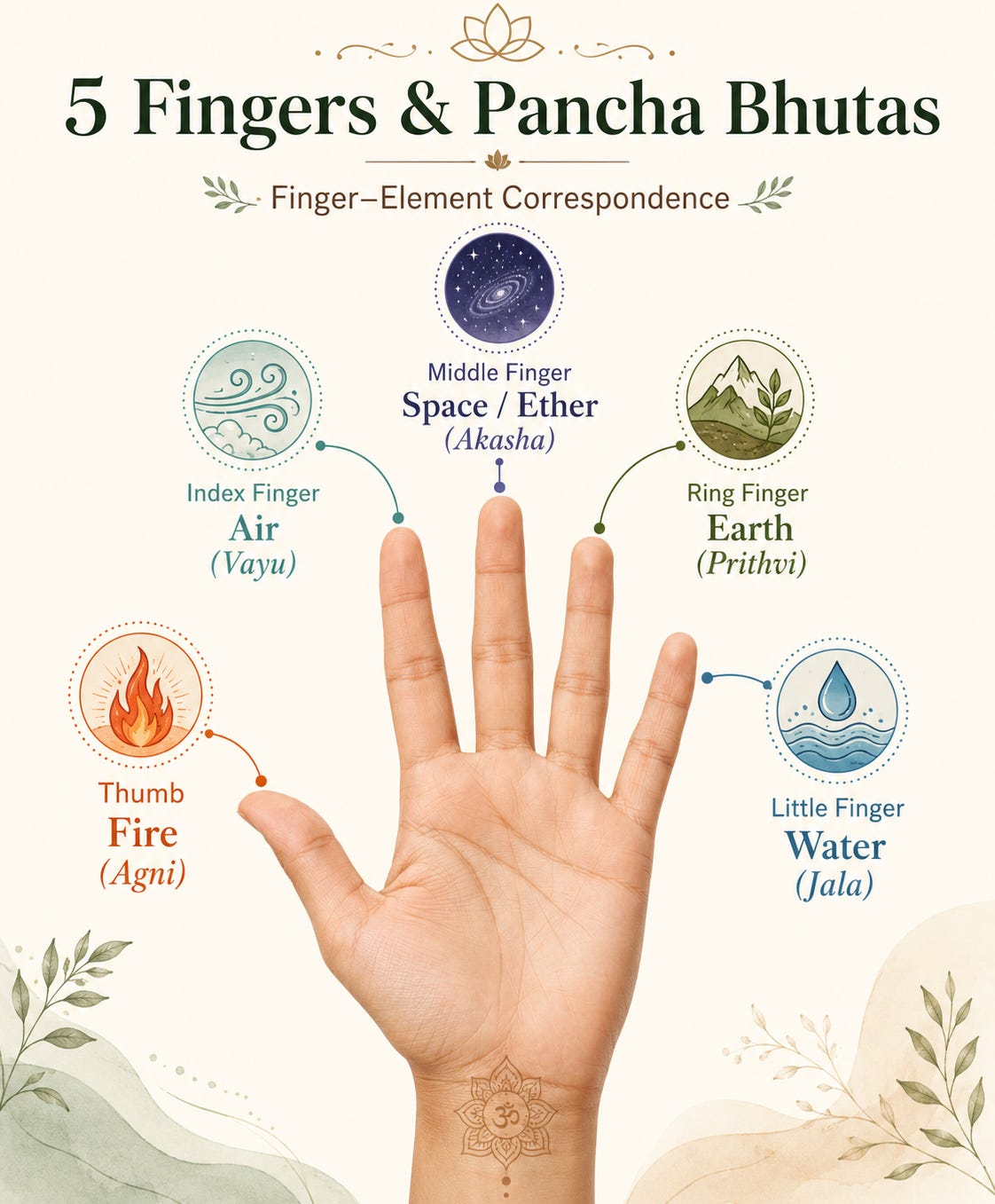
Thumb — Fire
Index finger — Air
Middle finger — Space
Ring finger — Earth
Little finger — Water
By bringing certain fingers together, opening others, or forming gestures with one or both hands, we create a particular mudra—a seal or gesture that can become an anchor for attention.
We add the breath.
We notice the pressure where the fingers touch. We notice warmth, sensation, and stillness. Then we pause and observe the mind.
Attention changes the quality of the movement.
That is how a physical gesture can become an object of contemplation and a mindful practice.
The movement is no longer only about mobility or dexterity. It becomes an opportunity for attention, awareness, and quietening.
Yoga, science, contemplative practices, devotional traditions, and biology may approach the hands differently, but they all invite us to recognize something we already know: our hands are precious. Now, can we care for them a little more every day, a bit more lovingly?
if time permits, give one of the practices below a try.
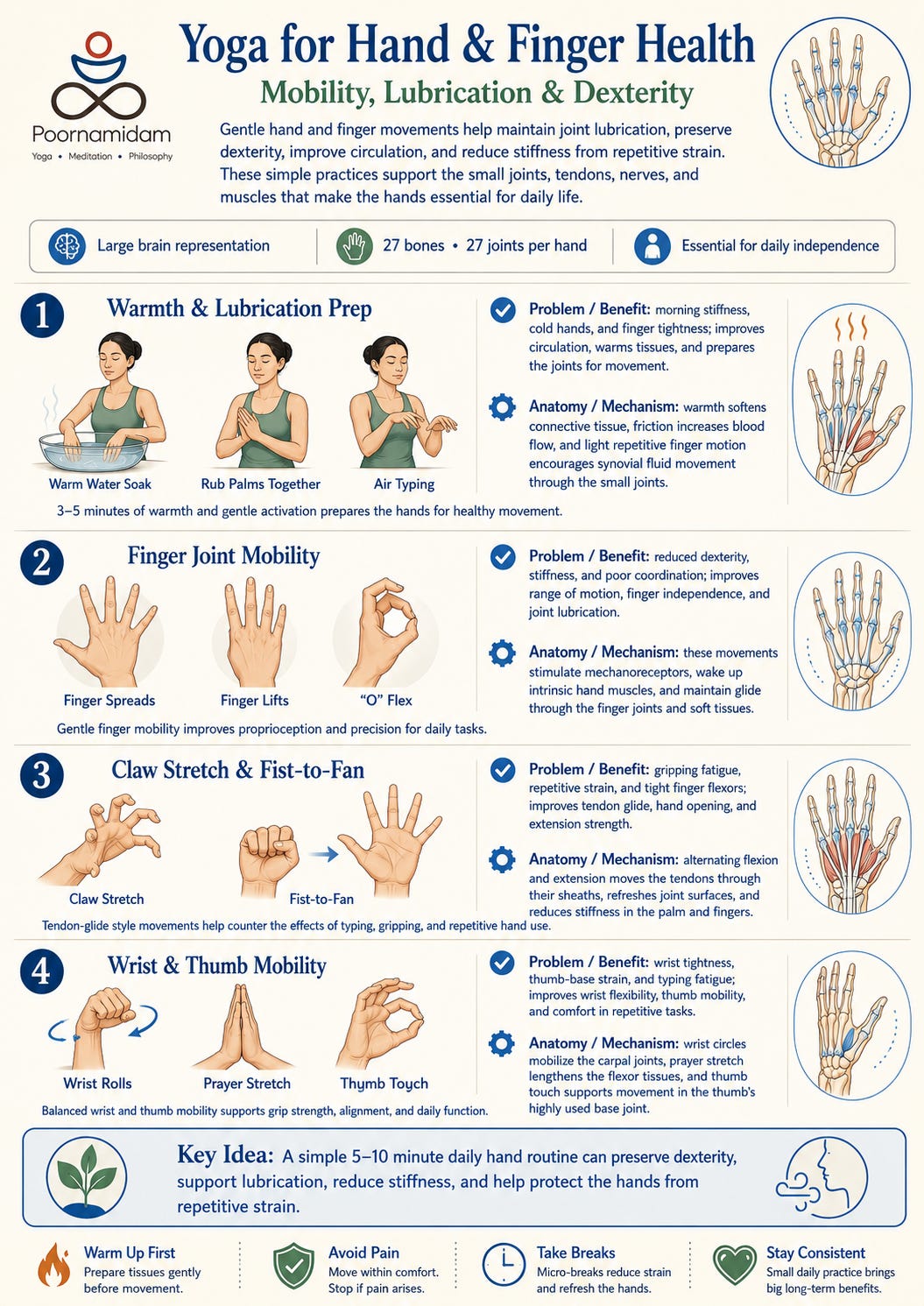
These hands serve us every day.
Perhaps the shloka is simply asking us not to forget how precious they are.
No posts
Comments
Nothing yet. Say the first thing.
Sign in to join the conversation.