
In the Bṛhadāraṇyaka Upaniṣad, King Janaka asks Sage Yajnavalkya a series of questions about the light by which a human being lives, acts, and finds direction.
King Janaka asks:
“O revered sage, what is the light that illumines, awakens, and impels a person to perform actions?”
Sage Yajnavalkya replies:
“The sun, O King. It is by the light of the sun that a person sits, moves about, performs work, and returns.”
Janaka continues:
“But when the sun has set, what light helps the person?”
“The moon,” replies the sage. “When the sun has set, the moon becomes the person’s light.”
“And when neither the sun nor the moon is present?”
“Fire becomes the light. By the light of fire, one sits, moves, works, goes out, and returns.”
“But when there is no sun, no moon, and no fire, what then is the light?”
“Speech, indeed, becomes the light. Even when we cannot see our own hand in the darkness, we can hear a voice and move toward its sound.”
Janaka asks once more:
“O revered sage, when the sun has set, the moon is absent, fire is extinguished, and there is no speech, what then is the light?”
Yajnavalkya answers:
“The Self, indeed, is one’s light, O King. By the light of the Self, one sits, moves about, performs work, goes out, and returns.”
याज्ञवल्क्य किंज्योतिरयं पुरुष इति; आदित्यज्योतिः सम्राडिति होवाच, आदित्येनैवायं ज्योतिषास्ते पल्ययते कर्म कुरुते विपल्येतीति; एवमेवैतद्याज्ञवल्क्य ॥ २ ॥
अस्तमित आदित्ये याज्ञवल्क्य किंज्योतिरेवायं पुरुष इति; चन्द्रमा एवास्य ज्योतिर्भवतीति, चन्द्रमसैवायं ज्योतिषास्ते पल्ययते कर्म कुरुते विपल्येतीति; एवमेवैतद्याज्ञवल्क्य ॥ ३ ॥
अस्तमित आदित्ये याज्ञवल्क्य, चन्द्रमस्यस्तमिते किंज्योतिरेवायं पुरुष इति; अग्निरेवास्य ज्योतिर्भवति, अग्निनैवायं ज्योतिषास्ते पल्ययते कर्म कुरुते विपल्येतीति; एवमेवैतद् याज्ञवल्क्य ॥ ४ ॥
अस्तमित आदित्ये याज्ञवल्क्य, चन्द्रमस्यस्तमिते, शान्तेऽग्नौ किंज्योतिरेवायं पुरुष इति; वागेवास्य ज्योतिर्भवतीति, वाचैवायं ज्योतिषास्ते पल्ययते कर्म कुरुते विपल्येतीति; तस्माद्वै सम्राडपि यत्र स्वः पाणिर्न विनिर्ज्ञायते, अथ यत्र वागुच्चरति, उपैव तत्र न्येतीति; एवमेवैतद्याज्ञवल्क्य ॥ ५ ॥
अस्तमित आदित्ये याज्ञवल्क्य, चन्द्रमस्यस्तमिते, शान्तेऽग्नौ, शान्तायां वाचि किंज्योतिरेवायं पुरुष इति; आत्मैवास्य ज्योतिर्भवति, आत्मनैवायं ज्योतिषास्ते पल्ययते कर्म कुरुते विपल्येतीति ॥ ६ ॥
—Adapted from the Bṛhadāraṇyaka Upaniṣad, 4.3.2–6
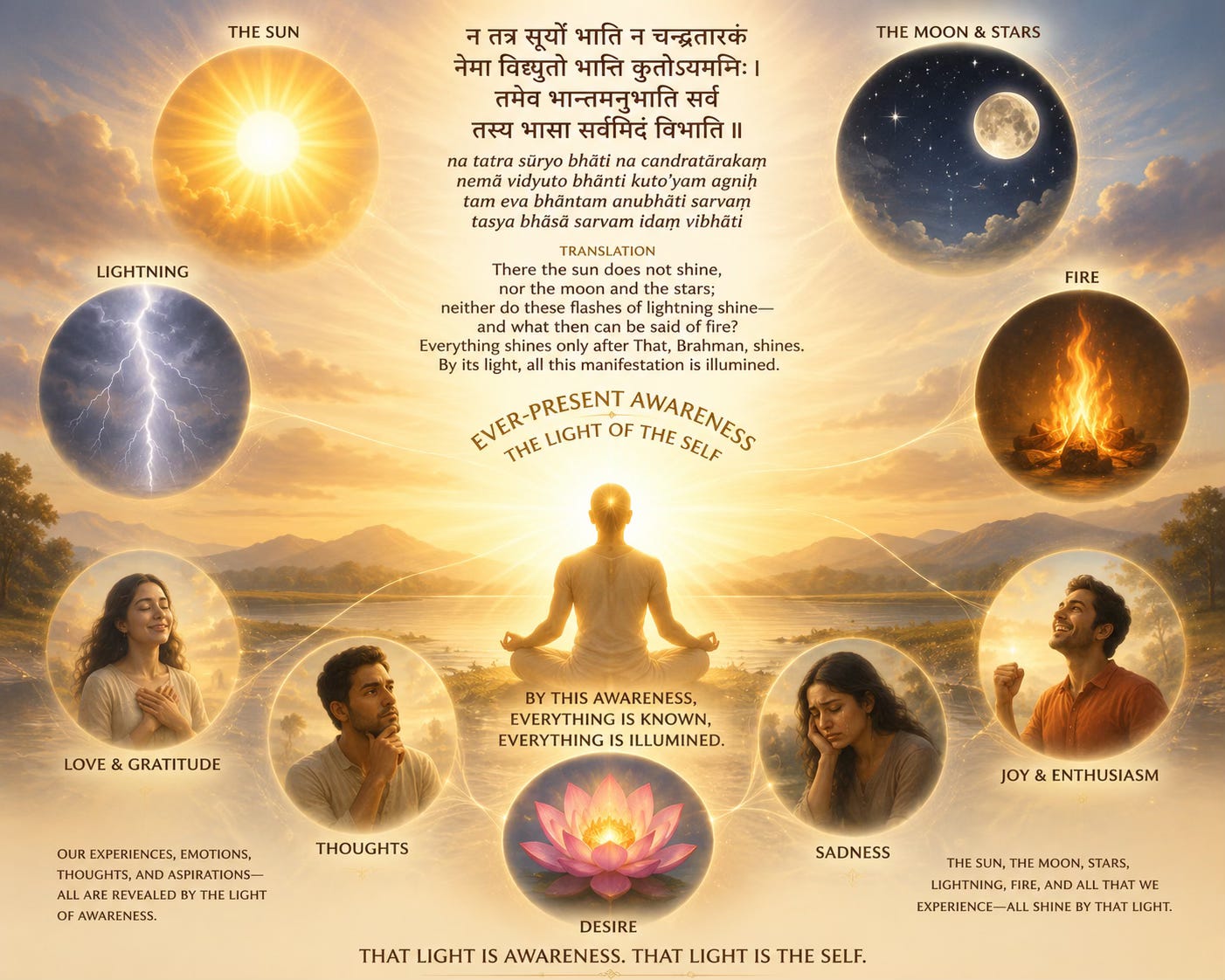
The first time I read this dialogue between King Janaka and Sage Yajnavalkya, there was an immediate aha moment. It connected me to the chant we recite at the end of aarati during our weekly Morning Prayer session.
I had recited the chant many times, but this dialogue helped me see that it was not merely a beautiful or familiar verse. Through that chant, I was regularly reaffirming a deeper truth—the light of the Self.
The great teachers have highlighted this dialogue in many ways. What follows are some of my own takeaways and reflections.
There is wisdom in how the teacher withholds the ultimate answer until the student is ready for it. Yajnavalkya moves Janaka from the visible toward the invisible—the universal symbols of the sun and moon, our own effort in kindling the fire, and our dependence on others through speech—before finally turning the whole question inward, redefining what light itself means and leading Janaka to his own awareness as that light.
And there is a patient student who does not rush to accept the first available answer, but keeps asking until he arrives at something more enduring—beginning with what is visible, letting go of what changes, and arriving at what cannot be denied.
In doing so, the dialogue also recognizes that, to participate in life, we need all these supports. The sun, the rhythms of nature, our own effort, the voices of others, and the guidance of teachers all illuminate and support the life in which we participate. Recognizing this can awaken gratitude for what we have and for the many ways in which we are supported in this world.
The chant that came to mind is
न तत्र सूर्यो भाति न चन्द्रतारकं
नेमा विद्युतो भान्ति कुतोऽयमग्निः ।
तमेव भान्तमनुभाति सर्वं
तस्य भासा सर्वमिदं विभाति ॥
na tatra sūryo bhāti na candratārakaṃ
nemā vidyuto bhānti kuto’yam agniḥ
tam eva bhāntam anubhāti sarvaṃ
tasya bhāsā sarvam idaṃ vibhāti
Translation
There the sun does not shine, nor the moon and the stars; neither do these flashes of lightning shine—and what then can be said of fire?
Everything shines only after That, Brahman, shines.
By its light, all this manifestation is illumined.
Muṇḍaka Upaniṣad 2.2.10 and the Kaṭha Upaniṣad 2.2.15
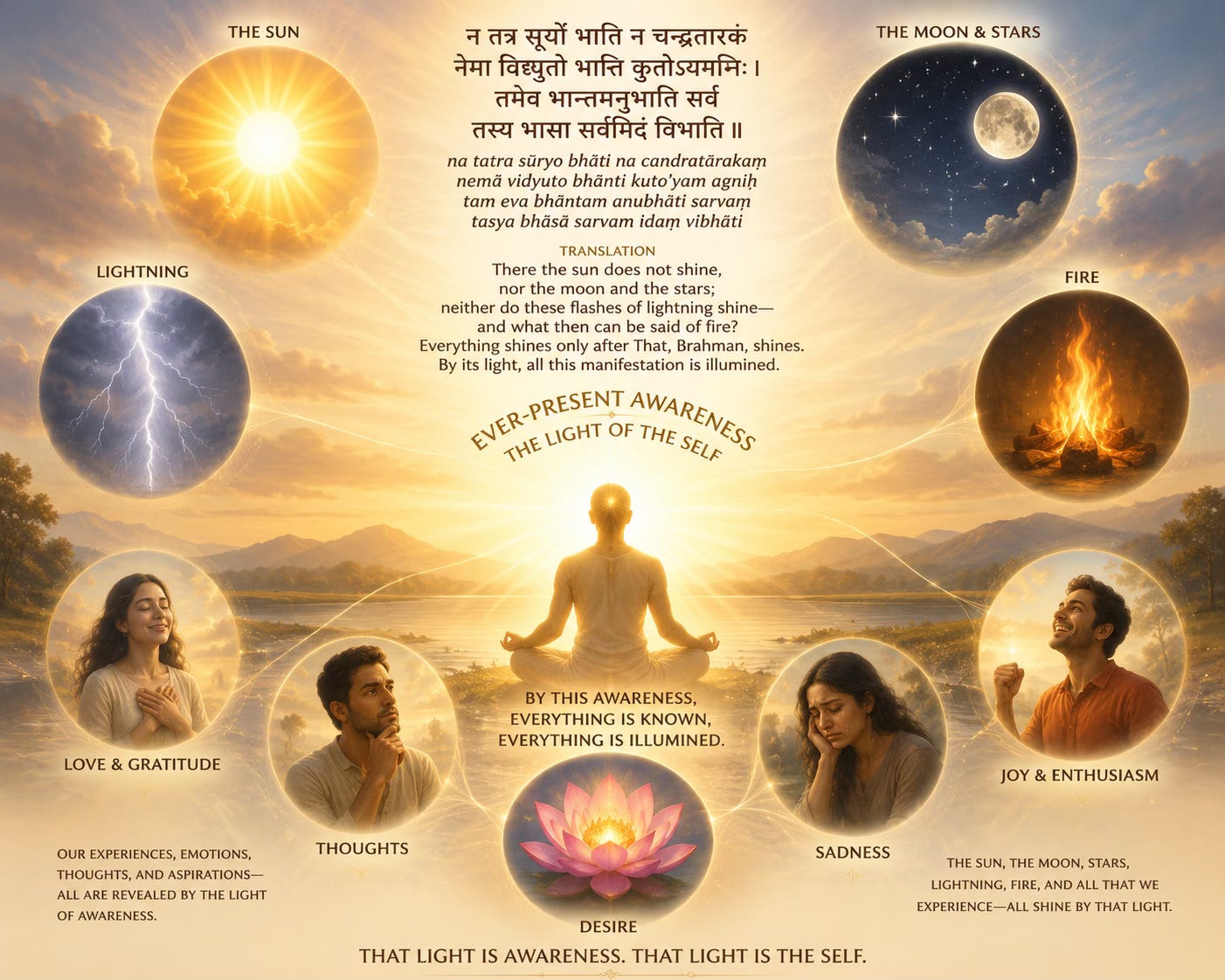
The chant points to the truth that everything we see, hear, think, feel, and experience is illumined by awareness—the Self. Our values, emotions, desires, enthusiasm, and energy are all contents of life revealed by this witnessing awareness.
Seen this way, I also begin to look at yoga—and especially Patanjali’s eight limbs—through a new lens.
The eight limbs, aṣṭāṅga, are supports we can rely on in practice. Our relationships with others and with ourselves, the body, breath, senses, mind, intellect, and focused attention are all included. They are tools through which the mind becomes quieter and clearer, allowing the light of the Self to be more readily recognized.
We become, for each other, something like mirrors—places where another person might catch a glimpse of their own light and recognize it.
Comments
Nothing yet. Say the first thing.
Sign in to join the conversation.