
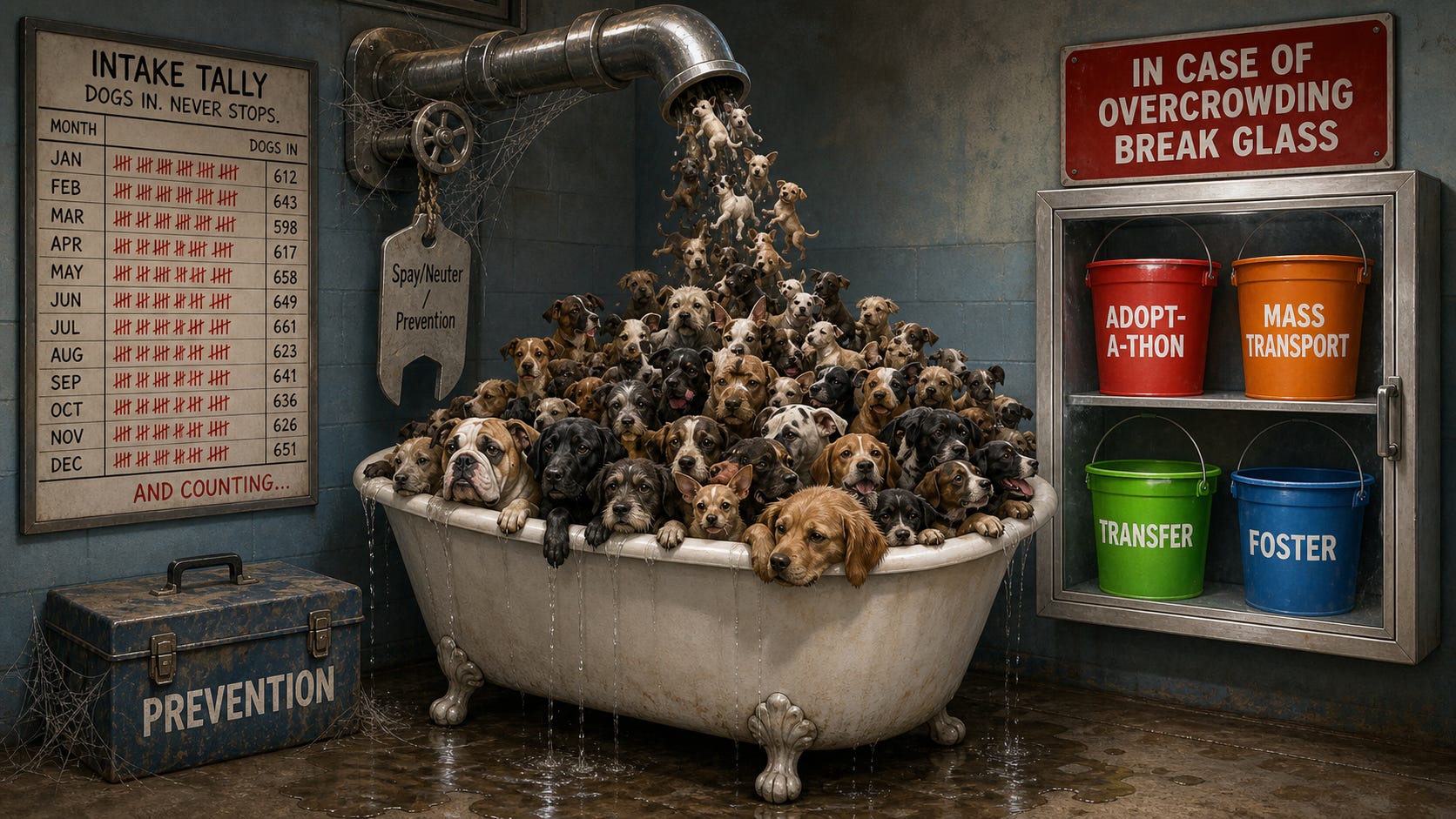
Nobody would disagree that the first step in fixing an overflowing bathtub is to turn off the faucet. That upstream logic was applied to the pet overpopulation problem in America from roughly 1990 through 2010. Over those decades, national estimates suggest shelter euthanasia fell from well over 15–20 million animals per year to around 4–5 million, a decline on the order of 80 percent, largely driven by expanded spay/neuter and other prevention efforts.
But over time, the emphasis began to shift. Instead of continuing to focus on turning down the faucet, attention and resources drifted toward draining the tub faster through mass transports, large adoption events, and expanded foster programs.
No one would argue that those downstream tactics save lives, and they remain essential. But they address a different problem. They help move animals through the shelter. They do not reduce the number of animals needing the shelter.
The shift is best understood as the predictable product of an incentive ecosystem: a system in which independent organizations, each pursuing its own mission, make decisions based on the rewards they receive. If funding, recognition, public attention, and success flow more readily to a visible crisis response than to preventing future shelter dependency, organizations can find themselves moving in the same downstream direction together without any coordination or collusion.
That does not require a conspiracy. It simply requires a system in which managing the crisis is more rewarding than preventing the crisis.
That brings us to a new national study that gives us an unusually clear look at what happens when the shelter tub overflows.
A new study titled, “Shelter Dog Census Changes Track Intakes but Resolve Slowly via Outcomes and Especially Adoptions,” was written by Michael Loizos Mavrovouniotis, a retired quantitative investment manager and data scientist, and Kristen Hassen, a shelter consultant. The paper was published in Animals in August 2026.
The researchers examined three years of monthly dog data, from 2022 through 2024, from the ASPCA/Shelter Animals Count database. The study included 1,676 organizations, divided into government-related organizations (GRO) and non-government organizations (NGO). Government-related organizations include government-operated and contracted shelters; non-government organizations include other shelters and rescues.
When the number of dogs in a shelter changes in a given month, what causes the change?
Once a shelter has accumulated more dogs than usual, how does it work that population back down?
The study gives two different answers. Month‑to‑month census changes are driven more by intake than by outcomes. Once a census increase has accumulated over several months, shelters generally work it down mainly through outcomes, especially adoptions, rather than through large cuts in intake.
The distinction between these two questions is central to understanding the study.
Think again about the bathtub. The intake is the faucet. The outcomes are the drain. The shelter census is the amount of water in the tub. When more dogs enter than leave, the census rises. When more dogs leave than enter, it falls.
The researchers found that, when looking at month-to-month changes, intake contributes more to changes in census than outcomes do.
For GROs, intake accounted for about 61 percent of the monthly imbalance, compared with 39 percent for outcomes. For NGOs, the split was about 74 percent intake and 26 percent outcomes.
The implication is straightforward: if we want to prevent the tub from filling, we have to pay attention to the faucet. That means looking upstream at spay/neuter, owner support, lost-pet prevention, accessible veterinary care, and other ways to reduce the number of animals who need shelter.
However, that is a policy implication, not a finding directly tested by this study. The paper does not compare the effectiveness or return on investment of specific prevention strategies.
So, the study found that the faucet matters more than the drain when explaining why the water level changes from month to month.
That is important.
But the researchers then asked what happens after the tub is already too full.
And here the story changes.
Once a population increase has accumulated over several months, shelters generally do not bring the population back down by reducing intake. Instead, they increase outcomes. Adoptions increase. Transfers increase. In GROs, non-live outcomes increase as well. The study found that adoptions made the largest contribution to reducing the accumulated population increase.
The faucet contributes more to the rise. The drain does most of the work once the tub is already full.
That is the central finding of the paper.
Shelters are sometimes treated as though their adoption capacity is fixed. If a shelter normally adopts 100 dogs a month, the assumption is that 100 may be about all it can adopt.
The study challenges that assumption.
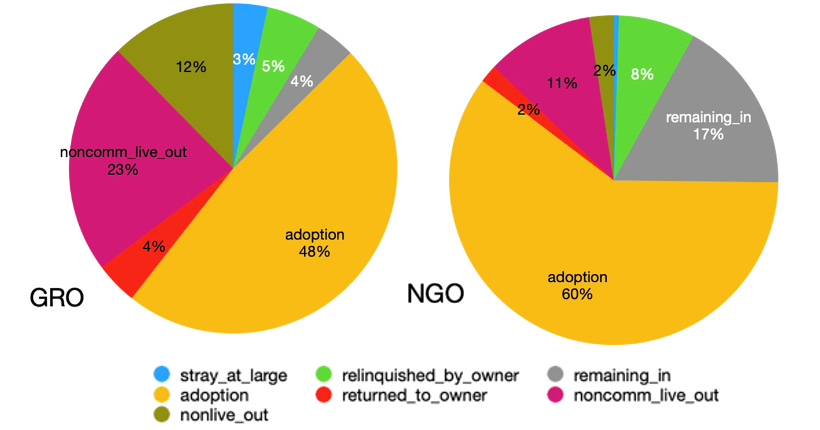
When the census rises, adoptions also rise. For every additional dog in the beginning-of-month census, the model found an estimated 0.156 additional adoptions per month in GROs and 0.264 in NGOs. Adoptions accounted for 48 percent of the modeled response in GROs and 60 percent in NGOs.
The authors conclude that adoption and transfer capacity should not be viewed as completely fixed. They suggest that shelters may increase adoption promotion, adopters may respond to seeing more animals, and rescue organizations may increase transfers when shelters become fuller.
That is useful information for shelter managers. A crowded shelter may have more ability to increase live outcomes than its normal monthly numbers suggest. It also fits neatly into a crisis narrative in which the main response to overcrowding is to push adoptions and transfers harder, rather than to ask why the tub is filling so quickly in the first place.
Because downstream efforts are more visible and easier to reward than upstream prevention, this flexible adoption capacity can become one more lever that keeps the system focused on managing crisis instead of ending it.
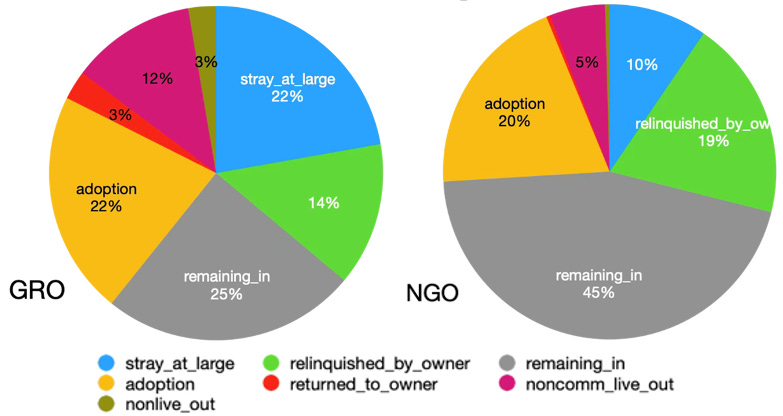
When a shelter’s accumulated census is higher, the researchers found that intake generally falls somewhat. But those reductions were much smaller than the increases in outcomes.
For GROs, intake accounted for about 13 percent of the modeled census recovery, while outcomes accounted for about 87 percent. For non-government organizations, the split was about 25 percent intake and 75 percent outcomes.
In other words, even when shelters are already too full, they mostly dig themselves out by moving more dogs out, not by turning down the flow in.
The crisis is intake-driven, but the recovery is outcome-heavy.
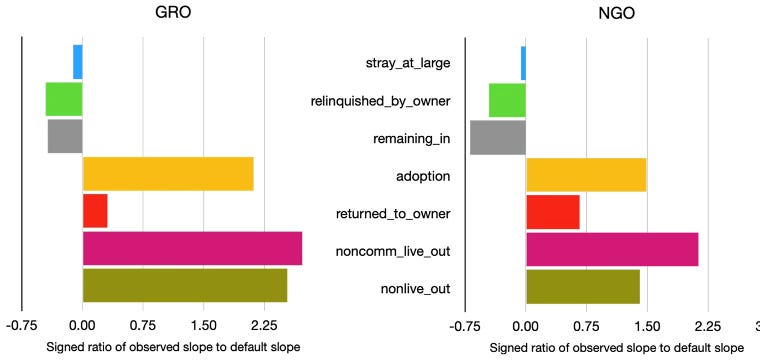
In GROs, none of the individual intake categories showed a statistically significant response to the accumulated census increase. In other words, the study did not find strong evidence that these shelters were substantially regulating or managing their intake in response to higher census levels.
The authors explain one reason for this difference is that GRO shelters often have legal or contractual obligations to accept stray animals. NGOs generally have more discretion over which animals they accept and when.
That difference matters. Public shelters often cannot simply turn off the intake faucet when they become crowded. That makes upstream prevention especially important.
When the census is already high in GRO shelters, changes in owner surrender play only a small role in what happens next. The authors describe owner relinquishment as a weak lever for managing census, and its estimated effect was not statistically significant in that group.
This complicates a common explanation for shelter overcrowding. It is easy to say that shelters are full because too many people give up their pets. The study does not support that simple explanation, at least for government shelters in this analysis. Stray intake and other intake streams played substantial roles.
The implication is practical: reducing shelter crowding requires attention to all the ways dogs enter the system, including stray intake, enforcement practices, community conditions, and gaps in support, not just owner surrender.
The study also estimates how long it takes for an overcrowded shelter to work most of the extra dogs back out.
In their model, it takes about 1.7 months for nonprofit shelters and about 2.5 months for government shelters to reduce a little over half of a population increase. But reducing a little over half of the extra dogs is not the same as almost clearing the surge.
In the same model, it takes about 5.2 months for nonprofit shelters and about 7.6 months for government shelters to work off roughly 95 percent of a population increase.
These numbers are estimates, not a claim that every crisis lasts exactly that long. But five to eight months is a long time in any shelter. It means months of crowded kennels, extra work for staff, more disease risk, more behavior problems, longer stays, and ongoing pressure to find placements.
The authors also note that if higher intake lasts for more than a short period, the extra population can stick around much longer and start to look like a new normal.
In other words, “temporary” in the model does not always feel temporary on the ground. A shelter can spend half a year working off one spike while the next spike is already forming.
The study found that GRO shelters had an overall live-release rate of about 90.1 percent. But when the researchers looked at the additional population associated with an elevated census, the estimated marginal live-release rate was about 85.8 percent. For NGO shelters, the difference was almost nothing: about 96.8 percent for the marginal population compared with 96.6 percent overall.
Here, “marginal” refers to the estimated live-release rate associated with the additional population being worked through.
Put simply, government shelters can work their way out of a population increase, but the additional population carries a higher risk of not leaving alive.
The authors describe this as a modest drop in the live release rate, not a collapse, and they note that most of the response still comes from live outcomes such as adoptions and transfers.
Even so, the findings matter. Working off a population spike over time does not mean the spike was harmless. It means the animals in the shelter absorbed the harm.
The study is observational, which means the researchers watched what shelters actually did in the real world. They did not assign shelters to different strategies and compare the results like in a controlled experiment. Because of that, the study cannot tell us exactly why adoptions went up. The increase could reflect shelter efforts, adopter behavior, rescue transfers, policy changes, or some combination of these factors.
The study also cannot tell us the true capacity limit of any one shelter. The data do not show when a shelter has crossed its safe capacity line.
There are other limits. The data are self-reported, shelters that report to Shelter Animals Count may differ from those that do not, and the study leaves out the very largest census changes. Its findings therefore may not apply to extreme events such as major cruelty seizures, disasters, or disease outbreaks. The study also looks only at dogs.
These limits do not make the study less useful. They simply define what the study can and cannot tell us.
Most importantly, the study does not test prevention.
It cannot tell us whether a dollar spent on adoption marketing produces a better long-term result than a dollar spent preventing an unwanted litter. It cannot tell us whether helping an owner keep a dog at home produces a better return than moving that dog through a shelter.
Those are important questions. They are simply different questions.
Adoption, foster care, transfers, transport, marketing, and enrichment are downstream strategies. They are the drain. They work on animals who have already entered the shelter system.
Upstream strategies are the faucet. Spay/neuter can prevent unwanted litters. Owner support can help a family keep a pet. Affordable veterinary care can stop a small medical problem from turning into a surrender. Lost‑pet prevention and reunification can keep animals from becoming shelter residents in the first place.
The study is mainly about the drain. It tells us that when the tub gets too full, shelters can pull that drain harder than many people may have assumed. It tells us much less about how to turn down the faucet. That is not a flaw in the study. It is simply the boundary of what it was designed to measure.
A community needs both. But frantically draining an overflowing tub is not the same as preventing it from overflowing.
The study does not show that managed intake is an effective way to fix a shelter that is already overcrowded. In the data, most of the extra dogs are worked off through increased outcomes such as adoptions and transfers, while intake reductions play a much smaller role.
At the same time, the study does not say that managed intake is useless as a prevention tool. Keeping an animal from entering the shelter in the first place is a different goal from reducing a population that is already inside.
But this is where practice and theory diverge. In theory, managed intake is presented as careful control of the faucet. In practice, restricting intake without equally strong investment in spay/neuter and field prevention can reduce visible crowding inside the building while leaving animals to accumulate, breed, and suffer elsewhere, often in backyards, garages, and unregulated rescues. It changes where the water shows up, not how much is flowing.
That distinction matters.
One turns down the faucet. The other drains the tub. A community needs to know which problem it is trying to solve before deciding which tool to use.
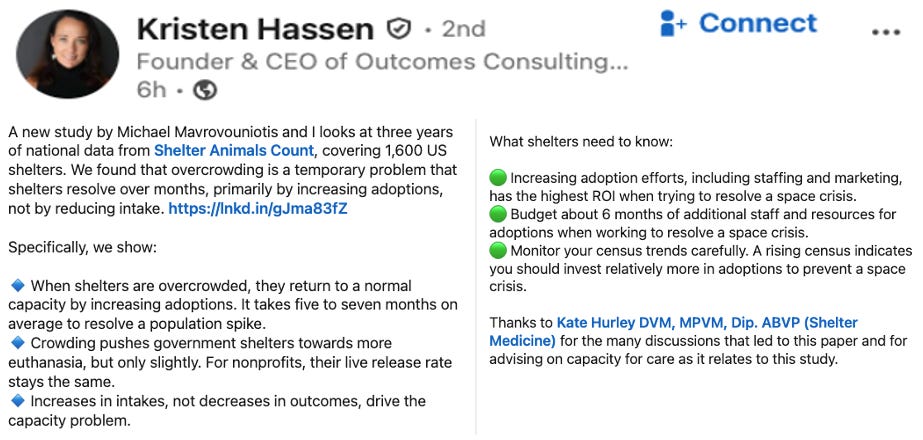
The study is being promoted as evidence that overcrowding is temporary and that increasing adoption efforts is the best investment for resolving it. Early commentary has emphasized two ideas: that shelter overcrowding is temporary, and that shelters can work their way out of a census spike primarily by increasing adoptions and other outcomes rather than reducing intake.
Those points are grounded in the study. But the distinction between what the study found and what the findings mean for policy is important.
The study found that accumulated census increases are worked down primarily through increased outcomes, especially adoptions, and that intake plays a much smaller role in resolving an existing census increase.
But the study did not test which strategy has the highest return on investment. It did not compare increased adoption spending with spay/neuter, owner support, veterinary assistance, lost‑pet prevention, or other upstream strategies.
That matters because “this is how shelters recover from overcrowding” is not the same claim as “this is the best way to prevent overcrowding.” The first is a finding about shelter behavior. The second is a policy conclusion. The study supports the first; it does not test the second.
And that distinction becomes especially important when we consider what the study says about intake. The researchers found that intake is the larger contributor to month‑to‑month changes in shelter census. Once a population increase has accumulated, however, outcomes become the primary way shelters work that increase back down.
In other words, the study describes a two‑part process: intake helps fill the tub, while outcomes help drain it after it has filled. That is a much more nuanced finding than simply saying, “Adoptions solve overcrowding.”
A crowded shelter has a visible problem that seems to require visible solutions. Adoptions, transfers, and live‑release rates can be counted and reported. A big adoption event produces photos, headlines, and numbers that can be shared right away.
Prevention works differently.
The success is often invisible. The unwanted litter never happens. An owner gets help and keeps a dog. A family gets affordable vet care and never reaches the point of surrender. A lost dog is returned home before becoming a long‑term shelter resident. The successful outcome may never appear in the shelter census.
Because of this, prevention is harder to see, harder to celebrate, harder to measure, and harder to monetize.
National nonprofits, foundations, consultants, academic programs, and corporate partners can each pursue their own missions while responding to the same rewards. If funding, recognition, performance targets, and media coverage are tied more to managing visible shelter crises and outcomes than to reducing future shelter dependency, organizations can naturally move in the same downstream direction.
No conspiracy is required. The system simply rewards what it can easily see and measure.
That is the incentive trap: managing the crisis becomes more visible and rewarding than preventing the crisis.
It challenges the idea that adoption and transfer capacity are fixed. It shows that when shelter populations rise, shelters and the people around them can increase live outcomes. It also shows that accumulated census increases are usually worked down through more outcomes, especially adoptions, rather than through large cuts in intake.
It also shows that government shelters pay a price for this. Their additional population during crowded periods has a lower live-release rate than their population overall, while nonprofit shelters do not show the same decline.
But the study does not show that adoption is the highest‑return investment for solving pet overpopulation.
It shows something narrower and more useful: when the bathtub is already too full, shelters can pull the drain harder than they normally do, and adoptions are the biggest part of that response.
The study also reminds us that the faucet matters. Month‑to‑month changes in how full the tub is are driven more by intake than by outcomes.
The study does not tell us how to turn that faucet down. That question belongs to prevention and policy, not to this one paper.
Animal Politics is asking why we have built a system that is so much better at absorbing the shock than preventing it.
For a field that has built its identity around saving animals in crisis, this study is a quiet reminder that the crisis begins at the intake door, not in the adoption center.
It shows that the system we have can work off each population spike through downstream effort, but it also shows that intake is the larger driver of month‑to‑month census changes and that crowded periods are worked down mainly through outcomes.
Taken together, those findings describe a system built to manage overcrowding as a recurring crisis, draining each surge after it appears, rather than to stop those surges from forming in the first place.
It also shows that this process is not cost‑free. Government shelters see a lower live‑release rate for the extra dogs they carry during elevated census, while nonprofit shelters do not show the same decline.
So the question for policy and funding is not whether shelters should push harder on adoptions when they become crowded. They should. The larger question is whether we will change incentives so that preventing overcrowding becomes as measurable, visible, and rewarded as managing it after the fact.
We have learned how to drain the tub. The next step is to become equally serious about turning down the faucet.
Editor’s Note: A more detailed look at how this crisis‑driven incentive structure developed, and how communities can shift it toward prevention, is in “The Business of a Never‑Ending Crisis,” a previous Animal Politics white paper.
Buy Ed a Coffee for his BIRTHDAY

Ed Boks is the former executive director of animal care and control agencies in New York City, Los Angeles, and Maricopa County, and a past board member of the National Animal Control Association. His work has appeared in the Los Angeles Times, New York Times, Newsweek, Real Clear Policy, Sentient Media, and now on Animal Politics, a lively community spanning 49 states and 75 countries.
Animal Politics is reader-supported. If this reporting matters to you, a paid subscription is the most direct way to keep it going.
No posts
Comments
Nothing yet. Say the first thing.
Sign in to join the conversation.