
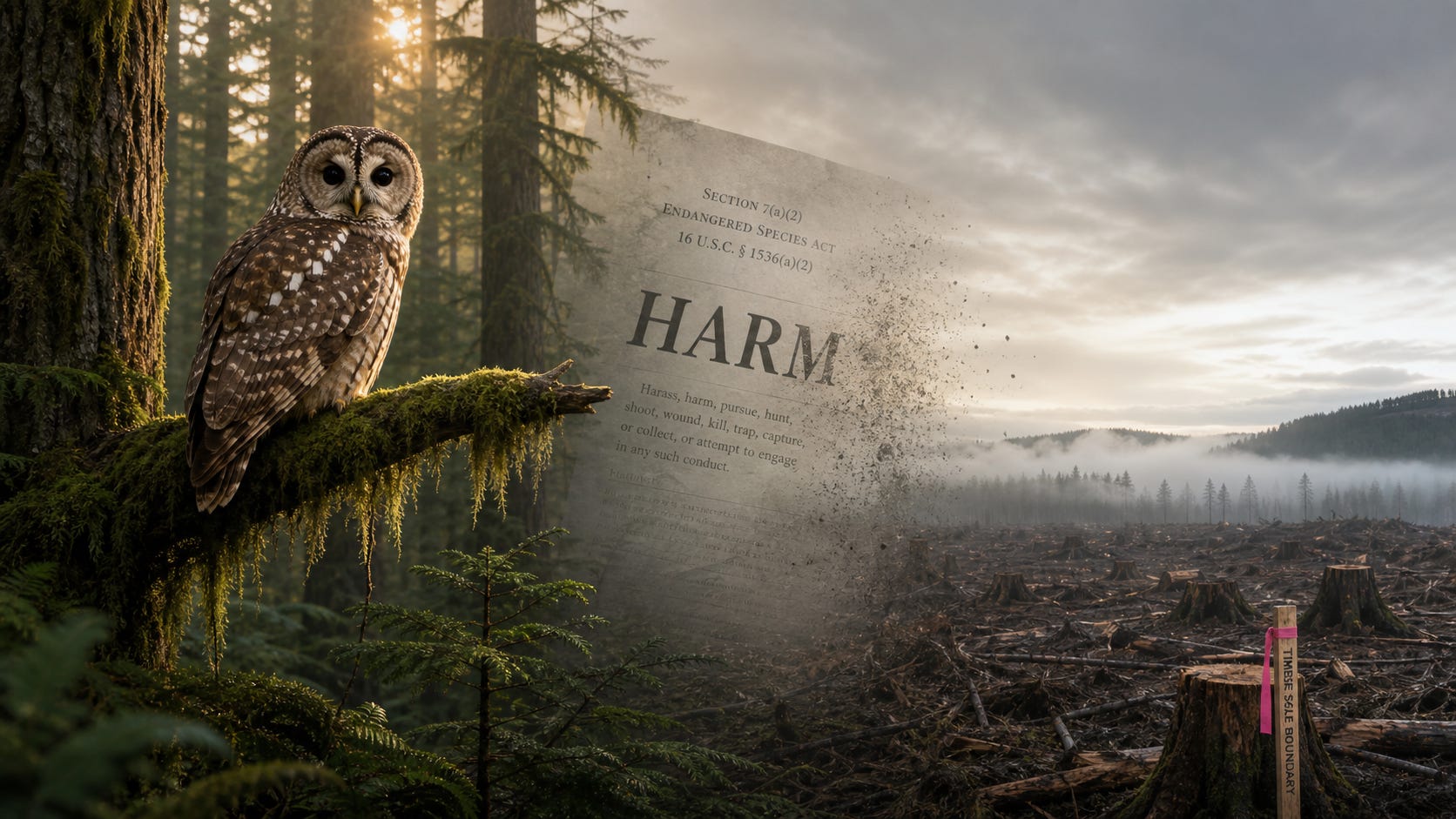
Federal wildlife agencies have published a final rule that, effective September 12, removes the regulatory definition that for decades treated certain habitat destruction as “harm“ under the Endangered Species Act. The change could make it harder to prove that habitat loss violated the law, especially when the injury unfolds slowly or indirectly.
For roughly five decades, the Endangered Species Act (ESA) has prohibited the “take” of endangered species. Since the 1970s, federal regulations have defined “harm” to include some kinds of habitat modification, such as destroying nesting grounds or draining wetlands, when those changes actually kill or injure animals by impairing breeding, feeding, or sheltering.
In April 2025, the U.S. Fish and Wildlife Service and the National Marine Fisheries Service proposed to rescind that definition outright, arguing that it conflicts with what they call the “single, best meaning” of the statutory term “take.” The agencies argued that Congress prohibited taking animals, not altering habitat, and that including habitat modification in “harm” exceeded the text Congress enacted. The final rule was published in the Federal Register on July 14 and takes effect September 12.
Taken together, the documents describe a quiet but consequential shift. It could make it far more difficult to treat habitat destruction as prohibited harm when the injury is indirect, gradual, and difficult to prove, potentially leaving more habitat-caused injury outside the agencies’ former regulatory framework.
Glossary:
Harm: For decades, federal rules said habitat damage could count as harm if it actually killed or injured wildlife. The final rule will delete that definition from U.S. Fish and Wildlife Service (FWS) and National Marine Fisheries Service (NMFS) regulations on September 12.
Harm Laundering: When officials narrow a legal definition so an action that once counted as harm becomes harder to identify and enforce as harm, even though it still hurts wildlife.
Take: Under the ESA, “take” is a legal term that includes harming, harassing, killing, capturing, or trying to do any of those things to an endangered species. Many threatened species receive similar protections through separate federal rules.
A Definition with Consequences
The rule being removed was not a minor footnote in federal wildlife law. It was the agencies’ working definition of a word Congress included in the ESA’s ban on “take.” In 1995, the Supreme Court upheld the agencies’ authority to include significant habitat modification in “harm” when it actually kills or injures wildlife.
The rule does not remove “harm” from the ESA itself. It removes the agencies’ written definition of what “harm” means. The agencies say the ESA’s prohibition on take remains in force and that the statute itself supplies the governing standard. The final rule, however, removes the regulations’ express definition of “harm” and does not replace it. That omission matters most when habitat alteration produces injury that is indirect, gradual, or difficult to reconstruct.
The rescission does not erase every ESA protection. Section 7 consultation still requires a federal review of projects that may affect protected species. But the final rule may affect when habitat-related impacts support an incidental-take statement, which is the mechanism agencies use to set enforceable terms and conditions for a project.
Section 9 continues to prohibit takes of endangered wildlife, and separate Section 4(d) rules may extend take protections to threatened species. The main change is that agencies will no longer have a clear written rule for treating habitat-caused injury as an illegal take, particularly in private projects that do not need a federal permit or approval.
The dispute may sound like a fight over a definition. On the ground, it is a fight over evidence and timing.
The former rule did not make every habitat change illegal. It required a showing that habitat modification actually killed or injured wildlife by impairing essential behavior. But it gave agencies and courts an established framework for recognizing that indirect injury as a take. The new rule removes that clear standard and leaves a harder question: What proof will be enough once the habitat, and the evidence, are gone?
Consider an occupied nesting stand scheduled for logging. Under the prior regulation, the loss of forest could qualify as a take if it actually killed or injured owls by impairing their nesting, feeding, or sheltering. The rescission removes that explicit standard. The agencies now say habitat modification that indirectly and accidentally injures wildlife does not itself qualify as a prohibited take.
Before the Bulldozers Arrive
The former definition gave developers, regulators, and courts a common standard for assessing the risk that habitat loss would amount to a take. A developer whose project could result in a take could seek an incidental-take permit, negotiate a habitat conservation plan, revise a route, alter construction timing, protect breeding areas, or pay for mitigation. The definition did not stop development. It required development to confront the biological cost when indirect injury could be shown.
The new rule does not change the law’s ban on harming or killing protected wildlife. But it deletes the rule that said destroying habitat can count as harm in some cases. That makes it harder to prove that habitat loss broke the law when injury results from gradual habitat loss rather than an act directed immediately at an identifiable animal.
This is where “harm laundering” has meaning. The habitat loss does not become less real. The legal system simply becomes less able to name it with the same clarity before the evidence disappears.
The Accountability Gap
The change may put more pressure on scientists and regulators to prove that habitat loss caused an animal’s injury or death. That is not simply a difference in legal theory. It changes when, and with what evidence, agencies may recognize habitat-caused injury as a take.
The agencies’ final rule raises a question the Supreme Court addressed three decades ago in Babbitt v. Sweet Home: If destroying essential habitat can actually kill or injure protected wildlife, why should that injury become harder to recognize simply because it occurs indirectly rather than through immediate physical contact?
In Sweet Home, the Court upheld the Services’ definition of “harm” to include significant habitat modification that actually kills or injures wildlife by impairing essential behaviors such as breeding, feeding, or sheltering. That decision gave agencies a clear, written standard for treating habitat‑driven injury as a prohibited take.
The new rule discards that regulatory definition without offering a replacement. It does not explain how, in future enforcement, agencies will draw the line between lawful habitat alteration and “harm” that counts as a take.
The Owl at the Center
Few species show the stakes of the rescission more clearly than the northern spotted owl. For more than three decades, the northern spotted owl has been central to debates over how the ESA balances habitat conservation and economic development. Its decline helped turn the ESA from a little-known federal law into a defining force in the management of public and private forests across the Pacific Northwest.
The northern spotted owl was one of the species that helped crystallize the idea that habitat destruction can “harm” wildlife. The logging battles of the 1980s and 1990s, and the Sweet Home case itself, rested on the simple premise that clear‑cutting old‑growth habitat could kill or injure owls even if no one ever laid a hand on the birds.
That history matters now because the northern spotted owl is again being used to justify a controversial federal intervention. The U.S. Fish and Wildlife Service has adopted a strategy that authorizes trained professionals to lethally remove barred owls in designated areas of Washington, Oregon, and California, arguing that competition from the larger barred owl threatens the survival and recovery of northern and California spotted owls. The strategy relies on willing land managers and landowners, and the agency says it is not a public hunting program.
But the federal government’s own environmental review identifies habitat loss from timber harvest on nonfederal lands as an additional primary threat to the northern spotted owl, along with wildfire. Commercial timber harvest remains a potential threat to all three spotted-owl subspecies, according to Forest Service researchers.
The contrast illustrates the issue. The government has authorized trained professionals to lethally remove barred owls to improve spotted-owl recovery, while removing the regulatory language that defined when destruction of spotted-owl habitat could qualify as harm. The agencies characterize barred-owl competition as a direct, observable threat that can be addressed through targeted lethal removal. The gradual loss of an old forest, even when it strips a spotted owl of nesting, roosting, and foraging habitat, is now less clearly addressed under the regulations.
Whether barred-owl removal is sound conservation policy is a separate question. The legal contrast is clear: the government is taking direct action to reduce one threat to spotted owls while removing the regulation that expressly addressed a different threat: habitat destruction.
Follow the Forest
The legal question has never really been whether habitat destruction can injure a northern spotted owl. The Supreme Court answered that question three decades ago, and federal wildlife agencies have long recognized that habitat loss can amount to a take when it causes actual injury or death to protected wildlife. The rescission removes the long-standing regulatory definition that agencies relied upon, leaving future habitat-based take claims to be resolved without that explicit regulatory framework.
The question is which projects will now face fewer barriers, fewer mitigation requirements, or less risk of enforcement once the agencies no longer define habitat destruction as harm. Timber-industry groups and county coalitions have challenged northern spotted owl critical-habitat protections in California, Oregon, and Washington, arguing that the restrictions constrain active forest management and impose economic costs.
The Unanswered Question
The FWS and the NMFS say the ESA’s core take prohibition remains in force, while maintaining that the statute itself supplies the governing standard. They contend that a separate regulatory definition of “harm” is unnecessary.
But the final rule offers no replacement definition and, in its explanation, adopts a narrower reading of “harm” than the agencies have applied for decades.
Although the agencies insist the statutory prohibition on take remains unchanged, removing the written definition leaves unanswered how indirect injuries caused by habitat destruction will be evaluated in future enforcement.
That leaves a practical question for anyone seeking to protect a species from indirect injury caused by habitat loss. What proof will the government require when a timber operation clears a nesting stand while protected animals are elsewhere, or when a project breaks apart the forest or wetland landscape that makes breeding, feeding, or sheltering possible over time? The agencies should state, in writing, whether the destruction of occupied or essential habitat for a protected species can still lead to enforcement without proof that a particular animal was found dead or physically injured.
The question is especially important for private land. Federal projects still must go through ESA review. But many private projects do not need a federal permit or approval. In those cases, the old harm definition provided a clear route for requiring an incidental-take permit when habitat destruction actually killed or injured wildlife. Without the old definition, it is less clear when habitat loss will support an incidental-take permit or other enforcement action.
New Lawsuits Take the Fight to Court
On July 14, nine environmental groups filed suit in federal court in Seattle challenging the rescission. A separate group of conservation organizations filed a second case in the Northern District of California. The plaintiffs argue that deleting the habitat-based definition of “harm” conflicts with the ESA, the Administrative Procedure Act, and the Supreme Court’s 1995 decision in Babbitt v. Sweet Home.
The lawsuits move the dispute from agency rulemaking into federal court. The cases will test whether the agencies may discard the habitat-inclusive definition that Sweet Home upheld, and how courts apply the ESA after the Supreme Court’s 2024 end of Chevron deference.
The Test Ahead
The ESA was built on a simple recognition: wildlife cannot survive without the places where animals feed, breed, shelter, and move. The Supreme Court recognized that reality in the northern spotted owl case over thirty years ago, when it upheld the government’s authority to treat serious habitat destruction as harm when it actually kills or injures protected wildlife.
The next test will not come in a Washington announcement. It will come in a forest plan, a timber permit, a road route, or a private-land clearing decision. It will come when a project removes the habitat a protected animal needs to nest, roost, and forage, and agencies must decide whether the resulting indirect injury can still be recognized as a prohibited take.
The question extends far beyond old-growth forests. Wetlands, desert habitat, prairie grasslands, spawning streams, and countless other ecosystems depend on the same legal distinction between direct injury and habitat destruction that actually causes injury or death.
If habitat loss actually kills or injures protected wildlife, the biological harm does not disappear because the regulatory definition has changed. Whether that injury continues to qualify as a prohibited take will now depend increasingly on how courts interpret the statute.
The harm on the ground will still be real. The test ahead is whether the law chooses to see it.
Additional Reading
Ed Boks is the former executive director of animal care and control agencies in New York City, Los Angeles, and Maricopa County, and a past board member of the National Animal Control Association. His work has appeared in the Los Angeles Times, New York Times, Newsweek, Real Clear Policy, Sentient Media, and now on Animal Politics, a lively community spanning 49 states and 75 countries.
Animal Politics is reader-supported. If this reporting matters to you, a paid subscription is the most direct way to keep it going.
Comments
Nothing yet. Say the first thing.
Sign in to join the conversation.