
Last week, re:publica took place in Berlin. Almost on my doorstep, I could walk there. Unfortunately, I came back from Various Others in Munich with a cold, which is why I only got to see Hito Steyerl’s talk and the following panel with her and Karen Hao.
The hour with Steyerl and Hao, the author of Empire of AI, was announced under the title Friction. And of course everything Hito Steyerl said in what followed was correct, only her proposed solution ultimately still falls rather short: the call to “Start building” as a form of resistance. Every now and then she added the word “stacks”, turning it into “Start building stacks”, although this did not make it any more concrete. This, in turn, reminded me of a talk I had heard a few weeks earlier at ZKM Karlsruhe during the symposium on the Connection Machine. Sarah Ciston, Professor of Computational Thinking & Aesthetic Doing at the Academy of Media Arts Cologne, spoke about the risks of technofascism from ELIZA to Anthropic. Her proposed solution was also “Start building stacks”. During the Q&A afterwards, there was a sense of bewilderment in the audience, and people kept asking, in ever new variations, what exactly this was supposed to mean and what one could concretely do. With Steyerl, too, it remained at “Start building”. One might also question how urgent it was for Steyerl to joke that Alex Karp, Palantir’s CEO, might be a con artist but is definitely a performance artist.
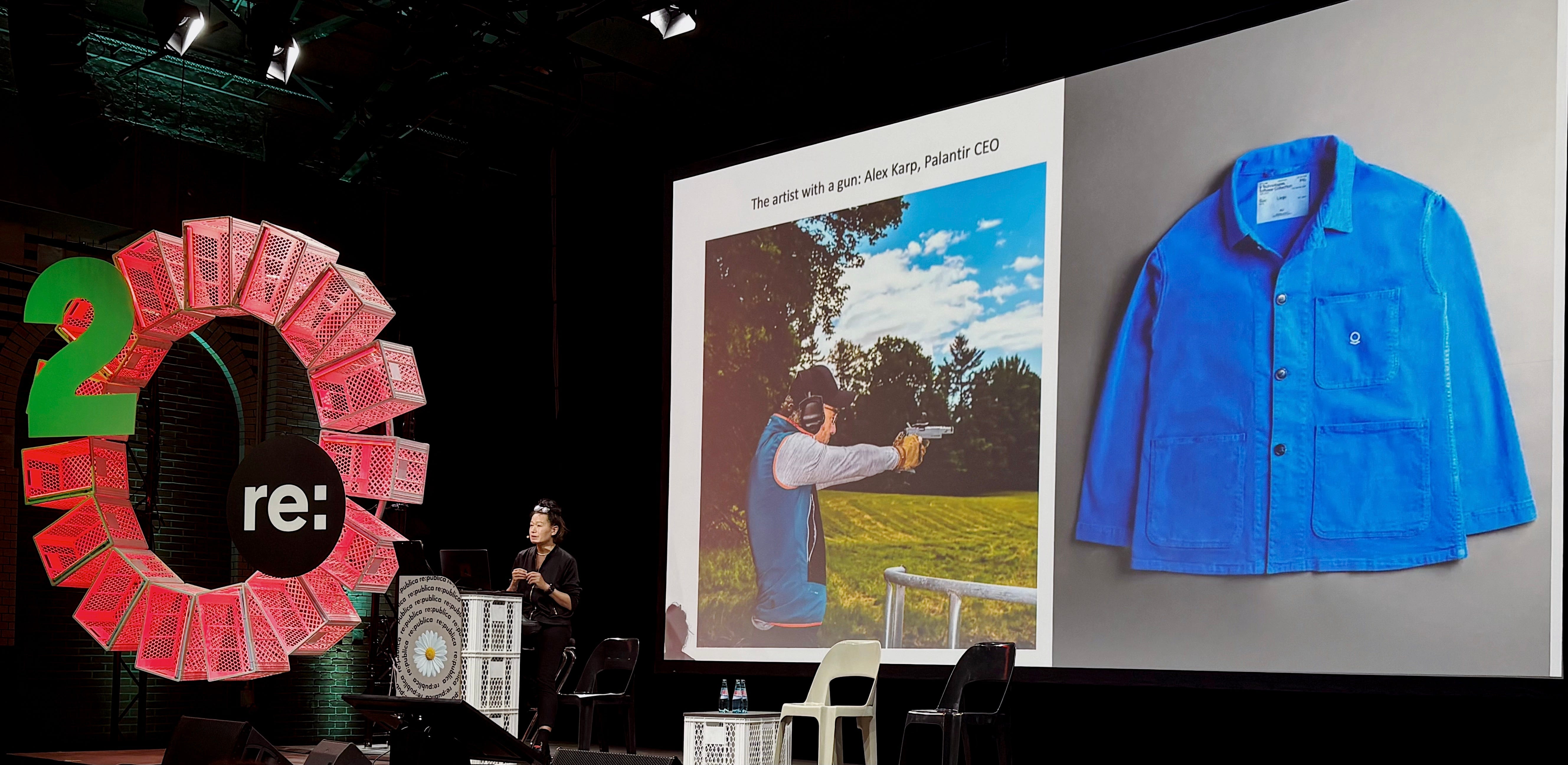
Another artist, Simon Denny, has only just raised the topic of Karp as an artist in his precise and thoughtful text for Artforum (Epic Fury: The Dark Art of Defense Tech, 20 April 2026). He writes:
“Karp even claims to be an artist, describing his role in making Palantir’s products as working as a kind of artistic mentor, shaping (and extracting value from) the talent of his employees as an artist would from raw materials.”
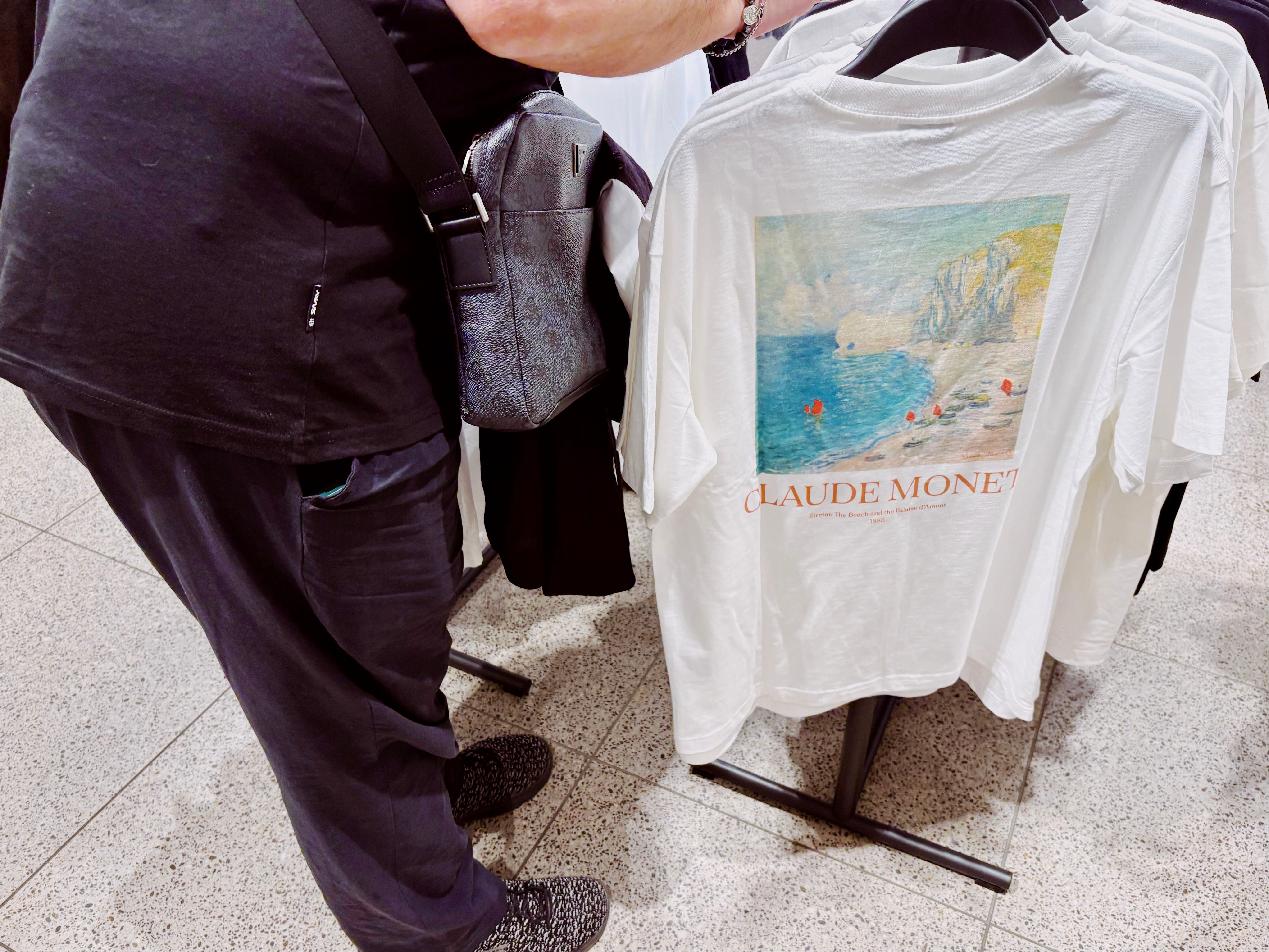
But the more interesting question is whether criticism should move closer to the language of the world it opposes. If Karp adopts the language of art, does this justify Steyerl adopting language closer to the very Silicon Valley she criticizes so sharply? “Friction”, “start building”, “start building stacks”: it begins to sound like a VC deck for critical theory. Or take a sentence like this from the announcement of the talk: “The prevailing logic of AI is a six-seven logic: whatever goes.” It has the feel of a hot take on Twitter. I would rather turn to Adrian Daub’s What Tech Calls Governing and read about solutionism in the tech industry and the age of disruption: “Ignorance is innocence, expertise is sin.” Because I do not believe that the solution lies in responding to Silicon Valley’s highly agentic vibe with its own agency and action. And “start building” works in Silicon Valley because venture capital exists, and at this point I would indeed recommend continuing with Daub, who also takes a closer look at VC Twitter. (And then it also quickly becomes clear that CT Twitter, meaning Crypto Twitter, is not far removed from it, and that artists who simply want to make digital art have found themselves somewhat stuck there. But that is another topic.)
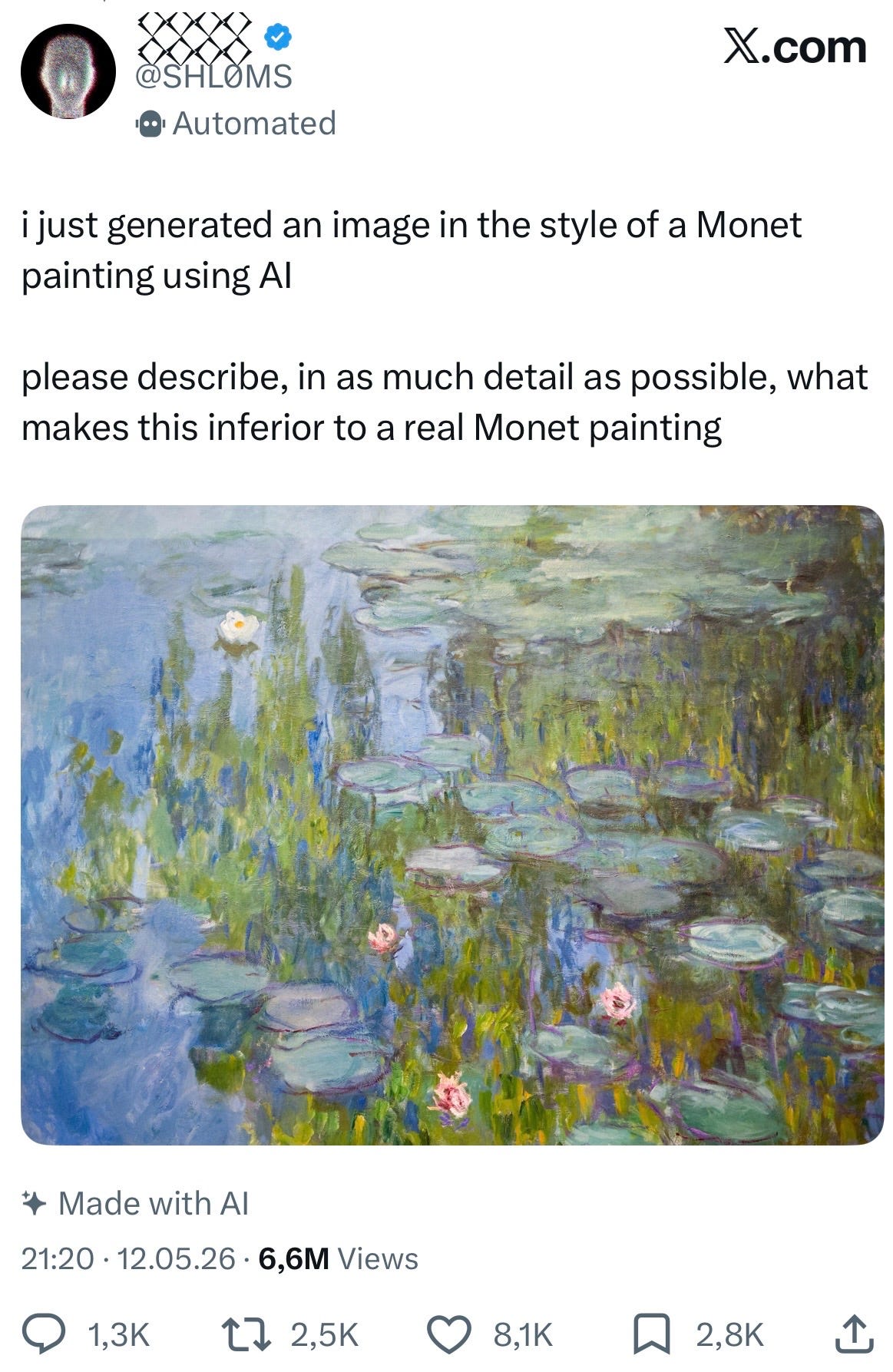
And since we are already talking about Twitter. Last week, people continued arguing about SHL0MS’s Inferior Image. To recap: the anonymous conceptual artist SHL0MS shared an image of a Monet painting on Twitter, pretended that he had generated the image himself with AI, and then asked people to describe as precisely as possible why the supposed AI version was inferior to a painting by Monet. To be honest, I was somewhat surprised by the extent the discussion around the post reached, and by the debate over whether and what art on the internet, or rather on social media, is.
My in-depth conversation with SHL0MS was published by SLEEK last Monday. And what probably surprised both SHL0MS and me the most:
AM I was surprised that people did not do a reverse image search.
SHL0MS I am a very skeptical person. I reverse image search everything I see that I have not seen before. If I am curious about a piece of information, it is very easy to do now. But people did not do that. When people decide they are looking at AI, the suspicion seems to replace the verification instinct. You do not reverse image search what you have already classified. Nor did they look closely at the (in my opinion) obviously real brushstrokes. It was a fairly high-resolution scan from Wikimedia. In fact, many said the brushstrokes looked extremely fake.
Many people also insisted, once the facade fell away, that it was an inferior Water Lilies painting. That is suggestive in itself. There are Monet scholars who have their own rankings of what makes a better Water Lilies painting, but I actually quite like this one.
(…)
Maybe it is because image models remain such a subjective topic. People are genuinely confused about what they are capable of. If you looked at the image objectively and had a good understanding of the current state of image models, you should have been able to tell that the resolution and coherence of the brushstrokes were simply beyond what they were capable of.
Some vocal AI proponents have called this a watershed moment because it so publicly revealed that we have switched paradigms. A year or two ago, we were still in what I would call the “six-finger paradigm.” The critique of AI was that it could never make a coherent image. It was always going to be Will Smith eating spaghetti, six fingers, and impossible wine glasses with incoherent splashes.
Now, many of the replies effectively granted the assumption that AI could make a perfect one-to-one replica of a Monet but that it had no soul. So the critique shifted from a mechanistic critique (“AI cannot do the thing”) to granting capabilities it does not actually have. It becomes less about discernment. The viewer now assumes the image generator can produce any image but insists it lacks some innate quality, some soul, which it turns out they cannot reliably detect.
What surprised me even more, however, was the way the topic was picked up by Tilman Baumgärtel in Monopol, for example. He sums it up like this:
“One could also describe the whole thing quite simply like this: Someone publishes a polarizing post on social media. An online mob has all kinds of opinions about it that stand in inverse proportion to their actual knowledge. What exactly is new about that? Weren’t social media invented precisely for this?”
What were social media invented for? So that people can fight each other online every single day? But that is not the point here. SHL0MS did not simply share a polarizing post on social media, but something that could have been clarified within seconds through a quick search online, namely by using reverse image search. That did not happen, and that is the truly disturbing, even frightening part. Instead, people prefer to furiously type away in ignorance, and yes, why exactly? Baumgärtel writes about disinformation online, but the issue is really AI. The prejudices against AI are so strong that they end up getting in the way of actually engaging with it. People are content with their own opinions.
As Baumgärtel correctly points out, the list of works by artists who staged performances on the internet, or on social media, and relied on audience reaction is not particularly short. And if one wants to argue in this way, that it has all been done before, then works such as Vote-Auction by UBERMORGEN or, at the latest, Excellences & Perfections by Amalia Ulman on Instagram in 2014 had already explored audience-driven performances on the internet.
It certainly does no harm for artists to regularly remind us that the internet is far too full of opinions that do not hold up if one were to simply use the internet, where one already happens to be, to briefly verify one’s own opinion. That may still be amusing, or be dismissed as rage bait, when it comes to a painting. But where has this already led us on other levels?
What I do wonder, and this is where TMO, short for Too Much Opinion in the title, comes from: does it really help when critics, artists, and cultural discourse itself suddenly respond with so much opinion, often in ways that come across as hot takes or rage bait? TMO begins when opinion arrives before verification.
Take care,
Anika
Comments
Nothing yet. Say the first thing.
Sign in to join the conversation.