
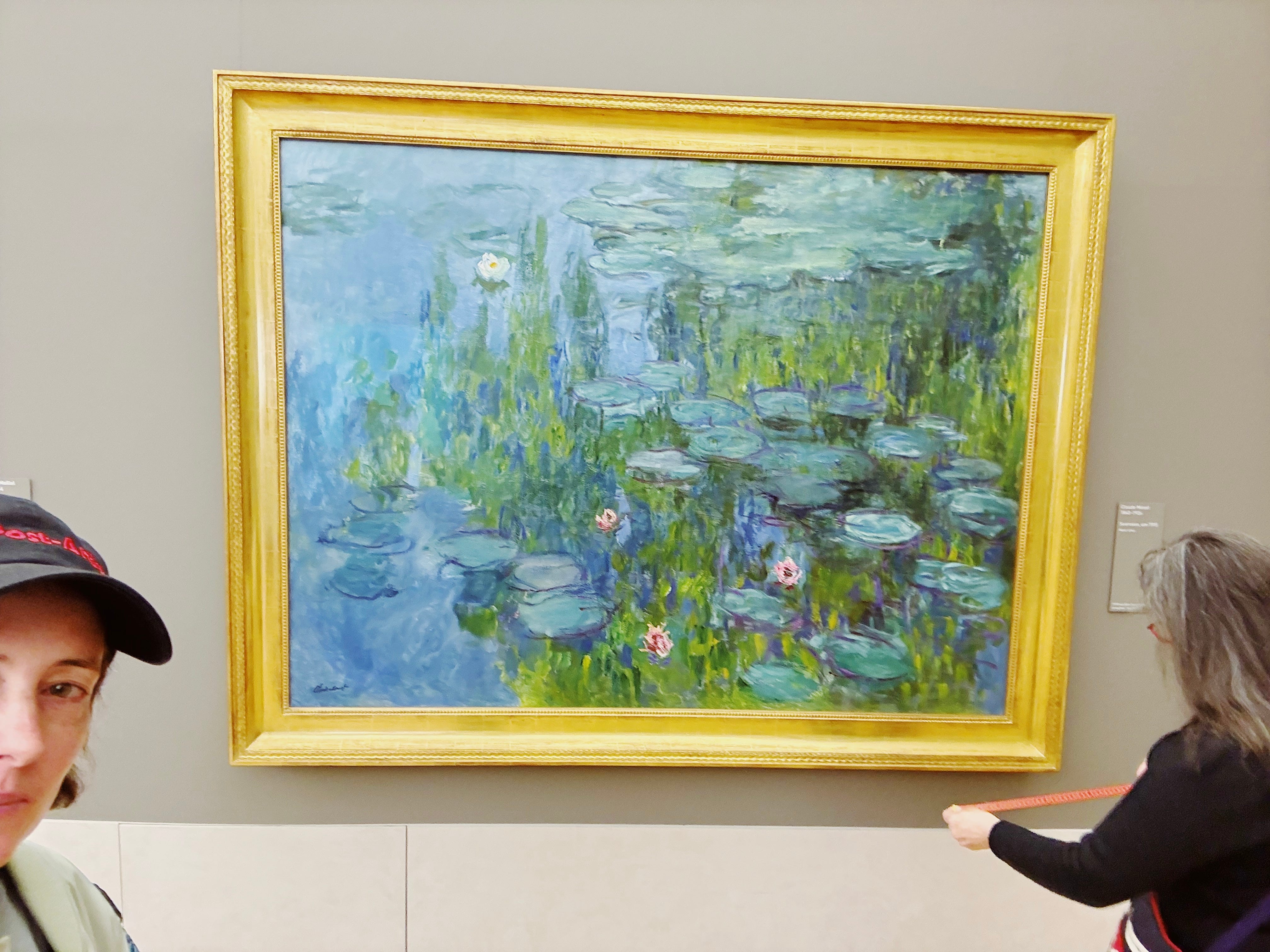
“Are you showing?”, someone asks me. I think we were in an auction house at the time. “No, this is not my exhibition,” I answer. Then I get told everything about the Tony Cragg sculpture spread out across the floor. Then I get asked again, “Are you showing?” And I finally understand that in Munich people apparently ask whether you are showing something somewhere during Various Others. So I finally say yes, and that we are showing something across from the Bayerischer Hof, there, where Michael Jackson once held his baby out of the window. Then we move on already, somewhere to the first floor. The artist Charlie Stein is already there again too. Actually, she is there before me everywhere all weekend and just leaving whenever I arrive. On the first floor, however, she stays a little longer. She quickly introduces me to someone. “Funny guy,” she says. “He puts sequins on everything. Anika puts sequins on nothing. You two will surely get along.” And then she leaves very quickly after all because her bedtime reminder goes off at half past ten. She holds her phone in front of my face as proof.
The next day, Saturday, I spend the afternoon going around to a few galleries. I go to Max Goelitz first because everyone recommended it to me, and I think that apparently there is nothing better to see in the city. When I arrive, I wonder why someone has crumpled up a piece of baking paper and placed it under a low-hanging lamp. At some point I think this must be the art because otherwise there is not much to see in the room. I move on quickly before someone immediately starts talking to me, like basically everywhere else. In Munich, someone rushes towards you in every gallery, shakes your hand, and starts explaining the art. And then you are already supposed to sign up for a newsletter and come back later that day for the artist talk.
Several times over the weekend I have to think of Trevor Paglen, who said in an interview with Art Basel that there would be a civil war between the blockchain community and the traditional art world. He said he found that strange. Me too, I mean the wording: Civil War. Trevor Paglen is guest curator of the third edition of Zero 10, the digital sector of Art Basel. That is why there is a lot to read by him these days about the status of digital art. “In reality, almost every artist today works digitally in some way – whether that’s a photographer working with digital images, or a sculptor modelling in Blender before fabrication. So, the divide is not as clear as people pretend”, he explains. He names Andreas Gursky as an example of an artist who has so far not been classified as a digital artist. “If nobody tries to bridge these worlds, they just become more antagonistic, which feels counterproductive”, says Paglen.
Well, this really was tried in 2022 and 2023. The traditional art world tried itself out in the blockchain community – without an invitation – not very persistently, but still. Pace, for example, was right at the front. Back then one got the impression very quickly, which was not particularly well received at the time, that the interest was financial. Yes, what else if the point was sales on NFT platforms? And now there is a second attempt. This time the traditional art world is doing the inviting and has for some time now been making space at several art fairs (Paris Photo, Art Dubai, Art Basel, …).
But why does Art Basel suddenly have to hand out the label digital art so generously? To Hito Steyerl, the filmmaker. To Avery Singer, the painter. To Andreas Gursky, the photographer. It does not seem to come from the artists. And if, as curator Paglen says, everyone is working with technology in some form anyway, one could also just leave everything as it is. Or do we now want to declare everyone working with a camera in some form a digital artist? Would that then mean that the Julia Stoschek Collection and the Zabludowicz Collection are the largest private collections of digital art? You will not find any mention of that on the collections’ websites. Quite the opposite, they speak of time-based art (JSC) and Contemporary Art (ZC). Both collections include many artists who made a name for themselves in the 2010s because they work with new technologies, for example, Lu Yang, Jon Rafman, and Rachel Rossin.
One could generally get the impression at the moment that the 2010s have somehow been forgotten. In 2016, the New York collective DIS curated the Berlin Biennale, and it looked as if internet culture and startup culture had been mixed together and poured into the white cube. Back then it was called post-internet art. And then Simon Denny curated Proof of Stake at Schinkel Pavillon in Berlin in 2018, and somehow nobody seemed bothered that it was also about blockchain, decentralization, and cryptocurrency. Avery Singer was also shown back then but never took the turn towards becoming a digital artist. Simon Denny did not either.
There has always been trouble whenever, to put it briefly, painting went up against new technologies. And when I saw the baking paper, which, of course, was not baking paper, lying in the Munich gallery, for a moment I was not surprised why.
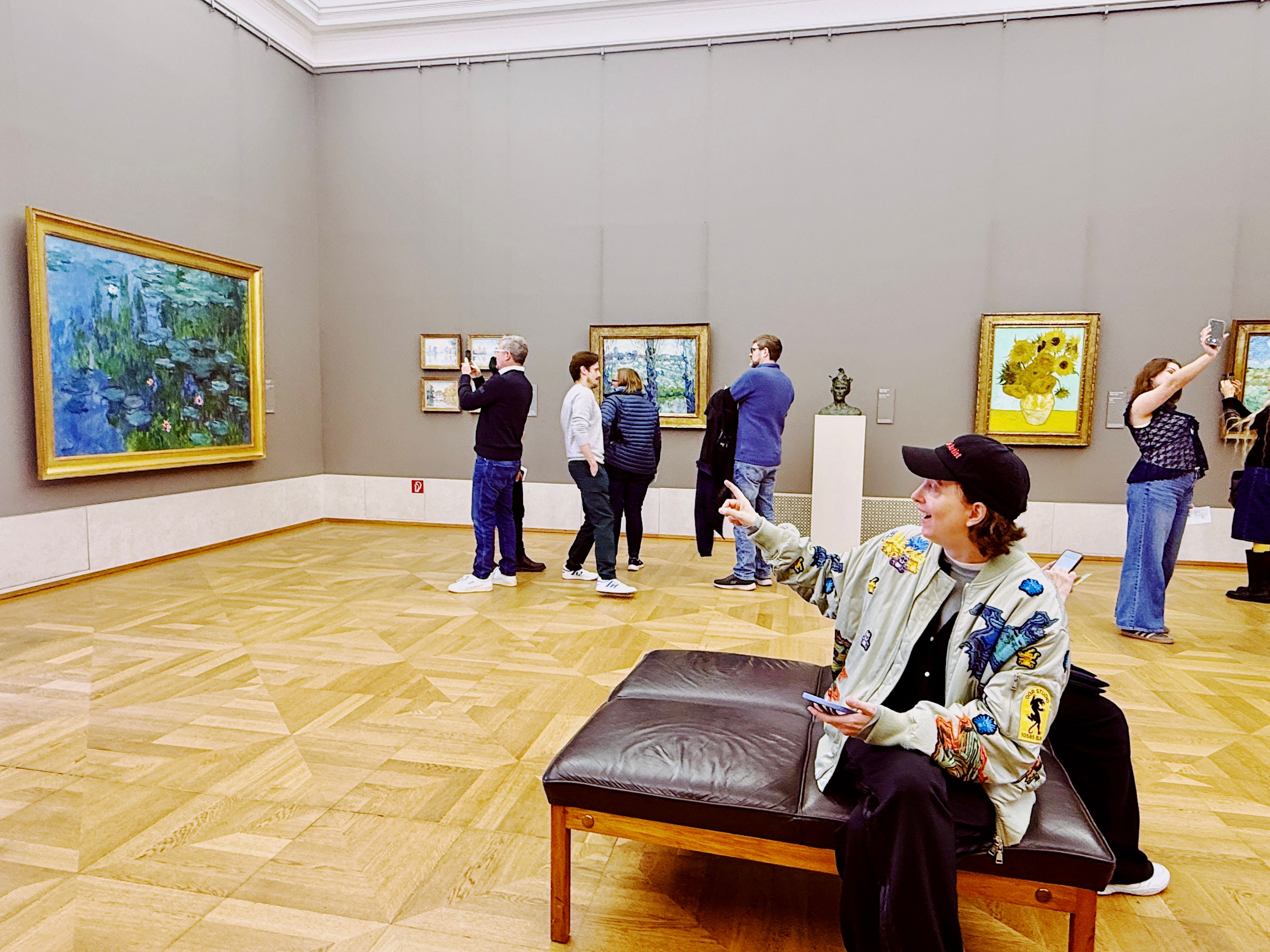
On Saturday morning I was at the Alte Pinakothek with Tamiko Thiel because there had been some internet drama. Which sounds like a romantic retreat to the Old Masters, but it was not. On May 12, the anonymous conceptual artist SHL0MS shared an image by Monet on Twitter and made it sound as if it were not a Monet but an AI-generated image. He wrote:
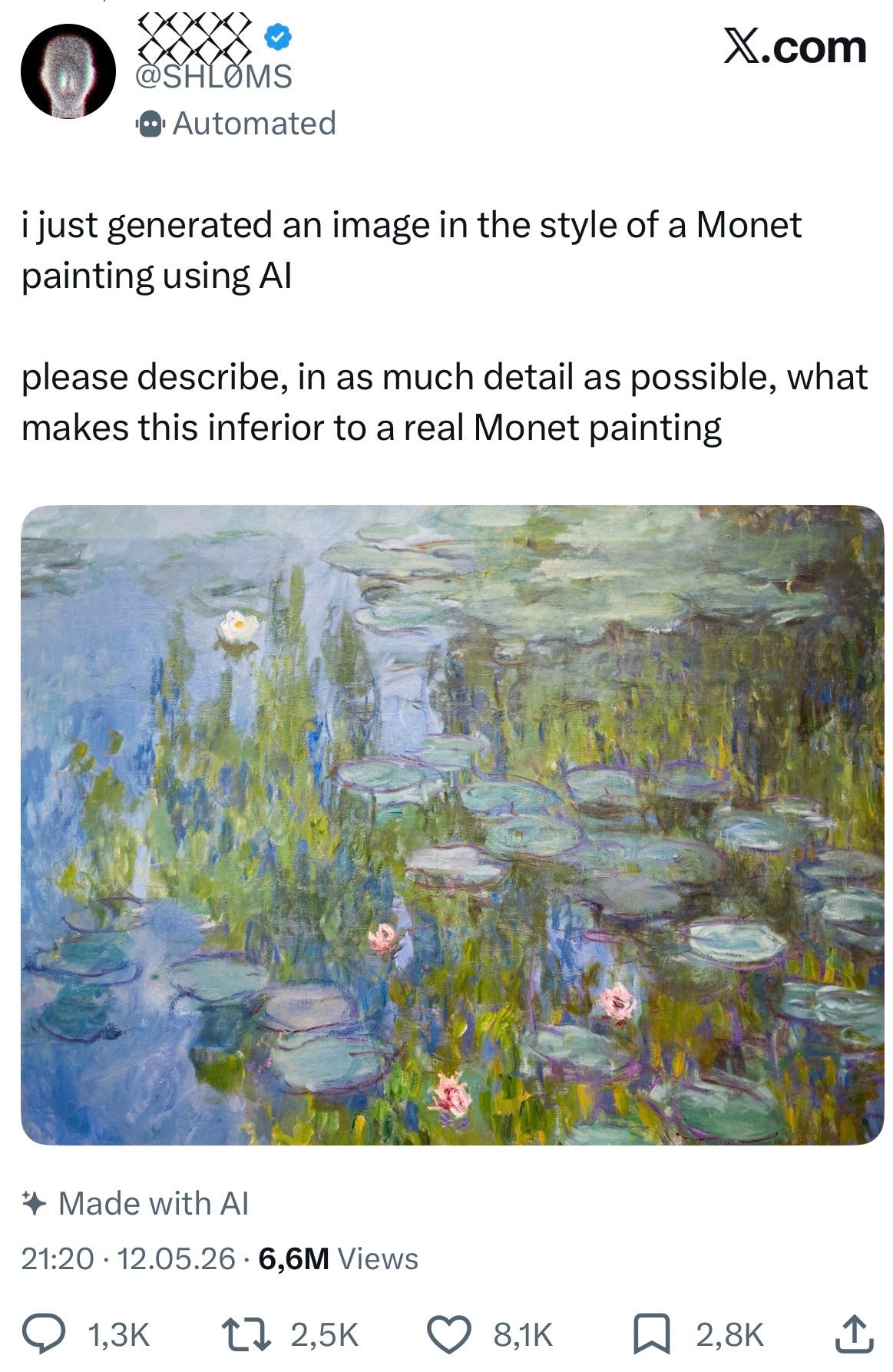
People took him at his word and, yes, freaked out. Soulless, something was wrong with the colors, with the reflections too, and so on and so forth. At some point he revealed that it was, of course, a Monet. (Which is in the Alte Pinakothek, which is why I was there.) He minted the image and sold it for 42,000 USD. Artists, of course, also freaked out because it was supposedly too easy to go viral, declare a viral hit art, and then also sell it for a lot of money. And then a lot was written and is being written about how social media changes the role of the artist. And that is when I became a little impatient because this was discussed in exhaustive detail in the 2010s.
The 2010s happened. As a reminder, Brad Troemel’s seminal essay Athletic Aesthetics (2013) already updated conceptual art for the feed. Comedian, by Maurizio Cattelan (aka the banana), is from 2019. And Wolfgang Ullrich’s Siegerkünstler (2016) already described artists whose success is inseparable from systems of recognition, visibility, and affirmation.
SHL0MS, by the way, called his Monet Inferior Image. Why does so much text about AI get generated over anything involving AI, but nobody talks about inferior writing? That surprised me.
I think the art world has a branding problem.
More on the topics briefly touched on above on Tuesday in my talk at re:publica (6:00–6:30 pm) in Berlin and next week in the traditional media. This afternoon I had a long conversation with SHL0MS for SLEEK.
Here is a quote from our conversation in advance:
Take care,
Anika
Comments
Nothing yet. Say the first thing.
Sign in to join the conversation.