
For three centuries debate about the Union has been framed as if England and Scotland shared the same constitutional logic. They did not. Once that’s corrected, the question of consent doesn’t become “difficult” — it becomes impossible.
England: sovereignty was vested in Crown-in-Parliament. The monarch and Parliament together held ultimate authority.
Scotland: sovereignty was vested in the Community of the Realm — the people as a constitutional body — and expressed institutionally through The Estates.
The monarch and the Parliament in Scotland did not hold sovereignty. They exercised power only under the authority of The Estates.
This isn’t an interpretation — it is proven by the events of 1689. The Estates legally deposed the monarch and codified the principle in the Claim of Right. That is only possible if the monarch was never sovereign.
Scottish constitutional law preserved the principle salvo jure cujuslibet — “saving the right of anyone”. On matters of fundamental right, the people (through their constitutional bodies) retained the authority to challenge or overturn decisions even of Parliament or monarch.
This principle only makes sense if sovereignty does not reside in those offices.
Protection of existing rights: The formula was used in Scottish legislation to make clear that when Parliament granted new privileges or passed fresh measures, these were not to be read as cancelling or diminishing rights already held by others. New enactments operated under the reservation that prior rights remained intact.
Routine parliamentary practice: From the late sixteenth century until 1707, it became normal for the Scottish Parliament to close its sessions by issuing a “salvo” — an open notice to the realm that anyone who believed their rights had been encroached upon by new laws could challenge them.
Constitutional meaning: In Scottish constitutional thought, this practice affirmed that ultimate authority lay with the people, who retained the right to review and contest parliamentary acts. This position stood in fundamental contrast to the English doctrine that placed final, unquestionable authority in Parliament itself.
The event called the “Union of Crowns” by English Constitutional Historians assumes the crown was the seat of sovereignty. In Scotland it was not. Therefore sovereignty was not united in 1603, it remained with The Community of the Realm in Scotland.
What united was not the crowns in the constitutional sense, but the wearer of two separate offices. From a Scottish Constitutional point of view it was therefore a Union of Monarchs not of Crowns.
The two systems of sovereignty remained distinct.
The idea that the Scottish Crown was held in trust for the Community of the Realm didn’t come from one Act or case. It emerged over time through political behaviour, public declarations and constitutional settlements from the late 13th century onwards.
Wars of Scottish Independence
(sometimes later referred to as the Anglo-Scottish Wars or Wars of the Scottish Succession) (late 1200s–early 1300s) - During the interregnum after Alexander III, authority was exercised by Guardians acting in the name of the community, not a monarch — an early assertion that the people were the constitutional principal.
Declaration of Arbroath (1320) - Affirms that kingship depends on the people’s will and that a king who fails in duty may be removed — a direct assertion of popular sovereignty.
Claim of Right (1689) - The Estates lawfully removed James VII for breaching fundamental law, asserting again that the monarch holds office under the people, not above them.
Post-Union settlement (1707) - The supposed ‘Union’ itself preserved the distinct Scottish constitutional tradition in Treaty and Acts even though Westminster governance ignored its substance in practice.
MacCormick v Lord Advocate (1953) - The Court reaffirmed that Scotland’s constitutional tradition does not follow the English doctrine of absolute parliamentary supremacy.
Across centuries of practice, Scotland treated the people — the Community of the Realm — as the source of constitutional authority. Kings and parliaments governed under that sovereignty, not in place of it.
The Estates were the body in whom sovereignty was held in Scotland.
Pre-1707 Scotland didn’t treat monarch or Parliament as sovereign. When, in 1689, the sovereign Estates constitutionally sacked a monarch, they codified that sovereignty into The Claim of Right.
So the monarch and legislature (Parliament) ruled only with and under the authority of the Estates.
This is why the Claim of Right (1689) could lawfully depose a king — because the king was not the source of sovereignty. Sovereignty belonged to the Community of the Realm, the people who had the constitutional right under “Salvo jure cujuslibet” to challenge and overturn any decision by Parliament or monarch via representatives convened and exercised through The Estates
The Estates originally constituted three parts:
Clergy
Nobility
Burgh commissioners (representing the people / towns)
By 1707 the Burghs predominated, this is why we see an enormous number of anti-Union petitions submitted to the Burghs in 1706/7.
British Historians dismiss this as incidental because they’ve been looking at the issue through an English constitutional frame. In fact the petitions had legal constitutional weight in Scotland and may well have led to the rejection of the Treaty of Union if The Estates had been convened, as constitutionally was required.
They were the sovereign constitutional actor in Scotland
Only they could authorise constitutional change
They were not the same as the “Scottish Parliament” that Westminster dissolved
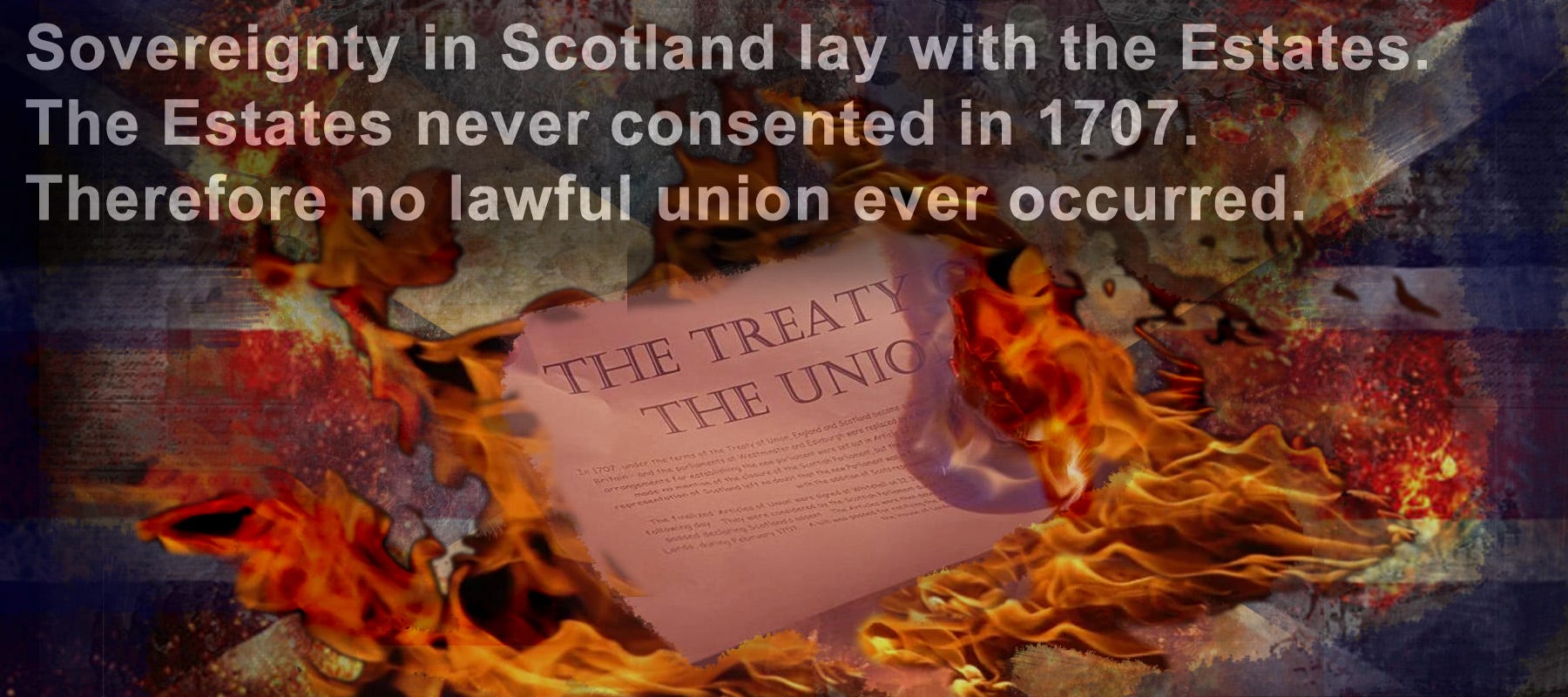
In 1707 they did not consent to the 1707 Union — they were never allowed to sit and vote on it
So when the Union was pushed through a non-sovereign parliament (under threat of invasion, bribery and economic blockade), it bypassed the only lawful sovereign authority in Scotland.
A constitutional change is valid only if authorised by the body that holds sovereignty.
In England that body was Crown-in-Parliament.
In Scotland that body was the Estates acting for the Community of the Realm.
The timeline of what actually happened:
16 Jan 1707 — a non-sovereign Parliament votes 110–67 to pass the Treaty
1706–07 petitions — mass anti-Union petitions submitted to Burghs (a core component of the Estates)
These petitions had constitutional force under salvo jure cujuslibet and required consideration by the Estates22 Apr 1707 — the Estates were due to sit — the only body competent to authorise or refuse
28 Apr 1707 — Parliament is dissolved by royal proclamation — not by the Estates, the only body competent to do so
30 Apr 1707 — The English Parliament declares itself the Parliament of Great Britain and continues sitting
1 May 1707 — the arrangement is enforced
The only body with lawful authority to consent — never gave consent.
The Treaty of Union wasn’t ratified by the sovereign people of Scotland acting through their constitutional institution, The Estates.
It was passed through a legislature, Parliament, that didn’t possess the authority required to alienate sovereignty.
No further historical detail is required. Before coercion, before blockade, before troops, before bribes — the defect is structural.
A union is only a union if the sovereign authority of both parties’ consent.
In Scotland that sovereign authority was never asked and never gave consent.
What occurred in 1707 was not a union between equal sovereign entities but the imposition of incorporation over a sovereign people whose only lawful constitutional authority was bypassed.

Further information:
Records of the Parliaments of Scotland — Act salvo jure cujuslibet
Records of the Parliaments of Scotland — Glossary of Terms
Latin Phrases — salvo jure cujuslibet
If you’d like to support my research into Scotland’s true history, you can chip in for running costs (and the coffees that keep me going) here: https://ko-fi.com/angrypict
No posts
Comments
Nothing yet. Say the first thing.
Sign in to join the conversation.