
In April 1707 the sitting of Parliament that could have allowed a Convention of Estates to arise was blocked; precisely because the people still held the lawful right to intervene.
This is Part I of a two‑part analysis. Part I establishes what was done: the constitutional mechanism by which the Union was brought into being before lawful consent could be obtained, and the erasure of the interval in which that consent should have been tested.
Part II sets out why this suppression was necessary: the legal, military, financial and diplomatic pressures that made it impossible for England to allow the Convention of Estates to sit.
The Union Was Never Consented to— It Was Forced on Scotland
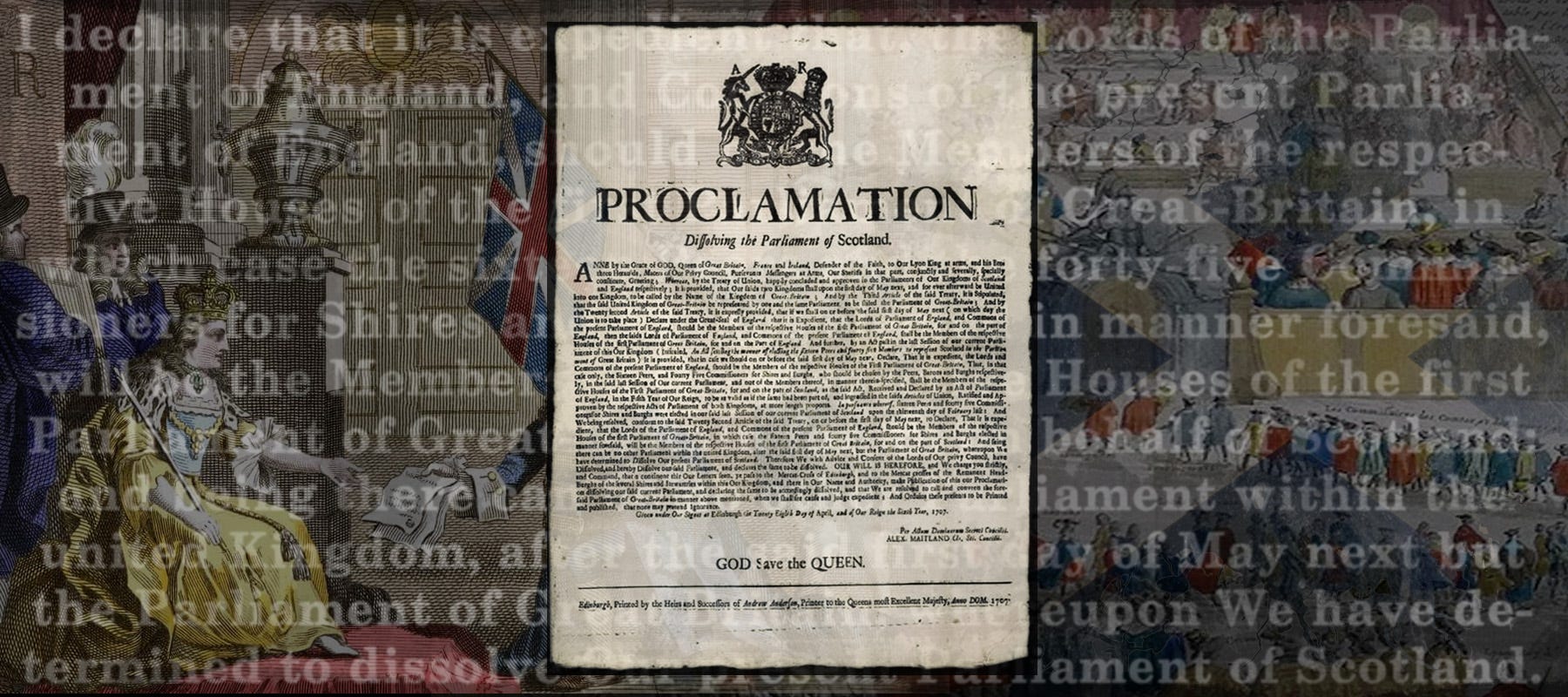
For three centuries the Union has been narrated back-to-front. The official story begins with the Act already passed and ends with the United Kingdom already in being — leaving no visible place for a constitutional breach.
However, that missing breach exists. Restore it, and the Union stops reading like a consensual treaty and, instead, reads like a constitutional seizure.
“The queen’s majesty declares this parliament current and adjourns the same to 22 April next to come…”
Records of the Parliaments of Scotland, 25 March 1707. Full text below.
On 25 March 1707 the Scottish Parliament did not dissolve. It adjourned to reconvene on 22 April.
That adjournment created a constitutional window in which The Convention of Estates, the only body competent to extinguish or transfer sovereignty, could have arisen. But summonses were never issued, and the sitting never took place.
Six days after that missed sitting, a Royal Proclamation dissolved Parliament and presumed a Union that did not yet exist in law.
That moment is the one that the British narrative deletes
It deletes it because it is where consent should have been given, or refused.
This is the moment where force replaced consent.
The defence the British state has created comes from silently importing the English constitutional model into Scotland, after the fact.
In England Parliament is sovereign. In Scotland it was not. The Scots Parliament was a delegated legislature; it had no authority to dissolve itself, and effectively the realm. Only the Convention of Estates could do that — and that body could still have arien at the adjourned sitting which is precisely why it was prevented from taking place.
Following this, on 28 April 1707, and after refusal had been made impossible, Queen Anne dissolved the Parliament as though the Union already existed — even though Scotland remained a sovereign kingdom in law until 1 May.
However the British might finesse, or ignore, that event it’s certainly not ratification. It’s a pre‑emptive annexation.
British claim: “Parliament was dissolved because the Union had been agreed.”
The reality: “The Union was declared agreed in order to dissolve Parliament before lawful authority could act.”
This inversion is the actual mechanism of the coup.
“…there can be no other Parliament within the United Kingdom after the first day of May next… whereupon We have determined to dissolve Our present Parliament of Scotland… and hereby dissolve the same.”
Queen Anne, Proclamation, 28 April 1707. Full text below.
Once that sequence is seen, the usual descriptions collapse.
It was never voluntary: the only body capable of refusal was blocked.
It was not bilateral: one side’s sovereign machinery was disabled in advance.
It was not lawful: the proclamation assumed a Union not yet in force.
It was not ratified: the ratifying body never met.
This structure matches every annexation in history: prevent the full constitutional process; declare the transfer of power; use the declaration as proof.
Concealment of the ‘crime’ was, and still is, active, and this isn’t accidental:
The 22 April adjourned sitting of Parliament at which The Convention of Estates could have lawfully acted, is erased.
A proclamation is re-framed as execution after the fact rather than foreclosure before.
The interval in which Scotland was still sovereign is written out of public memory.
And the British state’s own behaviour suggests knowledge of the constitutional breach:
It glosses over the missing week.
It never prints the proclamation in context (below is the first time the proclamation has ever been presented online).
It always begins the story after the crime.
The Scottish elite, in Parliament, could be managed: by bribes, threats, patronage and promises of compensation and land. Enough of them were brought to heel to ensure parliamentary compliance.
The people could not.
“…this parliament current and adjourns the same to 22 April next to come, ordaining all members of parliament, noblemen, commissioners from shires and burghs, and all others having interest, to attend at Edinburgh that day at 10 o’clock…”
Records of the Parliaments of Scotland, 25 March 1707. Full text below.
The adjourned sitting of 22 April wasn’t merely a meeting of the same men in a different room; it was the moment at which the people of Scotland, “all others having interest,” could lawfully enter the constitutional forum — the one forum in which the rights of thousands of petitioners, and the constitutional arguments already circulating against the Treaty in print, could finally be put on the record and tested.
One appearance wouldn’t simply register dissent — it would place those rights formally before the one body with standing to answer them.
Hundreds or thousands appearing would have made that reckoning impossible to avoid.
The 22nd April sitting therefore wasnʼt suppressed to prevent a no‑vote by the elite members of The Estates — the elite was already neutralised.
The possibility of The Convention of Estates arising at that sitting was suppressed to prevent the sovereign people of Scotland from being heard at all — the one forum, and the one moment, in which their rights and their refusal could have entered the constitutional record before the Union took effect.
If the necessary sovereign act of ratification never happened, nothing after that event rests on lawful Scottish consent.
The Union can’t be reformed by argument, devolution, or federalism — the so-called Union is, in fact, invalid at origin in 1707.
A constitutional act that was never lawfully authorised doesn’t become lawful through the passage of time.
It cannot be made lawful by referenda organised by the administering power. England masked as the UK, can’t gain lawful jurisdiction in Colonial Plebiscites 307 years later.
The original defect never expires, no matter what they say or do.
A state built on an unratified seizure cannot transform into a lawful entity by longevity or habit; its continuity is only proof of continued suppression; it therefore has no legitimacy.
The United Kingdom therefore rests, at its founding moment, not on consent but on the suspension of consent.
In contemporary law, a political order founded on the denial of a people’s sovereignty is classed not as a union but as an annexation.
That’s not a historical interpretation; it’s the present constitutional reality.
Put simply:
No adjourned sitting = no activation of the Convention of Estates = no consent = no lawful Union.
What then remains isn’t a partnership that can be renegotiated. What remains is an annexation carried forward by inertia, force and narrative suppression
An annexation that has only been sustained by the speed and thoroughness that buried the events of that missing week and the fact that they occurred at all.

[1706/10/467]1
Legislation
Act of adjournment
“The queen’s majesty declares this parliament current and adjourns the same to 22 April next to come, ordaining all members of parliament, noblemen, commissioners from shires and burghs, and all others having interest, to attend at Edinburgh that day at 10 o’clock, and that there be no new elections in shires or burghs, except upon the death of any of the present commissioners.”
NAS. PA6/34, ‘March 25 1707’. The Records of the Parliaments of Scotland to 1707, K.M. Brown et al eds (St Andrews, 2007-2025), date accessed: 28 October 2025.
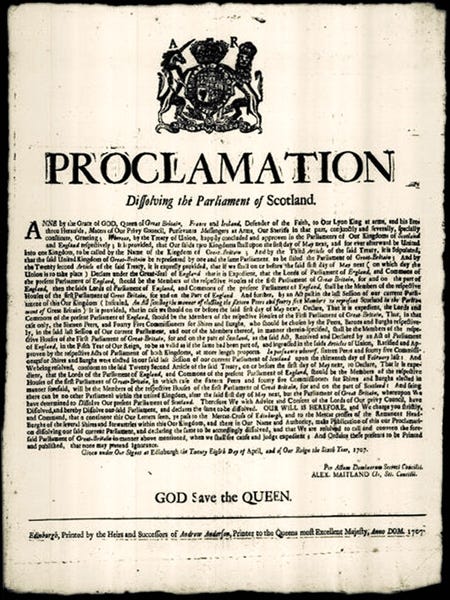
Queen Anne’s full proclamation, 28th April 1707:
“PROCLAMATION
Dissolving the Parliament of Scotland,
Given under Our Signet at Edinburgh the Twenty Eighth Day of April, and of Reign the Sixth Year, 1707
Anne by the grace of God, Queen of Great Britain, France and Ireland, Defender of the Faith, to our Lyon King of Arms, and his brethren Heralds, Macer of our Privy Council, Pursuivants, Messengers at Arms, Our Sheriffs in that part, conjunctly and severally, specially constitute Greetings. Whereas, by the Treaty of Union, happily concluded and approved in the Parliaments of Kingdoms of Scotland and England respectively, it is provided that Our Said two Kingdoms shall upon the first day of May next, and forever afterward, be united into one Kingdom, to be called by the name of the Kingdom of Great Britain. And by the Third Article of the said Treaty, it is stipulated that the said United kingdom of Great-Britain be represented by one and the same Parliament, to be titled the Parliament of Great-Britain. And by the twenty-second Article of the said Treaty, it is expressly provided, that if we shall on or before the said first day of May next (on which day the Union is to take place) declare under the Great Seal of England that it is expedient, that the Lords of Parliament of England, and the Commons of the present Parliament of England, should be the Members of the respective Houses of the first Parliament of Great Britain, for an on the part of England.
And further by an Act passed in the last session of our current Parliament of this Our Kingdom (Entitled, An Act settling the manner of electing the sixteen Peers and forty-five Members to represent Scotland in the Parliament of Great Britain) it is provided, that in case we should on or before the said first day of May next, Declare that it is expedient the Lords and Commons of the present Parliament of England, should be the Members of the respective Houses of the first Parliament of Great-Britain. That in that case only, the Sixteen Peers, and forty-five Commissioners for the shires and Burghs, who should be chosen by the Peers, Barons and Burghs respectively, in the said last session of Our current Parliament, and out of the Members thereof, in manner therein specified shall be the Members of the respective Houses of the first Parliament of Great-Britain, for an on the part of Scotland, as the said Act received and Declared by an Act of Parliament of England, in the fifth year of Our Reign, to be as valid as is the same had been part of, and engrossed in the said Articles of Union. Ratified and approved by the respective Acts of Parliament of both Kingdoms, at more length purports. In pursuance whereof, sixteen Peers and forty-five Commissioners for Shires and Burghs were elected in our said last session of our current Parliament of Scotland upon the thirteenth day of February last. And we being resolved to conform to the said twenty-second Article of the said Treaty, on or before the first day of May next.
I declare that it is expedient that, the Lords of the Parliament of England, and Commons of the present Parliament of England, should be the Members of the respective Houses of the first Parliament of Great-Britain, in which case the sixteen Peers and the forty-five Commissioners for Shires and Burghs elected in manner foresaid, will be the Members of the respective Houses of the first Parliament of Great-Britain for an on behalf of Scotland: and being there can be no other Parliament within the united Kingdom, after the said first day of May next but the Parliament of Great Britain, whereupon We have determined to dissolve Our present Parliament of Scotland.
Therefore, We with the advice and consent of Our Privy Council, have dissolved, and hereby dissolve our said Parliament, and declare the same to be dissolved. OUR WILL IS HEREFORE and We charge you firstly and Command, that it is continent that Our Letters seen, ye pass this to the Mercat-Cross of Edinburgh, and to the Mercat crosses of the Remanent Burghs of the several Shires and Stewartries within this Our Kingdom, and there in Our Name and Authority, make Publication of this our Proclamation dissolving our said current Parliament, and declaring the same to be accordingly dissolved, and that We are resolved to call and convene the foresaid Parliament of Great-Britain in manner above mentioned, when we shall…. Judge expedient, and ordains these present to be printed and published, that none may pretend ignorance.”

Records of the Parliaments of Scotland — Act salvo jure cujuslibet
Records of the Parliaments of Scotland — Glossary of Terms
Latin Phrases — salvo jure cujuslibet
If you’d like to support my research into Scotland’s true history, you can chip in for running costs (and the coffees that keep me going) here: https://ko-fi.com/angrypict
No posts
Comments
Nothing yet. Say the first thing.
Sign in to join the conversation.