
Introduction
The Annexation of 1707 wasn’t simply a political act; it was enforced militarily, materially and institutionally by the British state.
The Highland Clearances were the continuation of annexation, and conquest — Crown-backed, militarised, and colonial.
The Clearances dispossessed people from their land. British (in reality, English) Crown and state repression dismantled sovereignty and culture.
This article pairs with forthcoming pieces on Demography (the human impact) and Myths (the narrative justifications).
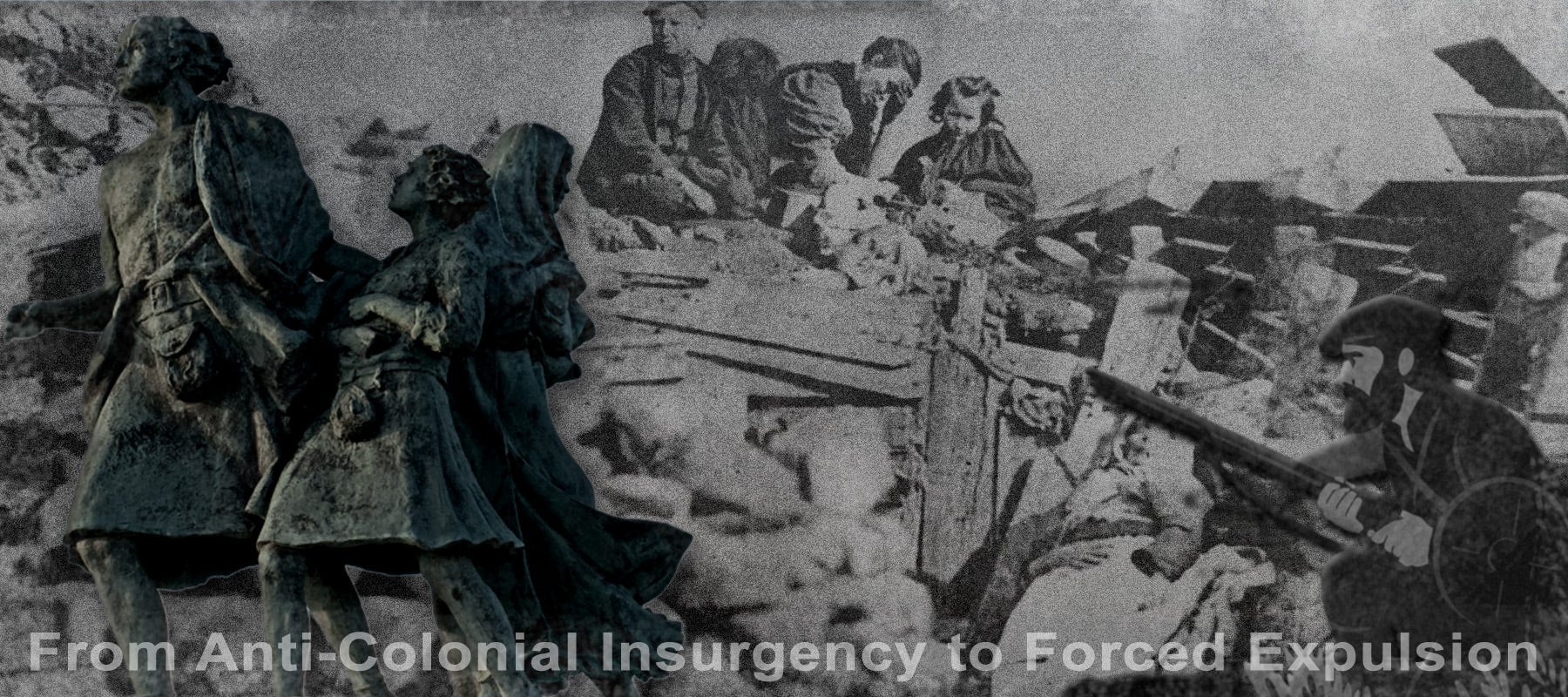
The Clearances — Dispossession as Improvement
Landlords presented the Clearances as progress: efficiency, rational farming, Improvement.
In reality ‘Improvement’ meant eviction, burnings, famine, and exile.
Donald Sage in “Memorabilia Domestica”, Donald Macleod in “Gloomy Memories”, Neil Gunn, Robert Hay, and Fionn MacColla and many more all record the devastation and trauma.
“Their houses were not unsafe; their farms were not too small; their land was not unsuitable for cultivation; the people did not leave of their own volition. The laird was not acting in their best interest but in the estates… while the claim that no-one was evicted who wished to remain was a downright lie.”
— Mary Mackenzie, David Taylor, Glen Banchor: A Highland Glen and its People
From Occupation to Clearance
For at least a decade, from 1746 into the late 1750s, the Highlands were under sustained and heavy military occupation. Garrisons, new roads, and Fort George symbolised permanent conquest. Low-level insurgency flickered on, but when the regiments eased their grip, the damage was done.
“Significant units of armed Jacobites continued to appear in the field even after around 1,000 men mustering at Ruthven in Badenoch had received orders from Charles Edward to sauve qui peut. The MacGregors had marched home unmolested, ‘with colours flying and pipes playing’. On 26 April, it was rumoured that there were 120 in arms at Balquhidder; in the same month four British battalions had to be deployed against Jacobite units. In May, one battalion of Lochiel’s regiment was still operational, as were 500 under Clanranald; ‘in July, significant numbers of Stewart of Ardsheal’s Foot had yet to surrender arms, and Ardsheal was still dealing with arrears of pay’.”
Furthermore, it wasn’t just The Highlands that were affected:
Orkney remained under Jacobite control until late May, despite British attacks, and four of the local Jacobite lairds remained successfully hidden. Jacobite expresses were sent until August; troops were reported in Strathdee in September, and in the same month there were insurgents in Angus. A British regiment was deployed across Banffshire in the summer. In November, Jacobite units were reported still in the field and still being paid; in March 1747, two officers of Lord Cromartie’s regiment carried out a raid on Dingwall. In December 1747, Colonel Watson noted that ‘Attainted Rebels . . . continue to appear publickly, in the Shires of Aberdeen, Banff and Angus, where they hold Traiterous Caballs’. Arms surrenders in the Mearns continued almost into the summer of 1748. British atrocities may have been carried out against helpless victims, but there were plenty of continuing Jacobite threats.”
— Culloden: Great Battles by Murray Pittock. OUP Oxford. 2016.
The shift from counterinsurgency to Clearance wasn’t a change of direction but a continuation of conquest by other means.
Occupation was not only physical but legal and cultural, with courts, churches, and garrisons enlisted to dismantle communal autonomy.
“Scotland was not settled until the 1750s, and then only through the imposition of ‘systematic state terrorism’…”
— Christopher A. Whatley, ‘Order and Disorder’, in Elizabeth Foyster and Christopher Whatley (eds), A History of Everyday Life in Scotland 1600–1800 (Edinburgh: Edinburgh University Press, 2010), 191–216 (191); Pittock, Myth, 130; Duffy, The ’45, 530–3.
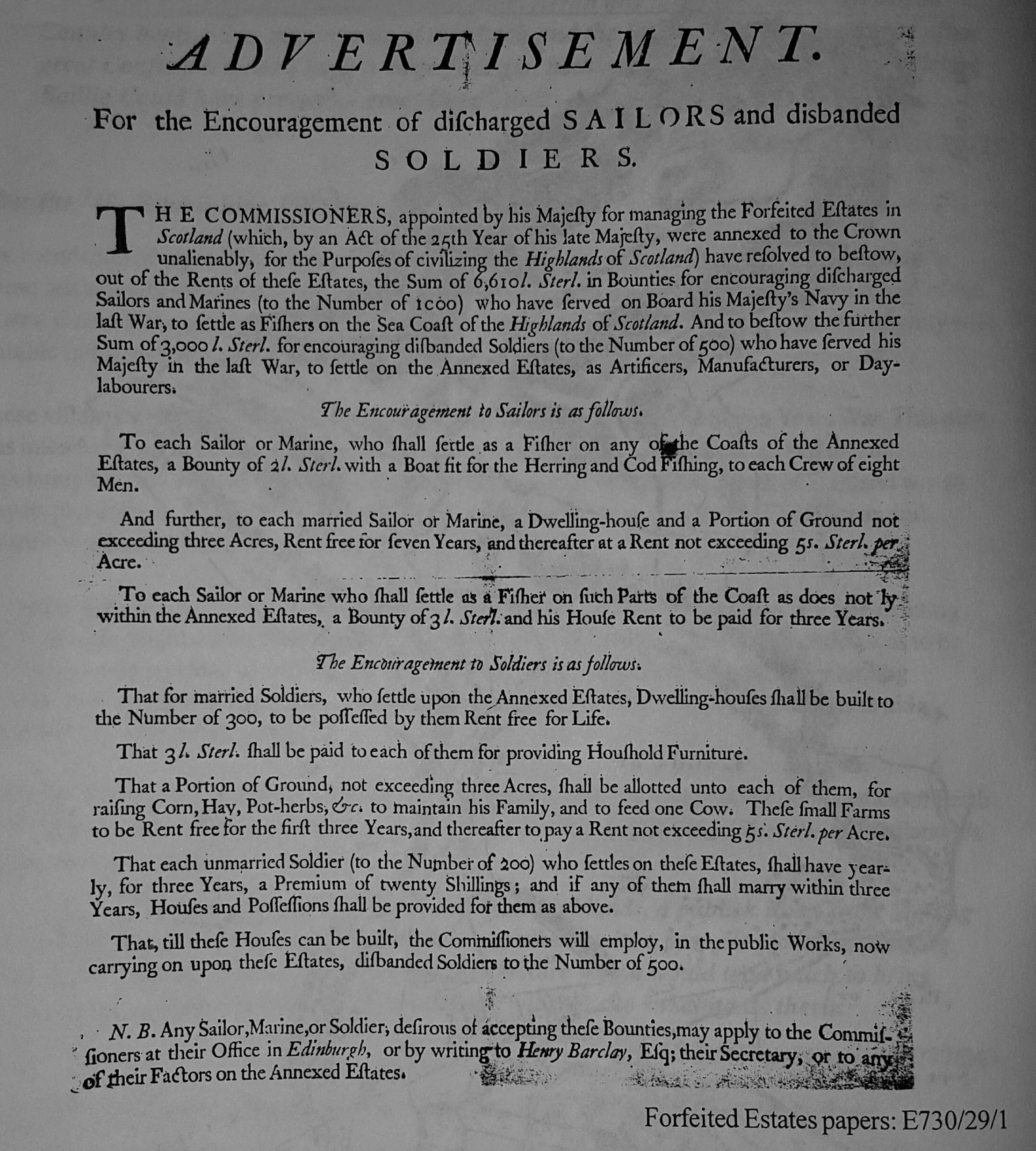
The so-called first “Improvements” were seeded by state policy on forfeited estates — including settlement colonies of disbanded soldiers and sailors. These reveal that early “Clearances” were not organic landlord policy, but British State-directed social engineering to break traditional society.
A textbook colonial strategy: pacification through cultural dismantling and engineered removal.
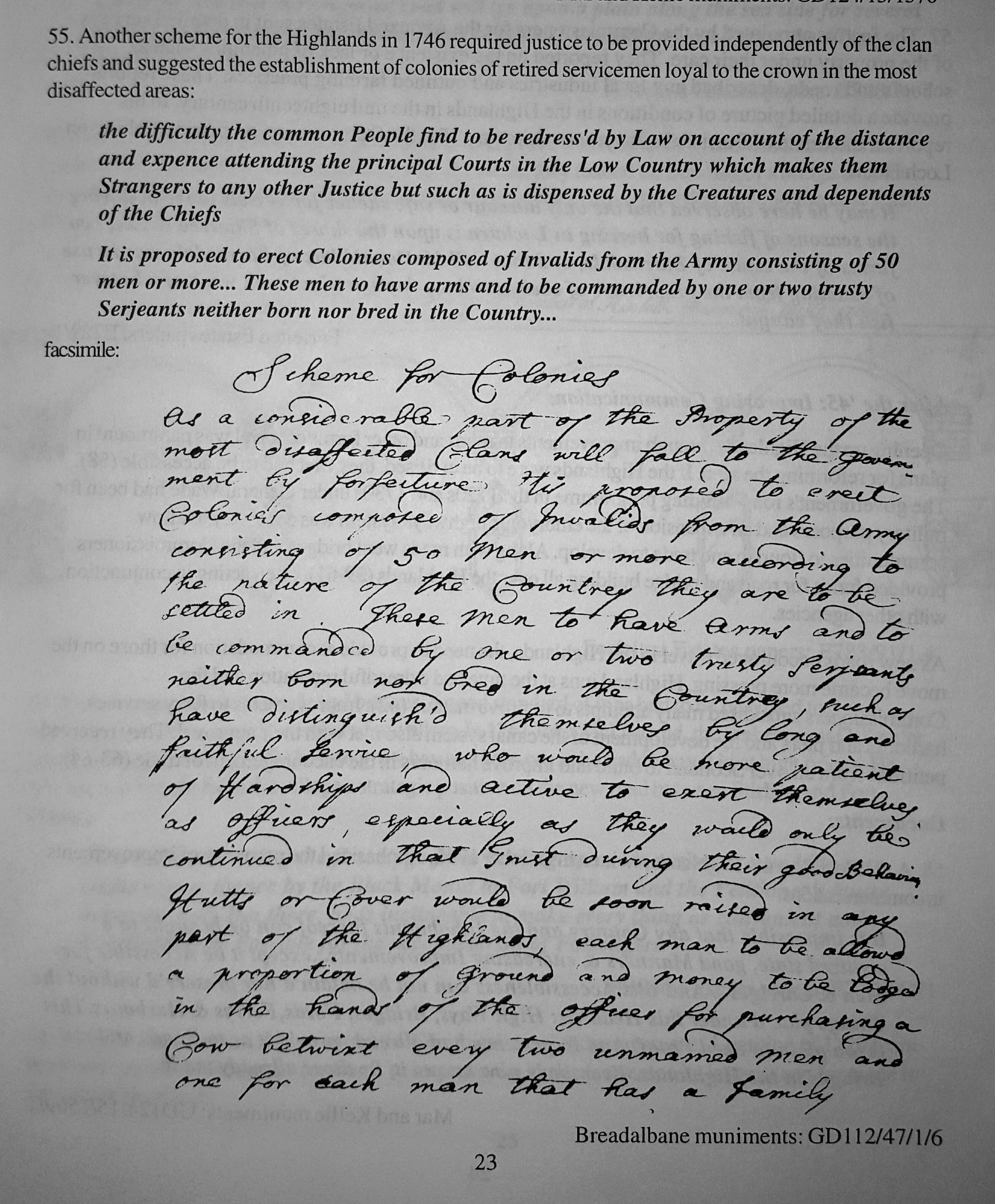
These experimental colonies were planted on forfeited estates — land taken directly into British Crown hands.
The Counterinsurgency Cycle
The Clearances weren’t a new departure in the late 18th and 19th centuries. They were the final phase of a counterinsurgency cycle that began immediately after Culloden.
Phase 1: Military Occupation (1746–56)
Cantonment Registers, Situation Reports, and regimental postings show how Scotland was blanketed with garrisons after 1746. Suppression was nationwide, but the heaviest concentration was in Highland terrain where guerrilla insurgents — “the lads in the heather” — still fought on.
The cantonment system was nationwide: garrisons dotted Lowland towns as well as Highland glens, showing that occupation was not a Highland anomaly but a national project with a Highland focus because that was where insurgency persisted.
Phase 2: Colonisation Schemes (1750s–60s) [see HMSO images above]
On forfeited estates, the British Crown tried to plant disbanded soldiers and sailors as loyalist settlers. The Callander scheme of 1763 is explicit evidence. These were described later as “failures,” but they reveal the state’s intent to replace and dilute populations seen as disaffected.
Phase 3: Legal and Economic Restructuring (1760s–80s)
When colonies faltered, policy shifted. Heritable Jurisdictions Act (1747) erased clan authority, Annexed Estates restructured, and cash rents replaced communal landholding. These measures looked like “Improvement” but functioned as indirect clearance — eroding communal authority and forcing people off the land.
Phase 4: Commercial Clearance (1780s onwards)
By the late 18th century, mass removals in Sutherland, Skye, and Strathnaver were rationalised as economic necessity — sheep, kelp, and wool. But the pattern followed directly from earlier phases: the people targeted were those already undermined by occupation, colonies, and legal change.
Taken together, these phases show that there is no sharp break between “pacification” and “Clearance.”
The latter was simply the mature form of the former. Historians often treat them as distinct, but that separation obscures the structural continuity of a colonial counterinsurgency project. This continuity is clearest on the forfeited estates under Crown control.
Crown & Control — State Repression
After Culloden, repression targeted not just armies but whole communities. The Disarming Act, Dress Act, and Heritable Jurisdictions Act were designed to pacify and strip authority.
Courts, churches, and the army became instruments of British control.
After Culloden, military occupation and the imposition of Crown law restructured authority; then forced eviction carried conquest to its final stage — the removal of people from their land and the pacification of the whole of Scotland.
“British troops treated Scottish towns and their inhabitants with contempt: as late as 16 April 1750, British soldiers in Inverness celebrated the fourth anniversary of Culloden by breaking the town’s windows”
— Culloden: Great Battles by Murray Pittock. OUP Oxford. 2016.
Scotland in the Imperial Playbook
The Clearances weren’t isolated. They formed part of a wider imperial repertoire.
What was trialled in the Highlands—forced removal, cultural suppression, and legal bans/restructuring — was then exported as a policy model across the British Empire.
Colonial administrators often moved between postings in Scotland, Ireland, and overseas. They carried the same methods with them. The logic was consistent: weaken traditional authority, seize land for profit, and justify with the language of Improvement.
Even official records spoke of “colonies” in the Highlands — Scotland itself was treated as colonial territory (See HMSO images above).
Cultural Destruction & Resistance
Suppression extended to language, dress, and religion.
These bans were designed to extinguish the social fabric that had sustained insurgency. This ensured that the road from occupation to expulsion ran through cultural as well as military suppression.
But resistance endured: the land raids of the 1880s–1920s, the Crofters’ struggles, and the survival of Gaelic poetry and song carried memory forward.
Resistance and Reform
The land raids of the 1880s were the long echo of Culloden — resistance shifting from guerrilla warfare to organised popular protest, but still aimed at reversing eviction and reclaiming the land.
In Glasgow, and other towns, resistance took industrial forms.
These struggles were not relics but milestones in a continuous line of anti-colonial resistance.
The memory of occupation, eviction and hunger sustained collective action. The Crofters’ War of the 1880s shows how organised resistance contributed to the Crofters’ Holdings (Scotland) Act of 1886, which granted security of tenure.
The Battle of the Braes in Skye was a flashpoint that forced state intervention.
The legacy of these campaigns still shapes contemporary debates like land rights.
“One afternoon as I was returning from my ramble a strange wailing sound reached my ears at intervals on the breeze from the west. On gaining the top of one of the hills... I could see a long and motley procession winding along the road that lead north from Suishnish... It halted at the point of the road opposite Kilbride, and there the lamentations became long and loud.
Everyone was in tears, each wished to clasp the hands that had often befriended them, and it seemed as if they could not tear themselves away...
When they set forth once more a cry of grief went up to heaven, the long plaintive wail, like a funeral coronach, was resumed, & after the last of the emigrants had disappeared behind the hill,... the sound seemed to re-echo through the whole valley in one prolonged note of desolation. The people were on their way to be shipped to Canada.”— Sir Archibald Geikie, Scottish Reminiscences (1906)
Demographic Impact — A Nation Reshaped
Thousands were displaced over generations to Canada, the United States, and Australia.
But just as significant was the internal shift: depopulated glens and resettlement into Glasgow, and the Central Belt.
This demographic rupture reshaped Scotland permanently—industrial labour in the Lowlands, emptiness in the Highlands.
The demographic story deserves its own treatment — which we take up in the next article.
The modern legacy of The Clearances isn’t only demographic — it’s also legal.
International Law — The Right to Self-Determination
Under international law, dispossession is not only a historical tragedy — it is a matter of rights.
The UN General Assembly’s Declaration on Decolonisation (Resolution 1514, 1960) states that “all peoples have the right to self-determination; by virtue of that right they freely determine their political status and freely pursue their economic, social and cultural development.”
Article 1 of the International Covenant on Civil and Political Rights (ICCPR, 1966) affirms that “all peoples have the right of self-determination” and that “in no case may a people be deprived of its own means of subsistence.”
Resolution 1514 sets the universal principle. The ICCPR makes it binding.
By those definitions, the Highland Clearances — the mass removal of a people from their land, the destruction of their economic base, and the suppression of their culture — clearly place Scotland within the framework of colonisation recognised in international law.
The Clearances are not only a historical injustice — they are a legal foundation for Scotland’s right to decolonisation today.
Conclusion — Force and Control as the Foundations of Union
“It is now a lamentable truth, that the Highlands of Scotland (Tir mo ghraidh. Tir nam beann, nan gleann 's nan gaisgeach) which the Roman army in their victorious days failed to conquer — which the brutal Edwards, and Cromwell, and many other formidable invaders failed to subdue — are now converted to a howling solitary wilderness, from which joy and rejoicing are fled for ever. Where the martial notes of the bagpipes, echoed by mountains and glens, ceased to be heard — and where no sweeter strains to cheer the stranger who may happen to travel there, are heard, than the yell of shepherds and foxhunters the bleating of sheep, the barking of collie dogs, and the screeches of the owl and eagle.
It is true my friends, that I have devoted all my spare time and means, for the last thirty-four years, expostulating, remonstrating with, and exposing the desolators of my country, and extirpators of my race, from the land of their birth, and advocating the cause of the suffering people, during these trying, murdering, and desolating times — considering that I could not serve God in a more acceptable way, than to help those who could not help themselves. Thousands of my countrymen in this country, and elsewhere, will bear me witness in what I have suffered at the hands of the scions of Highland aristocracy, for performing what I considered my incumbent duty.”— Gloomy Memories in the Highlands of Scotland or a faithful picture of the extirpation of the Celtic race from the Highlands of Scotland by Donald Macleod. First edition, Edinburgh 1841. Second edition, Greenock 1856. Third edition, enlarged and improved, Toronto, Canada 1857. Various editions thereafter.
The Clearances weren’t a separate episode from earlier repressions. They were the structural continuation of British counterinsurgency.
Military occupation after Culloden broke the old order. Crown law then restructured authority, converting chiefs into landlords under its courts. Evictions and “Improvement” carried conquest to its final stage — the removal of people from their land.
Conquest didn’t end with expulsion: survivors were redirected into Britain’s wars abroad, their loyalty extracted as their land was erased.
Clearance removed communities, repression dismantled sovereignty and culture. Together they ensured full subordination.
As Fionn MacColla put it in his autobiography, Too Long in This Condition (1975), the British Army was “the gas chamber of the Scots, and more particularly of the Gaels.”
“The country was darkened by the smoke of the burnings, and the descendants of those who drew their swords at Bannockburn, Sheriffmuir, and Killicrankie—the children and nearest relations of those who sustained the honour of the British name in many a bloody field—the heroes of Egypt, Corunna, Toulouse, Salamanca, and Waterloo—were ruined, trampled upon, dispersed, and compelled to seek an asylum across the Atlantic; while those who remained from inability to emigrate, deprived of all the comforts of life, became paupers, beggars—a disgrace to the nation whose freedom and honour many of them had maintained by their valour and cemented with their blood.”
— Gloomy Memories in the Highlands of Scotland or a faithful picture of the extirpation of the Celtic race from the Highlands of Scotland by Donald Macleod. First edition, Edinburgh 1841. Second edition, Greenock 1856. Third edition, enlarged and improved, Toronto, Canada 1857. Various editions thereafter.
International law is clear. Scotland’s history is not just its past — it is an unresolved colonial injustice that demands remedy.
Coming up
This analysis feeds directly into an upcoming piece on Demography, covering the scale of population loss, and then into Myths, where the justifications used, namely “progress” and “inevitability”, are dismantled.
Original British Army Cantonment transcriptions are thanks to:
Stennis Historical Society: https://sites.google.com/view/stennishs
Cantonment Maps: https://www.cantonmentmaps.scot/
With grateful thanks.
If you’d like to support my research into Scotland’s true history, you can chip in for running costs (and the coffees that keep me going) here: https://ko-fi.com/angrypict
Comments
Nothing yet. Say the first thing.
Sign in to join the conversation.