
As a result of social media developments (see below) we’re going to take a brief dive into Scottish ‘participation’ in the British Empire. A stick that is often deployed as if it’s proof that Scotland was never colonised itself.
We published a long form, two part, thread on X in response, and due to popular demand have decided to publish an expanded version here.
Next time we’ll return to the Annexation theme we’ve been pursuing for the last few weeks with an article on whether the Union on its own terms was actually legal at all or could ever have been legal.
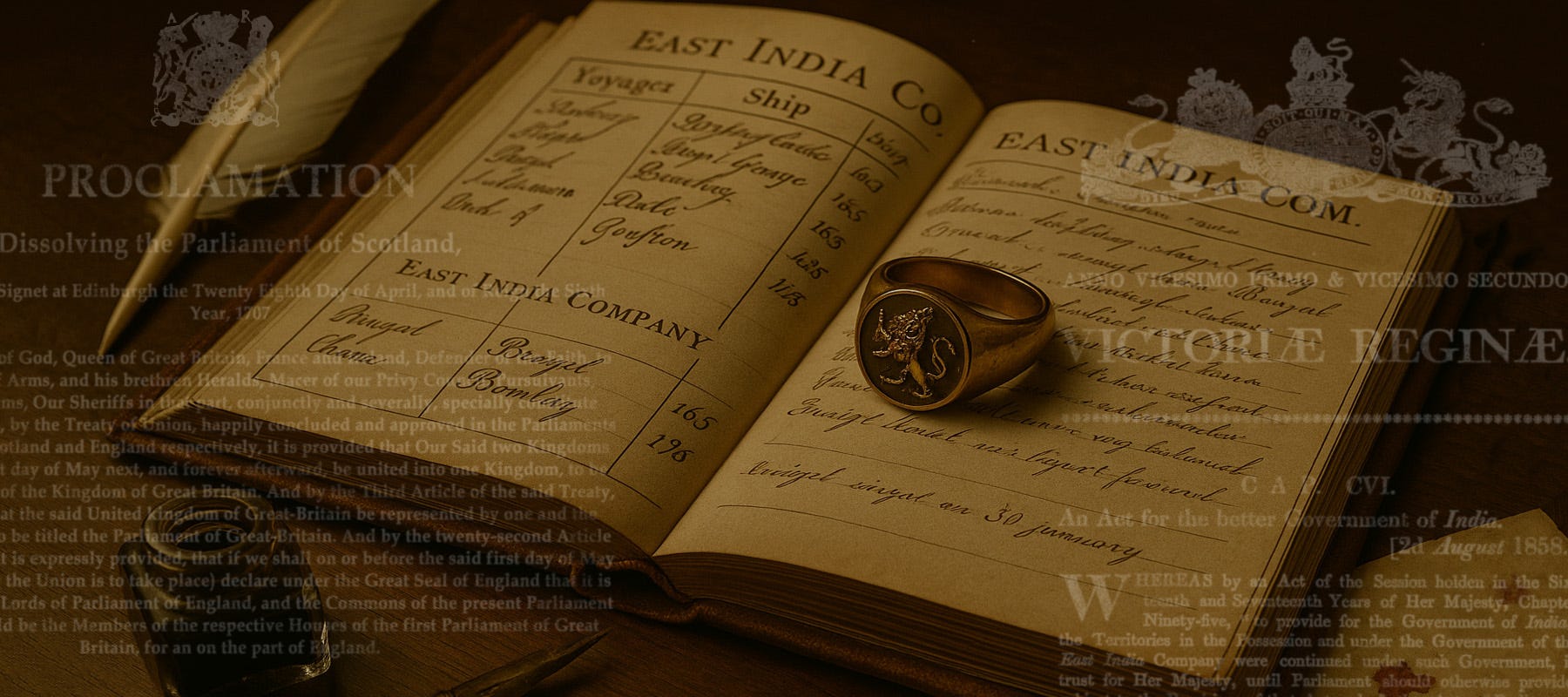
The Exchange That Exposed It All
It started with a spat on X.
Niall Ferguson, a historian well known for defending the Anglo-British Empire, mocked historian William Dalrymple for criticising imperialism whilst arguing that India’s widespread use of English was a competitive advantage. That being the result of “that wicked Empire you are so fond of denigrating”, Ferguson jibed.
The old boast in miniature: empire as civilisation.
Ferguson, from a Scottish background, and now resident in the United States, boasted “my grandfather served in India and Burma”, then goaded Dalrymple. “did I miss a heroic episode in Hamilton-Dalrymple history (aside from their ignoble part in the Glencoe Massacre)?”.
Dalrymple reminded him that “there were generations of Dalrymples in India” from his ancestor “Stair Dalrymple” to his “father who was in the army at partition in 1947”.
The Dalrymple family knew empire from the inside, they built it, but William’s subtext is liberal guilt, he regrets it. Ferguson in contrast takes unashamed pride in Empire.
The argument between Ferguson and Dalrymple is really about a historical elite, the same that betrayed Scotland in 1707, fighting over guilt, pride, and whose imperial credentials are superior.
Then Sanjeev Sanyal, a senior Indian state economist and Rhodes Scholar, entered the tit-for-tat squabble, turned the lens on the coloniser, and pointed straight at the contradiction that will tear the UK apart:
“Natives of one of the last remaining colonies arguing about how a former colony benefitted from the language of the coloniser.”
In one line he inverted 300 years of colonial hierarchy; the post-colonial economist diagnosing the coloniser’s condition.
Three men, three centuries of empire, all colliding in one thread:
Niall Ferguson: the Empire apologist, from a family that prospered under elite patronage.
William Dalrymple: heir to the Scottish families who ran the East India Company, now an elite liberal critic.
Sanjeev Sanyal: senior Indian state economist, Adviser to the Indian Prime Minister, Rhodes Scholar, architect of G20 policy.
Ferguson spoke for empire.
Dalrymple spoke about empire.
Sanyal spoke after empire, after Decolonisation, and spoke as the mature voice to it.
Scotland reframed by Sanyal as the empire’s last colony, England as the unrepentant coloniser.
The collaborators of the Scottish elite exposed.
Dalrymple tried to salvage it: “Scotland is a colony that quietly managed the coloniser.”
Sanyal answered: “Now it makes sense, undermining from within.”
And in that comment lay the truth of it, the elite that sold Scotland, and then benefitted from blood soaked Imperialism.
In a few posts they accidentally replayed the same mechanisms of elite betrayal that led to annexation in 1707.
History met irony.
Underlying both Dalrymple and Ferguson’s colonial assumptions there’s another, a diversion repeated like a religious mantra:
“Scots ran the Empire, so they were just as responsible as the English.”
From the elite position of their colonial ancestors, it makes perfect sense. As does Dalrymple’s hand-wringing over the issue.
Brutal Reality
But we have to ask: does every Scot take moral responsibility for what the venal, ruthless, and ambitious ancestors of the likes of Ferguson and Dalrymple did after the sold their own country, and it’s sovereignty, to the colonial power?
- In the crowded slums of Glasgow, and the other industrial hubs the Empire built while ethnically cleansing the rest of Scotland?
- In the empty ravaged glens where the human fodder that fed that industrial machine once lived?
- On the battlefields where those Scots whose only alternative was grinding poverty fell as cannon-fodder in the Empire’s wars?
“... it’s very little matter if they fall”
- And in the mass emigration of those forced out, physically or economically?
Should they share Dalrymple’s liberal guilt, or stand proud of Ferguson’s ancestors profiting from imperial loot?
In reality “Scots ran the Empire” is one of the oldest imperial deflection tropes, and it deliberately blurs who actually held power.
From Glencoe to Calcutta
The Dalrymples weren’t ordinary Scots, they were the legal and political engineers of the post-Union establishment. A family who helped dissolve Scotland’s sovereignty and then channelled its talents into service of the new British state.
The family’s fingerprints run from the blood of Glencoe to the boardrooms of Calcutta.
After 1707, they, along with families like the Dundases, Erskines, and Melvilles, built the patronage machine that fed Scots into imperial service.
These same ambitious families, and the same elite, had been responsible for emasculating Scotland’s sovereignty and betraying it’s constitution in 1707, and now wanted their piece of the Imperial ‘action’.
Henry Dundas, “the Great Tyrant”, controlled the pipeline. As First Lord of the Admiralty and Minister for War, he distributed posts, contracts, and commissions across the empire. His network made Scots indispensable to the East India Company’s military and civil ranks.
Scotland’s elite classes, locked out of political power at home, many by their own actions, found advancement through empire.
Lawyers, doctors, and minor lairds’ sons became the Empire’s middle managers.
It looked like success, but in reality it was dependency disguised as opportunity.
How Elite Patronage Built an Empire
The system worked like this:
Scottish universities trained the administrators, doctors, and surveyors prized by the East India Company.
Elite family connections secured nomination letters and cadetships.
Patronage through Dundas or the Board of Control guaranteed placement.
Salaries and pensions were remitted home, funding estates and endowments across Scotland.
By the 1770s Scots made up around 25 percent of the East India Company’s civil servants and over a third of its army officers.
Half its surgeons were Scottish-trained.
It was a ladder built on loyalty and nepotism, but every rung of it led through and to London.
The illusion of equality hid a deeper reality: Scotland no longer directed its own destiny. Its elites staffed the empire but didn’t command it.
The Fall of the Ladder
Then came the Indian Rebellion of 1857.
The uprising exposed the corruption and arrogance of the Company’s provincial regimes, the same patronage structure that had carried generations of elite Scots into imperial service.
In 1858, the British government dissolved the Company and all authority passed to the Crown. Entry to the Indian Civil Service now required open exams in London, dominated by English public schools and Oxbridge, and the Scottish pipeline collapsed overnight.
The empire no longer needed Scotland’s managerial class and the country slid from co-administrator to internal dependency.
The industrial boom that followed, shipbuilding, coal, and steel, was built on imperial demand through extractive imperial hubs, like Glasgow, as much of the rest of Scotland was underdeveloped and emptied of it’s population, many forcibly, others looking for opportunities not available at home because of underdevelopment.
This “surplus population” either fed manpower needs in the industrialised imperial hubs or emigrated, causing a large loss of population and embedding underdevelopment structurally. Then, when the empire waned, Scotland’s economy withered with it.
The Moral Mirage: “Scots Ran the Empire”
This is where the great deflection begins.
“Scots ran the Empire, so they were as responsible as the English.”
It’s a comforting myth, for both English apologists, liberal and right-wing alike, and Scottish Unionists. It spreads guilt downwards and sideways, dissolving England’s agency and Scotland’s subjugation in the same move.
The reality is far simpler:
After 1707, Scotland was an annexed state, not an equal partner. Scotland staffed the empire, Scotland didn’t control it, even if it’s former elites, the very same who betrayed Scotland in 1707, had joined the Anglo-British imperial system.
However, ultimately the charters, the capital, the command, and the major proceeds of colonial extraction, all sat in London.
The reality was that a small comprador elite joined the system, they had already helped erase their own Parliament and their own people’s sovereignty.
Most Scots were subjects, emigrants, the cleared, the destitute, the cannon fodder, not shareholders or beneficiaries of a foreign Imperial system. They filled the slums of Glasgow and the ranks of regiments, the cannon-fodder of imperial wars and the workforce of colonial industry.
“Scots ran the Empire” isn’t history, it’s propaganda, a cover story — the story empire tells itself to spread guilt and blur responsibility. The phrase survives because it dissolves England’s agency and Scotland’s colonised status in one move.
This elite system worked because it rewarded loyalty to the Anglo-British Imperial system.
London controlled the purse.
Dundas controlled the appointments.
The East India Company controlled the ground.
The Scottish ruling class survived by attaching itself to English Imperial power, and in doing so reproduced the same patterns of exploitation at home:
Clearances mirrored dispossession in India.
Rural depopulation mirrored colonial extraction.
Glasgow’s wealth was built on empire’s trade and empire’s labour.
The same elite that sold a nation gained an empire, until the structure collapsed under its own weight.
When the Indian Rebellion broke out, it wasn’t only an uprising against Company rule, it was the beginning of the end of Scottish patronage inside the empire.
The Crown’s takeover in 1858 marked the final stage of centralisation. Imperial administration became a closed English system, governed by bureaucracy instead of family networks. For Scotland, this meant exclusion, and decline.
The ladder the Scottish elite had erected and climbed was pulled up behind them, and what was left was the same condition that began in 1707: dependence, extraction, and loss of agency.
The Ethical Lens: Naming Structures, Not Spreading Guilt
As @WildernessPeace observed on X:
“To identify the Scots who benefited from Empire while so many suffered is not abdicating guilt or responsibility, it’s *identifying* it. It’s acknowledging the harm that empire does, & isolating exactly the culpable structures still in place today.”
The empire’s greatest trick was convincing the exploited they shared its guilt.
Real decolonisation begins by tracing that deception back to its source.
Identifying the profiteers is an exposure of power. The task therefore isn’t to moralise, but to dismantle the mechanisms that still shape inequality and colonial control today.
The Empire’s Last Colony
When Sanjeev Sanyal called Scotland “one of the last remaining colonies,” he wasn’t being flippant. He was identifying the structure: an imperial core in London still ruled by the same class that once ruled the world — unaccountable, insulated, unreformed.
For Scotland, the paradox runs deeper. The same elite that helped run the empire also ensured Scotland’s subordination within it. They traded sovereignty for status, and when the empire fell, so did their illusion of power.
Unfinished Business
From the annexation of 1707 to the East India Company’s collapse, one pattern repeats:
Scotland’s elite pursued advancement through empire, and in doing so locked their own nation into annexation and dependency.
That is the moral of the Ferguson–Dalrymple–Sanyal exchange - the empire’s contradictions now live inside its last colony.
The work of decolonisation doesn’t begin in Delhi or Nairobi, but in London and Edinburgh, where the structures of extraction, patronage, and denial were born.
Because the empire’s last colony might be the one that still thinks it wasn’t.
But for how long?

The original X thread can be read here:
Part One
Part Two
Addendum: Scotland and Subaltern Historiography
A reader has rightly noted in the comments the strong parallels between Scotland’s post-1707 condition and the post-colonial historiography developed by the Subaltern Studies group in South Asia.
That framework, associated with historians such as Ranajit Guha and Partha Chatterjee, treats local collaboration not as moral failure but as a structural requirement of imperial rule. Empire rarely governs directly. It governs through cultivated intermediaries, patronage networks, and administrative classes drawn from the subordinated society itself.
Seen in that light, Scottish participation in British imperial administration is not anomalous, compromising, or exceptional. It is precisely what one would expect of an annexed society incorporated into a larger imperial system without sovereignty of its own.
The analytical error is to treat entanglement as equivalence.
The meaningful test is not who served the empire, but where power sat. Who controlled charters. Who controlled capital. Who controlled armed force. And who retained the right of exit.
By those measures, Scotland after 1707 aligns closely with other colonial cases. Not as an equal partner, but as a managed periphery whose elite survival depended on accommodation with imperial structures.
This is not an argument about collective guilt. It is an argument about structure, agency, and sovereignty. Identifying the intermediaries of empire doesn’t indict a people. It clarifies how domination persists, and why liberal constitutional narratives remain so effective at normalising it.

If you’d like to support my research into Scotland’s true history, you can chip in for running costs (and the coffees that keep me going) here: https://ko-fi.com/angrypict
Comments
Nothing yet. Say the first thing.
Sign in to join the conversation.