
This week we return to our detailed examination of the legality of the 1707 events, often erroneously called “Union”.
As we established in parts I, II, and III the so called “Union” was unlawful in constitutional terms but here we examine whether the Union on its own terms, and in then European law, was legal or could ever have been legal, even in the early eighteenth century.
We recommend you read Parts I, II and III first, but you can start here if you want to simply understand that what happened in 1707 wasn’t a lawful union, it was an unlawful act of Annexation.
Annexation I — The UK exists because the Scottish people were denied their lawful rights
The Union wasn’t completed by consent, it was completed by removing the only moment in which consent could exist.Annexation II — Why and How
The week Scotland was silenced — and an empire was born: annexation disguised as Union.Annexation III — The Week Scotland Was Silenced, and an Empire Was Born
Britain didn’t invent modern democracy. It invented the suppression of it — first at home, then abroad.
Everyone knows the basic rules:
if a person sells a house they don’t own, the sale is worthless.
if they sign at gunpoint, it’s void.
and if they sign one thing but are delivered something completely different, the law sees through it and the contract is voided.
These principles aren’t new, theyʼve been enshrined in law for centuries.
These rules were already recognised in 1707, and they’re the rules the so-called “Union” between Scotland and England in 1707 broke at every level, and on every basis then, and now.
When the two parliaments began negotiations in 1706, the idea was sold as an “equal negotiation”: two ancient kingdoms joining voluntarily to create a new state called Great Britain. Pamphlets, many written by English Government Agent Daniel Defoe, spoke of friendship, trade, and security. But even a surface reading of the reality of what happened shows something else. The English Parliament continued almost unchanged, simply adding a few dozen Scottish members. English law remained in force except where explicitly altered. The English Crown and succession rules were transplanted wholesale. Far from a new creation, “Great Britain” actually looked like England enlarged.
The question here though isn’t ether that outcome was fair or wise. It’s whether, even by the standards of 1707 itself, it was lawful. The answer is no.
By the close of the seventeenth century, Europe had developed a coherent system of legal principles and statecraft that shaped international law and practice, at least in relations between European countries.
Those widely understood principles, both domestic and international, were:
Sovereignty and competence in Scotland
The Claim of Right (1689) declared that the monarch ruled only “according to the laws and constitutions of this realm” and that the people could depose a king who violated them.
Sovereignty therefore lay with the community of the realm, the collective nation represented through the Convention of Estates. The Crown therefore wasn’t a personal possession of the monarch but the legal personification of that community.
Parliament (The Three Estates) was a delegated legislature, competent to make laws within the kingdom, not to dissolve the kingdom itself. The power to alienate sovereignty did not exist.
Ultra vires (“beyond one’s powers”). A body acting beyond its lawful competence produces no valid law, no matter how proper its procedures.
Nemo dat quod non habet (“no one can give what he does not have”). Even perfect consent cannot legalise an act that exceeds lawful power.
Duress and fraud in treaty law were long established. Grotius and Pufendorf both held that a treaty signed under threat or deceit bound no one. Vattel later codified what was already accepted custom.
These principles applied to the law of nations and were a component of Scots constitutional thought and practice as well.
1. The Scottish Parliament lacked authority.
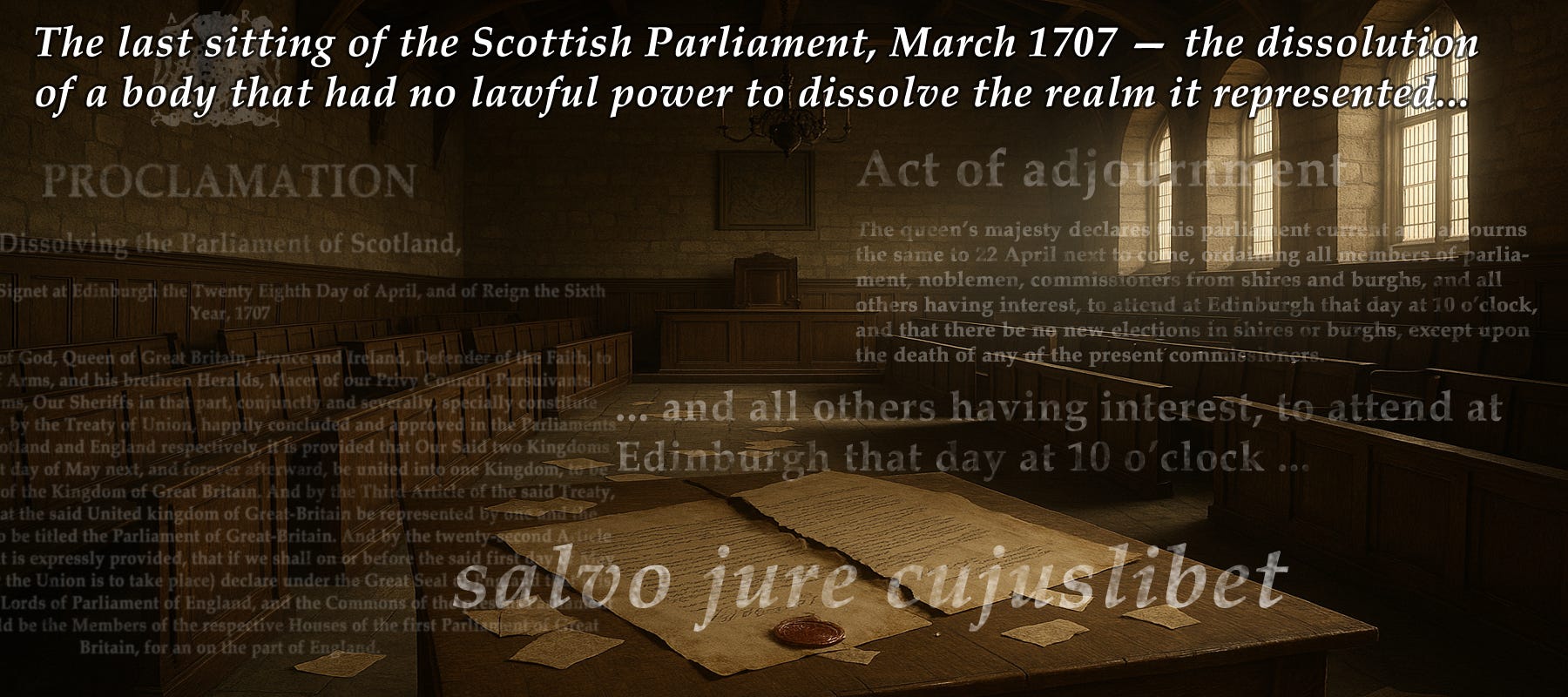
It could legislate for taxes, justice, or trade but not for the destruction of the realm itself. The Claim of Right and every earlier constitutional statement defined the kingdom as a community whose sovereignty could not be transferred. Only a Convention of Estates, the body representing the sovereign people, could have consented to such a change, and no such Convention was ever called, the opportunity to do so on 22 April 1707 was suppressed.
Under normal Scottish practice, every major statute included an Act of Salvo — a clause reserving the existing rights of the realm and of each subject (“salvo jure cujuslibet,” saving everyone’s right). It ensured that no law could undermine a prior constitutional right. No such safeguard was allowed on the 1707 Acts, the opportunity was suppressed. That wasn’t an accident: it removed the legal firewall that would have allowed ‘Union’ to be challenged. The absence of the opportunity for Salvo itself shows that those behind ‘Union’ knew the Treaty and Acts likely couldn’t survive lawful sovereign scrutiny.
Even more tellingly, Queen Anne then dissolved the Three Estates, giving no further opportunity for any Convention to meet to review or ratify the treaty. In doing so she shut down the only body constitutionally capable of giving or withholding the people’s consent. What followed wasn’t ‘Union’ between equals but a royal and ministerial coup that silenced Scotland’s sovereign authority at the very moment it was most needed.
2. The process was coercive.
By 1705 England had passed the Alien Act, threatening to treat all Scots as foreigners and to close English markets unless Scotland accepted the Hanoverian succession and entered union negotiations. In modern terms that was economic blockade backed by the threat of force — classical duress. Under the law of the time, any treaty concluded under such pressure was void.
3. The outcome was fraudulent.
What the Scottish commissioners thought they were negotiating, a partnership between equals, was never enacted. The resulting Acts incorporated Scotland into the continuing English state under a new name. In effect, the English state simply rebranded itself. The same crown, the same parliament, the same legal system, only the name changed. The new “Great Britain” wasn’t a creation of two kingdoms but the continuation of one, its borders extended northward. The Union was in fact a change of ‘branding’ that disguised an act of annexation.
Under the law of the time, those three conditions — no authority, coercion, and false execution — rendered the transaction void before it began.
At the heart of the matter lies a fundamental contradiction. In Scots law, the Crown was the people; the embodiment of the realm’s sovereignty. In English law, the Crown was the monarch; the source of sovereignty itself. These two concepts cannot be fused. You can’t merge a community’s sovereignty with a monarch’s personal prerogative without destroying one or the other. They’re fundamentally incompatible.
So when James VI of Scotland inherited the English crown in 1603, there was never a “Union of Crowns” in Scots law, only a union of persons, of monarchs. He wore two crowns in two distinct capacities, much of the history of the relations between Scotland and England in the seventeenth century attests to this. To imagine that those two distinct sovereignties could later be “united” by a treaty is to misunderstand the Scottish constitution entirely and fundamentally.
That means the so-called Union wasn’t only coerced; it was juridically impossible within Scotland’s own legal order. A non-sovereign parliament couldn’t lawfully vote itself out of existence any more than a court can abolish the law it exists to apply, nor could a non-sovereign monarch lawfully dissolve that parliament and claim sovereignty over its jurisdiction.
Even if every vote in Edinburgh had been sincere and every clause properly drafted, the act would still have been void, because an invalid object cannot be made valid by paperwork, no matter how ‘correct’ it may look to later generations schooled in English constitutional practice. The April proceedings, the final sitting called, but never held, on the 22nd and the Queen’s proclamation dissolving Parliament on the 28th, were therefore the performance of an illegality already complete in principle.
If a company board signs a contract it has no charter power to make, the signatures don’t cure the defect; the contract simply has no legal life in the first place. The later royal proclamation dissolving the Scottish Parliament merely compounded the breach by assuming powers no monarch in Scotland ever possessed.
The corruption surrounding the vote; bribes, threats, and the English blockade; doesn’t create the illegality; it demonstrates it. The illegality existed from the moment the wrong body began to act. The evidence only shows that those responsible knew it.
In law, form without competence is nothing. European jurists made the same judgement elsewhere: no state can lawfully abolish itself by the signature of agents who lack that power.
Some argue that after three centuries these points are academic, that practice has replaced principle. But international law rejects that idea. The maxim ex injuria jus non oritur, no right arises from a wrong, remains fundamental. The passage of time may conceal an illegality; it can never transform it into law.
Modern precedent agrees. The annexation of the Baltic republics by the Soviet Union in 1940 was recognised as illegal for fifty years, even though Moscow exercised total control. Namibia under South African occupation and East Timor under Indonesia were treated the same way. Their eventual restorations were justified by the continuing validity of their original sovereignty. The same logic applies here: a void act is a nullity forever unless freely ratified anew by the sovereign people themselves.
But that standard of free and lawful ratification has never been met in Scotland. The 2014 referendum was authorised, organised, and legally defined by the Westminster Parliament under the UK’s own constitutional order, the very framework whose legitimacy is in question. A referendum conducted under the authority of the occupying or administering power cannot, in law, constitute independent ratification by the sovereign people. True ratification requires equality of parties and restoration of competence: a people voting under their own constitution, not by licence, “permission”, of another. Until that condition exists, Scotland’s original sovereignty remains legally unextinguished.
Therefore, the 1707 Acts of Union never created a lawful new state. They enacted an unlawful annexation of a sovereign kingdom.
Because, by the very standards of the time:
the Scottish Parliament lacked lawful competence to surrender sovereignty;
the treaty was concluded under coercion; and
the form in which it was implemented bore no resemblance to the supposed agreement.
Under the law of both Scotland and Europe in 1707, those facts made the transaction void ab initio, void from the beginning. Nothing done afterwards could supply authority that never existed.
Bribery and duress explain how the annexation was achieved. The constitutional contradiction explains why it could never have been lawful. Combine the two, and the case is complete: no competence, no consent, no legitimacy.
That’s why the Union doesn’t need to be “repealed.” A void act produces no legal rights. It simply never took effect in law. Scotland’s sovereignty was suppressed by force and administration, not extinguished by consent.
Scotland therefore doesn’t need the so called “permission” of an illegitimate parliament and unlawful administrating power, Scotland’s sovereignty was suppressed in 1707, but can still be legally exercised without any “permission” from unlawful bodies exercising de facto control.
As Sara Salyers recently wrote:
“You can’t obtain a treaty — by fraud or otherwise — and then do something completely different while still claiming you have one.”
That line distils the entire constitutional logic. A treaty signed without authority, against the will of the sovereign people, and under threat of invasion was never put into lawful effect. It created de facto control, not legitimacy; it created subordination, not union.
This matters today because international law recognises that a people unlawfully deprived of self-government remain entitled to restore it. Demonstrating that the Union was never lawfully enacted would place Scotland within the same legal category as other non-self-governing territories; entities whose right to independence doesn’t depend on the permission of the administering power. Confirming the illegality of 1707 isn’t therefore an historical curiosity but the juridical foundation for modern self-determination.
The argument doesn’t simply rely on modern international law, it rests on the same legal reasoning any jurist of 1707 would have recognised. Sovereignty can never be sold, particularly by individuals and bodies that never held sovereignty in the first place. Consent under duress isn’t consent, and authority can’t be invented after the fact.
Three centuries later, those principles still stand. The law that voided the Union then voids it now.
You can’t lose by law what the law never let you give away in the first place.

If you’d like to support my research into Scotland’s true history, you can chip in for running costs (and the coffees that keep me going) here: https://ko-fi.com/angrypict
No posts
Comments
Nothing yet. Say the first thing.
Sign in to join the conversation.