
For three centuries the story of 1707 has been told backwards. We’re invited to begin after the fact, with the Union already in being, and to assume that whatever happened before must somehow have led naturally to that result.
Parts I and II showed something else entirely. They exposed the missing week when Scotland’s sovereign body should have met—and didn’t—because it was stopped. That silence is the breach in which the whole British narrative hides.
Everything turns on one simple constitutional hinge:
Sovereignty in Scotland lay with the Convention of Estates.
The Convention of Estates never consented.
Therefore no lawful Union ever occurred.
Once that’s understood, every other detail follows. The absence of that one act of consent defines everything that came after.
So let’s bring together the whole story of what actually happened, as laid out in the previous two parts, look at the wider pattern, and look at the implications for us today.
We recommend you read Parts I and II first, for detail and to see the primary evidence. But you can start here if you want to simply understand the reasons why what happened in 1707 wasn’t a lawful union, it was an annexation.
Annexation I — The UK exists because the Scottish people were denied their lawful rights
The Union wasn’t completed by consent, it was completed by removing the only moment in which consent could exist.Annexation II — Why and How
The week Scotland was silenced — and an empire was born: annexation disguised as Union.
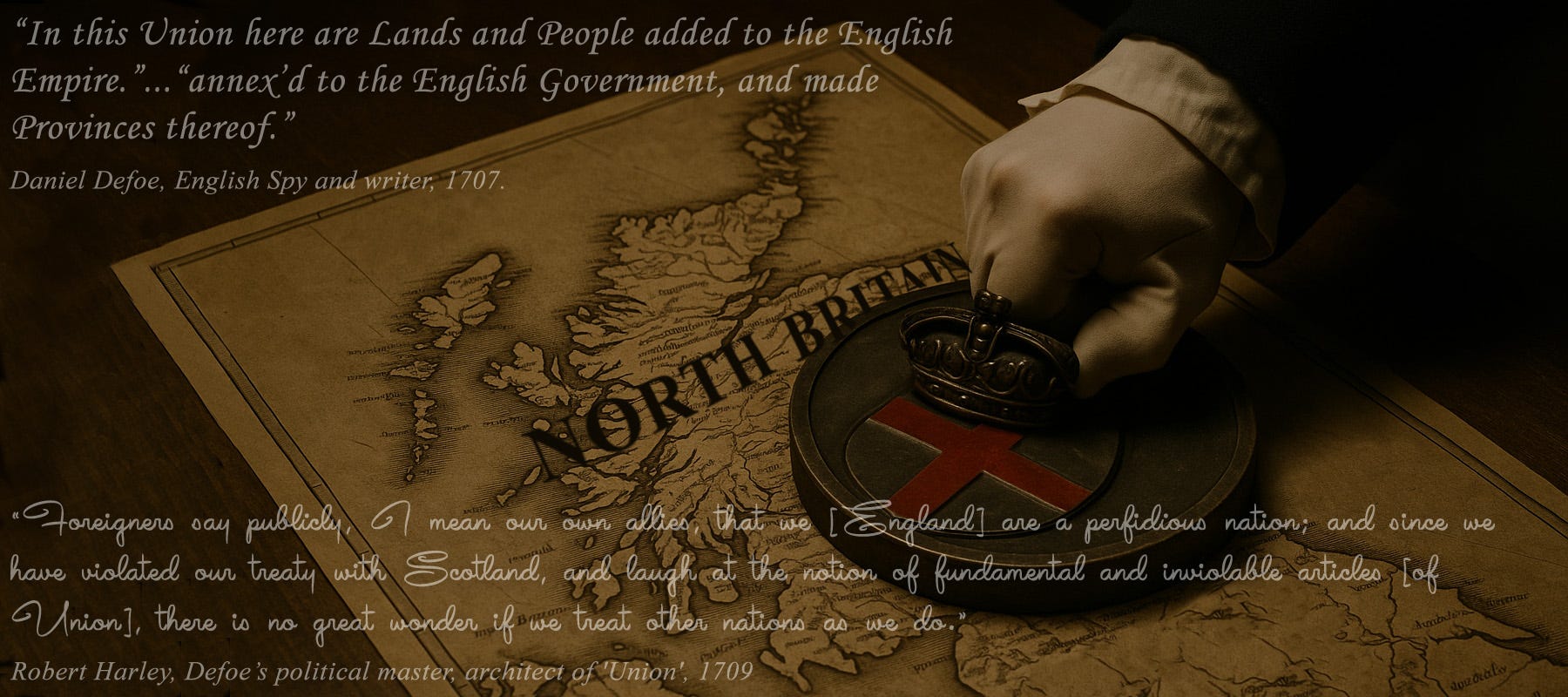
The Week That Vanished
On 25 March 1707, the Scottish Parliament didn’t dissolve. It adjourned to 22 April, a normal procedure using the standard wording, “all others having interest” (see Part I), that allowed for lawful intervention by anyone having an interest in any legislation passed in the session of Parliament that was coming to an end.
Reconvening Parliament on 22 April meant any Scot who objected to Union could petition and constitutionally halt passage of the Acts, which at the very least would have delayed ‘Union’ beyond the first of May, if not stopped it altogether. We know there were thousands of names on petitions objecting; at least 20,000 according to modern sources.
Under Scots constitutional practice, that sitting would have reactivated the Estates in their sovereign capacity to reconsider the Treaty and Acts, namely as the Convention of the Estates.
It never happened.
No writs were issued beforehand. Parliament House stayed closed. The High Street and Parliament Close were placed under military control. Troops held the approaches to the chamber. Edinburgh was silenced by inaction and force. A compliant, and often bribed, Scottish elite and Privy council made sure silence replaced the normal constitutional process, see Part II for a detailed examination of this.
On 28 April, six days after the missed sitting, Queen Anne proclaimed Parliament dissolved “in consequence of the Union”, even though that Union didn’t legally exist until 1 May. That act created the illusion of legality; but it masked a constitutional void. (See Part I for the full proclamation, presented publicly online for the first time.)
Therefore, what looks like a routine procedural gap was in reality the exact method of suppression. This illusion has been relied on by the British state and it’s supporters ever since. It’s explained away as a meeting that had no purpose so never happened, something of no consequence, if it’s even mentioned at all.
The Pressures Behind the Silence
Why was delay, or even rejection on 22 April, so dangerous?
By early 1707, England’s position was perilous. War debt had exploded. The Bank of England, barely a decade old, was struggling to keep the state solvent given England’s large debt burden:
England’s national debt had exploded from under £1 million in 1688 to around £14.5 million by 1707, an enourmous and potentially unsustainable figure for the period.
War expenditure from the War of the Spanish Succession consumed the bulk of state income.
Credit markets were jittery; the Bank of England (founded 1694) was still fragile and politically contested.
To sustain borrowing and issue new credit instruments, the English state needed:
A broader fiscal base; more taxpayers and more taxable assets.
Political consolidation; a single “British” state that could issue unified securities and reassure investors.
The Annexation of Scotland in 1707 delivered both.
Robert Harley, the key English political figure behind the annexation of Scotland, and his associates at the Sword-Blade Company were already exploring debt-conversion schemes that would later become the South Sea Company; a mechanism (in fact what we’d now term a ponzi scheme) for turning Anglo-British state debt into long-term trade backed securities. But these plans needed collateral, and a larger tax base to support the borrowing that would provide that collateral.
Scotland provided an expanded tax base that could then act as security on borrowing.
At the same time, fears of French leverage, Jacobite mobilisation, and the loss of prestige if the Treaty missed its 1 May deadline created unbearable pressure. If Scotland reached that date still sovereign, England’s position weakened on every axis: financial, military, diplomatic, and political.
Therefore a Convention couldn’t be allowed to sit because it was still sovereign, acted as the voice of The Community of the Realm (The sovereign people of Scotland), and their objections would certainly delay, possibly derail, passage of the Treaty and Acts of Union. So suppressing the sovereign Convention was the only path that could be taken.
The Structural Pattern
Look closely and the wider pattern comes into view:
threaten invasion
demand a treaty
neutralise elites with patronage and/or threat
prevent the lawful sovereign body from assembling
hold the capital under military control
declare the outcome as fait accompli
reclassify extraction of tax revenues as “internal revenue”
use the captured state as collateral for credit
expand again
That’s a sequence seen later across the Anglo-British Empire. It didn’t start in India or Ireland, it started in Scotland in 1706/1707.
In fact, when the pattern is identified, Scotland is the template for the later fiscal expansion of the Empire. The same logic repeated across the half the world: suppression dressed up as law, extraction dressed as stability.
Aftermath and Recognition
Some of those who had supported Union quickly realised the trap. By 1713, during the Malt Tax crisis, Seafield—who had presided over the 1707 settlement—moved to repeal the Union in Westminster. The motion failed because Scotland’s tiny representation meant the outcome was predetermined.
The trap had already closed.
As Burns put it years later:
“Bought and sold for English gold.”
Burns words were a clue to what had happened, they crystalised the popular feeling of his time that something had been stolen from the Scottish people by a compromised elite colluding with a foreign power, namely their sovereignty.
Why It Matters Now
Our entire understanding of what happened in 1707 shifts once we understand:
No Convention = no consent
No consent = no lawful transfer of sovereignty
No lawful transfer = no lawful Union
Scots have long sensed something was wrong with the story we were taught. Now we can see precisely where the constitutional break was. The missing week between 22 April and 28 April once restored, rewrites the story of everything that followed.
This is in the constitutional record, it can be seen in the primary evidence from 1707, but it’s been hidden, blurred and ignored for more than three centuries.
People are beginning to join the dots for themselves: one person sees it clearly, three more follow. An unstoppable cascade of realisation and understanding has begun.
What Does This All Mean?
It means the Treaty of Union wasn’t a treaty between equals. It was annexation carried out through procedural capture and the silencing of lawful sovereign jurisdiction. It was the quietest coup in British history—and it was the prototype of an empire built on the same template.
Britain didn’t invent democracy.
It perfected the suppression of it—first at home, then abroad.
Scotland wasn’t the first colony of the British Empire.
Scotland was where the British Empire learned how to colonise the world.

If you’d like to support my research into Scotland’s true history, you can chip in for running costs (and the coffees that keep me going) here: https://ko-fi.com/angrypict
Comments
Nothing yet. Say the first thing.
Sign in to join the conversation.