
Why Suppression Was Necessary and How Did they Execute It.
Part I showed the Union was never consented to; in fact, it was executed by blocking the one lawful moment in which Scotland could have said no, the 22 April adjourned sitting of Parliament, where the Convention of Estates could have lawfully acted.
Annexation is a crime under international law, we now have the date of the crime but we haven’t examined the motivation, or how the crime was committed and who was responsible.
Part I also established the constitutional breach itself, the missing Convention of Estates and the six-day void where consent should have stood.
That kind of suppression is never an accident. States only shut down jurisdiction when they know that, if the law were allowed to run, they would lose.
Part II sets out why the Estates could not be permitted to sit and how we believe the Convention was suppressed:
22 April was the day everything could have gone wrong for England — legally, militarily, financially, diplomatically, and because the Union had to be forced through before 1 May or the entire plan would collapse in the open.
Suppression was the method by which annexation was made possible but why was it necessary?
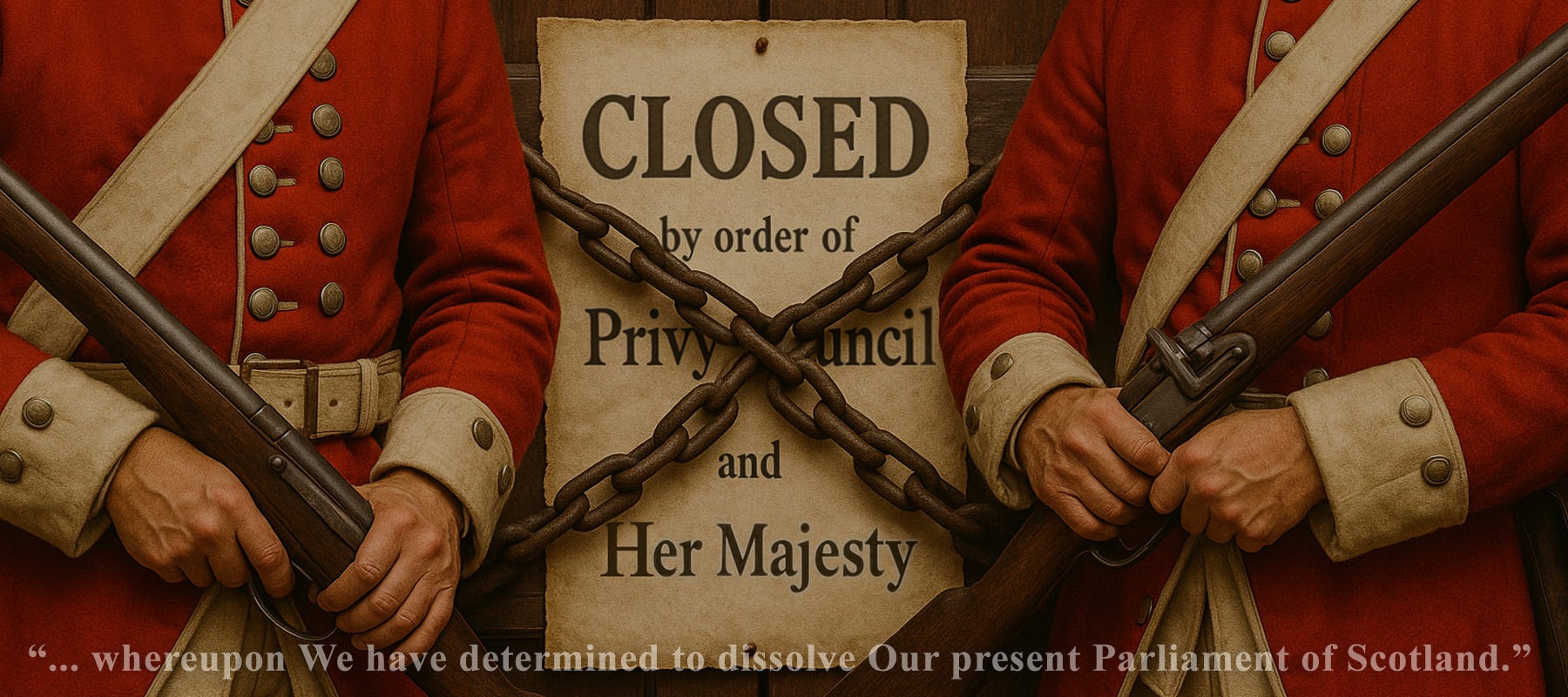
Why Suppression Was Necessary
The Convention of The Estates: A Live Legal Threat
The people in the room wouldn’t have changed on 22 April, but the jurisdiction could have. The same men sitting as Parliament had no standing to reopen the Treaty; the same body sitting as Estates, with the floor open to all others having interest, did.
The danger didn’t lie in their votes, but in the legal persona that would have come into existence the moment the Estates convened.
The adjournment to 22 April created a constitutional window. That sitting wasn’t formally summoned as a Convention, but it was the moment at which the Estates’ sovereign capacity could have been lawfully activated, and crucially, the adjournment order extended to “all others having interest.”
That phrase mattered because it opened the floor to anyone with lawful standing — the one forum built to hear exactly the kind of rights objection salvo jure cujuslibet existed to protect, at a moment when the Treaty had put more private, corporate and constitutional rights at risk than any Act in living memory.
One appearance would have put that reckoning on the record. Hundreds or thousands would have made it impossible to close quietly. The danger therefore wasn’t a simple vote, it was sovereign jurisdiction being activated in the form of a Convention of the Estates.
The English Government Could Control the Scottish Elite, They Couldn’t Control the Scottish people
By March/April 1707, enough members had been bribed, threatened or rewarded into compliance. Elite resistance was neutralised.
The people were the problem. They couldn’t be bought in advance, and once a Convention of the Estates sat, its own recent history — 1689 above all — showed it capable of acting well beyond anything a single clause could authorise in advance.
Therefore, the sitting at which the Estates could have convened in sovereign capacity couldn’t be allowed to occur.
Suppression wasn’t a mechanism to secure a “Yes” vote, suppression was a mechanism, the only mechanism, that could produce a reckoning — the people of Scotland finally putting their rights, and their refusal, on the constitutional record.
Why It Had To Happen Before 1 May
The Treaty fixed 1 May as the date the new state would legally “exist.”
After that date Scotland would no longer exist in law as a separate sovereign entity; any challenge would then be treated as sedition against Britain, not as a Scottish constitutional claim; and the jurisdiction of the people would vanish with the legal personality of the kingdom.
That gap between the adjournment on 25th March and the formal activation of the Treaty and Acts of Union at the start of May isnʼt there by chance. It was the narrow window in which the annexation was quietly completed. During that window Scotland was controlled by a compromised Privy Council dominated by those who were determined to see Union enacted.
The Pressures Making Delay Impossible
Financial instability: England entered Union negotiations already in a debt crisis driven by continuous war expenditure.
Contemporary accounts record that the national debt had “spiralled out of control” and that the Bank of England itself was created “to get the government out of financial trouble.”
Behind those measures stood Robert Harley, England’s chief political financier. He was already designing debt-relief schemes that depended on a stable “British” credit base, and through his agent in Scotland, Daniel Defoe, he managed both the propaganda and intelligence operations surrounding the Union.
At the date of Union England’s debt stood at a minimum of £14.5 million; by 1714 it had more than doubled to £36 million.
English debt from war required the Union to stabilise credit. The coming South Sea debt-conversion scheme (formally launched in 1711) would depend on Scotland already being absorbed.
England was a credit‑ridden state using Union to stabilise itself.
England couldn’t afford uncertainty or delay: credit markets, war finance and political stability required that the Union appear completed by the date stipulated in the Treaty. A visible failure to conclude by 1 May would have signalled instability to creditors and foreign powers alike — precisely the signal a debt‑strained state could not permit.
War and foreign policy: England was still at war with France. A sovereign Scotland was a strategic liability and potential French lever.
Jacobite readiness: 1706–07 was an active Jacobite year. A failed or delayed Union would have triggered mobilisation.
State prestige: Failure to enact by the Treaty date would collapse confidence and restore Scottish leverage.
Internal armed forces: Jacobite and Cameronian networks, though hostile to each other, were both anti‑Union and geographically positioned to converge on Edinburgh if the Estates sat. The 22 April sitting would have been read as a constitutional trigger, creating a moment in which armed intervention could claim legality rather than rebellion.
Delay therefore reopened every danger. Completion removed them. — Failure to enact by the Treaty date would collapse confidence and restore Scottish leverage.
The Result
The inescapable conclusion is that Union didn’t proceed because Scotland consented to it. It proceeded because the one moment in which Scotland could lawfully reject it was removed.
This was an annexation carried out within a narrow procedural window, closed deliberately to eliminate any lawful opportunity for Scotland to reject Union.
How and Who Executed It
When the events surrounding the weeks from the 25th March to 1st May 1707 are examined there are two clear ways in which any possibility of a Convention being called was avoided:
Control of the machinery of government via the Privy Council
Control of the streets
But how were these leveraged?
Suppression
The weeks between the 25th March and 1st of May, and in particular the six days after 22 April were the cover in which the real work of suppression had been done.
22nd April passed quietly and almost silently, letting later records say the Estates “did not meet” instead of admitting they weren’t allowed to.
On the 25th March 1707, the Crown staged what looked like an ordinary adjournment. The adjournment wording matched earlier forms: Parliament declared “current,” a date and hour fixed, elections frozen, but the purpose was different. It wasn’t the usual preparation for further business; it was the way to stop it — forever.
The promise of a return date held dissent in check. Those opposed to the Treaty waited for their chance to act, unaware that it would never come.
As the day approached, the City Guard and regular troops were deployed through Edinburgh.
The approaches to Parliament House were controlled, soldiers stationed near the gates, and movement around the High Street restricted.
The justification was “preventing tumults,” but the effect was clear — no public gathering could form, no delegates could reach the chamber.
Control of the Streets
Eyewitness reports and later correspondence describe an atmosphere close to occupation. Sentries were posted on the High Street and Canongate; dragoons patrolled near the Parliament Close; and mounted troops were kept ready by the Netherbow Port (confirmed in the Melville / Leven Papers, 1707 garrison reports).
The City Guard, under the Provost’s direction, worked alongside army detachments to disperse crowds before they could form. Any attempt at demonstration or assembly was broken up as “disorder.” Edinburgh was effectively under military regulation, its civic spaces turned into a buffer zone around the seat of government.
The silence that followed made it look like routine. Six days later, Queen Anne dissolved Parliament as if the Union already existed.
That sequence, silence, troops, dissolution, declaration,, turned a constitutional breach into the appearance of lawful process.
If the Estates had met, the people could have forced the Treaty’s legitimacy to be tested, in the open, before the one body with standing to hear it. By surrounding the Parliament and preventing it from meeting at all, the government removed the last moment when that reckoning could have happened.
How the Privy Council Stopped the Convention of 1707
When people imagine the Union of 1707, they tend to picture debate, disagreement, and at the end of it all, a vote.
But Scotland’s sovereignty wasn’t lost through Parliamentary debate, argument or persuasion; it was lost through procedure, executed by a Privy Council that was already financially compromised.
The decisive act wasn’t a vote at all. It was the non-event of 22 April 1707, the day a sovereign Convention of Estates could have been called — and never did.
Who Controlled the Silence
The machinery that made this possible sat inside the Privy Council of Scotland, the executive body that administered government on behalf of Monarch and Crown (Crown in Scotland being the people).
In early 1707 it was dominated by ardent Unionists, and, as George Lockhart of Carnwath later revealed, at least fourteen of them had received direct English “gratifications” for their services.
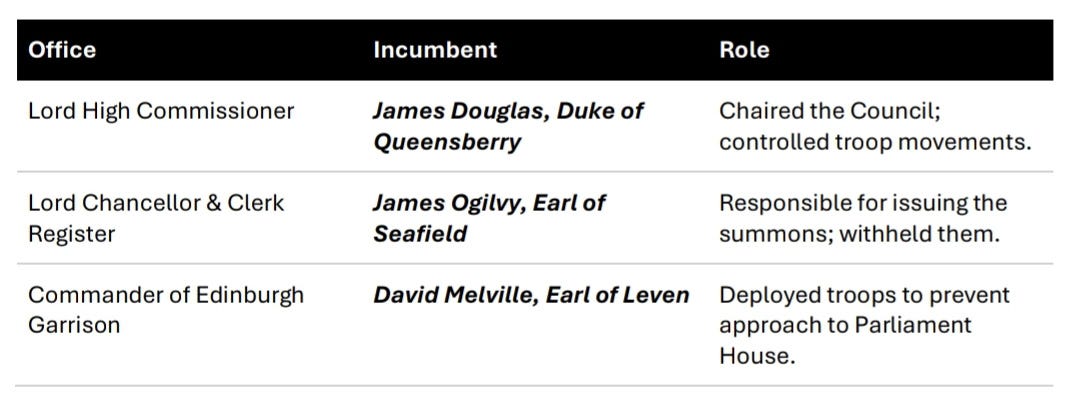
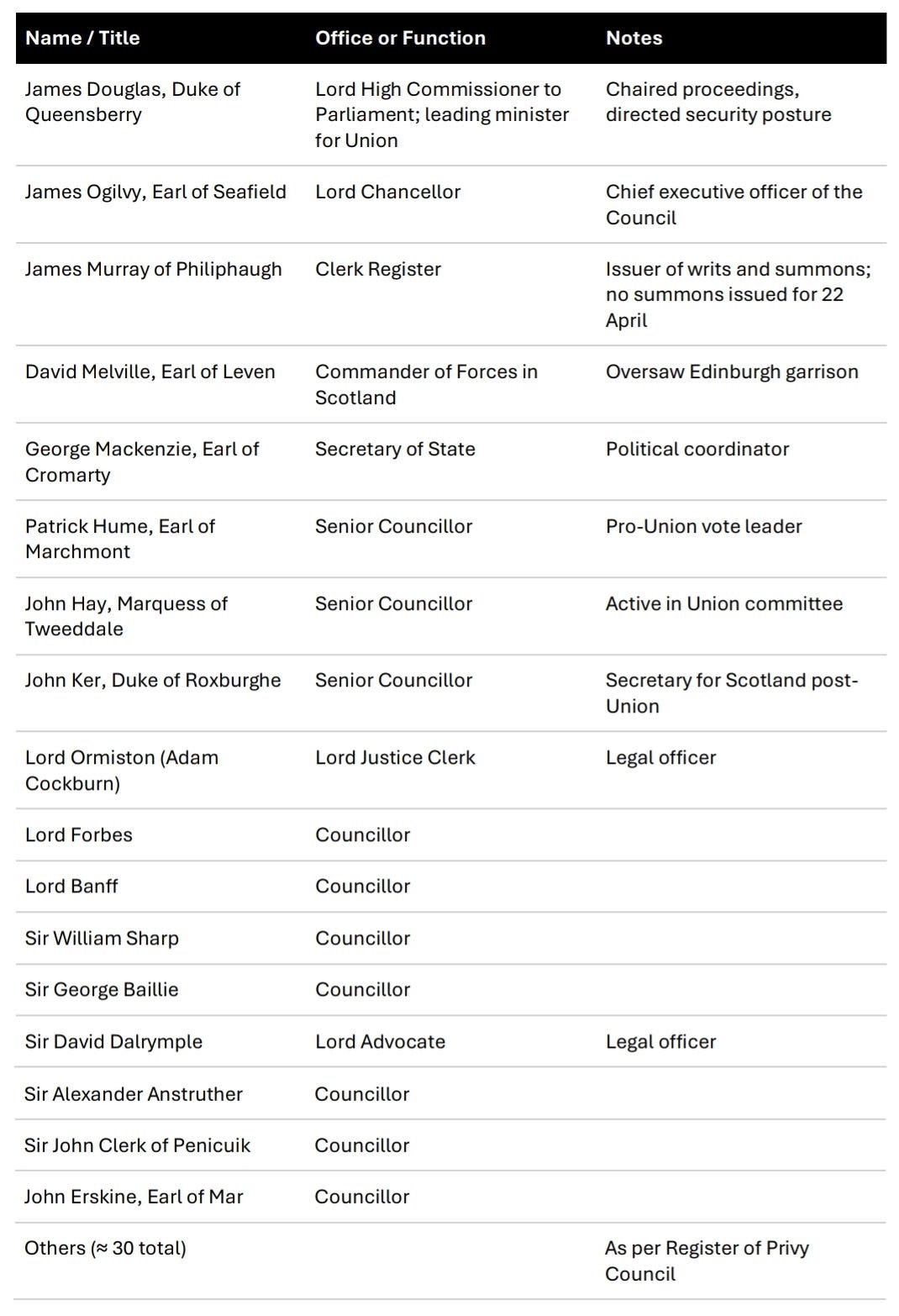
Alongside them sat a chorus of smaller ministers — Marchmont, Tweeddale, Cromarty, Roxburghe, Ormiston, Forbes — many of them also listed among those paid off by London.
Cross-checking Privy Council rosters with Lockhart’s 1714 List of Bribes shows that at least 40 percent of the Council — including both presiding officers — received direct English payments.
Lockhart, himself a member of the 1707 Parliament, later described these as “gratifications” paid through the English Treasury to secure the obedience of Scotland’s executive government.
See Appendix I and II below for further details.
It took no conspiracy in the modern sense; only coordination through the ordinary levers of government.
The Price of Silence
The famous list of Bribes exposes what that silence cost:
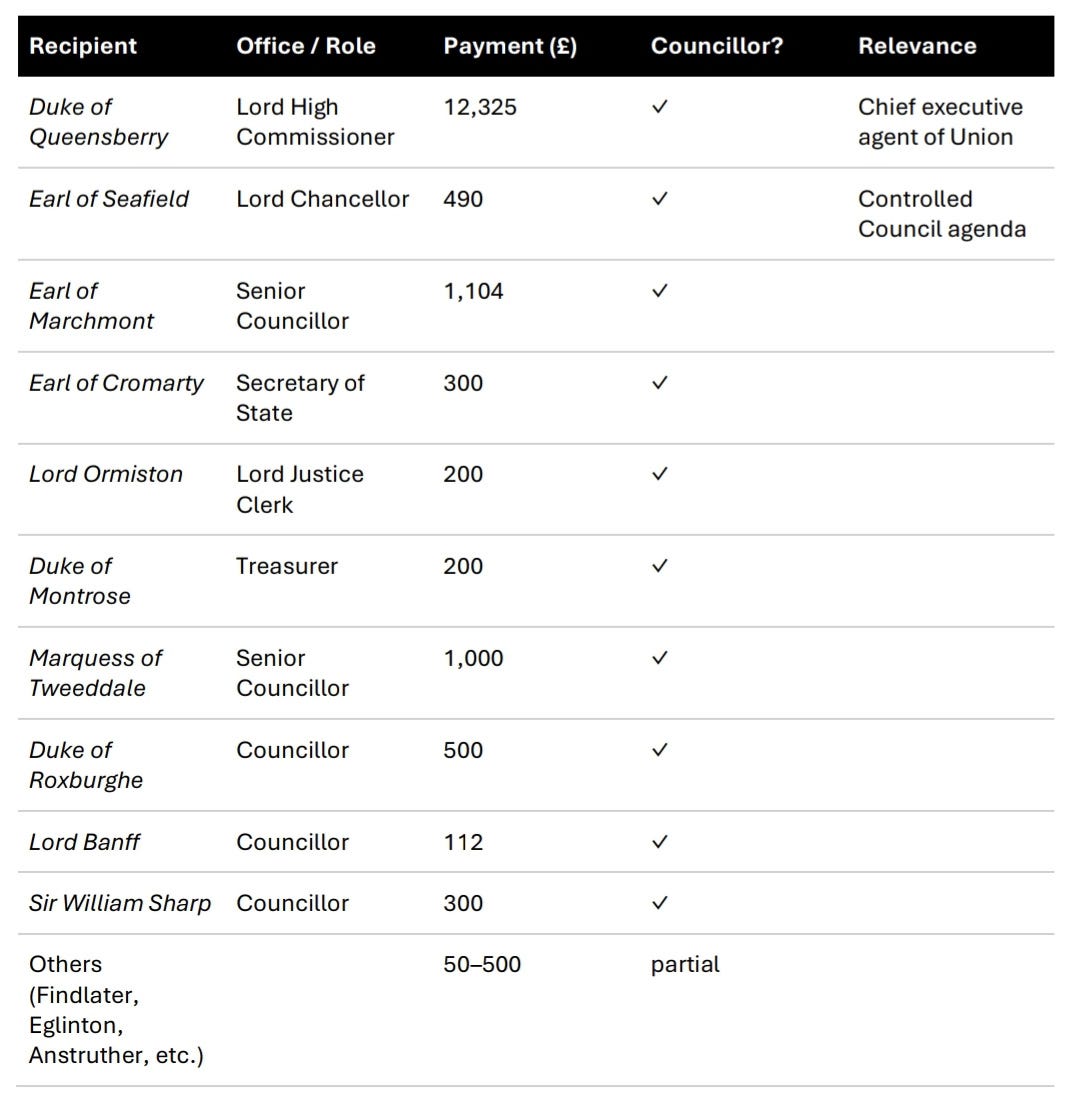
Queensberry received more than £12,000 (in modern terms, according to the BOE inflation calculator, over £2.5 million); Seafield £490 (over £102,000); others smaller sums ranging from £50 to £1,100 (£10,000 to £230,000).
Some payments were justified as “arrears” or “expenses,” but their timing and distribution leave little doubt as to purpose.
England’s Treasury, staggering under war debt, was buying the Scottish Privy Council’s obedience, whilst the Scottish Parliament was threatened and coerced.
England, burdened with more than £14 million of war debt and paying over half its revenue in interest, used the Union to absorb Scotland’s untapped fiscal base.
So behind the politics lay necessity: England’s finances were collapsing.
The Union didn’t offer Scottish rescue, as Scots are frequently told, it offered English survival via an expanded tax base, a new “British” credit structure, and the chance to convert England's old war debt into fresh securities.
Within four years, many of the same men involved in 1707, including Robert Harley, now Earl of Oxford and architect of the new debt-conversion plan, were behind another financial device, the South Sea Company. It was intended to stabilise the same enlarged “British” credit base the Union had created, and it collapsed in 1720 for the same reason England had sought Union in the first place: speculative debt dressed up as national prosperity.
What began as a fiscal annexation of Scotland became the prototype for Britain’s wider empire; a system built on debt, control, and the conversion of other nations’ wealth into credit for the colonial centre.
The Meaning of What Happened
Between 25 March and 1 May 1707, Scotland was manoeuvred out of its sovereignty by procedural manipulation.
On 25 March, Parliament appeared to adjourn in the Queen’s name, using the ordinary form of words that fixed a return for 22 April. That adjournment was the mechanism of suppression. By declaring Parliament “current,” naming a day and hour, and freezing new elections, the Crown created the illusion that business would resume as normal while ensuring that it never could.
The 22 April came and went without summons or sitting. Troops secured Parliament Square; the Privy Council stayed silent. Scotland’s lawful Convention of Estates, the only body empowered to confirm or refuse the Treaty, was simply never allowed to exist.
Then for six days, between 22 and 28 April, Scotland stood in a constitutional void with Parliament neither assembled, nor dissolved.
Then, on 28 April, Queen Anne proclaimed Parliament dissolved “in consequence of the Union,” even though the Union wouldn’t legally take effect until 1 May. The proclamation replaced consent with unconstitutional royal assertion.
In law and in structure this wasn’t a union, it was annexation by manipulation: a sovereign body prevented from meeting, silence turned into consent, and a proclamation used to convert that silence into legality.
No summons meant no lawful jurisdiction. Under Scots law, a Parliament or Convention prevented from sitting cannot be treated as consenting; any royal act issued in its place stands ultra vires: beyond lawful authority.
It was the quietest coup in British history — and the first rehearsal of the imperial method Britain would later perfect abroad — the origin point of Britain’s imperial model.
One of the greatest ironies of all is that many of the Scots who engineered the Union, including Seafield himself, realised by 1713 that they’d been caught in a “perfidious” trap. When the Malt Tax was extended to Scotland, James Ogilvy, Earl of Seafield moved in the Lords to repeal the Union altogether.
That attempt failed — and proved for the first time that the tiny number of Scottish representatives at Westminster were caught in the very snare they’d duplicitously helped construct, a bargain Robert Burns would later condemn as the price of “English Gold.”
Evidentiary Basis
RPS, 25 Mar 1707: “Adjournment Act” — establishes 22 April Convention.
Queen Anne’s Proclamation, 28 Apr 1707: premature dissolution.
Lockhart of Carnwath, Papers Concerning the Union (1714): bribe list identifying Privy Councillors.
Register of the Privy Council of Scotland, 3rd Series (1706–07): confirms Council membership.
Melville/Leven papers: confirm garrison authority in Edinburgh.
Contemporary correspondence (Harley & Defoe): coordination of narrative and propaganda.
Equivalent vs. Lockhart ‘Gratifications’
Equivalent = statutory fiscal settlement (public, legal).
Gratifications = private payments to key ministers and Privy Councillors (coercive, extra-statutory) ensuring executive compliance.

Appendix I — Privy Council of Scotland (1706–07)
(Confirmed from Register of the Privy Council of Scotland, 3rd Series; contemporary rolls.)
Appendix II — Cross-Reference: English ‘Gratifications’ (1714 Lockhart List)
(Amounts in £ sterling; names italicised = confirmed Privy Councillor at 1706–07.)
Aggregate finding:
From c. 30–40 Privy Councillors, at least 14 (40%) are confirmed recipients of direct English payments. These include both presiding officers (Queensberry and Seafield) and the officials controlling summons (issue) and force (deployment).

Acknowledgements
With grateful thanks to Seannachaidh and “Baby Dragon” for additional research and suggestions.

Further information:
Records of the Parliaments of Scotland — Act salvo jure cujuslibet
Records of the Parliaments of Scotland — Glossary of Terms
Latin Phrases — salvo jure cujuslibet
If you’d like to support my research into Scotland’s true history, you can chip in for running costs (and the coffees that keep me going) here: https://ko-fi.com/angrypict
Comments
Nothing yet. Say the first thing.
Sign in to join the conversation.