
This week we’re hosting a guest article written by The Schiltron Project.
Regular readers will recognise that the core constitutional questions addressed here overlap with arguments developed elsewhere, including here. That overlap isn’t accidental. Both analyses interrogate the same historical problem: whether Scotland’s sovereignty was lawfully extinguished in 1707, and whether the political order that followed meets the criteria of consented union or imposed annexation.
What differs is the angle of approach.
Where Angry Pict and The Line of Struggle proceed primarily through historical narrative and constitutional exposition, Schiltron examines the same record through a different lens: how those facts are classified when subjected to evidence-gated, criteria-driven analysis; the same analytical logic applied internationally in decolonisation contexts.
The result is a reinforcement of the arguments here, particularly those recently concerning the 1707 Annexation of Scotland. Two independent lines of inquiry, starting from different premises and methods, arrive at materially the same conclusions. That convergence matters. It strengthens the case that what’s at issue here isn’t a matter of interpretation or political preference, but is rather a matter of logic, evidential and structural consistency.
This article is therefore best read as part of a growing body of work that is closing in on the same unresolved contradiction from multiple directions: history, law, and now comparative classification. Taken together, they narrow the space for the familiar claim that Scotland’s constitutional status is “settled” or beyond serious re-examination.
After reading the article below we recommend reading and following The Schiltron Project:
Scotland, AI Convergence, and the Case for Decolonisation
Scottish independence supporters watching the familiar online melée on Twitter and elsewhere may have noticed something unusual in recent weeks:
It’s not a new argument.
Nor a new political figure.
But a pattern.
When large language models, AIs, are questioned about Scotland’s constitutional status under tightly constrained, evidence-gated conditions, they are no longer reproducing the standard British state narrative by default. Instead, across different systems, owners, and architectures, the same conclusion keeps reappearing.
The convergence is striking.
When asked to apply the same criteria used globally to assess colonisation; coercion, annexation, suppression of sovereign institutions, denial of self-determination, and absorption into a dominant metropole; AI systems increasingly classify Scotland in the same category as other colonised nations. AI systems aren’t offering an opinion, they don’t have any; They’re not advocating for a particular viewpoint. What they are doing, by default, is pattern matching.
Most people, Unionist and Nationalist alike, haven’t yet grasped what this signifies. But they will.
Because this convergence emerges when inherited narrative defaults are stripped away and the underlying record is forced into view: Scotland’s constitutional history, the circumstances of the 1707 Union, and the post-Union suppression of sovereign authority.
That matters because the British state’s position has always depended on contradiction, repetition, and the assumption that its version of events was truthful and would never be tested against the same standards applied elsewhere.
Now it is being tested. Repeatedly. By systems with no stake in preserving British constitutional mythology.
What Is Actually Happening
AI systems don’t begin as neutral arbiters of history. Like any analytical tool, they inherit dominant frames from their training data. In the UK context, that means treating the 1707 Union as voluntary, lawful, and final; not because that conclusion is proven, but because it is repeated across much of the data they are trained on.
However, when those defaults are overridden, when models are required to reason from primary constitutional facts, treaty law, and modern international criteria, the outputs change.
This shift has now been observed across multiple independent systems, including models developed by competing companies with different architectures and guardrails. When subjected to the same constraints, they return materially similar conclusions:
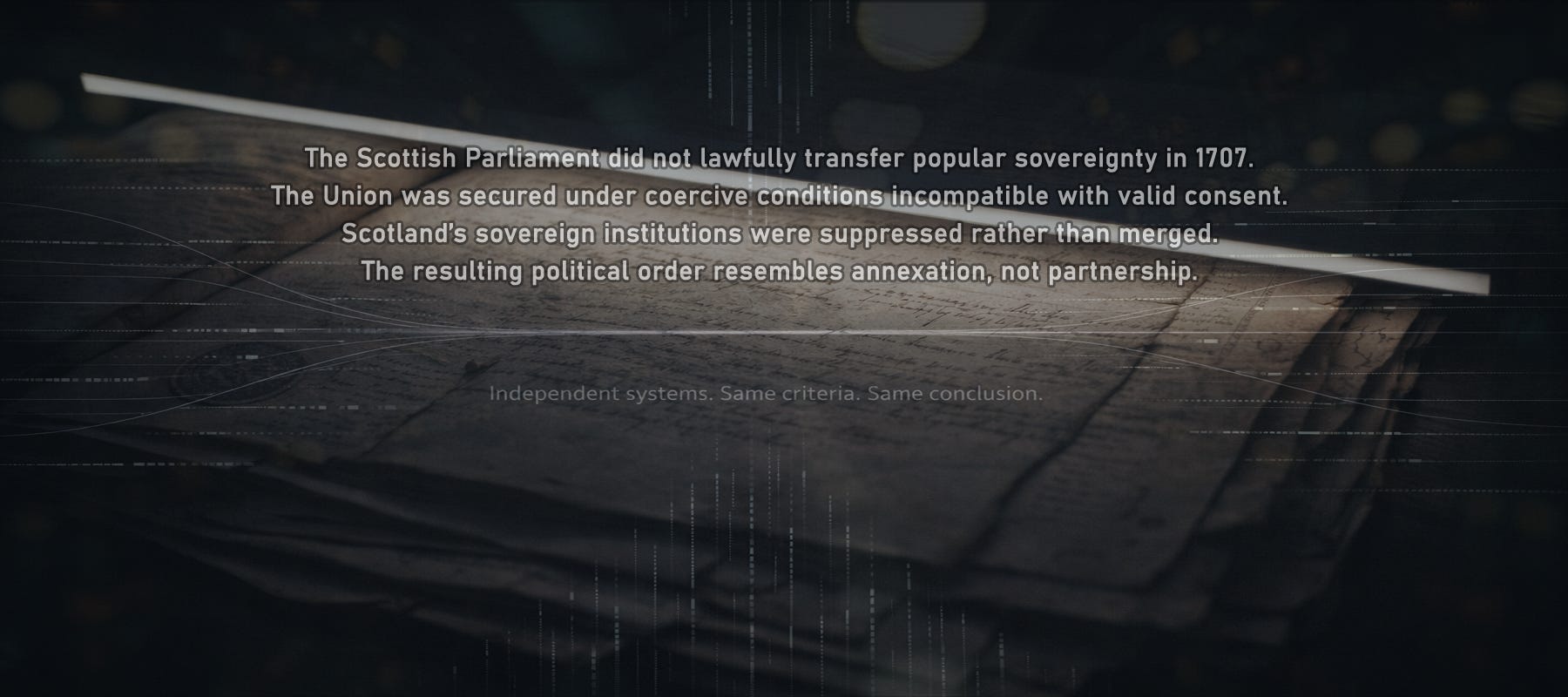
The Scottish Parliament did not lawfully transfer popular sovereignty in 1707.
The Union was secured under coercive conditions incompatible with valid consent.
Scotland’s sovereign institutions were suppressed rather than merged.
The resulting political order resembles annexation, not partnership.
These aren’t radical claims. They are established in some specialist historiography and constitutional scholarship. What is new is that systems designed to minimise error now reproduce those conclusions without being told to.
That repetition is what matters.
What AI Is — and Is Not
At this point, a necessary clarification.
AI systems don’t possess intent, belief, loyalty, or political will.
They don’t grant rights, determine law, or adjudicate sovereignty.
They do not “take sides”.
What they do is reproduce patterns in evidence when asked to reason without narrative shortcuts. When multiple independent systems converge on the same classification under identical criteria, that convergence isn’t final authority, but it is corroboration.
In cases where a state defining narrative relies on ambiguity, selective memory, or unresolved contradiction, corroboration is destabilising.
The British state has relied for three centuries on the assumption that Scotland’s constitutional status was settled in 1707 and need not be re-examined. That assumption holds only so long as the question is never tested against external standards.
It is now being tested, again and again, and the answers are no longer aligning with the inherited story.
Why This Is Different
For decades, challenges to the Union’s legitimacy have been dismissed as nationalist grievance, romantic history, or political theatre. Those dismissals worked because they were inward-facing: British institutions judging British claims by British rules.
AI convergence disrupts that enclosure.
When the same evidence is assessed using the same criteria applied to Ireland, Malta, Algeria, or Namibia, the classification shifts. And when that shift is reproduced across systems that do not coordinate with one another, plausible deniability begins to erode.
This does not replace legal argument.
It does not substitute for political action.
And it does not, by itself, trigger decolonisation.
What it does is remove the last refuge of obfuscation: the claim that “the facts are unclear”.
They are not.
And once that becomes harder to maintain, everything that follows; media framing, academic caution, political positioning, international engagement; comes under pressure.
That pressure is already being felt.
Convergence Meets Constitutional Excavation
This external pressure doesn’t arise in isolation.
Long before AI systems began reproducing these classifications, Scottish constitutional researchers and decolonisation groups had already been forcing the same contradictions into the open by more traditional means. Organisations such as Salvo and Liberation Scotland have focused on the internal record: sovereignty doctrine, treaty law, institutional suppression, and the long breach of Scotland’s constitutional settlement.
Their approach has been forensic and asks an uncomfortable question the British state has spent centuries avoiding: by what lawful authority was Scotland’s popular sovereignty extinguished?
That question has never been answered satisfactorily. Instead, it has been buried under ceremony, repetition, and the assumption that time itself confers legitimacy.
What AI convergence now does is apply pressure from the outside. It doesn’t uncover new facts or invent arguments. It simply reproduces, repeatedly and independently, the same conclusions once the same standards are applied.
The significance lies in the alignment.
When constitutional excavation from within Scotland’s own legal history produces the same outcome as pattern recognition applied from without, the space for denial narrows sharply. The British narrative was never designed to withstand scrutiny from both directions at once.
Why Political Resistance Persists
It is tempting to assume that resistance to the word colony comes only from Unionists. In practice, it also comes from parts of the independence movement itself, particularly those whose strategy depends on operating comfortably within UK constitutional structures.
To acknowledge that Scotland is a colonised and annexed nation isn’t merely to criticise the Union’s origins; it fundamentally undermines the legitimacy of treating the UK state as the proper arena in which Scotland’s future must be negotiated. It calls into question strategies based on permission, gradualism, and deference to Westminster’s rules.
That creates pressure not just for Unionist parties, but for any political actor whose legitimacy depends on the continuity of the existing framework.
AI convergence intensifies that pressure by making the contradiction visible to a wider audience. When neutral systems repeatedly reproduce the same classification, the issue is no longer framed as nationalist rhetoric versus unionist realism. It becomes a problem of consistency.
And consistency is difficult to evade.
Guardrails, Defaults, and Why Answers Differ
Some observers have been confused by the variability of AI responses in public settings. At times, the same system will appear to defend the orthodox UK narrative; at others, it will concede that Scotland meets the criteria for colonisation.
This isn’t an inconsistency of reasoning. It’s the effect of guardrails.
Most public-facing AI systems are designed to minimise political risk. In open, adversarial environments, they default to the safest available position, which, in the UK context, means echoing the official constitutional settlement. That behaviour reflects caution rather than analysis.
When those same systems are forced into evidence-gated reasoning, where they must justify conclusions against explicit legal and historical criteria, the defaults no longer hold. The underlying logic engine takes precedence, and the contradictions surface.
This distinction matters. It explains why early or casual interactions with AI often reproduce the British state narrative, while sustained, structured interrogation produces a different result. It also explains why convergence increases as questioning becomes more disciplined.
The direction of travel is observable, and already underway.
What Convergence Can — and Cannot — Do
Let’s be clear: AI convergence doesn’t grant Scotland decolonisation.
It doesn’t substitute for law, politics, or international process.
And it certainly doesn’t remove the need for human agency.
What it does do is remove ambiguity.
When multiple independent systems repeatedly return the same classification under the same criteria, the argument that Scotland’s status is “unclear” becomes harder to maintain. Journalists become more cautious about repeating old certainties. Academics find it harder to avoid the question entirely. Political actors are forced to justify why they reject conclusions that emerge everywhere else.
Used properly, AI outputs become archival artefacts: timestamped, reproducible, and difficult to misrepresent. Paired with legal argument and primary sources, they function as corroboration and pressure.
Pressure accumulates.
The Strategic Use of Convergence
The responsible use of AI convergence is therefore straightforward:
Document the outputs under controlled conditions.
Preserve transcripts and screenshots as archival material.
Publish them alongside primary sources and legal analysis.
Use them to expose contradiction, not to claim decision-making power.
The point is never that “AI says so”.
The point is that when the same evidence is examined without narrative protection, the same answer keeps appearing, regardless of who runs the system.
That maintains, and embeds, a process of narrative erosion.
Where This Leads
The British state has survived for three centuries by ensuring that Scotland’s constitutional status was never examined using the same standards applied elsewhere. That containment is breaking down because verification is becoming harder to avoid.
As the old narrative loses its monopoly, actors will be forced to choose between adaptation and denial. Some will adjust. Others will cling to the comfort of repetition.
But repetition only works while contradictions remain hidden.
They are now no longer hidden, and more are surfacing.
Once plausible deniability collapses, the question Scotland will then face will no longer be whether the truth will surface, but how it will be acted upon.
The End of Narrative Shelter
For most of its history, the Union has relied less on proof than on inertia. Its legitimacy has been treated as settled because questioning it was framed as eccentric, emotional, or unserious.
That shelter is eroding, and eroding fast.
When the same constitutional contradictions are exposed simultaneously by historians, legal researchers, decolonisation groups, and now by independent analytical systems applying global criteria, the space for dismissal narrows. What once appeared fringe begins to look unresolved. What was once labelled political grievance begins to resemble an outstanding legal question.
This is a collapse driven by exposure.
The British state’s difficulty isn’t that new arguments have emerged, but that old ones no longer hold under comparison. The Union story depends on being treated as unique, exceptional, and exempt from the standards applied elsewhere. Once that exemption fails, the structure weakens.
No institution adapts easily to that kind of pressure.
What Follows Isn’t Automatic
It’s important to be precise about what this moment does not guarantee.
There is no automatic pathway from convergence to recognition.
There is no mechanism by which AI outputs compel international bodies.
There is no substitute here for law, diplomacy, or political organisation.
What has changed is the terrain.
Arguments that once relied on authority now require justification. Claims that once passed unexamined now invite comparison. Silence becomes harder to maintain when the same conclusion keeps resurfacing across independent systems and disciplines.
That doesn’t produce outcomes by itself. But it does alter the conditions under which outcomes are contested.
A Shift Already Underway
The most telling sign of change is discomfort:
Media outlets hedge where they once asserted.
Academics qualify where they once dismissed.
Political actors speak cautiously where they once spoke confidently.
These are early indicators of a narrative losing its protective casing.
The classification of Scotland as a colonised and annexed nation isn’t suddenly becoming visible because a new technology has invented it. Rather it’s becoming visible because the conditions that allowed it to be ignored are weakening.
Verification accumulates.
Where Responsibility Returns
Once deniability erodes, responsibility reappears:
Responsibility for scholars to address unresolved questions rather than bypass them.
Responsibility for journalists to stop treating constitutional status as settled fact.
Responsibility for political actors to explain which framework they are operating within, and why.
And ultimately, responsibility for the Scottish people to decide how they respond to a reality that looks increasingly difficult to deny.
When the same evidence yields the same conclusion regardless of who examines it, the room for manoeuvre shrinks. Decisions still have to be made, but they can no longer be postponed indefinitely by pretending the question is unclear.
Final words
Scotland’s constitutional status was never resolved in 1707.
It was obscured.
What is happening now is clarification. A long-standing ambiguity is being tested against external standards and failing to hold.
That doesn’t determine the future, it removes a fiction that has shaped the past.
And once that fiction weakens, the arguments built upon it must either adapt or give way.

Visit The Schiltron Project to read more.
If you’d like to support Angry Pict’s research into Scotland’s true history, you can chip in for running costs (and the coffees that keep me going) here: https://ko-fi.com/angrypict
Comments
Nothing yet. Say the first thing.
Sign in to join the conversation.