
In a district I’ve served for the better part of seven years, I once spent a morning watching a fifth grader use texture inside of a story to create a mood. With intention.
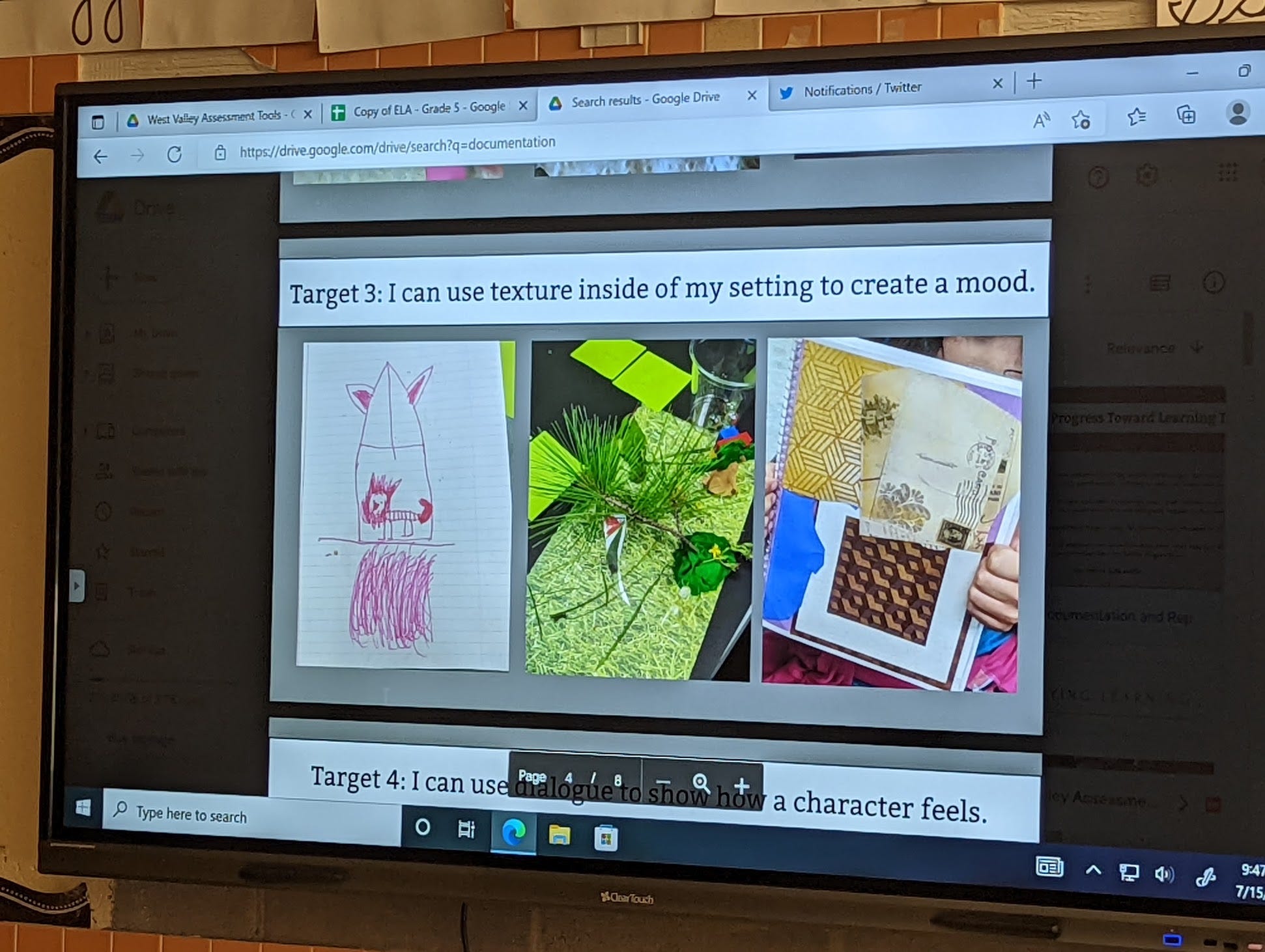
We were just as intentional about the instructional moves we made next, as he transitioned to written words. And what emerged was far more complex than your standard fifth-grade fare.
I’ve had similar experiences making writing in studio sessions with designers of all ages over the last twenty years. Here’s a peek into what that looks like, and I’m smiling as I settle this image into place in this post.
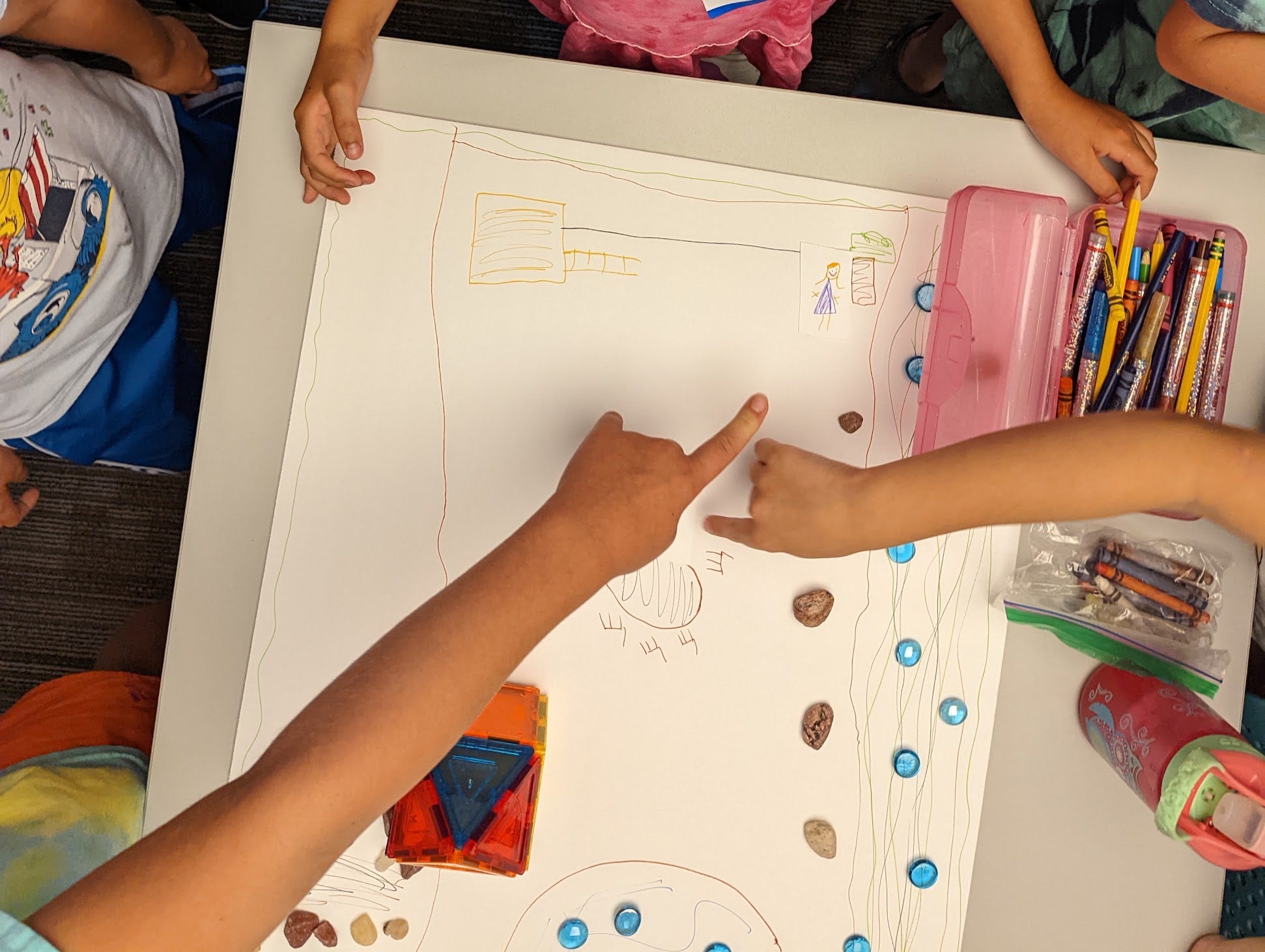
Because would you just look at how the other kids are literally wrapping their arms around this story? Do you see how animated they are? This bit of documentation from my own notebook reminds me that engagement isn’t simply a cerebral thing. It’s embodied and connected and playful.
I remember how we were studying plot and what made it work inside of a mentor text, in order to map our own. Rather than outlining or using a graphic organizer first—rather than pinning ideas solidly to a page—this writer reached for stones and colored pencils and a handful of blue marbles that helped him make a river. He doodled and moved these materials through the plot while living his story aloud, stopping to rearrange a scene when his idea evolved a bit. Teachers stood nearby—myself included—capturing short videos and pictures like this one. We weren’t capturing these data in order to score his work but instead, to understand how this child made sense of another author’s story and then, conceptualized his own.
We were the students here. This writer and his friends were our teachers.
I mean sure, we could have thrown a graphic organizer at him, but that would have hidden what those few minutes and a handful of loose parts and doodles revealed. Those discoveries helped us better understand this writer’s knowledge, linguistic strengths, and multimodal design skills. It helped us notice which modes of expression helped him best communicate this story to this audience in this moment, knowing that print simply would not be enough.
Do we ever think about teaching and assessing literacy in this way?
Do we ever consider the fact that sometimes, learners “struggle” to communicate using print simply because print truly isn’t the best mode for a particular message in a particular moment on a particular platform occupied by a very particular audience?
I don’t know that we do, and we need to.
Do we understand that print is reductive?
Human beings have always represented, communicated, and interpreted ideas multimodally. Print is one just one mode of expression that paper and individualism made king. It travels well. It can also create tremendous distance between the writer and the receiver. Socrates himself had other cautionary tales to tell about this privileged mode of expression too. I’m revisiting them with wonder as I contemplate my feelings about AI and hear fellow English teacher friends grapple with our new reality.
Not the point of today’s post, I know…I know. Maybe another day.
Anyway, just because we can make words travel by pushing them across a page or a keyboard, this doesn’t mean the story they offer is complete. Each mode of expression has its own affordances. Each mode communicates much that the others cannot. When we reduce our understanding of literacy to the production and consumption of written words alone? Well, we diminish those descended from more communal cultures, too.
Human beings communicate through image and color, through the arrangement of objects in space, through sound and rhythm and gesture, through the logic of a layout or the sequence of a video. Adults do this all day too, though we tend to stop counting these creative efforts to communicate as any kind of literacy the moment they leave the page or the hallowed halls that academia built. And I get it: These antiquted definitions of literacy are inherited. They also run deep.
But while many are wringing their hands over the latest reading crisis (because we’ve been having one since before I was born), I worry more about the print comfortable people in my world who are not quite as multiliterate as they need to be—especially English and ELA teachers. Because building learners’ print literacy skills simply isn’t enough if we intend to communicate and interpret ideas and information well.
It never has been, and we’re living the cultural consequences of that truth right now.
While everyone is freaking out over who is or is not reading books anymore, I’m still wondering: Why is it we never clutch our pearls when multimodal text is misinterpreted or a message fails to land because the messenger chose the wrong modes of delivery? I mean, it’s hard to ignore the harm being done by leaders who assume their print comfort will carry them through complex communicative experiences. I have to ask: When is the last time a child failed to earn a diploma because they didn’t know how to critically analyze a meme? And yet, votes are being cast by people every single day who are duped by the very multimedia texts that no diploma ever required them to comprehend.
What multimodal composition reveals
Here is what has kept me returning to the district I mentioned above year after year: When we invited children to show what they know across modes, we came to understand them in ways no single quantitative measure allowed. We learned how a particular child organizes ideas, where her curiosity lives, what she reaches for when she has something complicated to say. We also learned more about her literacy needs that a score aligned to items aligned to standards never revealed. Multimodality helps us distinguish the child who does not yet understand a concept from a child who understands it deeply but is not yet print-comfortable.
That distinction matters enormously, and it is nearly invisible when alphabetic expression is the only expectation…I mean…demand.
Over years, a faculty that documents this way builds a fuller picture of its learners, teaching, and learning than any test could offer. Strangely enough, this is how those test scores begin to improve in my small world. The teachers begin to design, assess, and intervene differently because they’re working from richer information. They notice patterns across a class, across a grade, across the modes children gravitate toward, and they design from what they see.
Try this
You don’t need a new unit or a set of fancy resources or materials to give this a go. Here’s a simple way to begin that moves in three parts.
The next time you want to know what a student understands, offer a real choice in how they show you. They might build it, draw it, act it out, record it, arrange it, or write it, and the choice has to be genuine rather than a reward for finishing the writing first.
While the child composes, document rather than direct. Take a few photos, capture a short video, or jot what you notice about how they are making meaning, where they pause, what they revise, what they reach for when the thinking gets hard. Document evidence of complexity. Document their joy, too. And your own. Where does the temperature rise and fall across the experience? Where does their energy? You’re studying the process, not only collecting and grading the product.
Afterward, sit with these artifacts and your notes and ask two questions. What did this show me that a written response would have hidden? And what does it tell me about this learner’s strengths and the literacies she is ready to grow next?
You can keep everything you love about teaching writing and still widen the doorway into it. What matters is that you look carefully at who walks through it, and let what you see shape what you teach next.
Missed opportunities and second chances
None of this happens because a school adopts multiliteracy as an initiative in September. It grows the way any literacy grows, through repeated invitation and a community that treats these modes as worth taking seriously. Children need many chances to compose in more than words, and they need adults who know how to notice and respond to what they make. Teachers need permission to value a build or a soundscape as evidence of learning, which often means interrogating the biases that suggest ideas don’t really count until they’re written down.
The district I opened with has been at this long enough that it now feels ordinary there. Their youngest learners can talk about what they make and why. Their teachers document across modes without being told to, and they study that documentation for what it reveals about learners and learning. I wonder how many schools are already sitting on years of multimodal evidence of learning that they haven’t yet named as literacy.
Why these schools are ready for what’s coming
I’ve been writing about the Portrait of a Graduate work moving across New York and it’s embedded competencies for some time now because I designed and led a good portion of the very early PD that PLAN Pilot schools engaged with. I stepped away from that work by choice for some very good reasons, and the best among them included the opportunity to work in a sustained way with a handful of districts seeking regulatory flexibility from NYSED. They opened their PBLA pathways this year, their students designed and defended work that was far more complex than the Regents exams demand, and they saw quite a lift in performance on the January exams as well. When I interview kids and teachers in these districts, I am told attendance is much better. Accessibility is everything, right? So is authenticity in learing. When learners have the ability to make and defend meaning in more than one form as they produce real things for real audiences, it’s a game-changer. It’s also life changing.
The schools that have nurtured multiliteracies with intention and for years are already realizing the vision of NY Inspires, whether or not they ever used the language of the Portrait. They have the receipts, too: Documentation notebooks and their own learning stories, and learners who know how to show and more importantly—share—their thinking. They have teachers who know how to gather and intepret evidence of learning that lives well outside of a test. They have blueprints that demonstrate alignment to the APA Standards for Educational and Psychological Testing, too. Because reliability and validity are a thing. They matter. We need to do our best here.
For schools like these, NY Inspires isn’t a riptide pulling them into deep water. It’s a homecoming. NYSED is asking them to prioritize are what they’ve valued all along.
I keep thinking about that young writer in my studio and his river of blue ribbon and about how much teachers of multiliterate kids like these might learn by putting down the worksheet and picking up their phone. NY Inspires asks us to consider multimodal evidence of learning. It challenges us to develop a truer picture of the children in front of us. This seems like an effort worth making and a risk worth taking.
More on those risks next week.
Comments
Nothing yet. Say the first thing.
Sign in to join the conversation.