
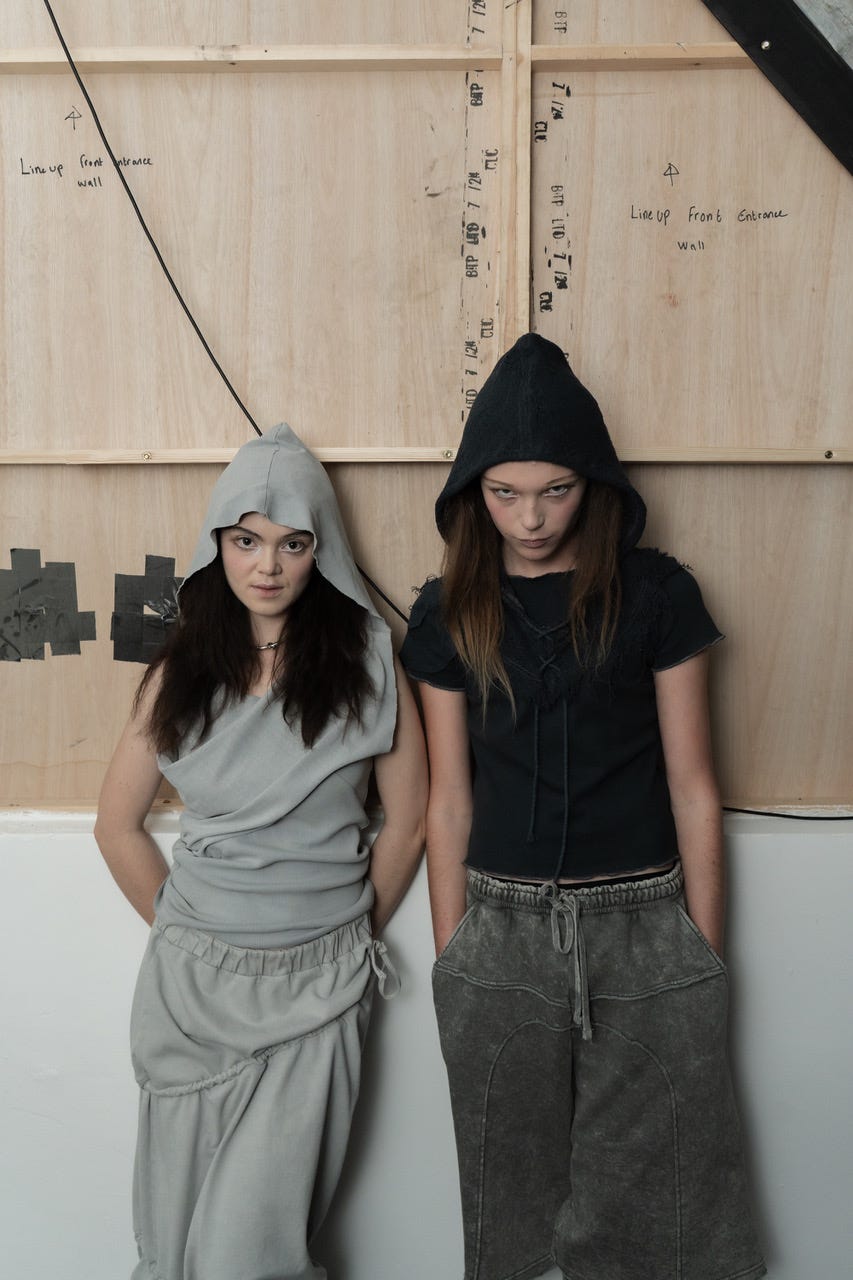
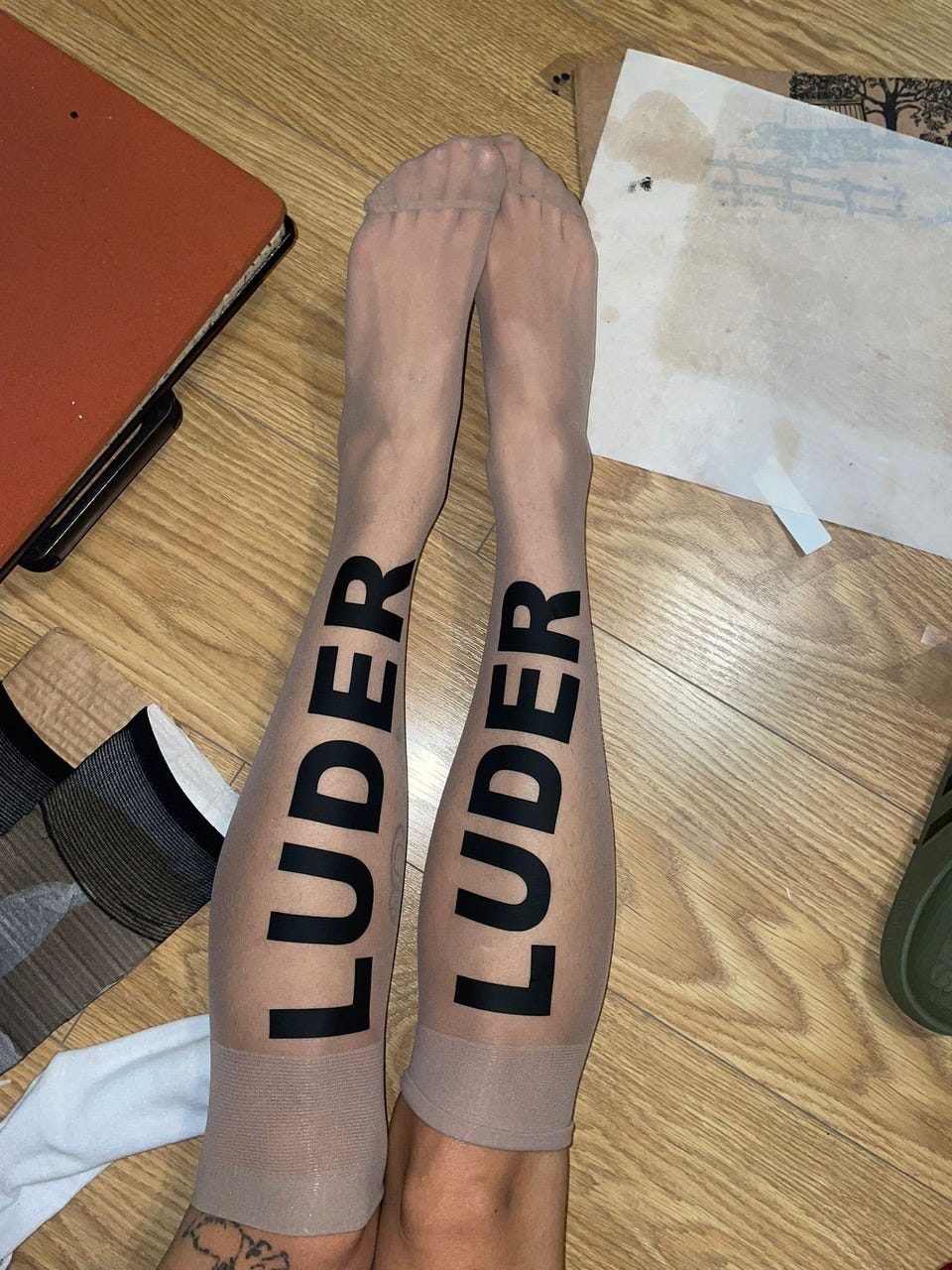
Describing her clothes as “mental armour,” Marie Lueder spirals through the chaos and precarity of the present to reimagine styles past as costumes of care and talismans of safety. Winding ancient pattern cutting techniques and traditional tailoring around medieval silhouettes and the conventions of contemporary sportswear, her collections are engineered for the LARP (Live Action Role Play) of modern life. Though her namesake brand, LUEDER, was founded in 2019, it turns out the designer has been making clothes for role players since she was six.
It was during these formative experiences assisting her mother in preparing her own medieval apparel to stage pre-modern performances of cooking, cleaning and fighting that she developed an approach to design she has maintained to this day. Suspended somewhere between practicality and empathy, Lueder’s process begins with deep consideration of an imagined protagonist, the LARPer in need of protection as they navigate the hazardous currents and unpredictable pressures of the contemporary.
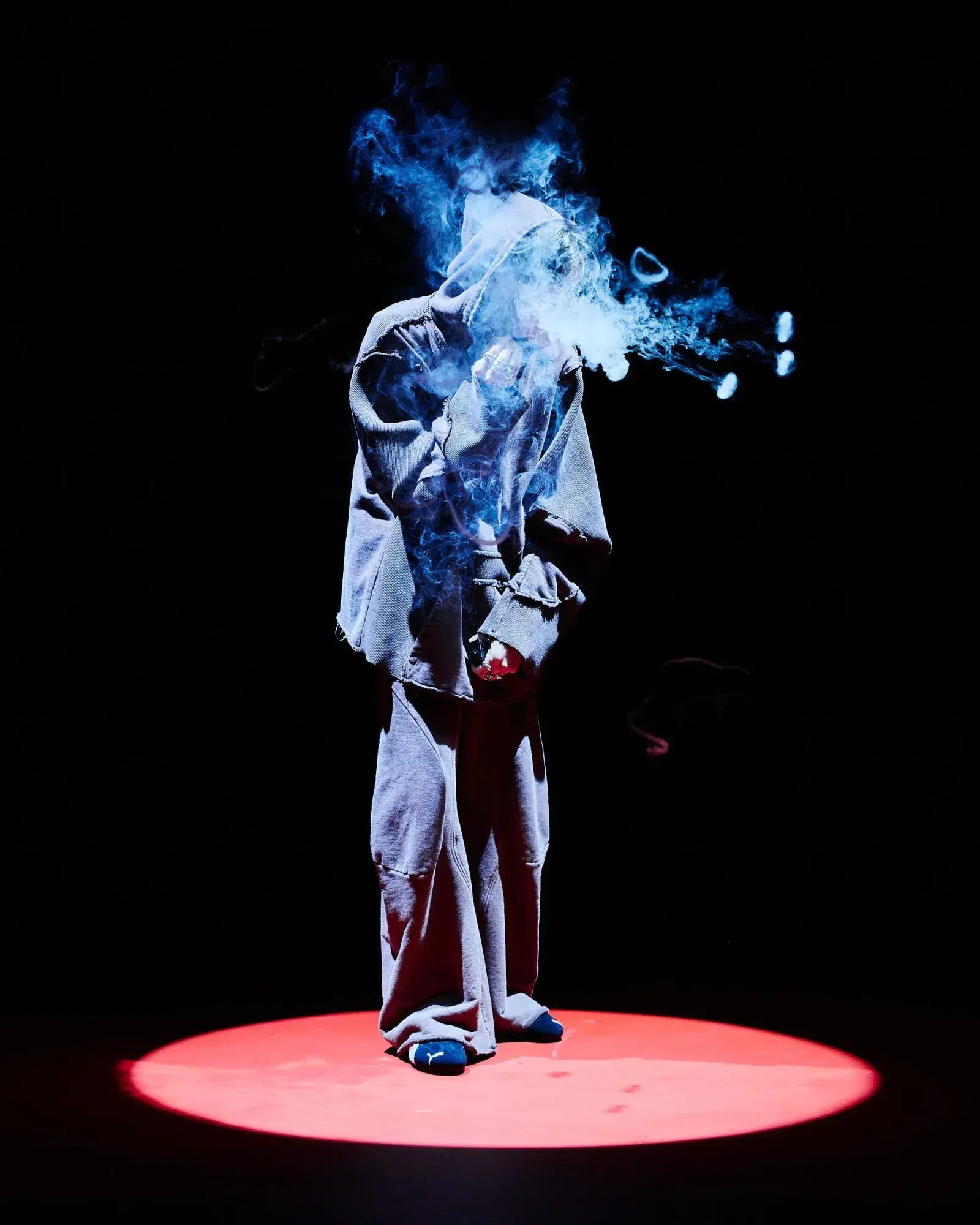
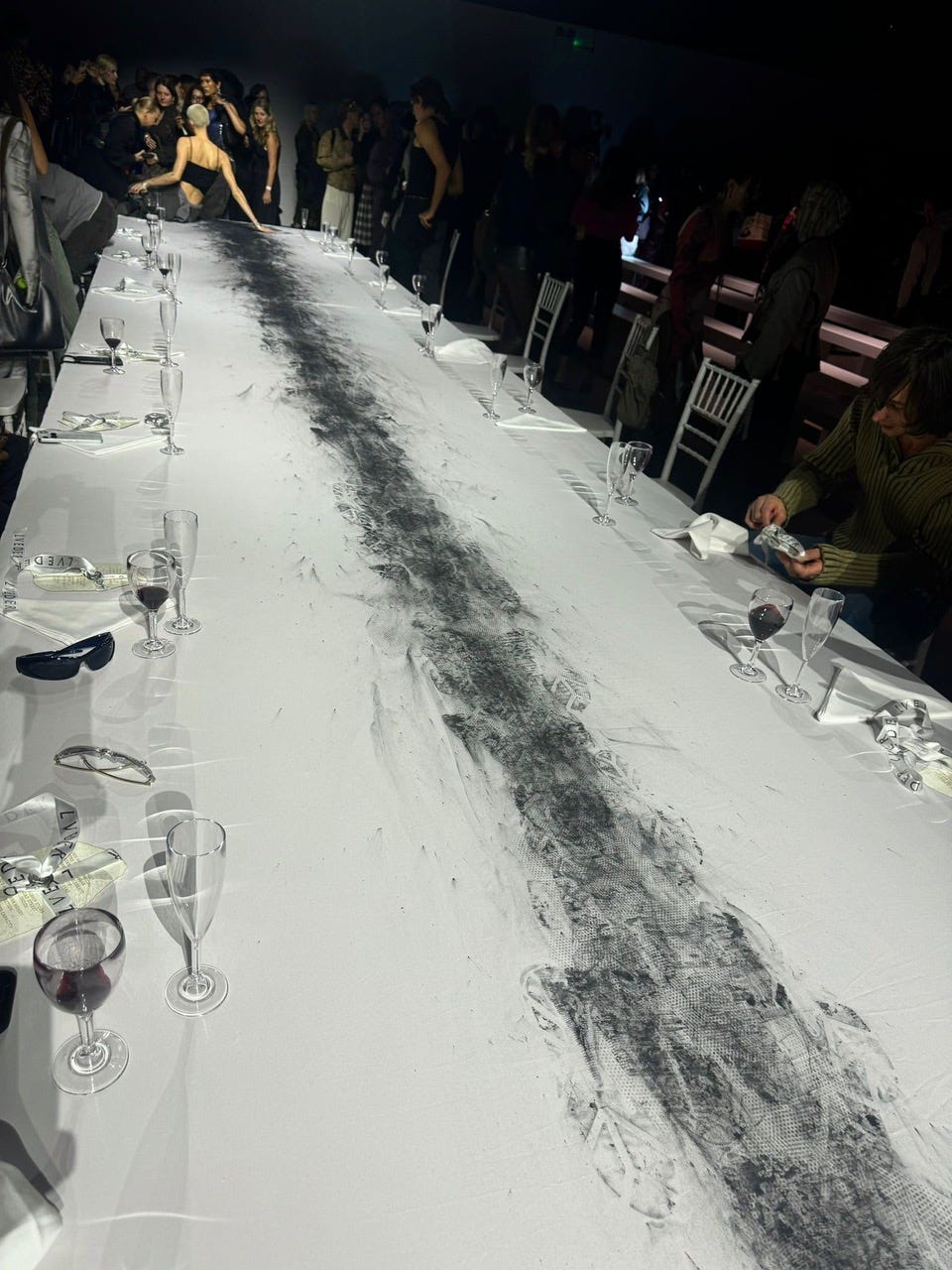
Transient spaces with limited resources require innovative solutions, whether a bedsheet repurposed for a makeshift banquet in a warehouse, or the perfect hoodie, designed specifically for the trip from Venue MOT to the afters through cold night air. Lueder’s ambitious shows capture the romance of these scenarios, whether it’s a professional vape artist ripping intricate clouds through an impromptu rave spun up by Two Shell, or models traipsing grim across a white tablecloth spread over the catwalk, complete with crisp napkins and half empty wine glasses.
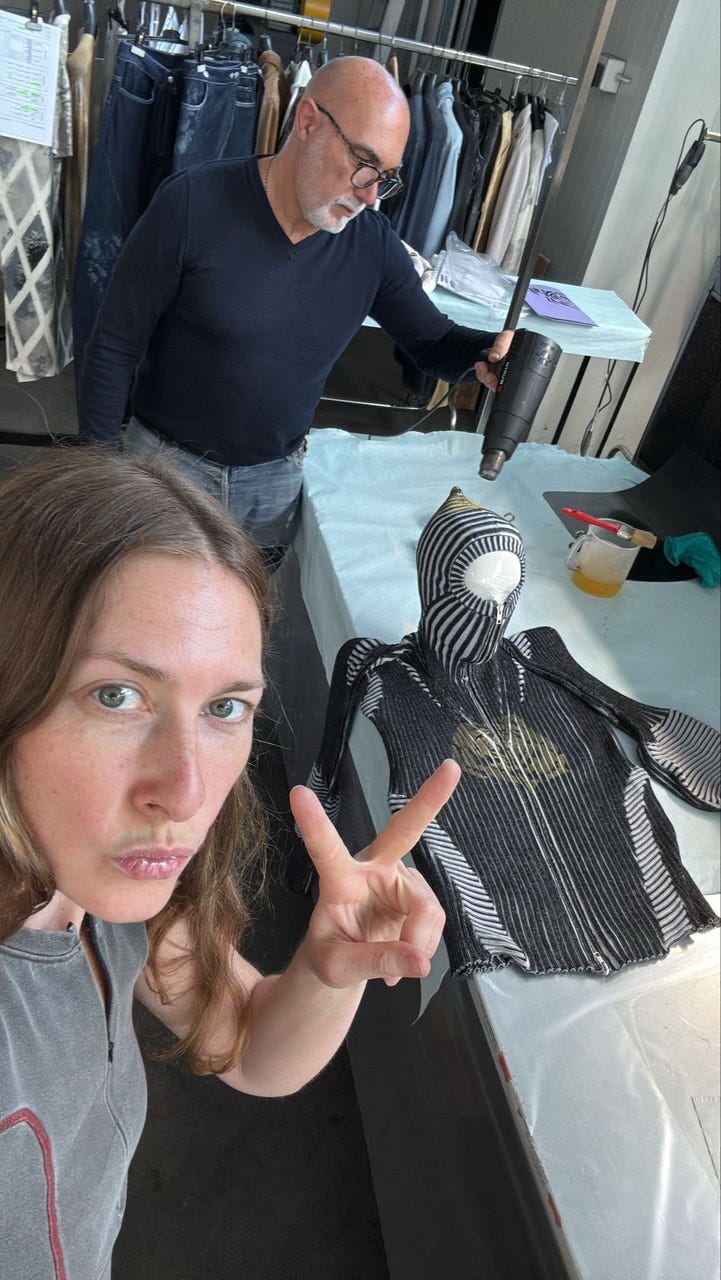
A fundamental tenet of Lueder’s practice is constant technical experimentation with both tools and materials, something recognised by the Vogue Fashion Fund, for which she was shortlisted in 2024, and that saw her inclusion in the BFC Newgen cohort at London Fashion Week. Inspired by her openness to experimentation, we caught up with the designer to unpick her process and to discover just how powerful the LARP can be.
How is your approach to design informed by digital fashion tools and creative technology at present?
In general my techniques always vary, so it really depends. At the moment I use AI, especially for conversation, to communicate the idea. It’s really good for me, what I do in my job is talking. With my team, it’s like I’m a detective who describes a profile of someone, almost like they did a crime! Because of the speed and how fast we have to create something, I use different ways to make what I say visible. We don’t use CLO3D, although we did for a while. It’s not exact enough, we had a lot of problems when we used it and it was not doing enough. The way a smaller brand operates, you have to build on the brand identity. You’re making an evolution of carryovers, you’re not completely changing your direction. If I suddenly started doing lingerie, then maybe I would start from modelling things in CLO3D because it’s so different.
When we were recreating dresses from the 18th century with our friend and collaborator Kathy McGee for an exhibition we did with the Costume Institute at the Metropolitan Museum of Art, we ran into issues with CLO3D as it was created with modern fashion design in mind. Some of your silhouettes are quite unusual and reference historical dress, so did you ever run into problems with the software during the prototyping stage?
That’s interesting, because at that time people did not know how to cut a three dimensional shape, like an armhole. In the past they would use square pattern pieces and then gather them to shape a round silhouette. Things would come off the loom and they were so precious you wouldn’t cut them. A farmer shirt would be made out of rectangles. It’s a very archaic way of pattern cutting, so it’s funny that the technology is too advanced to understand it. I sometimes ask my team to go back and make this farmer shirt so they can understand that way of pattern cutting, because it’s so rich but so simplified. It helps you understand this transition from 3D to 2D. It’s the same with leather. You skin an animal, which is 3D, then it’s flat, 2D, then you make a three dimensional jacket again! When we pattern cut, you have to have someone who’s very good at understanding that.
That’s something I really think they have to do at university, teaching them to pattern cut before using CLO3D. If they don’t do that, I think it doesn’t work. You shouldn’t miss out on that practical step. The jacket I’m wearing now, for example, is based on the most simplified version of a justaucorps. It’s a super old garment, but it was made with a lot of volume and somehow looks like a puffer jacket now. I like this fusion of the archaic and super modern technologies. In 2021 we dressed some musicians in Haiti for a music video using CLO3D. We were in different time zones, but because we had the body measurements we were able to make this video with Sarah Dibiza, which was really fun.
It’s interesting to hear that your primary use for AI at the moment is conversational. How do you feel about prompting becoming a vital part of the creative process? Is language a good interface for design?
When I prompt something, I’m always so kind to the program, like, “could you please?” It’s kind of funny, but when I think about it, it’s actually quite similar to how I would talk to my team in a respectful way. Am I feeding this kindness into the program as well? Is that also part of it? At Sarabande Foundation there was a talk with RCA students that was the beginning for me using AI. We talked about different programs, like Midjourney and a couple of others, which I then started using. It was nice to think about it in terms of conversation. I think the main reason I use it is because I don’t have time to learn new programs at the moment. I’m also dyslexic, so there’s many things which I’m really bad at, like contracts, something I’ve never done before. I can now write them very quickly. I feel so much more confident in my job, it gives me confidence as a business owner without having specific mentors and specific business partners. I have a kind of partner with AI.
So are you primarily using it for those practical elements? We’ll sometimes use AI as a brainstorm partner, so is there anything more conceptual you use it for?
I want to try and make a campaign with it. I’m very curious, because I haven’t seen anything good yet. The programs update all the time, aesthetics change so quickly. I like the old aesthetic better than the new one, so I get annoyed because I don’t like this anymore and then everything looks the same. It’s interesting how time stamped it is.
What elements would you want to be AI-generated?
I would like to capture the talent somehow. I would love it to surprise me. I would be inclined to try more things, like prompting before and trying to imitate that. I don’t know about the collaboration with it, yet. I have a model in mind, but I don’t know if they can actually appear in person because they live in Canada. It would be cool to have a test space for lucky accidents, but it has to be in combination with real footage.
Do you have any thoughts or feelings about the use of digital twins?
This sounds very scary to me. I don’t want to be scared of it, but it sounds like it could be very abusive in the hands of big corporations. The copy that has been used to make it sound interesting is so horrible. This is literally the opposite of what I want. I want someone to have jet lag, to be tired, to be a human and to tell me what they want. I always work quite closely with my models, my interns, everyone! If an intern works on a piece I will name it after them. I ask my models how they feel. I also find the idea of having a clone and not having to talk to them really horrible, that human connection is not replaceable and should be paid for. I don’t want to be worrying about it being too fast, or bad. I’m observing it, but I don’t see any benefit. Yet.
A lot of models and model agencies are aware of it and concerned by it. More and more, it’s clear that digital twins are going to be a part of the future of image making. We share pretty much all of your concerns, but our stance is that we want to try and get ahead of it. Is there a sense in which you think the use of AI can be a democratising technology within fashion, whether it’s used for legal contracts and getting ideas down, or it’s used to make a digital twin of your model so they can appear in your campaign and you can collaborate with them with real intimacy, without you having to fly them over from Canada, for example?
That makes sense, things are done so differently now. 100 years ago you would have to manually move the sewing machine with your feet, there was no motor. Things are so much easier, so things should become easier in all kinds of ways. The only problem is that models have to be their own agent. How do you do that? I think that’s the problem. Maybe with ChatGPT they can make themselves their own lawyer, but it’s about agency. If that’s working, then okay, but if someone is 18 years old and has no idea how to protect themselves, to have the terms of conditions, the terms of work, then that’s the worry. This person in Canada is 35, they know what they need, what they want, what they’re worth. If they can’t be on set because they’re shooting a film in Canada, but want to do it with their digital twin, that’s cool.
It’s about ethics. If there is a strong moral compass that people accept and work with, then it works. But why would people do that? Sadly, people want to exploit each other. I don’t have 100% trust in the industry, because the people who are doing the creative work are often the ones who don’t have the power over these things. There are so many people who make all the money in the fashion industry. Who are they? It’s not the designers! It’s not the writers! It’s not the photographers! Well, maybe it is the photographers. If there are good people pulling the thread, cool. I’m for it.
Has the explosion of generative AI in recent years changed the way in which you approach or understand the fashion image?
It’s funny, at the moment people are so nostalgic. Of course it helps me to create something new if I’m good at prompting, otherwise it’s just things which already exist. Fashion is so nostalgic at the moment and I find it difficult. I don’t watch enough films, I don’t read enough, my ideas come from somewhere else, often human interaction and conversation, which I think is good for me. It feels authentic. Everything has existed already! It’s all indie sleaze, or punk, but where’s the future? We can create so quickly. It should be new images, but I don’t see so many new inspiring worlds appearing. The most inspiring images I see from fashion are very underground young brands in Paris or in London who are almost making prosthetics. In a way it’s not fashion, it’s things that look like how you would put special effects on a person, like a huge plaster on their face made out of some kind of rubber, or a weird plastic hammer and sickle, or a massive sword.
I saw this one show where it was raining and they had machine guns, but with umbrellas coming out of them. I don’t know if they just put the umbrella inside the machine gun, or if they were holding an umbrella because it was raining, but it was such a good image. Putting the umbrellas inside the guns made them look peaceful, it reminded me of a computer game. Otherwise it’s all quiet luxury, or archives, again and again. We need to find something ugly, but good ugly! I’m a bit stuck. With shows I just focus on the model giving me something with the movement, or the music, but with the image I have found it very difficult to create something new. I think there’s a tendency to go very into the now. There are a lot of performances happening at the moment, as well as live music. Or designers are going very sci-fi, but comical sci-fi. I want to see the future in a different way, which is more reality fiction, but I find that difficult right now. I want this for LUEDER.
We can relate to the idea of not seeing inspiring worlds being built. You talk about there being a protagonist at the center of your brand, what kind of world are they living in at the moment?
At the moment I’ve been rereading Mark Fisher’s Ghost Of My Life. I don’t know why, I think because I was so annoyed by quiet luxury. I was thinking about nostalgia, about where archives and quiet luxury started. So I think my protagonist is between wanting to consume and thinking about whether they should go off the grid. They need comfort, but also want to be in the moment and expressive. They’re a bit worried about the future, which is why I did the rave show with Two Shell. The last show was very much about being present, performing on the table. They know where they are, they know how they commute, they know what their interior looks like, what they eat, what they drink, but they don’t know where they’re going to live in one year.
How has your protagonist changed?
I don’t know if they’ve changed. I think that they just want to be a bit more safe. Maybe that’s because they live on an island by themselves and they don’t know how they’re gonna survive, but it’s their decision. Instead of being poor in a big city, they’re just gonna be off the grid - or fully employed. They’ve got to stop suffering. It’s just me, I guess. It’s just fucking me!
Is London, as a world or level for the protagonist to move though, approaching end-game difficulty?
It’s very hard, but also it’s so rich as well. They somehow only feel comfortable here, because if they live somewhere else they would be bored. That’s the biggest enemy, boredom! Boredom doesn’t work, nor does comfort. They want to be challenged. It is so curious that they would rather suffer than be bored. It’s getting difficult. If all these creative people who are making them excited get pushed to the outskirts, or can’t even enter this country, then it’s not gonna work anymore. That’s a big scare about London, that will be a problem. Otherwise, it’s beautiful.
What influence does LARPing have on your design? We read that as a youth you designed your own costume for participating in a medieval LARP organised by the University of Hamburg with your mother while growing up in Germany. To what extent are you still doing that? Are we all ultimately just LARPing?
I started doing it when I was six and it was a good tool set for making any life circumstances work. It made me able to adapt to any circumstances, because it was so fun. It was not a fashionable art form at that time, they didn’t call it LARPing. There was this history professor who thought it was cool to watch around 50 children trying to make fire with two flints, sitting around in the rain under a tarp. They would all sit there hungry, feeling primal fears, but the by-product was being able to adapt to a lot of things. We learnt to be very creative about anything you do, like making food, dressing yourself, we even staged some fights! It also taught us a lot about gender, because girls were not allowed to fight and we really didn’t like that. We were just watching, but we were much taller than the boys.
Class, too. The class element was one part that influenced me very strongly, being open to everyone around me. There aren’t really private schools in Germany. Everyone, rich and poor, is all together. There’s no school uniform, which leads to problems with people wearing brands, but it’s not very classist in that way. It’s always a topic for me in clothing, like long, pointy shoes for people who don’t have to work, or long sleeves that can catch fire, because they’re hanging in the flames. We were taught a lot about fairness, but that maybe made me not care about having money myself. So maybe I’m still LARPing, I have Peter Pan syndrome because I’m still in the game.
You can also understand party and rave culture in terms of LARPing.
I used to live in this yard in Bermondsey and this was so important. That’s why I’m still here, everyone else from my year at the Royal Academy of Art who was not from the UK moved back. I was one of the only people who stayed because I had such a rich community here. We had parties all the time. At times it was a bit intense, but you were never alone. If we wanted to have a dinner party, someone took a bed sheet and threw it on the dinner table, we screwed some candles into the wall and it looked like a medieval banquet in one second. It was so quick! We made this magic and it was very inspiring and had nothing to do with money. That’s what is so similar to LARPing, these worlds we create. That’s why I like real human stories so much, they’re so unexpected.
It can be useful to think about LARPing as both a way of critiquing certain kinds of behaviour, or social dynamics, but also to think about it more positively, as an almost emancipatory process, to be able to be expressive despite the fact we’re living in such a tough city. To be able to do all the things you want to do as an artist, you almost have to be a LARPer.
That’s so true. It makes me want to go out! We designed these ornamental talismans with different protagonists in mind. We made six shapes and my friend Thomas Grogan designed them, using my character descriptions to make them. I prompted the protagonist’s descriptions, which we then turned into the shapes. That’s the most direct translation of AI into an object. It wasn’t LARPing, but it was as if you would write a LARP. That’s what I want to get out of working with AI, trying to find a way to get information you are estranged from, to then feed that into the prompts.
Interview by Henry Bruce Jones and Róisín McVeigh
No posts
Comments
Nothing yet. Say the first thing.
Sign in to join the conversation.