
Though his work reveals a keen eye for the mythic and magical, Mark Leckey’s greatest gift is arguably his nose for what’s next. This impulse has led him through some of the most important transformations in living memory. The euphoric explosion of acid house, MDMA and free parties during the Second Summer of Love that catapulted subterranean club culture into the muddy joy of rave. The noisy whir of analogue video tapes into digital editing software that allowed the artist to manipulate the archive of this same period in his canonical video work, Fiorucci Made Me Hardcore. Now, faced with what he describes as an ever-present “image anxiety” that the dizzying advance of generative AI leaves in its wake, Leckey is once again following his nose through another tectonic shift in our media environment.
For Leckey, AI image generation presents us with a unique opportunity to come to terms with the true nature of the image. Recognising that throughout the history of image making representations of reality have always garnered suspicion, Leckey grapples with the inherent blasphemy of the image, a quality that stretches from false idols to AI slop. Though we initially connected with the artist to work on a project chasing some of this profanity through the work of William Blake, the conversation that follows immediately expands to include the millennial cults of counter culture, the metaphysical battle between different media forms and a gnostic theory of history, within which the arrow of the 20th century bends back into the spiral of the 21st.
Has experimenting with generative AI had any influence on your approach to your art practice?
I’ve realised that AI is not really going to affect art in any immediate way. I think what it does is split commerce and art. During the 20th century there’s this productive friction between art and commerce, the two things are always rubbing up against each other, but in the end they’re productive. You get this relationship between commerce and creativity that’s very successful and basically produces pop culture. My fear of AI is that it becomes entirely commercial without any artistic input, or being more conspiratorial, that they have found a way of producing images that doesn’t need artistic input. That’s my anxiety, it was always a machine, but it was a machine that enabled you to engage with it and produce things within it. Now the machine is excluding you from that production.
We fed it, now it’s feeding us.
Exactly. It’s not art, in terms of art making or galleries. It’s not going to undermine those in any direct way. That friction between art and commerce has given me everything, all the culture that I’ve absorbed throughout my life has been through that rubbing up together between commerce and creativity. In a sense, that was the anomaly, that was the weirdness that happened for 50 years. What a strange thing to happen! You could extract your own unconscious desires and be paid for it. It gets weirder and weirder to look back on. People used to get paid just to reveal their psyche in some way, or cast out their demons. There was a pay check for it!
Everything is so frictionless now, it’s almost like there’s no foothold for the human to have purchase on the smooth machine logic of AI image generation. You have spoken about subculture being the product of the waste that sparks off this friction, is there some sort of subculture emerging from AI slop?
I think something’s emerging. The point about waste is that it has a lot to do with the transfer from analog to digital. There was a parallel between London and New York both being wastelands after the second World War. You could play in the ruins, you could have underground nightclubs in the wreckage. Analog also has a kind of waste. The signal is not one-to-one, there’s a lot of noise to exploit. The two worked as a metaphor for each other. With digital, it’s just on or off. There is no gap between, there’s no waste and these things all add up to create a completely different set of conditions for creativity. We’re still trying to repeat analog ideas. When I see artists like KingCon2k14, they’re trying to deal with what images are becoming. It returns us to this idea that images produced by machines are in some ways blasphemous. There’s always been a suspicion of images, but then we were inculcated into being unable to parse the difference between images and and the real. That’s what I see in AI slop, a questioning of the blasphemous nature and inherent falsity of images.
Are you talking specifically about photography?
I’m talking about all images! All representations that are a fundamental doubling of reality. In doubling reality you see images as being in the world as you are in the world. Images take on a real quality, or a kind of truth. But images are graven, they’re false idols. We mistake them for us. As they proliferate, as the archive of images becomes vaster and vaster, there’s this assumption that the world is a world of images and that we live amongst those images. It goes back to all the warnings from post modern writers like Baudrillard, images become a simulacra that we mistake for the real. When images become entirely mechanical, images making images of themselves, the human hand comes out of it and the scale becomes greater than human. Then it induces a kind of terror, an image anxiety, where you realise the monstrous nature of them, that they can and will devour us. Even though we make images for a living, I’m becoming increasingly suspicious of them. There’s an over-saturation I’m almost repulsed by. Part of AI’s nature emerges as systems become so vast and complex that they replace us in terms of how we understand the scale of the universe. It’s no longer human sized, it’s system sized and we’re left out of that. The human hand is a marvellous instrument but it just gets completely dwarfed, the way you marvel at an ant carrying a leaf.
You’ve spoken about the transfer of analog to digital as one of intensity. Is there another transfer of intensity present in the creation of AI imagery?
Acid house is the best example of this. The 303 bass line makes you feel mechanical. It’s malfunctioning, when I hear it I just start twitching in this very glitchy, dysfunctional robot way, like it’s infected my nervous system. For me, that’s the ultimate cyborg relationship with machines or systems. Now that systems organise themselves outside of our bodies, what do we do with creativity? Maybe that impulse was always determined by those systems and our relationship to them and maybe we find that, after AI, we no longer need them. Is that fundamentally depressing and horrific, or does it mean that we’re released from the compulsion to make images to overcome our alienation. When everything is truly alienated and we don’t even inhabit the same space, when AI operates in the symbolic realm, we get to be like creatures again, all watched over by machines of loving grace. We don’t have to live in this mediated existence anymore, we just get to fuck and eat and grunt at each other as language dissolves. That’s the future I’m looking forward to, to get massively fat and just slurp upon fucking life. Otherwise it’s still this idea that there’s some space where creativity can operate which I think is a very 20th century idea of understanding what creativity is.
If we’re being banished, or freed, from the realm of images by the machines, where do you see creativity emerging from?
We’re returning to something that’s more embodied. Somehow we have to find a way of being more situated in the world and not mediating, either through language or through images. We have to find some other way of being. This is an ontological shift that seems so enormous to me and we’re only just feeling the initial vibrations of it. This is why I always go on about the medieval like I’ve lived through it! The printing press entirely transformed the world, not just in terms of distribution of the written word, but how it conditioned the world. It’s the same thing now, we’re getting reconditioned. The most creative things come out of allowing for the possibility of a consciousness altering relationship. This is, to me, where it gets very religious. The idea of self annihilation, where you rid yourself of all your human desires and give yourself to the one, the swarm, assimilating with the Borg. But all of these things leave out one vital part, which is capitalism. We can talk about AI and the potential of human-machine symbiosis, but it neglects the extractive drives of capitalism, which I fear more than AI. I don’t think AI is inherently fascist, but whether it’s a natural, emergent property of capitalism is something to consider.
It sounds like you’ve been reading Marek Poliks & Roberto Alonso Trillo’s Exocapitalism.
They talk about this idea of ‘lift’, where finance is so abstracted it takes place without being tethered to physical reality. I think finance is a kind of dark magic now. If you even just poke at it, you realise a lot of it is like divination, just using different techniques. They have this financial tool called a stochastic oscillator, which is just a randomiser. They’re using the scale of these systems to randomise numbers until it produces an effect. That’s basically dark magic! I think that’s where we might be creatively, rather than learning to be a saboteur, you become more like a magus, or a witch. You use hexes or divination to manipulate reality, because reality is no longer material. Magic is the way out!
One of the side effects of this we’re observing is that the value of images is declining. How is that being reflected in the art world? Are you feeling anything similar?
Very similar. The institutions of art have become more porous, it feels like the apparatus that held art up has just gone. Now it’s just objects in a room, you’re going into a gallery and it’s just a showroom. For me, the point of crisis for art was the period after post internet art, where it retreated from any sense of trying to understand the implications of the digital. During the pandemic this accelerated into material, paintings sell in a way that doesn’t quite make sense with the rest of what’s going on in the art world. Galleries were once this modernist space, a white cube you could bring things into and they would be magically transformed into art. It was able to transubstantiate things just by its institutional power, but that power has evaporated. As it evaporates, the events around it become the discourse, rather than a critical appraisal of works. In the attention economy, it becomes more about what’s happening to art and its institutions, all these conversations move away from the art itself into these other spaces which can be reduced to something that is part of that economy. Going back to painting was very uninteresting to me. Art’s momentum was always forward, but long ago it lost any idea of a vanguard. People talk about it in a roundabout way, but something really drastic happened after the pandemic.
It’s the same with fashion. The whole concept of it is the new, or the next, but that doesn’t seem to be working anymore.
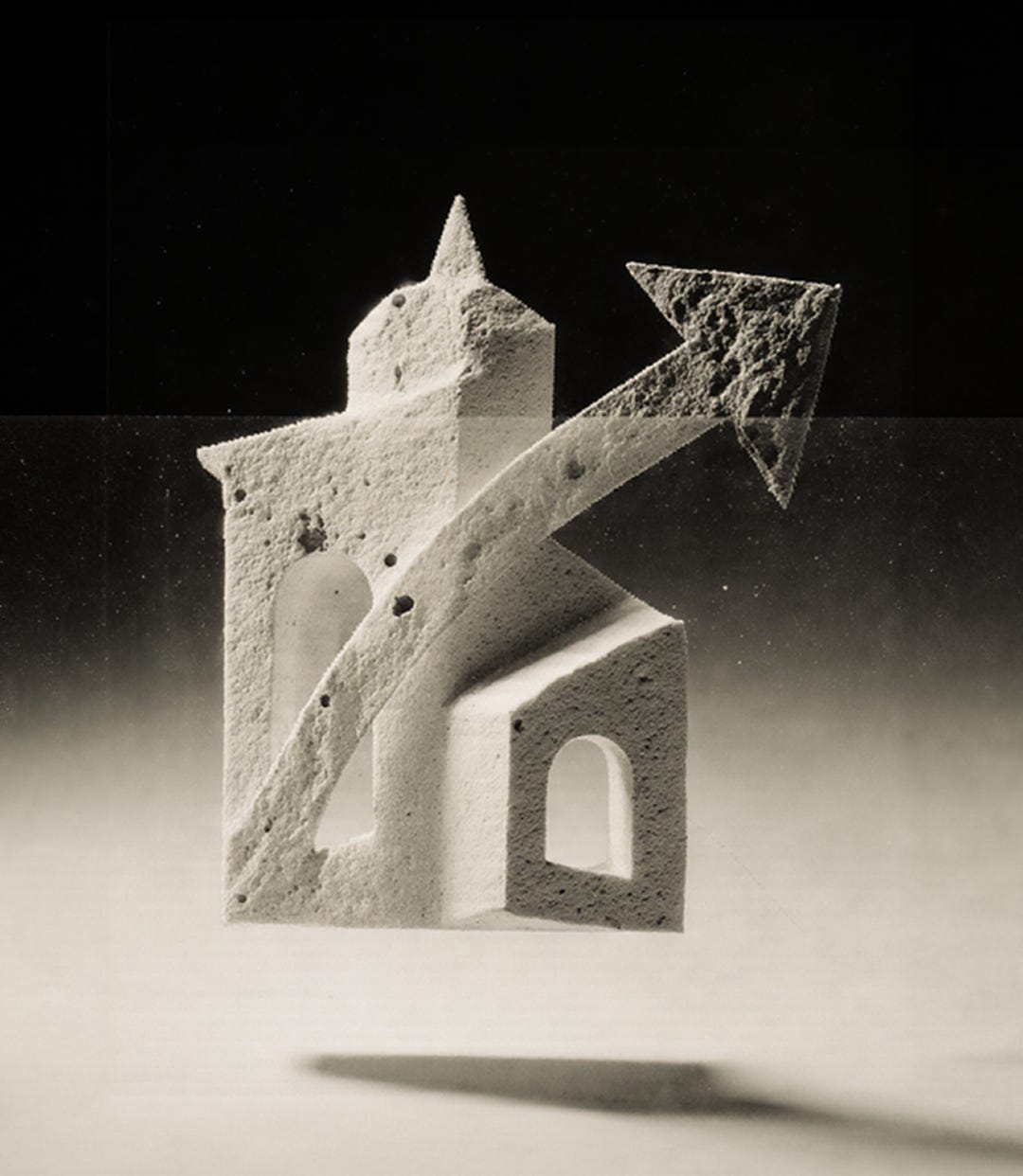
I’m working on something at the moment called ‘In Pursuit of the Millennium’. I’m trying to make this argument that 20th century counter culture was a return to these millennial cults that you had in the medieval period. They were basically accelerationists, in that they were trying to bring heaven down to Earth to try to bring about the second coming, to force Jesus Christ to return to Earth. They did this through different theological arguments, one of them being that they no longer accepted the laws of the church, or even man-made laws. They became like anarchists. My argument is that it got repeated in the hippie counter cultural movement and that the millennium was a transcendental idea that could escape the material realm. The 20th century was this arrow pointing to Y2K and everything was in this perpetual movement towards it. The realisation of that is the internet. The internet is a realisation of the counterculture, it immanentises the eschaton. The eschaton is the end, by which they mean heaven, and to immanentise is to bring it down to this world, so you bring heaven down to earth and the apocalypse is a thousand years of peace and harmony. This transcendental realm was realised through the internet and the arrow of the 20th century stops, because it reaches its goal, and then keeps circling back to 1999. It’s like The Matrix, they’re stuck in 1999, but it’s 2087 in reality. Instead of an arrow it’s a spiral, we’re just spiralling back and back and back. That’s why all these things keep returning and there’s this sense that nothing new ever happens. There is no arrow anymore, we’ve lost our directional guide, but the arrow was bad! We should embrace the spiral and and the sexy fucking existence that the spiral could potentially bring about.
Is it particularly art and fashion that struggle to keep up with the spiral, as opposed to say, music?
With music, I think you have to bring in something entirely outside this frame, which has a lot to do with class. Class changes music. Rock bands are definitely caught in the spiral, but rap isn’t, it somehow escapes that. It’s especially clear now. I was watching some footage from an EsDeeKid show and it looks fucking crazy. That’s what it was like when I went to gigs when I was 16. I listen to Radio Six in the background and nothing usually infiltrates my perception, then the new one from Rosalia comes on, which to me sounds like a declaration of something. It’s so intentional. Music is more the condition of now, everything, in a sense, feels musical. Image making is facing this existential crisis, but music knew about this before, it was ready. Music feels at home in this environment.
Why do you think it was ready for it?
Music can carry on communicating when images and text, which are the two things being assailed by AI, don’t know where to turn. All of this is coming from Marshall McLuhan, whose whole idea was that we were going through this transition from a written culture to an audio culture. Everything starts to be like music, whereas the world in the 20th century and previous was more determined by writing. Like the arrow of the 20th century, writing moves ever forward, it’s in discrete units and it goes from the beginning to the end.
We’re talking about these mediums as though they’re metaphysical powers battling each other.
I think they are! Metaphysically, music is the one that touches the transcendent, that has the most spiritual potential within it. The relationship between images and the spiritual is always potentially blasphemous. The more I look back on the 20th century, the more I realise that’s what pop music was trying to do, to bring the transcendent into the world. I have a very sentimental nature and I don’t know if listening to music has helped that. You could say that’s the biggest trick of music. An older Marxist argument would be that it’s just another form of opium for the masses, that keeps you in this bubble of delight. One of the things you get from music, which in terms of real world politics I think is necessary, is a sense of the ecstatic. We’re not going to find politics through truth to power and reason, we can only find politics through ecstatic belief, the idea that the world can be changed and to be excited and elated and euphoric by that. That’s what revolutions are. MAGA is euphoric. The Right is ecstatic and in being so changed the world, so the Left needs to find an ecstatic politics again and music is the best form to speak about that. It might be me being a bit of an old hippie, but when I see all those kids bouncing like fucking crazy to EsDeeKid there’s a potential politics in that, a politics that can be harnessed and directed. You have to overcome the cynicism and fear and the only way to really do that is through euphoria.
Can we find this same euphoria in images by using AI? Can it put us in touch with the transcendent?
This idea of ‘lift’ that Exocapitalism presents, this sense of being untethered from the physical world, does at least alert you to an idea of the transcendent. It can’t help but invoke a kind of spiritualism. I think that’s the future that we can’t quite see now. We’re still in a very rational epistemology, it’s the only way we can understand how we relate to things. The thing that we can’t see is this potential spiritualising of matter and what that is going to bring about. There is a possibility of some escape from an overly deterministic, rational, measurable worldview. That’s the paradox of all this, the most logical systems operating by these mathematical abstractions could potentially return us to a place where we can think once more about spirituality. I’m such an old hippie it’s fucking scary, but I’ve only become a hippie through technology. That’s the point I’m trying to make: technology has turned me into a hippie.
Interview by Henry Bruce Jones, Tom Wandrag and Róisín McVeigh.
No posts
Comments
Nothing yet. Say the first thing.
Sign in to join the conversation.