
“The object isn’t to make art, it’s to be in that wonderful state which makes art inevitable.” Robert Henri
Between 2010 and 2014 I lived in a small dorp called Barrydale in the Klein Karoo.
From time to time Derek Gripper would blow through town on one of his countryside tours, mesmerising locals with his guitar. We were at university together, so we'd meet for coffee or go for a walk when he arrived. Then, one evening, he’d perform his wood-magic to about thirty people in the town hall with little pretense and lots of joy.
Looking back now, it’s a slightly absurd thing to remember.
Here was one of the finest guitarists in the world, setting up his own chair in a little Karoo town as though he’d just popped in to fix someone’s washing machine.
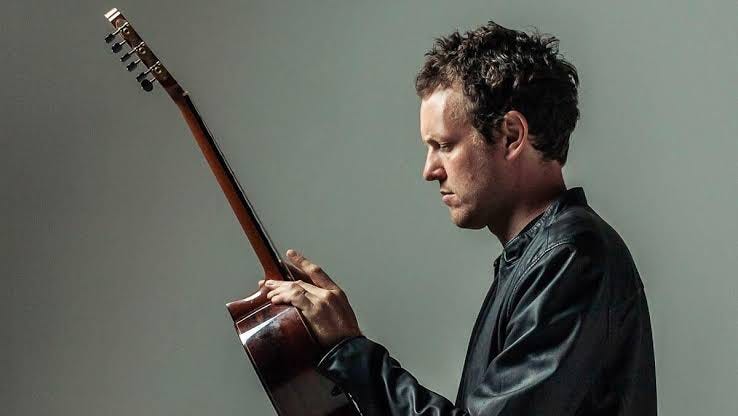
His brilliance is easy to forget, because the celebrity part of him seems to have wandered off somewhere years ago. Derek is very blasé about the whole thing.
He is deadly ordinary and wildly brilliant at the same time.
There’s a long list of things, besides for being a star, that Derek Gripper has dispensed with. The need to ‘perform’. To know what’s coming next. To control. To be, at all times and in all rooms, the cleverest banana in the bunch.
He has relinquished thoughts and habits that many of us would spend our lives polishing like inherited silver, passing them lovingly from one anxious generation to the next.
I’ll be honest, I’m jealous.
My own mind goes after an unncecessary thought the way an enthusiastic Labrador goes after tennis balls. But spend an afternoon with Derek and the appeal becomes obvious.
Something loosens. A little freedom leaks in. And in his case, the music comes alive.
So naturally I wanted to know how he does it.
One of the people who’s left tracks across Derek’s thinking is the Japanese farmer Masanobu Fukuoka.
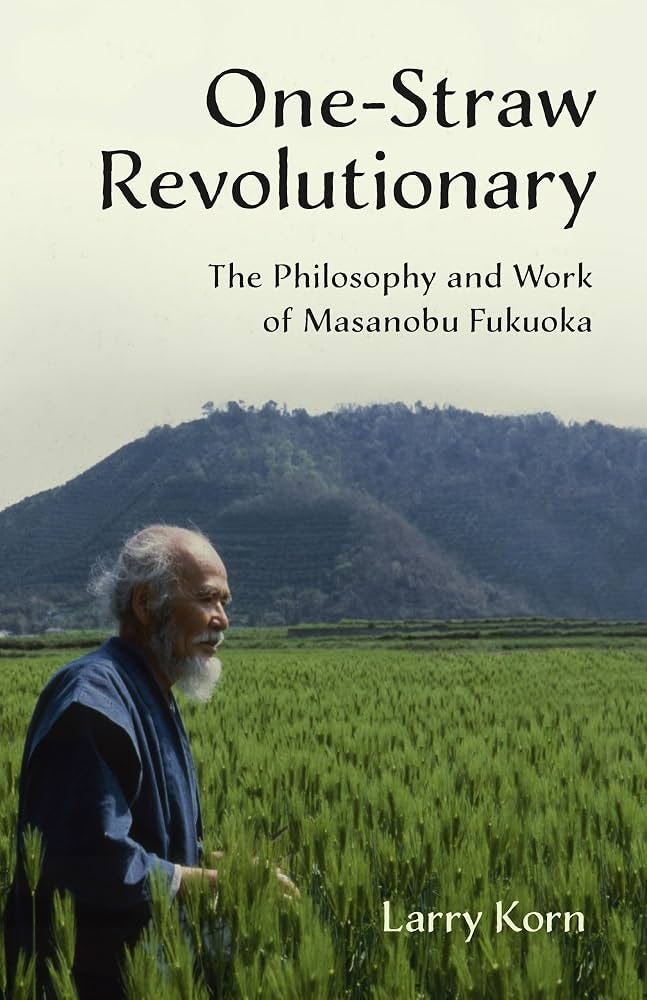
In 1937 Fukuoka was a young microbiologist working as a plant pathologist for the Japanese customs service. His job was to inspect imported plants for disease. Like most scientists at the time, he thought nature was something that needed to be tamed, managed and improved.
Then, in his twenties, he suffered what he later described as a kind of existential breakdown.
Exhausted and ill, he spent days wandering in confusion before collapsing on a hillside overlooking Yokohama Bay. At dawn he watched the morning mist lift from the landscape. A heron flew across the sky, and in that moment he experienced something that changed his whole understanding of the world.
“Humanity knows nothing at all. There is no intrinsic value in anything, and every action is futile, meaningless effort… My spirit became light and clear. I was dancing wildly for joy. I could hear the small birds chirping in the trees, and see the distant waves glistening in the rising sun. The leaves danced green and sparkling. I felt that this was truly heaven on earth. Everything that had possessed me, all the agonies, disappeared like dreams and illusions, and something one might call ‘true nature’ stood revealed.” from the One Straw Revolution by Masanobu Fukuoka
He looked at forests and noticed they seemed to be getting on perfectly well without human supervision. Nobody had appointed an Operations Director. There were no quarterly strategy meetings. Spring kept turning up anyway.
Why, then, did agriculture demand such relentless intervention?
Mystical experiences are one thing. Rice fields are another. So he decided to put the revelation to work. He returned to his father’s farm and for the next forty years he treated it as a living experiment. Every season he asked the same simple question.
“What unnecessary thing am I adding?”
His first attempts nearly cured him of the whole idea. Doing nothing and non-interference, it turns out, are not the same thing, and his early hands-off efforts simply killed his crops.
So he watched.
And watched.
He spread straw back over the fields to protect the soil, and scattered seed at the right moment. He observed the weather, insects and the rhythms of the seasons, and little by little, he removed the practices that modern agriculture thought was essential.
Fukuoka was trying to understand what the field actually needed from him, and so his work shifted from producing crops to cultivating the conditions within which those crops could flourish.
He learnt when to step in and when to leave well enough alone, and the more he learnt to create the conditions in which life could express its own intelligence, the less he found himself needing to manage life directly.
Mastery, we’re told, is an act of accumulation. Learn another technique. Read another book. The modern self is forever under renovation, adding another room here and another skylight there, until eventually the whole house starts looking suspiciously like a hardware store.
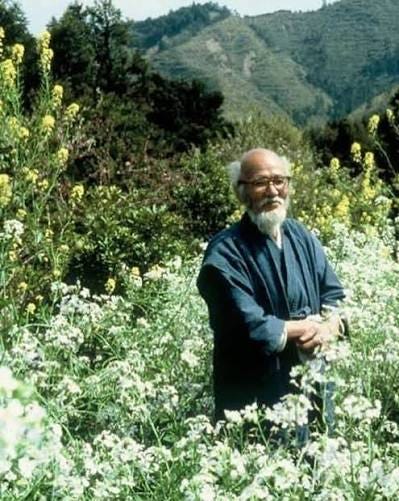
Fukuoka spent forty years heading steadily in the opposite direction, removing whatever prevented the field from expressing its own genius and vitality.
The Alexander Technique, which Derek also mentioned, uses the same observation, but applies it to the body. Instead of forcing it into good posture, it asks what habits are interfering with the body’s own remarkable capacity for balance and coordination. Much of our suffering comes from the ingenious ways we’ve learnt to get in its way.
Even childbirth, Derek pointed out, can be approached in this ‘no interference’ way. The French obstetrician Michel Odent spent years arguing that the body often knows rather more about giving birth than the thinking mind does, and that the conditions surrounding birth can either support that ancient intelligence, or continually interrupt it.
Each of them asked a version of the same question:
How can I interfere less with the natural intelligence that’s here?
Somewhere along the line we appointed ourselves CEO of Life, despite having remarkably little experience of being a rice field.
We've become convinced that life needs our constant supervision. That more control produces better outcomes. Yet forests, rivers, migrating birds and healthy bodies seem to have missed the memo.
Modern culture domesticates us into believing that control produces life.
It doesn’t.

At first blush this sounds suspiciously like laziness dressed up as philosophy.
But Derek is one of the most disciplined people I’ve ever met. He’ll spend days thinking about the way sound travels through a concert hall or the exact way a guitar should be amplified. His explorations are rarely casual.
As he puts it: it’s life or death. He prepares obsessively, so that when the music begins, preparation can step aside.
Performance, for Derek, is a subtractive process.
A Free Range Human might call it ‘untaming’. Little by little, you stop interrupting your own intelligence so it can move in its own wild way. You learn what to practise, what to trust and, eventually, what to leave alone.
Perhaps that’s what mastery is. Not becoming more extraordinary, but becoming less of an obstacle to the life already trying to move through you.
For Derek, that means the music.
The rest of us have our own instruments.
Comments
Nothing yet. Say the first thing.
Sign in to join the conversation.