
Humans,
It took Derek Gripper untold hours of painstaking work to transcribe note-for-note the complex compositions of Malian kora player Toumani Diabaté and find a way of playing them on six-string guitar. The results appeared on his ninth album, “One Night on Earth.” The album created an unprecedented meeting point between the written tradition of Western classical music and the oral tradition of the West African griots.
Critical acclaim was quick to follow. Classical guitar legend John Williams said he thought it was “absolutely impossible until I heard Derek Gripper do it.” Toumani Diabaté himself asked for confirmation that it was indeed just one person playing one guitar. Both invited Derek to collaborate with them: Derek performed with Williams in London’s Shakespeare’s Globe and King’s Place, and with Diabaté and his Symmetric Orchestra at the Acoustik Festival Bamako, Mali. He also played with Trio da Kali at Carnegie Hall and won a Songlines Award for the best album in Africa and the Middle East. Derek tours regularly in the USA, Canada, Britain, Europe, Zimbabwe, Swaziland, Namibia, Australia, Malaysia, India and Mali.
Aside from these transcriptions Derek has created original music from his diverse influences, from Africa: Mali, Senegal, The Gambia, South Africa, Zimbabwe, Arvo Part, and Egberto Gismonti. Derek has also spent many years performing and recording his own translations of Bach’s violin and cello music, infusing his interpretations with his lessons from the oral traditions of Africa.
His works for string quartet, larger ensembles or installations have been performed/exhibited at The Venice Architecture Biennale, Peasmarsh Chamber Music Festival in the UK and used in films such as “Five Fingers For Marseilles.”
Derek Teaches an online group of guitarists from around the world. Join here.
Here’s an abridged version of the transcript, for those on the run.
Anél Hamersma (04:18) So we’re going to talk about music, but in a peripheral way — using it as a teacher, in the way you’ve learned to live your life. Based on what I know about you and what I found in my research, it seems like your life philosophy right now is something like a “do nothing” philosophy. Or the “what less can I do” philosophy.
Derek Gripper (05:03) That comes from Fukuoka — Masanobu Fukuoka, who wrote The One Straw Revolution in the seventies. I wasn’t introduced to that book first, though. It was his second book, given to me by a man called Anthony Baker, who for thirty years ran a venue in Observatory called Cafe Ganesh — still one of the most interesting experimental live spaces in the city, even after he stepped back from it. Years ago, on Anthony’s farm in the Cederberg, he introduced me to Fukuoka. The farm is called Niks Is Nodig — “nothing is needed” — which I love, because normally in Afrikaans you’d double up the negative.
That book was called Natural Farming: The Theory and Practice of the Green Philosophy — I’ve got a proper copy on my shelf now. It’s about a Japanese farmer who came from a scientific background and, through his own process of self-realisation, wanted to show people the simplicity and perfection of life. Nobody understood him when he tried to explain it, so he started farming instead, and invented what he called “do nothing farming.” It’s not actually about doing nothing — it’s about constantly asking what less you can do, what’s getting in the way. That’s been a good guide for me, because I’m a complicated person. I like grandiose ideas, big thoughts, and that pulls me into needless complexity — the rabbit warrens of it. As a musician there are endless paths you can go down, and I do go down them — but I always come back to what I’m actually doing, and how. The guiding thing has been the guitar itself: this one instrument I’ve played for years, trying to honor the sound it makes, whether in performance or on a recording. I bounce out into massive complexity and end up back at that. So when you say I have a philosophy, I laugh a little — there’s a lot of wavering in it, a lot of picking up new things along the way. But from the outside it looks like I’ve done the same thing for twenty or thirty years: play the guitar, share it, learn what it is, and keep doing it.
Anél Hamersma (09:58) There was a Datsun, there was a hamster, there was De Aar…
Derek Gripper (10:22) I had an interesting childhood — a bit of a multi-tiered perspective, because I lived in different environments, and I learned through that how to be comfortable in different realities. It’s a little like changing schools a lot: you learn more than if you’d spent all twelve years in the same place, the same way people who’ve had to move around a lot pick things up that others don’t.
I lived in two different families. There was the very suburban, conventional household with my grandparents: dinner at six, one house, everyone in it, through ages two to six, and again from thirteen to eighteen. And then there was my mother, who was seventeen when she had me. When I was nine or ten she was twenty-seven — wild to think about now. The two of us drove off in the Datsun to De Aar, in the middle of the Karoo, where she’d got a job as an English teacher. I was ten. We lived there a year, out on a farm six kilometres from town. The hamster didn’t make it.
A twenty-seven-year-old single woman with a ten-year-old, teaching English at the local high school in De Aar — that’s a very different experience from the two-parent household with my grandparents, where my grandfather went to work at his engineering firm in Observatory every day and came home at six for dinner at half past.
Anél Hamersma (12:46) So when did you start playing the guitar?
Derek Gripper (12:46) Because of a man called Mike Hool, my music teacher at Westerford High School. I’d been playing violin before that, but it fell apart when I couldn’t find a teacher in De Aar, so I spent a year and a half on piano instead and more or less forgot the violin. By the time I got back, I had to relearn enough to audition for music as a subject — my technique wasn’t together, but they let me in.
Mike inspired me — a very enthusiastic teacher who’s shaped a lot of local guitarists. Classical guitar suited me better than the violin ever would have. I don’t think I’d have made a good violinist; that instrument wants you in an orchestra, working with other people. Guitar is a bit more solitary, and that suits me.
Anél Hamersma (14:09) And was he also the person who taught you the Calvinist work ethic — the one you mentioned, the Calvinist work ethic of Western classical music?
Derek Gripper (14:28) No, he didn’t teach me that — I taught it to myself. I suppose I got my head turned a little by the university, by the whole idea of classical music, the sense that you had to strive for something outside yourself. It was a lovely idea, and it was probably a good way to spend those early years of your twenties, when you can otherwise get into so much trouble. The fact that I had this thing I had to do meant I needed to take hours of the day, and I obviously developed real skills through it: that idea of practice, sit down for eight hours, metronome on slow, Tai Chi-ing your way through a long Bach sonata. That’s what I was into and busy doing.
Anél Hamersma (15:35) And was that your own desire to play well? What was driving you?
Derek Gripper (15:39) That’s a funny thing to untangle. You have to have some desire for affirmation to spend your time perfecting a performance — you can’t say it’s purely the music, that’s not true. There’s music you could sit under a tree and listen to for yourself alone. So I think it was inspired by other people, by their stories.
There was a guitarist called Paul Galbraith who inspired me a lot at one point — through a single review, because there weren’t five thousand YouTube videos of him to watch back then. All I had was a review of a concert: this man playing guitar in a dark theatre, single spotlight, no applause for an hour and a half, an audience completely absorbed. That image appealed to me enormously. Why? No idea. But it did.
Anél Hamersma (17:23) Well, in Sangoma we say you have a type of spirit that attaches itself to you and drives you to create.
Derek Gripper (17:24) Exactly — and unfortunately for me it’s never been as simple as the one spirit. It’s always been contradictory spirits. I had Paul Galbraith’s spirit on the one side, and on the other I discovered a musician called Egberto Gismonti, both of whom I’ve since met, years later. Gismonti represented something like digging into the bowels of the earth, and when you’re in the Gismonti spirit, you can’t even stomach the spirit of the other guy. These two — not the people themselves, but the directions they represent — keep oscillating for me, and of course neither of them is actually me.
When you’re looking for a train to get on, you land on one and think, yes, this is what I’m doing. There’s a real sense of belonging in that — this is who I am. It’s the same mechanism as religion, and it causes just as much strife. But what you do is none of your business, really. You don’t walk into a performance already knowing who you are and what the audience is going to get from it. That’s a waste. You go in as unknowing as possible — that works better. It’s the Fukuoka thing: do I need this idea of what kind of music I’m about to make? No. Cutting away with Occam’s razor — do I need that idea to do the performance? No.
Anél Hamersma (19:43) Once you’d finished your studies, from what I know about you, you played everywhere, for whoever wanted to listen. What was your playing like at that point — were you playing very consciously, or very unselfconsciously? What was happening inside you?
Derek Gripper (20:07) I started a process with a guy I was doing yoga with, Victor. We talked a lot, worked together, practiced yoga together. At that point I’d kind of thrown the guitar away — put it in the pantry — and was making a living as a yoga teacher, because it felt more aligned with my romantic ideal, at the time, of what you could do with your life. Guitar felt so corporate by comparison; I’d see these unwell people playing and think, no, these aren’t the people I want to be surrounded with. I tried to escape it. But through the process with Victor, we talked a lot about what music could actually be, and I started a series of house concerts — last Sunday of every month, for an entire year. I’d have twenty or thirty different people come each time, off a mailing list, and every one was an exploration of a different process. I remember once handing out little meditation prompts, a different one to everyone — follow your breath, follow a sensation, whatever it was — and I was involved in mine too, so we had this collective meditation happening alongside the music.
Around then I made two records: one with Alex van Heerden, called Sagtevlei, and my first solo album, Blomdorings. It was a straddling of two realms — wanting to be part of the classical world, with its technical precision and high ideal of mastery, and the more elemental side of just finding the thing that you do, which I touched on properly through the work with Alex. That whole process was about working out what I actually wanted to do on the guitar.
Anél Hamersma (22:52) What strikes me about you, Derek, is that you’ve always had this exploratory, playful approach — “let’s take what I know about yoga and combine it with guitar playing.” There’s an immediate crossing of boundaries, an experimental attitude. That’s what sets you apart.
Derek Gripper (23:22) I’d say playful is more aspirational than accurate. In the moment, in the exploration, I take it quite seriously — it’s life or death for me. It only becomes playful afterwards, once I’ve integrated it and stopped caring about it, once it’s just part of me.
Anél Hamersma (23:41) Is it?
Derek Gripper (23:41) Yeah. When I realise afterwards that I don’t care about that thing any more, but I’ve already integrated it, and then I pretend I never went through it — because I don’t think about it any more, it’s just part of me. So I’ll do this life-or-death deep dive into something — yoga, classical guitar, whatever it is — and the boundaries between them are totally fluid. Everything’s metaphorical. The way you do yoga is reflected in the way you play guitar; when you’re back on the guitar you’re not doing yoga, you’re thinking about what it represents. It’s all fluid, there are no real boundaries between these things for sure. If you’re thinking Fukuoka, it’s kind of modular — how does that plug into this practice? If you go on a Vipassana course, how does that interact with it? They all click in and link together. Fukuoka linked to the Alexander Technique when I discovered that through a teacher called Walter Vaughan Jones. And the Alexander Technique linked up with Montessori once I had children and started learning about that philosophy. For me they were always the same thing, being expressed in different realms.
Anél Hamersma (25:16) So when you went on stage at that point in your life, did you have that sense of life or death? What happened inside you just before you started?
Derek Gripper (25:23) It depended on the period. But the process of learning to perform has been a subtractive one. Years of yoga and meditation practice, and shopping around: do you want to focus on the sensation of your fingers on the fretboard? Only on the sound? Do you want to follow your breath and let the music happen? Or do you want a perfect idea of the piece worked out beforehand, and your job is just to execute it?
All those possibilities, all that could be driving a performance — it became a process of subtraction. I don’t need a plan before I play. I don’t need to know what I’m playing first. I don’t need to decide beforehand what people are going to hear. I don’t need to improvise, and I don’t need to recite something pre-written. So now the performance itself is the easy part.
I was just on tour with Ballaké Sissoko, who’s really the greatest kora player — the kora being this twenty-one-string harp, for anyone who doesn’t know it. Ballaké is a griot, from a long line of musicians; the kora has been part of his family for generations. He’s an extraordinary player. He said to me once: the performance is easy, it’s the rest of the time that takes the pills. I don’t know what pills he meant, but I know what he means.
Neither of us is caught up any more in the life-or-death struggle of what happens on stage. And I think our collaboration has been a real high point in realising that Fukuoka philosophy — because Ballaké doesn’t speak English, and I don’t speak Bambara or French. Genuinely zero shared language. On tour for a month, we ran on three modes: hand gestures for the simple stuff, Google Translate for logistics — what time in the lobby, should we push the soundcheck back — and Gemini’s voice translation when we needed to get to something deeper, though that didn’t happen often.
His English is slightly better than my French, and my French ends at “I don’t speak French” — so it really was zero shared language between us, not the usual thing where someone can at least tell you what they want to eat.
So: getting on stage together with no rehearsal, no shared idea of what it is to make music, no plan. I have no idea what Ballaké thinks his role as a musician is — I can imagine, but I don’t really know. He comes from a completely different realm of music; he’s worked in the Western commercial world for most of his life, but he doesn’t engage with music that way. We never spoke about what we each wanted from a show, or from the outcome of a concert. Playing to a thousand people in a US auditorium, I could tell he was completely in it — but I don’t think he cared what people took away from the experience afterwards. Once the show was over, it really was over. That’s complete conjecture on my part, but the performance itself is this very pure experience of conversing through music: improvising, starting something, responding, with very limited means. It’s not like jazz, where you’ve got a whole chessboard of possibilities and a shared language to draw on. As the tour progressed we used less and less of the resources of our instruments and got simpler and simpler, and the journey got more open and, in a strange way, more complicated too. That, for me, is the yes.
Getting to the point where I could do a tour like that with someone wasn’t about having learned some kora music on guitar — that had nothing to do with it. It was about accepting that you don’t need to know what’s going to happen in a performance, and you don’t need anything to prove or offer as a starting resource. You can still have the whole thing happen.
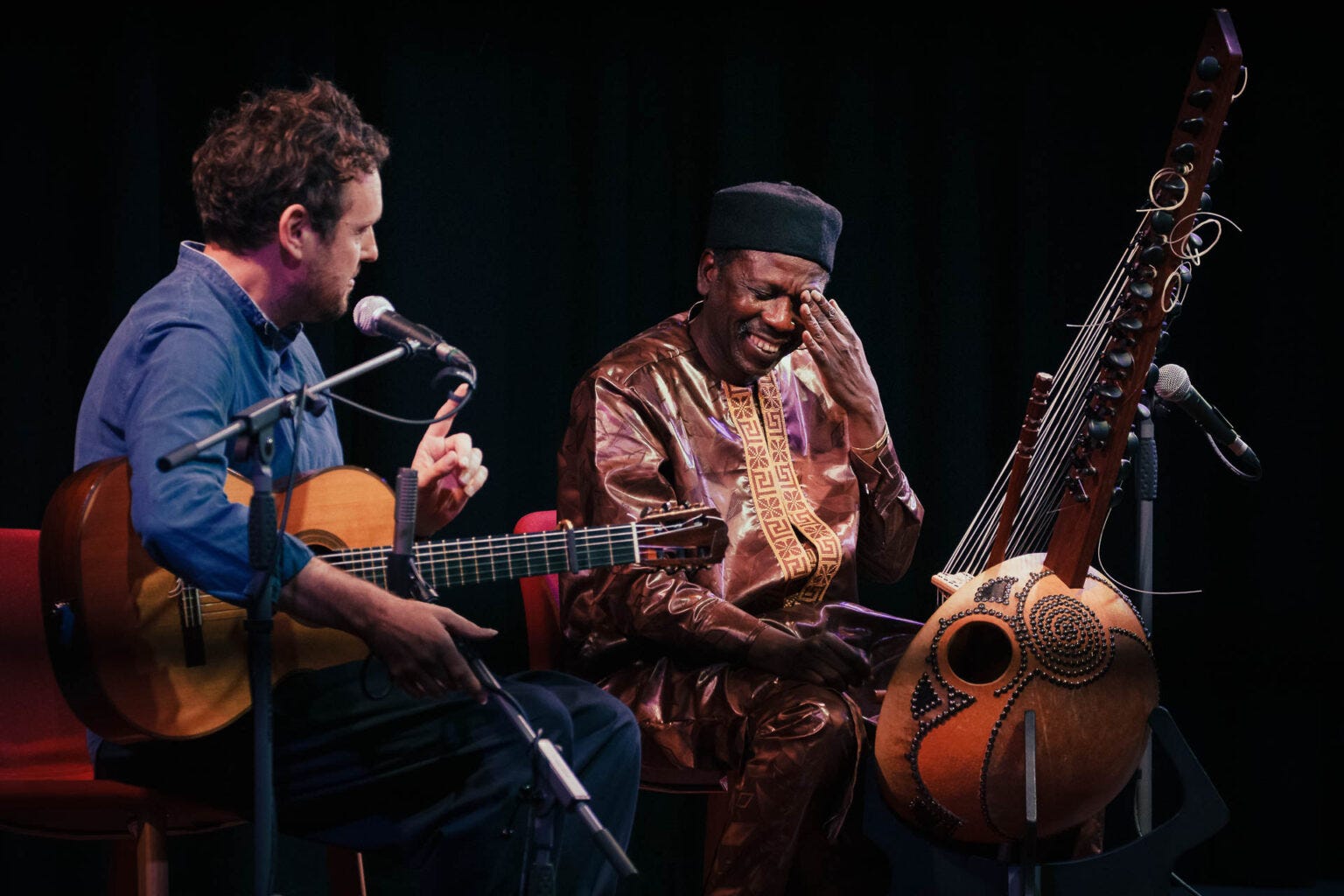
Derek and Ballake Sisoko during a previous collaboration
Anél Hamersma (32:50) That’s deeply countercultural, Derek. Most people would say: you rehearse, you get on stage, you perform, you try to do it perfectly, you hope people enjoy it and write nice reviews. What drives you when you play?
Derek Gripper (33:07) I’ve been quite fortunate, in many respects. Firstly, being a South African musician in a very niche realm of music meant there was no music industry here — I’m talking about the industry itself, not the greater life-support structures, which I’ve obviously had — no music industry that, twenty years ago, I could have got the attention of. A lot of people still have this idea that you just need to get into the right magazine, the right blog, the right YouTube video, the right podcast, and the career takes off. If you’re a musician in South Africa, you learn to be DIY to a degree. Working a lot in the US now, I see people who’ve existed in a completely different world, where they’ve never organised a concert in their lives, never done a house concert. They did something that got attention, and then there was a manager, then a booking agent, then a whole country to tour, and that’s what being a professional musician means there. Here it means finding the wave and working out how to ride it. That was a lucky thing, I think, because it makes you think differently.
We’re also lucky that nobody expects a review any more. You do a concert in New York to a thousand people, and you don’t wake up to a write-up in the Times. Nobody reviews concerts now. You get fifteen shares on Instagram saying “amazing night with Derek Gripper and Ballaké Sissoko,” and then life carries on — that concert is never thought about again except by the people who were there. It doesn’t go into any system of thought about music, the way that guitar magazine review did twenty years ago. It just happens, and it’s gone. The tour we just did was twenty-one concerts, ten thousand people over three and a half weeks — five hundred to eight hundred people a night, with a few nights off. Finished. Over. Not one review. Not one printed review. Nothing. So you have to have a different reason for doing it than the reviews, or the sense that it’s building toward something further down the line.
Even backstage with Ballaké, there’s none of that. We don’t get to the dressing room and relive the solos — it’s just “ten o’clock, lobby,” and that’s it. Even after a thousand people give a standing ovation, we’re not going to talk about it. It suits how disembodied everything is now anyway — an album isn’t a physical thing sitting in your car any more, it’s a picture on your phone and a line on a playlist.
Anél Hamersma (37:41) So what’s in it for you? Why do you do it?
Derek Gripper (37:42) I just really enjoy it. I like the sound — I think a lot about sound, and I probably spend more time thinking about the reproduction of it than about what I’m actually playing. Right now, for instance, I’ve got a concert at Kirstenbosch Gardens, the Kirstenbosch Summer Series. We’ve been playing these beautiful wooden concert halls with perfect acoustic treatment, chairs raked so everyone can see you, beautifully amplified, an engineer over there looking after the monitors and another for the house — it’s all been very controlled. Now I’m about to be on this massive outdoor space instead, music designed to draw people in, and suddenly I’m on this completely different thing. I’ve been thinking a lot about it, purely about the mechanics: how I’m going to amplify it, what goes into the signal chain. That’s been my obsession for a few days — what happens if I do it this way, what if I had it like that. I had an ideal, and then I had to deal with the practicalities, and I finally broke through and stopped caring — but for those few days it consumed me completely.
What’s in it for me is wanting it to sound good — and when it does, you can feel it. There’s a granularity, a rumble, a vibration you feel in the room, and then you play one sound and it goes out there. It’s a tactile, physical experience. When that’s missing — when you’re fighting feedback, when it’s loud and aggressive — I’d rather be at home, where I can get the same thing through headphones.
Touring itself isn’t very pleasant. It’s a job, obviously, but organising one is never really about the money — it’s some new thing I want to try, something that worked in the last one that I want to carry further. Organising a South African show after Kirstenbosch, for instance, is a total mission — finding a hall, sorting tickets, advertising, all of it — and I wouldn’t do it if it were just about earning. The motivation is wanting the experience itself: being in that space, seeing if I can do it alone this time, without Ballaké. That strange vibration thing — that’s what drives me.
Anél Hamersma (41:29) What is beauty to you?
Derek Gripper (41:40) That’s a tricky word. I think it’s what I’ve been describing — that sense of sound, a motivating force with some material behind it.
I’ve been taking photographs for the last few years, on an old Leica made in 1960 — a simple, heavy brass mechanism, beautifully made. I like things like this, where someone got it exactly right. My guitar maker is the same: a man called Hermann Hauser, third generation, whose daughter is making guitars now too. Their family discovered something — his grandfather discovered it — in how to make the sound move through the wood. It’s very difficult to describe, but it’s real: it’s the most copied guitar in the classical world, and for years people have been copying it, and the copy never has that thing. There’s a little secret. You need to shave off one millimetre of wood in exactly the right place, and Hauser won’t tell anyone where. I asked him about the eighty-two-year-old who’s worked in his workshop since before Hauser was born — surely he knows? Hauser just laughed. He doesn’t know it either. And then Hauser’s daughter made her first guitar, without being told the secret, and it already had that sound.
That guitar keeps me grounded. I could easily have gone off and invented guitars with more strings, microtonal fretboards — a lot of stupid, complicated stuff — but I always come back to this very simple six-string instrument, because it sounds so good. I can’t let that go.
The camera’s been the same. I’ve got a little darkroom in the shed. I’m not a photographer — I heard Roger Ballen talk at the art fair recently, and that’s a serious photographer, someone who’s been deep in that language for a very long time; his images are layered in a way I couldn’t manage. I just walk around on tour with nothing else to do and photograph boring things, and I love getting the film back. It’s the same as the sound: a very simple thing, the way photography began — Cartier-Bresson had a drawing sensibility, geometry, but underneath it’s just that instant when the image happens and gets printed beautifully. Look at his book The Decisive Moment — the grain, the tonality. The content matters, but really it’s just that a thing can be done, and that’s beauty in a sense.
The process of doing it is what’s interesting, and I think that’s the moment we’re in now. I remember at university being taught about programs that could play a score back to you using MIDI — write the music into the computer, press play, and it plays it back to you perfectly, rhythmically, without a single mistake. Which is what ninety-nine percent of classical guitar practice is actually about: not making a mistake, not forgetting the notes, not making an extraneous noise. And I thought: if a machine can already do that, it’s none of my business, I don’t need to get involved in it. The trajectory of that was obvious — twenty years later computers can do even more, and I feel that everything a computer can do simply isn’t our business any more. It’s not that it can do it for us; it’s that we don’t need to be interested in it at all. It keeps liberating us, basically. If a computer can play a guitar piece without a single mistake, good — my job was never to play guitar music without mistakes. If a computer can generate a perfect photograph, absolute clarity, wonderful lighting, perfect colour — good, photography was never about that either, I’m not interested. I like a nice blurred photo that’s a bit too open, printed a bit wrong in the darkroom, that still looks nice on the paper. We should keep thanking our AI overlords for liberating us from all these useless tasks, and hopefully they’ll fly off before they completely destroy the planet — upload themselves into their data centres and go away. Bye. Praise God.
Anél Hamersma (48:26) Derek, tell me about the Alexander Technique. What did you learn that liberated your playing?
Derek Gripper (48:33) It’s simple, really. Named after F.M. Alexander, an Australian — a difficult character, which is part of why it never became as well-known as it should have. Whenever it threatened to go mainstream, he’d shut it down himself, needing to control it. So it’s remained a niche but powerful presence in performing arts and re-education, though you’ll find it taught in universities, in acting and music programs everywhere.
At its core it’s about what Alexander called inhibition and direction — two sides of the same coin, neither existing without the other. Freud later gave “inhibition” bad connotations, but in Alexander’s sense, before and alongside Freud, it meant something much more constructive. Direction is really thought and intention. How the two work together is the health of the mind and body — which, of course, were never separate to begin with.
Inhibition creates the space for a thought to happen — it’s the same thing we’ve been talking about with Fukuoka: do I need to be thinking this right now? We use inhibition constantly, all day, every day; we wouldn’t be functioning at all without it. Of course we now have devices designed specifically to erode that ability — massive supercomputers built to erode our capacity to inhibit and make our own decisions. We’re addicted to these little things, reacting and reacting, all day long. Inhibition, in Alexander’s sense, is the ability to see that reaction coming and simply say no to it, quite simply. And because you’ve created that space with the “no,” you’re then able to redirect yourself — on a very physical, ordinary level, saying: I’m not going to engage with that particular piece of digital manipulation, I’m going to walk out of the room and look up at the sky. That’s how inhibition and direction carry out the other direction, how they’re linked together.
In Alexander Technique that goes all the way into the physical — into posture, though not posture exactly, more how the body moves, how proprioception works, how we physically respond to our environment. There’s no gap between the mental and the physical; it works in these subtle and gross ways, all linked. Does that make sense? It’s a hard thing to describe.
Anél Hamersma (52:32) Of all these things you’ve learned — Alexander Technique, Montessori, do-nothing farming — I remember there was a philosophy your wife drew on when she was pregnant with your first child. She read a book about midwifery, about bringing a child into the world without interfering with the process.
Derek Gripper (52:33) Michel Odent — a French obstetrician who worked out the same thing, essentially. There’s a natural process already underway, and there’s a conscious-mind element that can obstruct it. Montessori’s big discovery was that most of what we do to “teach” children actually gets in the way — learning is a completely natural process, and children who struggle, who go into confusion or act out, are usually reacting to a natural drive that’s been obstructed by an unnatural environment. In an ideal world you’d have an alien landing on earth and mastering everything it needs to through spontaneous play. That’s just normal.
Fukuoka discovered the same thing from the other direction. It’s like: go into the Amazon and these massive trees, bigger than skyscrapers, are growing just fine — nobody’s weeding underneath them, nobody’s putting in fertiliser. But we need massive machines and chemicals just to grow a tiny, pathetic strand of rice: flooding the field, replanting, cutting the straw, burning it. Why is it so difficult to grow a carrot, when outside there’s a tree the size of a skyscraper doing fine on its own? So he asked: what are we doing, through centuries of habit and acculturation, that’s made this so complicated? He kept asking what happens if I don’t do this, what happens if I don’t do that, kept removing steps, and ended up with a beautiful method he ran for thirty years — a rotating crop of rice and barley, winter and summer, flooding the field only once, never weeding at all. One year he’d be infested with frogs, the next with spiders, and neither did any harm. It changed his whole idea of the notion that we’ve been thrown out of the garden and have to toil to fight our way back in — which is the human narrative he was arguing against all along.
Anél Hamersma (56:21) So when you teach guitar now, how do you approach it?
Derek Gripper (56:22) I’ve always been uncomfortable with teaching, even though I do a lot of it — there’s a whole existential question of what I’m actually trying to show someone, tied up with self-worth. I don’t want to be the teacher who listens to someone play and says “slow down, bring out the melody here, go home and practice your scales.” Since COVID the process has become more focused. Before that I’d stopped teaching for a few years, though I’d developed a Montessori-based teaching method and taken it into a few schools around Cape Town.
During lockdown I started something half-jokingly called the Guitar Ashram, Guitar Ashrama — a WhatsApp group that started with me playing, and grew, while I was stuck at home with four teenagers for a few months, into something bigger. I had to learn what I needed to learn to get the video and audio right. I’d never owned a sound card before that, had no way of getting a microphone properly into a guitar recording — so I got all that going, microphones, an external camera, ways to show people scores. These weren’t individual lessons, they were group classes, more like a yoga class: you start the class, you move through it together, and for an hour everyone’s in that process. It’s simplified since then and carried on — a few hundred people during COVID, down to around a hundred and sixty actual members now, with a smaller group still doing the live classes.
I’ve actually moved to doing audio-only now, much to everyone’s horror — focusing entirely on the audio experience, as analog and warm-sounding as possible. Half an hour, headphones or speakers, guitar in hand. The idea is you’re not signing up for six lessons to learn to play a piece — you join the class, you’re playing guitar, that’s the whole story. You don’t spend a year “learning guitar” and then start playing it. Guitar is just being with the instrument, listening to it, for half an hour. It can become more complicated and you can learn more, but that doesn’t mean you enjoy it more — often the opposite; the more complicated things I can play, the more I forget what’s good about the instrument in the first place.
The classes now are about leading people through a process of listening to something which at first seems very simple, and becomes more interesting the longer you listen — learning nuance, learning to be more sensitive with your fingers. Part of it is trying to stay in a single sensory register at a time. The technology offers the possibility of showing my fingers moving, putting a score underneath so you can read the music, and letting you hear the audio, all at once — that’s three things. But Montessori told us very clearly: when you’re teaching, you have to be in one realm at a time. Say you’re teaching a child three colours at the beach — the umbrella is red, the spade, the sea is blue — and meanwhile this poor child’s mind is full of the beach itself: the sea, the waves, a shark somewhere in his thoughts, the memory of getting there. Trying to land the names of three colours on top of all of that at the same time is a disaster.
Anél Hamersma (1:02:05) So there’s something about paying attention — about how we pay attention when we’re learning, or engaging with the world.
Derek Gripper (1:02:05) That’s the whole thing, again — if somebody wants to learn to play guitar, what do they need to do? Play guitar. It’s very difficult to do that now, because we don’t actually know how to just play guitar any more; we’ve got a whole lot of ideas about it instead, and that’s the most important thing to notice. There’s a lovely story about Jimi Hendrix having a one-string guitar that was totally broken. He just lay on the sofa and made sounds with it — that’s how he learned, trying to find sounds on an instrument that didn’t even work. As a result he developed this very advanced ear, this understanding of timbre. Once someone finally gave him a real guitar and an amplifier, and those two things could interact, could feed back into each other, he already had the ability to tune in and hear it. If he’d been twelve years old now, he’d have had YouTube tutorials and other musicians to listen to, instead of just three vinyl records with the edges worn off lying around the house. There’s too much available now.
Wasn’t it Woody Guthrie who had that sticker on his guitar — “this machine kills fascists”? What can a guitar actually do about the fascists of the twenty-first century? Just spending half an hour off your screen, with a piece of wood and six strings, giving yourself that time instead of reacting to everything you think you should be doing — that’s time well spent.
Anél Hamersma (1:03:56) Derek, has this unlearning translated into the rest of your life?
Derek Gripper (1:04:04) It keeps me busy — it gives me a central project, and I think having one is a great thing to have. When I see people without that, I think: life must be so complicated, how do you make choices? I get distracted too, thinking I should be doing this or being that — but at the end of the day, even across a year-long cycle, it comes back to: I play guitar. I need to do whatever keeps that working well, because that’s what feeds everything else.
Anél Hamersma (1:04:46) Last question. If you look back over your life, what is it you hope to have accomplished?
Derek Gripper (1:04:50) I’ll defer to Ballaké here — we had this exact chat in an airport a week or two ago, about people who use music and engage with it as a business. He said something that captured exactly how I felt, though he articulated it better than I could — and you have to remember he was saying this to me through his phone, translated into a woman’s computer voice, holding it up so I could hear it back in that voice. He said: some people do it as a business, but for him, he’s doing it because he wants to reach his true potential. And I think that’s a nice mystery — what do you end up doing, what is the possibility of what you were, becoming what you end up becoming? That’s an interesting project.
So if someone came to me and said, I’ll give you the money to build your career exactly as you want it — I don’t think I’d be interested. I’d probably say yes, if I’m honest, but it would be a bit of a pain, really, because what’s interesting to me is how the music keeps creating its own possibilities. You do one thing and it results in that; suddenly you’re on tour with this person, or doing a solo tour, or you make a record and someone hears it and invites you somewhere else. That’s the lovely story that just unfolds, which is what happens in our lives generally. The idea of some kind of God coming down and saying, poof, I’m going to make your dreams come true — that’s not interesting, because then you don’t get to watch the thing unfold. I’m happy for it to unfold as it unfolds. Hopefully, in a creative and interesting way.
Comments
Nothing yet. Say the first thing.
Sign in to join the conversation.