
People who live inside ordinary life, but haven’t lost contact with its beauty or traded their aliveness for it. They are wholeheartedly human, astonished and at large. Finding them, and finding out how they got that way, is what this series is about.
Trisha Lord has 38 years’ experience of working with individuals, teams, and organisations in developing the potential of their human resource. Having spent the last 19 years specialising in the work of Nancy Kline’s Thinking Environment™, Trisha has proven repeatedly to both herself and her clients, that nothing an external facilitator or coach can do replaces, for its power and validity, this extraordinary structure in which clients can think for themselves, thereby generating genuine solutions with inherent longevity and efficacy.
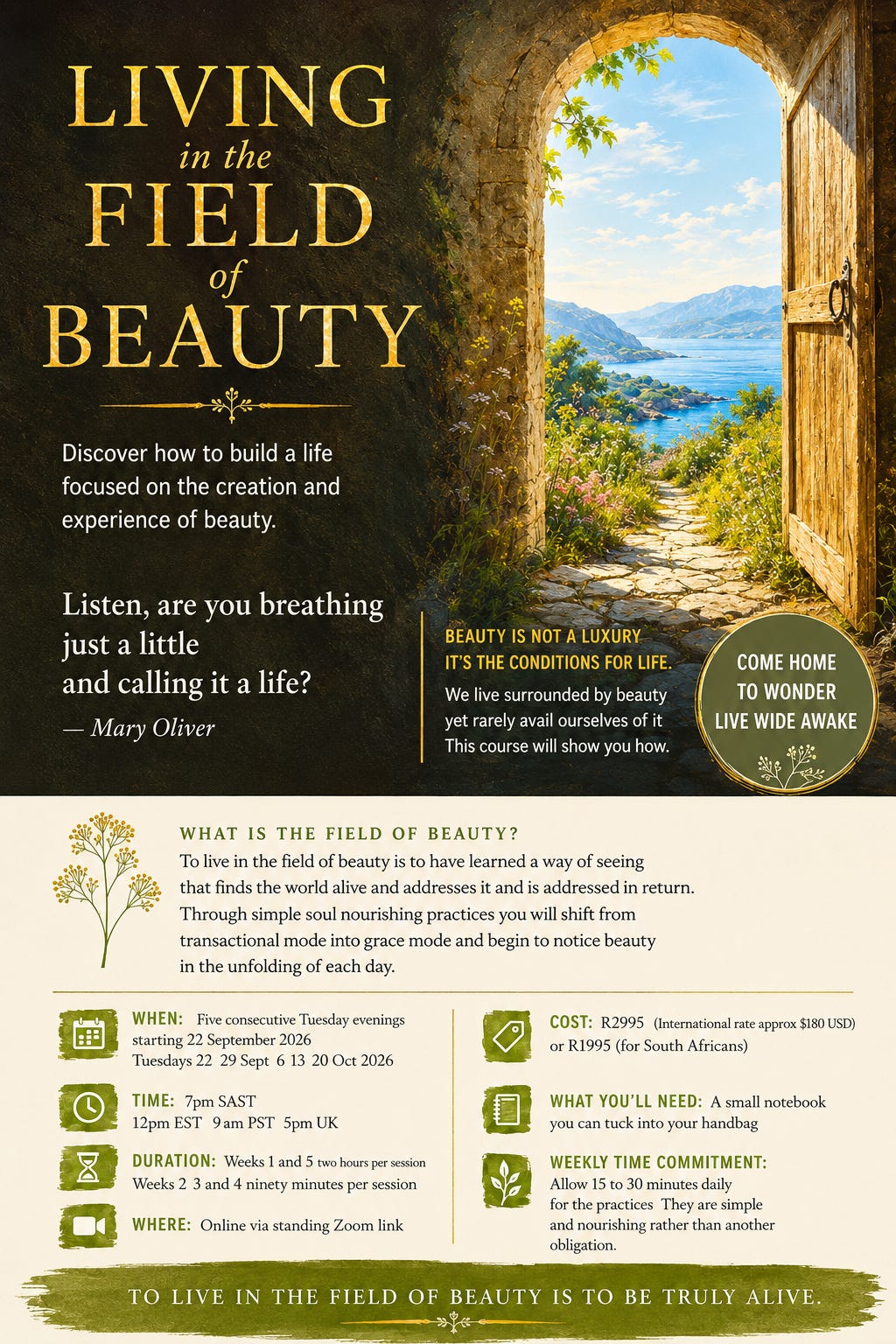
*This transcript has been edited for length.* Full transcript available on the post page.
Anel: “There is no way to re-enchant our lives in a disenchanted culture except by becoming renegades of that culture and planting seeds for a new one.”
Trisha, when I think about you, I think of you as a renegade, an advocate for a completely different way of being and engaging with the world. Can you introduce yourself?
Trisha: My name is Trisha Lord. I am a Thinking Environment teacher, and I teach this body of work most of the time. I have spent about forty years working in what I call the field of developing human potential.
I think I was fascinated by people from childhood. I found human behaviour the single most interesting thing going on around me. I was the third child in a family of five, and I remember having a feeling of looking in from the outside. My parents obviously belonged together, and my older brother and sister belonged together. I belonged to them, but I didn’t quite belong to them in the way they belonged to each other.
I think that being an observer of human behaviour has been with me all my life. As a teenager I became more and more fascinated by what it meant to be human. I read Carlos Castaneda, books about Schrödinger’s cat and all sorts of things that opened up questions about behaviour and reality.
In my early twenties I began participating in personal development workshops. A lot of that field had been sparked by Werner Erhard, who was one of the first people to develop workshops that people could simply choose to attend because they were interested in understanding themselves. I eventually went to work for one of those organisations, and that launched my career.
So for about forty years I have been passionately interested in what it means to be human and how we can live in a way that is the fullest expression of ourselves.
Anel: You’ve mentioned Carlos Castaneda and Werner Erhard. What did you take from those two?
Trisha: Carlos Castaneda introduced me to the world of psychedelic medicine, but what really captured my imagination was the relationship with the plant and animal world and nature. His books were full of strange and wonderful facts of nature, and the character was continuously being taught through his relationship with the natural world.
I remember the lizard that could move its eyes in two directions at once, lucid dreaming and astral travelling, and the winds. The direction of the wind was connected to whatever lesson Castaneda was supposed to be learning.
When I first moved to South Africa, people talked about the wind as though it were a person. I thought they were slightly mad. Then summer came, the Southeaster howled and the whole peninsula went on fire. I suddenly understood why people talked about the wind.
The broader thing that stayed with me was the unseen and almost unknowable, and the possibility of having a relationship with something you cannot see and cannot fully know. That really captured my imagination.
Werner was my first big teacher. I worked on his London staff for five years, from my mid-twenties to my early thirties. He had absorbed an extraordinary range of knowledge, from Western philosophy and psychology to Eastern philosophy and traditions and human behaviour. He turned all of that into a form of personal development based on the idea that we can choose to develop ourselves.
I was fortunate enough to meet him and participate in his programmes. He was charismatic, intelligent and very compelling, and I was awestruck by him. It isn’t particularly easy to be yourself when you’re awestruck by somebody.
One sentence of his has stayed with me: “Paradox and confusion are the guardians at the gate to the citadel of the truth.”
Anel: What else did you learn from Werner that has stayed with you?
Trisha: One of the most transformational things was recognising that there are things we experience because we are human, rather than because we are Trisha or Anel.
One of those things is our attachment to being right. Human beings can give up connection, love, aliveness and vitality in the service of being right. When we’re attached to an opinion or an argument, we stop being available to other possibilities.
That has been a lifelong journey for me, catching the attachment to being right. I still feel like a beginner.
Anel: What happens when you notice yourself becoming self-righteous?
Trisha: Sometimes I fail. I fall straight into the trap. But halfway through my career I found Nancy Kline’s work, and the Thinking Environment gave me something that I didn’t necessarily have before: a how-to.
There are lots of bodies of work that can be inspiring and illuminating, but people often struggle with how to translate an insight into their behaviour. The Thinking Environment gives us behavioural competencies that help us apply what we know.
So when I notice myself going down the rabbit hole of righteousness, I can use those principles. I can shut up and listen. I really don’t want to live from the position of needing to be right.
The older I get, the more aware I am of how little I know. I want to live my life as a great big walking question mark.
Anel: Why a question mark?
Trisha: Imagine a circle containing everything that is available to be known. If you marked the part you know, it would be tiny. Then there is another section containing everything you know you don’t know. The enormous remainder is everything you don’t know you don’t know.
We don’t usually walk out the front door into a world of possibility. We live attached to what we know. If I discover that I need to learn Russian, for example, I can expand the area of what I know I don’t know. But meanwhile there is this enormous field of things I don’t even know exist.
What don’t I know and don’t even know I don’t know, which I might find out today? That is a much more exciting way to live than being attached to what I know.
Anel: It makes me think of the Fool in the Tarot, that open, curious, available figure who carries very little baggage. He feels like the manifestation of a question mark, and he is zero, the point from which everything emerges.
Trisha: Absolutely. And you get there by understanding your humanness.
Another piece of Werner’s work that made a huge impact on me was what he called “rackets”. Not rackets like tennis rackets, but rackets like a mafia racket.
His analogy was a charming little corner shop. Everything looks perfectly innocent, but if you go through a back door there is something else going on that isn’t advertised.
A racket is a persistent complaint in your life where you keep complaining about something while appearing to want it to change. You gather more and more evidence that things shouldn’t be this way, but you don’t actually take the actions that would change them.
The hidden truth is that you are committed to the complaint. You don’t want to admit that you actually quite like having it.
That was transformational for me because I realised I had a few of those going on in my life. Now, if I complain about something for long enough, eventually I can say, come on, Trisha. This is a racket. Either admit you’re not going to do anything about it and stop complaining, or do something about it.
Anel: Even knowing that you’re running a racket seems to loosen something.
Trisha: Absolutely. And that brings us to choice and responsibility.
There is very little in life that I have direct control over. Very little. But I do have control over the choices I make. Werner used to say, “I have no choice” is a choice.
We’re choosing all the time. So it’s about owning that and taking responsibility for it. Mary Oliver asks, what will you do with your one wild and precious life? You can choose to do something about the thing you’re complaining about, or you can choose not to. You don’t have to change it. But if you’re not going to change it, stop pretending that your complaint is an action.
Anel: You have also spoken about interpretation. What did you learn from Werner about that?
Trisha: There is a thread running through all of this. If being human includes the tendency to want to be right, then we also tend to treat our interpretations as though they are the truth.
One of the big pieces of Werner’s work was the idea that everything is an interpretation. We make meanings about life, but then we forget that we made them. We behave as though our interpretation is simply the truth.
He used to say that life is empty and meaningless, and it is empty and meaningless that it is empty and meaningless. We are extraordinarily good at making meaning. Look at the enormous body of work human beings have produced through the meanings we’ve made about life.
The question is: what interpretation are you living inside? Does it empower you? Does it free you to be yourself as fully as possible? If it doesn’t, make up a different one.
This connects directly with Nancy Kline’s work because the Thinking Environment says that human behaviour is driven by assumptions. Some assumptions sit underneath others. One assumption can look like the problem when a deeper assumption is actually creating the situation.
In thinking sessions, we go looking for the key untrue or limiting assumption that is keeping something locked. Sometimes the thing you think is the problem is simply the surface expression of something deeper.
Anel: That brings us to Nancy Kline’s idea of learning to “think for yourself as yourself”. For me, that is profoundly liberating. It makes you ask: am I actually thinking my own thoughts? Where do I get to stop and find out what I really think?
Trisha: I can only tell you how I have interpreted that phrase over the twenty-one years I’ve been teaching Nancy’s work.
Thinking for yourself means that you stop shaping your thinking in order to please somebody else, fit in, gain approval or belong. We’re thinking all the time, but there is often an editor sitting between what happens inside our minds and what we allow ourselves to say.
A simple example is sitting in a meeting and thinking, “That’s never going to work,” but not saying it. Everyone has had that experience.
Sometimes choosing not to say something is sensible. You might be making a conscious decision because saying it would be career limiting or unkind. That’s fine. The problem is when we’re editing ourselves so automatically that we don’t even know what we think anymore.
We do it with friends, partners and family. We have interior worlds that we don’t express.
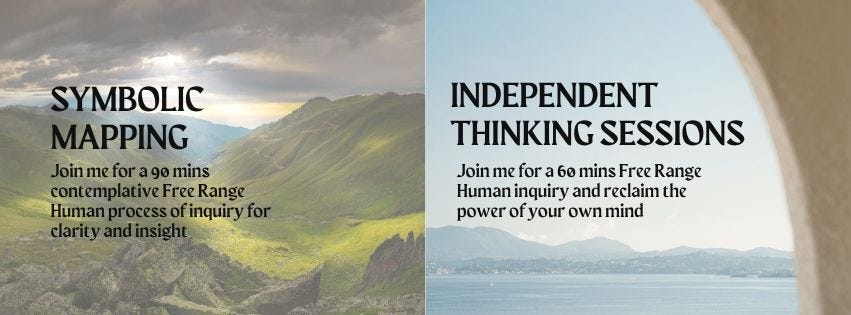
Independent thinking is therefore a reclaiming of yourself. You begin to recognise what you actually think, and you become able to choose whether or not to express it.
Then there is the second part: thinking for yourself as yourself.
Who are you underneath all the layers that have been placed on you? We’ve been overlaid from the minute we arrive.
My parents were Catholic and I was raised Catholic. When I was eleven, I was sent eleven thousand miles away from home, from tropical Uganda to an Irish Catholic boarding school in Ireland. It had enormous gates and broken glass along the walls. It felt like being incarcerated.
The school I had attended in Uganda had children from many different religions and backgrounds. We had separate religious studies classes for all sorts of traditions. Then suddenly I was in an Irish Catholic convent with 160 schoolgirls and 80 nuns.
By about twelve or thirteen I knew I wasn’t Catholic, but it took another seven or eight years before I could tell my parents.
So that was one layer I had to take off. Then there were all the layers around being a woman. My father once told me, “Horses sweat, darling. Men perspire and ladies glow.” From about the age of seven, I thought my job was to glow rather than sweat.
We accumulate all these messages about who we’re supposed to be. So thinking as myself means taking off layer after layer and discovering what remains.
It’s a journey of a lifetime. The Thinking Environment looks at the conditions we can supply one another to support that discovery and recovery.
One of the most important conditions is listening without interruption. If we know the person listening to us isn’t going to interrupt, we can slow down. Interruption makes us hurry. When we know we’re going to have time, we can go down layer upon layer and discover what we really think, feel and want to say.
Anel: How could somebody listening experiment with this?
Trisha: First, assume that you can think for yourself as yourself. That’s the starting point.
Then find a thinking partner. Your attention catalyses my thinking. If I’m alone, I can easily become distracted. With another person, we’ve made an agreement that I’m going to keep going.
Listen to what you’re listening to. We’re always listening to something internally. If something unexpected comes up, trust it. If I’m thinking about one thing and suddenly find myself thinking about something else, I follow it rather than immediately deciding it is irrelevant.
Don’t edit unless it’s genuinely necessary. If something isn’t appropriate to say aloud, write it down instead.
Allow silence. Become friends with pauses. Don’t rush yourself.
Create a physical environment that supports thinking. Go for a walk in the forest or down to the ocean. Put your phone in another room. Remove the things that constantly pull your attention away.
I make notes while I think. I allow myself to cry and laugh. Feeling and emotion are part of thinking. I allow uncertainty and confusion. And I love paradox.
Anel: When people do this in a group, just five minutes of uninterrupted listening can be extraordinary. People come back laughing, crying, surprised by what they’ve discovered. It’s such a small gesture, yet it reconnects us with ourselves.
Trisha: Exactly. That’s what the Thinking Environment is about: creating the conditions for someone to discover and recover their own thinking.
When somebody gives you five uninterrupted minutes and simply says, I’m going to be here with you, you can begin to hear yourself. Something shifts because you’ve been given permission to stay with what is actually happening in your mind.
It can become a way of befriending yourself. You start to discover what you think in a place where it feels safe enough to do so.
Anel: I want to talk about your love of mystery. What does mystery mean to you?
Trisha: I think mystery means so much to me because I lived a lot of my life separated from it.
As a child I had moments when I was aware that something extraordinary was happening in the world around me, even though I didn’t understand what it was. I remember being on a beach in Kenya surrounded by sea creatures and having a sense that there were things beyond my knowing.
The Scots have a lovely expression, “beyond my ken”. Ken means knowing. I like the idea of there being things beyond my ken.
Somewhere along the way I lost touch with that. Life became about what I could touch, see, taste and understand. Later, through trying not to be so attached to what I know, I reconnected with all the things I don’t know.
There are things I will never know in this lifetime. My life will run out before I get there. Yet I know that something is happening. I know there is much more going on than I can access or explain.
Things like synchronicity and coincidences, or those moments when you wish for something and then somehow it appears. I don’t claim to understand these things. I simply know there is an enormous amount going on that I cannot explain.
My relationship with mystery is a mixture of longing, curiosity, hopefulness and occasional wonderful surprises. I think we cut ourselves off if we don’t remain interested in it.
Anel: How do you stay curious rather than overwhelmed by all the things you don’t know?
Trisha: Confidence. I think confidence is essential to a Free Range Human life.
The word confidence comes from the Latin meaning “with faith”. I don’t mean religious faith. I mean faith in possibility, faith in mystery and faith in ourselves.
Thinking for yourself as yourself builds that confidence. The more you practise it, the more you develop faith in yourself.
I have confidence that whatever it is I’m meant to find out, I will.
Anel: You have said that you use beauty as a guide. Tell me about that.
Trisha: Nature is an obvious place to begin. Go for a walk in the forest, down to the ocean or through a meadow. There is so much happening, and some of it is tiny and miraculous.
I’m particularly drawn to very small flowers, the ones you can easily trample unless you’re paying attention. They’re little works of art scattered everywhere.
We are incredibly lucky to live in the Western Cape, one of the world’s great floral kingdoms.
I once read the phrase, “Nature laughs in flowers.” I love that.
I’m not a botanist or a quantum physicist. I don’t understand everything I find beautiful. But I can pay attention to it.
That’s why I use beauty as a guide. Whatever I find beautiful, when I give it my attention and spend time with it, seems to take me a little further towards the mystery of things I don’t know.
Anel: Thank you so much for this conversation.
Trisha: Thank you. I think what you’re doing with this podcast is a thing of beauty, and it’s been a joy to be part of it.

Comments
Nothing yet. Say the first thing.
Sign in to join the conversation.