
Romania has been on a roll. For a country that sees its share of negative headlines, there’s been a stream of good news, with several global-level “wins” in recent weeks.
As I sat down yesterday morning to write this, accompanied by a steaming cup of coffee, I felt upbeat, maybe even as proud as the Romanians.
The Neighbor's Goat: An American in Romania is a reader-supported publication. To receive new posts and support my work, consider becoming a free or paid subscriber.
Then I started to see the breaking news. Overnight, a Russian drone hit an apartment building in Galați, Romania, a port city on the Danube River near the border with Ukraine, injuring two people and causing damage. The drone apparently targeted a Ukrainian port across the river but fell into a densely populated area of Galați, a city of more than 200,000.
Thankfully, it wasn’t worse, but many are wondering, what’s next?
It was the first time a Russian drone had caused injuries on European Union soil since the war in Ukraine began; CNN reported it was the 28th time a Russian drone had breached Romanian airspace during the conflict, a mind-boggling statistic.
Romania joined the EU in 2007; before that, in 2004, the country became a member of the North Atlantic Treaty Organization (NATO), which has come into greater focus since the Russia-Ukraine war, as Romania helps anchor the “Eastern Flank.”
Fortunately for my family, Galați is on the other side of Romania, more than 720 kilometers away, or about 450 miles. But I can only imagine how terrifying the incident was for the families impacted. Evidently the injuries were minor but several apartments sustained significant damage.
I sipped my black coffee, wanting to focus on the good news, trying but failing to ignore the other “elephant in the room” – Romania’s political chaos of the moment after one party recently pulled out of the fragile, multi-party coalition government, forcing a no-confidence vote that booted the prime minister; nearly a month later, the president hasn’t found a clear path to name a new PM, while Romania’s sovereign debt rating is negative and one step from junk status.
But let’s get to the uplifting stuff. For many of you, these may be new names:
Last weekend, Romanian director Cristian Mungiu won the Palme d’Or at the 79th Cannes Film Festival, taking the top prize for “Fjord.” The film – based on a true story about a Romanian Christian evangelical family that emigrated to Norway and was later accused by Norwegian authorities of child abuse due to their strict upbringing and spanking – now has Oscar buzz.
In “Fjord,” Mungiu teamed up with Romanian-born American actor Sebastian Stan, of “Marvel” fame, who garnered his first Oscar nomination last year for “The Apprentice.” Mungiu is only the 10th director to win the Palme d’Or two times – an elite group that includes Francis Ford Coppola; no one has won it thrice. Mungiu’s first was in 2007 for “4 Months, 3 Weeks and 2 Days,” a gripping film about a woman’s desperate search for an illegal abortion during Romania’s Ceaușescu dictatorship. I saw it with my wife at an art house cinema in Berkeley, California.
Also in the arts world, there was the $108 million paid for a work by the late Romanian sculptor Constantin Brâncuși, whom I wrote about last week.
Earlier this month, in the world of soccer (yes, football in Europe), Romania’s Cristian Chivu coached the storied club Inter Milan to the Serie A title, winning the Italian Cup in his first season as head coach. I once sat next to Chivu on a plane; despite playing for AS Roma then, he was humble and personable. As we said goodbye in the airport, he calmly walked over to a gaggle of Romanian journalists waiting for him.
Two weeks ago, Alexandra Căpitănescu, a 22-year-old Romanian singer, placed third at the Eurovision contest, handing Romania its best finish since it started participating in 1994. Bulgaria won, but one of the singer’s producers is a Romanian.
Sorana Cîrstea, a Romanian tennis player, went to the semifinals of the Madrid Open recently (after beating world no. 1 Aryna Sabalenka), losing to American star Coco Gauff, who was ranked no. 3. Cîrstea plays tomorrow in the fourth round of the French Open, which Europeans call Roland-Garros. At 36, Cîrstea is now the world’s no. 18 – her highest career ranking – in what’s supposed to be her final year. She previously announced plans to retire from tennis, but we’ll see if she reconsiders.
Per local news reports, Darius Mihoc, an 11th-grader from Timișoara, Romania, advanced to the world finals of an aerospace engineering competition. Mihoc was chosen from 1,000 European students to represent Europe and Romania at the International Space Settlement Design Competition, which will be held this summer at NASA’s Kennedy Space Center in Florida, where he and other competitors will have 72 hours to design a space station. Good luck to him!
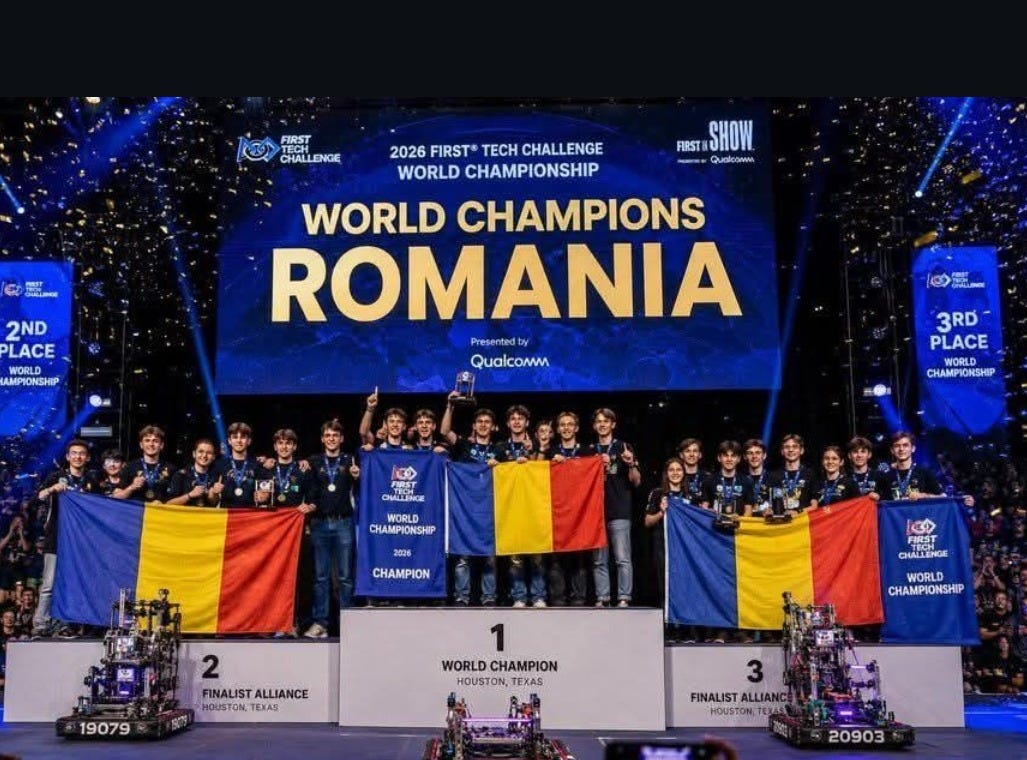
Lastly, a fascinating one from earlier this month: Romanian high school robotics teams rocked the 2026 FIRST Tech Challenge World Championship, sweeping the podium (and even 4th place) in Houston, Texas, where 320 teams from 81 countries competed. Romania’s robotics education is becoming renowned as the country’s teams have won multiple world championships in recent years. Kudos to these kids! Interestingly, only one team was from Bucharest, the capital, with the other winners hailing from small cities in Romania.
Romanians are rightly proud of these winners, from various fields and ages, for their recent accomplishments that popped in rapid succession. Media stories and personal social media accounts celebrated the good news widely, something this country of 19 million doesn’t always have a chance to do.
The Neighbor's Goat: An American in Romania is a reader-supported publication. To receive new posts and support my work, consider becoming a free or paid subscriber.
If you don’t want to commit to a subscription, but you’d like to show appreciation for my writing on The Neighbor’s Goat, please consider Buy Me A Coffee.
I like long black or flat white. Thank you!
Comments
Nothing yet. Say the first thing.
Sign in to join the conversation.