
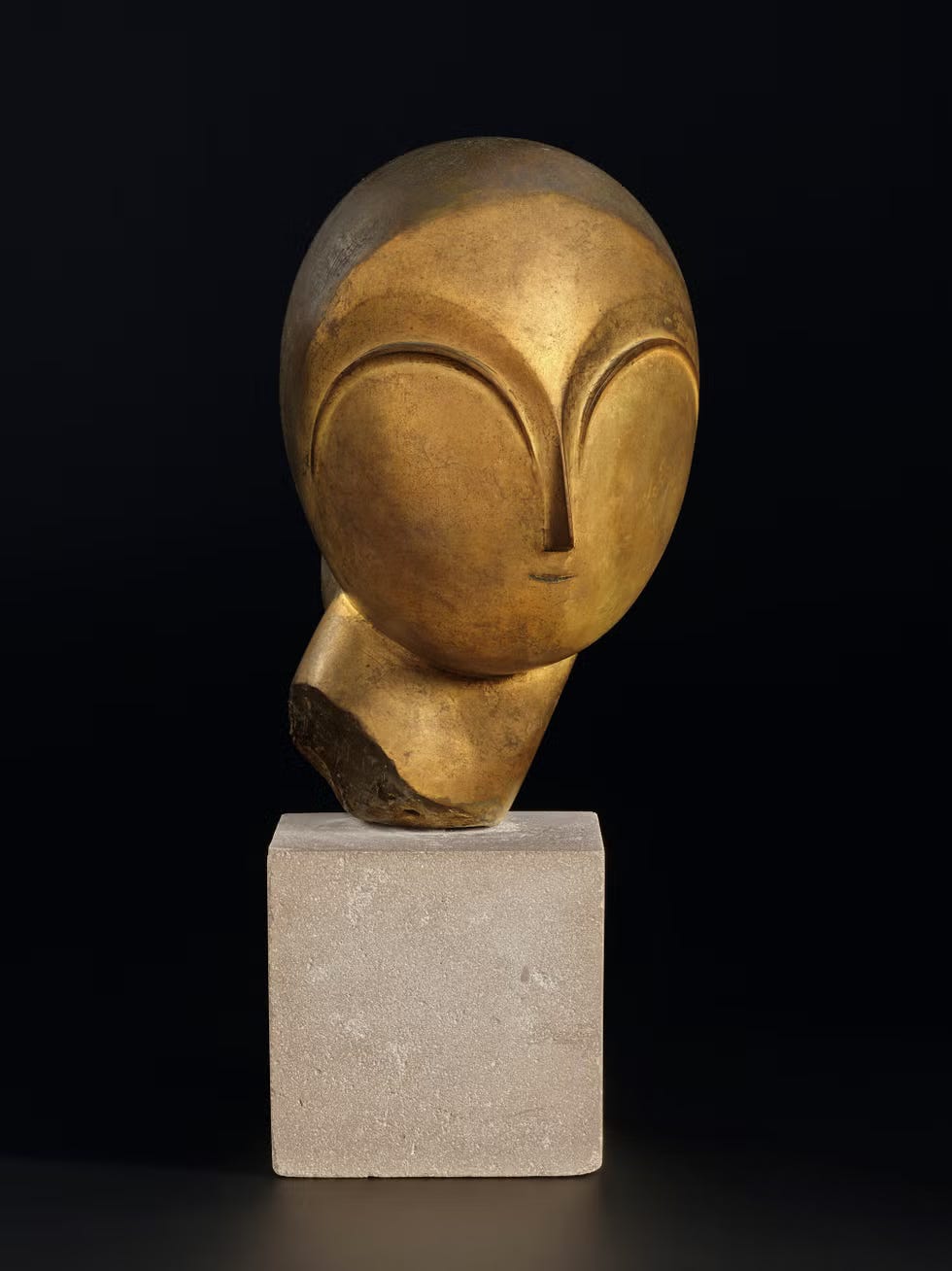
Headlines screamed: $107.6 million, the second-most expensive sculpture in history.
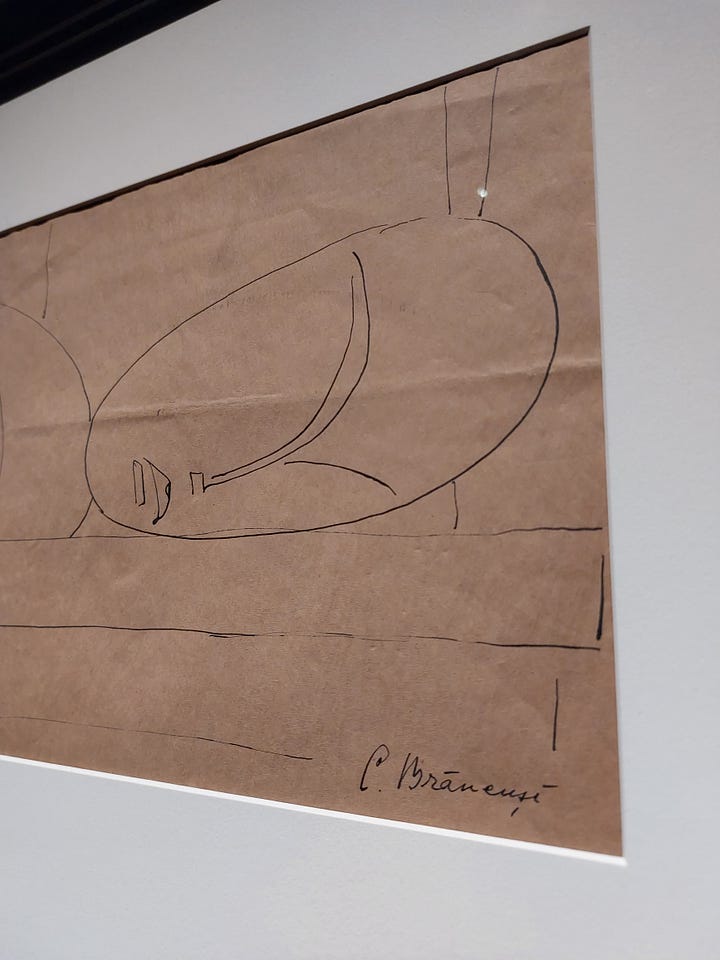
Indeed, Danaïde (c. 1913), a bronze and gold leaf head by Constantin Brâncuși, fetched nearly $108 million from an anonymous buyer at an auction earlier this week in New York, putting the artist in elite company as only the second sculptor whose work surpassed the $100 million price tag.
Minutes earlier, a 1948 work by American painter Jackson Pollock sold for $181.2 million, another record. Both were part of a 16-piece collection of S.I. Newhouse, the late Condé Nast media magnate, that was auctioned by the venerable Christie’s, collectively selling for an eye-popping $630 million. Notably, Newhouse paid $18.2 million for Danaïde in 2002.
Aiming for PR buzz ahead of the auction, Christie’s released a video starring actress Nicole Kidman, who carefully admired the Brâncuși sculpture while dancing around it as David Bowie’s “Golden Years” played.
What was lost, however, at least in some of the news coverage I saw, was Brâncuși’s Romanian roots, which began in the humble village of Hobița in the southern Oltenia region. Here in Romania, naturally, the media played up the homegrown angle.
Brâncuși (1876-1957) was born, raised and educated in Romania, studying the arts in Craiova and Bucharest, the capital. But he left Romania in 1904 to seek new horizons – famously walking all the way – spending several months in Munich before moving on to Paris, where he initially studied under Auguste Rodin, then spent the rest (and majority) of his life in the French capital.
In 1952, five years before he died, Brâncuși became a French citizen. He’s buried in the famous Montparnasse Cemetery in Paris.
The modernist master is so associated with France that many people are unaware of his Romanian heritage, pronouncing his name “Brahn-koo-ZEE” instead of the Romanian “Brahn-koosh.”
A friend of mine, who served with me in the Peace Corps in Romania, volunteers as a docent at the Des Moines Art Center, which has one Brâncuși sculpture. Patrons and fellow docents sometimes corrected him on the pronunciation. But my friend insisted, adding that he’d lived in Romania and knew how to say the name – and the museum’s docent handbook has since been amended.
Brâncuși’s relationship with Romania was rather complicated.
He never returned to live in his homeland, but as his age advanced, he wished to bequeath his studio and hundreds of works to the Romanian state. Being in the 1950s, the communists were in charge. They rejected his offer dismissively, allegedly saying his groundbreaking modern art – rooted in Romanian folk motifs – was “bourgeois” and “unimportant” and “any uneducated peasant could have done it.”
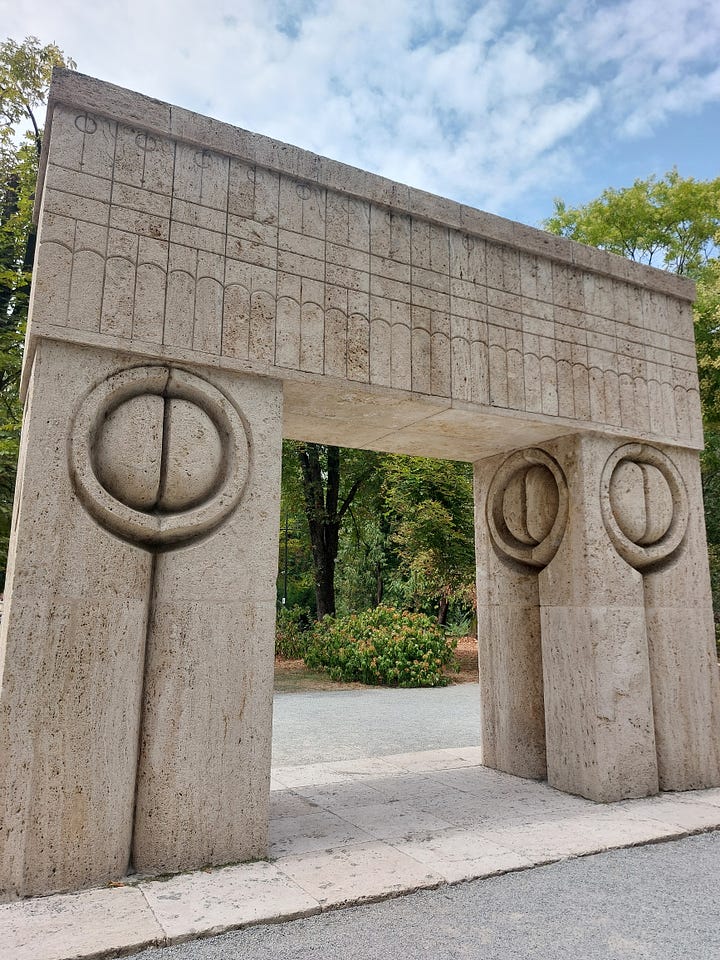
The communists, claiming his work did nothing to help socialism, even tried to destroy his celebrated Endless Column, a 29-meter (96-foot) sculpture in Târgu Jiu, a city near his hometown. The column survived and, along with a few of his other outdoor works, it’s now part of a UNESCO World Heritage Site. Târgu Jiu is otherwise unremarkable but I really enjoyed visiting the Brâncuși ensemble a few years ago.

Turned down by Romania, Brâncuși offered his estate to France, which happily accepted. But the law required him to have French citizenship, which he pursued and was soon granted. Decades later, in 1997, a reconstruction of his studio was made in a pavilion outside the Centre Pompidou in Paris. It’s a cool place – I’ve been there twice – but currently closed for Pompidou’s multi-year renovation.
By the 1960s, when the dictator Nicolae Ceaușescu started to lead Romania, the communists’ pivot to nationalistic sentiments meant they began to embrace Brâncuși, labeling him a genius and national hero. But, of course, the artist was already deceased.
No longer shunned, Brâncuși was elected posthumously in 1990 to the Romanian Academy, whose members are cultural, literary and scientific luminaries. His birthday, February 19, is a national holiday in Romania. Several Brâncuși works are in the permanent collection of the National Museum of Art of Romania in Bucharest.

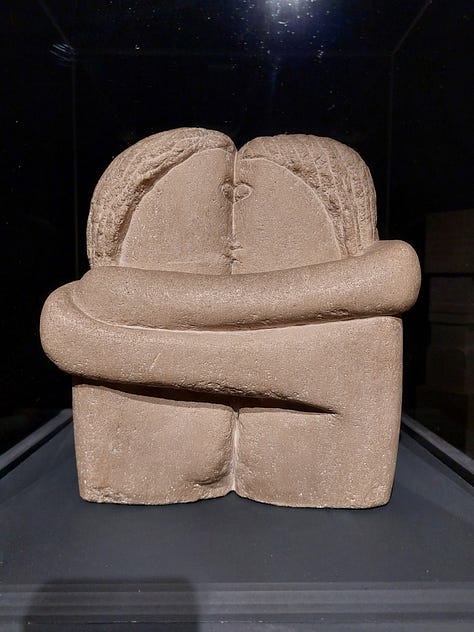
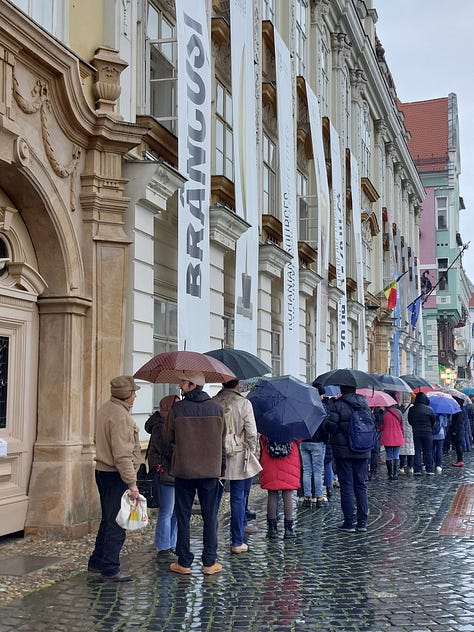
In 2023, when Timișoara was a European Capital of Culture, the city’s National Museum of Art hosted a major Brâncuși exhibition, the largest in Romania in 50 years, with works brought in from museums and private collections around the world. I went near the tail end of the exhibition in January 2024; it was spectacular.
Brâncuși’s works can be found at the Museum of Modern Art in New York and the Tate Modern in London and other museums far and wide. The fabulous Philadelphia Museum of Art holds the largest and most important collection of Brâncuși sculptures in the United States.
My friend, Sorin Trâncă, a Romanian advertising creative director who’s authored a few books, wrote one about Brâncuși in 2023, Drumul lui Constantin: Evadarea lui Brancusi din Romania, o reconstituire (The Road of Constantin: Brancuși’s Escape from Romania, a Reconstruction); it’s available only in Romanian.
In the book, Trâncă retraces Brancuși’s long, pan-European walking route from Romania to France – via stops in Hungary, Austria, Germany and Switzerland – researching and documenting it with photos, delving into the artist’s life more than his works, trying to shed light on the mysterious man.
Meanwhile, from the depths of Montparnasse, Brancuși, the peasant son from Hobița, is probably chuckling at those misguided Romanian communists.

If you don’t want to commit to a subscription, but you’d like to show appreciation for my writing on The Neighbor’s Goat, please consider Buy Me A Coffee.
I like long black or flat white. Thank you!
Comments
Nothing yet. Say the first thing.
Sign in to join the conversation.