
I read with intensity as each teenager took me on a journey, revealing raw feelings, unpacking soulful reflections and exposing literal and figurative wounds.
There was a debilitating illness bonding mother and daughter, a grandfather battling memory loss, fleeting young love, a cross-country move mired in culture shock, near-drowning of a sister, an African girl’s guilt-ridden quest to help her mom over the poverty line and a coming-of-age struggle tangled in India’s relentless heat. And more.
The essays tugged at my own emotions; two moved me to tears.
Asked by Write the World to be the volunteer Guest Judge for its 2026 Personal Essay Competition, I was charged with reading these creative non-fiction pieces and selecting the winner and runner-up, along with the best peer review.
A global nonprofit in Boston, Write the World holds free monthly writing competitions for young writers (ages 13-19) from anywhere in the world who can submit their essay for a chance to win $100 plus prizes and have their voice amplified for a worldwide audience.
Write the World was founded in 2012 by David C. Weinstein as a Senior Fellow at Harvard University’s Advanced Leadership Initiative, inspired by a belief that writing is one of the most powerful tools young people can use to find their voice, engage across differences and shape the future – no matter their socioeconomic status. David, a friend, mentor and former boss of mine, is a retired C-level executive at Boston-based financial powerhouse
Through David’s leadership and philanthropic support, Write the World has grown into the preeminent global community for teenage writing. A mission-driven nonprofit organization whose offices are just a few blocks from Harvard in Cambridge, Massachusetts, Write the World empowers students to not only develop their critical thinking and literacy, but also their creativity and global citizenship – skills that are essential for success in school, career and life.
Write the World, with its monthly writing competitions, college essay programs, creative writing workshops and virtual summer writing camps, has reached more than 150,000 teens and educators from over 190 countries.
For this year’s Personal Essay Competition, 2,080 teenagers from 113 countries submitted their stories (capped at 1,000 words) – the most entries Write the World has received for any competition that wasn’t poetry or flash fiction, both of which have minimal word limits. From those 2,000-plus entries, Write the World’s staff laboriously narrowed it to 100 shortlisted stories and then down to 10 finalists.
As much as I would’ve loved to have read them all, my aging, bespectacled eyes might not have endured, so I was grateful to be presented with only 10, as is customary for the judge. However, being given only the crème de la crème, it was no easy task. My hat goes off to the staff for making such exemplary selections for me to deliberate.
Six of the essay finalists were from the United States (California, Massachusetts, Michigan, Montana, North Carolina and Texas); the other four hailed from India, Japan, Nigeria and the United Arab Emirates. I could only see their usernames and countries and, in the Americans’ cases, their home state. Even without the locations, the stories mostly revealed themselves on that front.
For the peer review, in which young writers critique each other’s work, there were two finalists, from Canada and Portugal, and I had to choose one. The finalists in both categories who weren’t selected as winners received honorable mention.
The young writers had a three-week period in June during which they could submit and request peer review. I was given the essays on July 1 and had almost a week to make my decisions, just before leaving on family vacation. I mostly blocked out that week – even alerting my Substack subscribers that I was taking two weeks off, one for the contest and one for the holiday I’m just back from – so I could properly focus and give the kids’ the attention their wordsmithing deserved.
After all, it takes courage to spill your guts in a personal essay, as I said in an interview published by Write the World as the competition commenced.
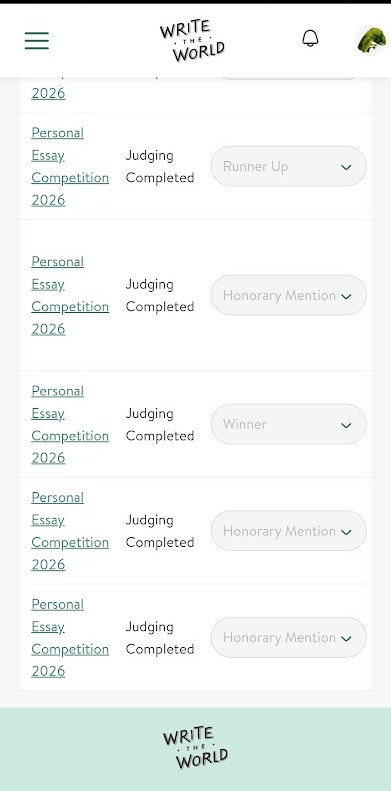
As I logged in and slowly read each of the 10 narratives in the random order in which they were listed, I ambled down virtual paths with them – and was blown away by the talent. I wondered, in some cases, whether they were boys or girls (couldn’t tell from all the user names or the stories) and how old they were. I put myself in their shoes, thinking of them anxiously waiting on the results in far-flung locales.
I read and read and read. Over and over again. I have no idea how many times I read each of the 10 essays. But I was duly impressed and treated to turns of phrase like this:
“I took a shallow breath and buried my hands in the fabric of my oversized tee. My fingers and toes looked sickly, like bruised bananas spotted with mauve. I tried telling myself it was just the nature of this pallid bathroom. Under its flickering counter lights, everything looked jaundiced and shivering.” (MJTwritingbee, Michigan, USA)
“I felt the heat of the hot Indian summer air feasting on my skin, the dull throb of my fingers tapping against the charcoal black table, and my thighs slowly growing slick with my own sweat; but I continued to sit and stare nonetheless.” … And this bit on the writer’s mother’s hands: “You could see when she was irritated simply by her hands. They would become heavier, more rigid and tense, like she was flogged harshly on her wrist. Ever since I was a child, I gazed at her hands instead of her eyes, and by now, we were familiar friends.” (Avaani Singh, India)
“Perhaps it was the juxtaposition of the old versus the new, the Southerner versus something novel and fresh and unapologetically Montana. She reminded me of home in a place that was cold to people from my old haunts.” (Gerrit Wood, Montana, USA)
“Child me hiding in the corner felt like a boulder was crushing my internal organs and would grind me to paste at the sight of my mother’s despair, so that night when her eyes finally closed, I snuck out of the apartment in my finest black ruffle dress and my hair in braids my mum did and went to the corner my mother always valiantly shielded me from or avoided completely in fear for what lay in it, but I was not a stupid child; I knew what went on in the corner due to my curiosity and cunning to have unrestricted access to the Internet underneath my mom’s nose and was quite determined to at least make myself useful so the guilt I felt for my existence could at least be painted over and covered for a while.” (StarDiamond, Nigeria).
By now some of you must be wondering about artificial intelligence – of course, Write the World has filters to try to detect use of it and the staff are skilled writers and trained educators. Although I’ve never used AI, it’s not hard to tell when it’s leaned on heavily. It just sounds too robotic, less real, too homogenous.
Figuring that teenagers (and millions of others) are going to have a magnetic attraction to use AI instead of writing, Write the World last year launched Clara, a free, optional Socratic AI tool. Rather than simply write text for them, it performs like a helpful coach by asking thoughtful questions to help the teens brainstorm, draft and refine their work. They’re still writing. And it shows.
As I read and re-read over several days, revisiting the essays to look for more details and nuances, I gradually eliminated five and then two more and was left with three, then two, from which I chose the winner and runner-up (USA and India, respectively); the best peer review was from Portugal. The stories by the winners and finalists are here, with my commentaries on each. I’d encourage you to give these fine young writers a read.
Write the World announced the winning entries last week but has since revealed the winners’ full names and interviews with them here. Congratulations to Mila Trulock, USA, age 18, for the winning entry, “Clean Shaven”; Avaani Singh, India, age 14, for the runner-up entry, “Blank Walls”; and Riddhima Shrivastava, Portugal, age 14, for best peer review.
These young writers left me inspired because they’re focused, as are many others, on honing their craft and not lazily leaning into AI and becoming dependent on it. There is hope for the future!
***
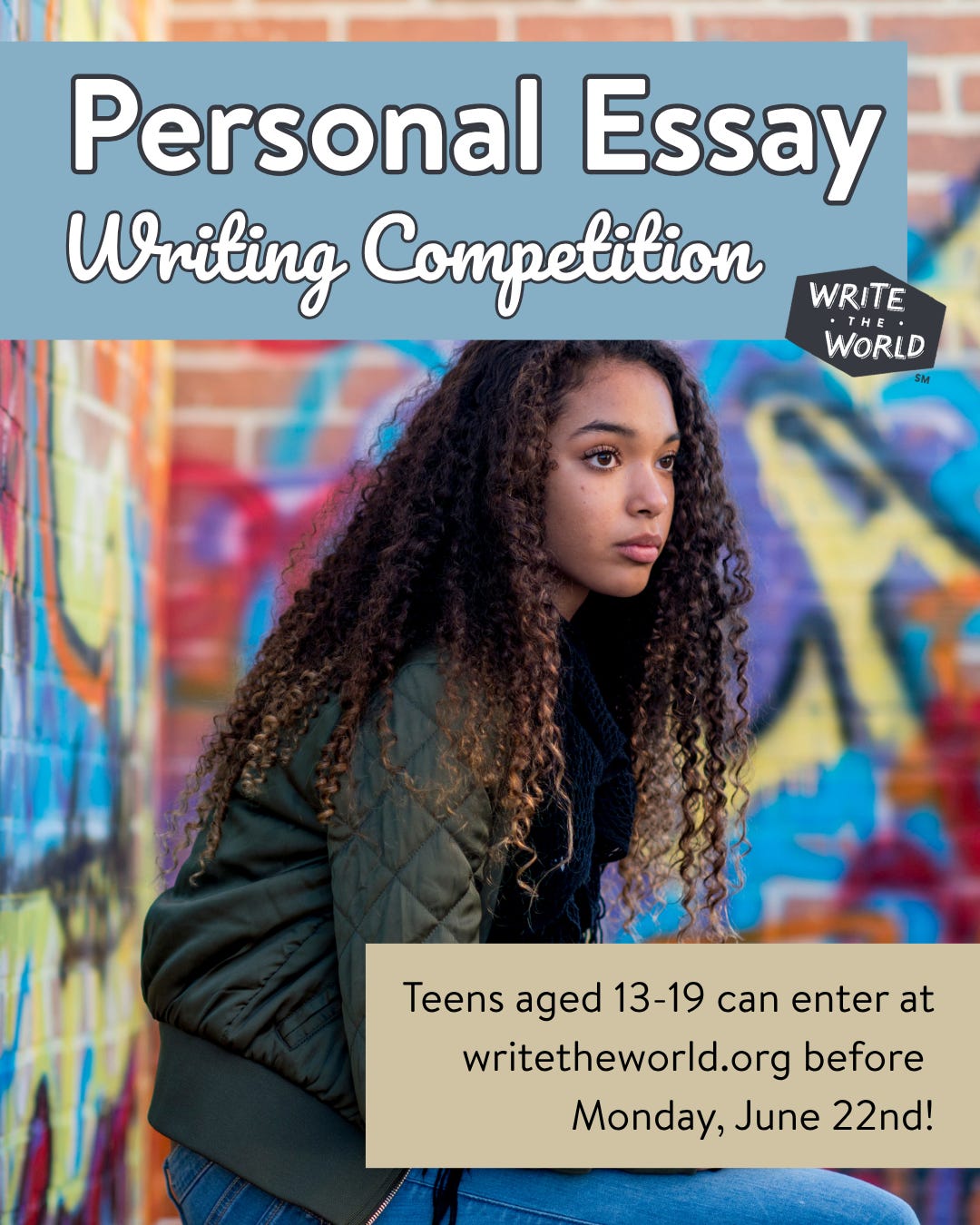
N.B. – If you know teenagers who are interested in writing and entering these monthly competitions, they can sign up for free on the Write the World website here (ages 13 to 19 only).
This month’s competition theme is “Fantasy” – writers can see more details and enter here until July 27.
Keep writing!
If you don’t want to commit to a subscription, but you’d like to show appreciation for my writing on The Neighbor’s Goat, please consider Buy Me A Coffee.
I like long black or flat white. Thank you!
Comments
Nothing yet. Say the first thing.
Sign in to join the conversation.