
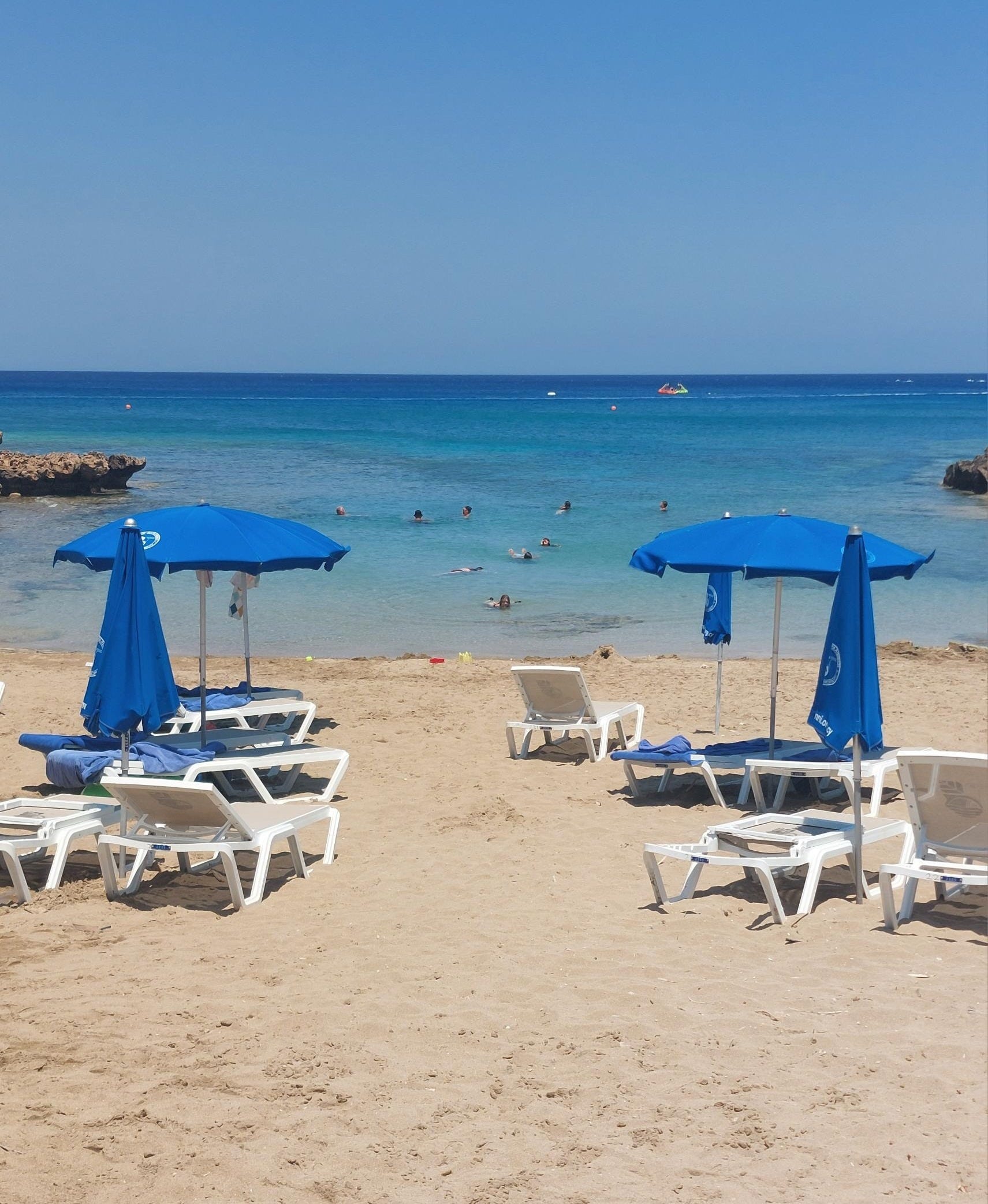
I scanned the empty horizon of the azure Mediterranean, interrupted momentarily as a small pleasure boat whizzed along the placid waters.
My mind drifted to geography, long one of my favorite subjects, as I pondered my location, Cyprus, where I stood in relative security just 100 nautical miles from perennially tormented Lebanon and Syria and the crucible that is the Middle East.
The Neighbor's Goat: An American in Romania is a reader-supported publication. To receive weekly posts and support my work, consider becoming a free or paid subscriber.
Pausing on that thought as the swash soaked my feet, I was grateful to be safe and on vacation with my family in Cyprus for the third time in the past four years.
My wife and son were still asleep, but I got up early and went straight to the beach in front of the hotel. There’s nothing like that first sea view and a dip when you’re on vacation. Then I grabbed a double espresso and couldn’t wait to play beach volleyball.
In March, when an Iranian drone hit a British Royal Air Force Base on Cyprus and caused minor damage – fired from Lebanon by Iran’s proxy Hezbollah – the country seemed perilously close to getting dragged into the Iran war. Our flights and hotel were already booked, but I didn’t panic.
I’ve had marvelous, uneventful trips to Israel and the United Arab Emirates in the past. I never exactly feared the Middle East but it is a precarious neighborhood that can change quickly. Traveling to the region merits caution, especially now. Cyprus sits at its doorstep.
Although not in NATO, Cyprus is a European Union member, its easternmost state; it was also under British rule from 1878 to 1960 (officially a crown colony from 1925 to 1960). Immediately after the drone hit, European nations, namely Greece and France, plus the United Kingdom, pledged their defensive support by sending fighter jets, a Navy frigate and a warship with anti-drone capabilities. Nothing else happened, save for two more Cyprus-targeted drones getting intercepted soon thereafter.
By the time our 2.5-hour flight from Romania landed at Larnaca’s gleaming airport a few weeks ago, all was calm, all was good.
The sun-splashed island nation in the eastern Mediterranean is the home to just over 1 million people in an area bigger than Delaware but smaller than Connecticut. Cyprus is known as the Land of Aphrodite, so named for the ancient Greek goddess of love and beauty who was born from the sea foam near present-day Paphos, according to Greek mythology.
I’ve come to love Cyprus’s affable locals and its sandy, “Blue Flag” beaches and crystal-clear waters – the EU’s cleanest for swimming – along with the soaring Troodos Mountains, white-washed churches with blue domes, towering palm trees that remind me of California and breakfasts with endless Halloumi, the semi-hard white cheese from sheep’s and goat’s milk produced in Cyprus and famous worldwide for its tasty grilled slices. Not to be missed is ice-cold Zivania, a stiff brandy made from grape pomace that is the national drink, and KEO beer, a ubiquitous lager that’s crisp and climate-perfect.
Cyprus is chill, on island time. But it has some baggage. It’s divided, quite literally.
The vast majority of Cyprus is ethnically Greek and it keeps close relations with Greece, sharing linguistic, commercial, cultural and religious ties. However, a sizeable Turkish minority, about 20%, coexisted peacefully with Greek Cypriots for decades, but the relationship slowly deteriorated, boiling over in 1974, when a Greek-backed coup prompted Turkey to launch a military invasion to protect its minority.
The Turks successfully captured 35% of the island and still claim it as the Turkish Republic of Northern Cyprus, a de facto state recognized only by Ankara. Today, Nicosia remains the world’s lone divided capital, with both sides using the city as their seat of government, bound by a United Nations buffer zone and a demilitarized Green Line “border” stretching 112 miles and managed by a UN Peacekeeping Force. Greek Cypriots and Turkish Cypriots are allowed to go back and forth as needed, but must enter through checkpoints.
All that has really no impact on everyday travelers like us. I’ve not been to the Turkish side, but the Greek side is a curious blend of Greece and the UK. Cars drive on the left; British phone booths dot the landscape; English breakfasts and pubs are common; British colonial infrastructure remains a legacy (including two sovereign military bases) and the country is well organized; Cypriots are exceedingly polite and friendly; English is widely spoken, even if Greek is the official language; HP sauce, Cadbury chocolates are other British brands are common; and Cypriot food is deliciously Greek-ish with heavy Middle Eastern influences, given the proximity.
As we settled into holiday mode, something else happened.
That first day on my way from the pool to the beach, I spotted a family from Denmark whom we’d met last summer. Same hotel, same spot at the pool. We’d played beach volleyball together for 10 days straight last year, sometimes twice a day.
Incredible, I thought. But then the same thing happened a few days later with another Danish family we’d befriended last year, with whom we played French boules and beach volleyball every day, sharing laughs and drinks.
We’d already decided to stay put this time and just relax, though we enjoyed previous side trips to the stunningly beautiful Cape Greco National Park along the sea; bustling Ayia Napa for a peek, confirming we like less-crowded Protaras better; Larnaca and its famous Church of Saint Lazarus and seaside promenade; urban life in Limassol with its surprising skyline; and the traditional villages of Lofou and Omidos in the Troodos Mountains, a pine-forested region that boasts the Painted Churches UNESCO World Heritage Sites and ancient Orthodox monasteries such as Kykkos, Trooditissa and Panagia Machaira, all popular tourist attractions.
This trip was about family time, sea, sun and fun. My son relishes sports and meeting new kids from all over, loving the chance to speak English for days on end. Seeing our Danish friends made it even easier.
The family-focused resort, which is cozy and comfortable, nice but not flashy, is dominated by Scandinavians, at least 75%, which in my view is an added bonus. They’re respectful fellow guests – calm, polite, friendly and not overly loud. The other two years we’d been at the hotel we also interacted with many Danes, Swedes, Norwegians and Finns, though guests also hail from the UK, Germany, Austria, Switzerland, Israel, Poland and other countries. Many of the Scandinavians are repeat visitors; one Norwegian family was there for the eighth time.
In three visits, we met just a handful of Romanian families. For the most part, they were trying something new and avoiding Greece due to its annual summer invasion by Romanians, who generally aren’t exactly like the Scandinavians on vacation, let’s put it that way. Of course, it depends on the people and they tend to flock to certain areas of Greece. I still love Greece, but seek out the less crowded spots, including islands without airports.
Two Romanian families not-jokingly said we shouldn’t spread the word to Romanians about the hotel; I didn’t want to admit I’d already recommended it to a neighbor who was there the week prior with his family. In reading about the recent trend of “gatekeeping” in travel, I’ll honor their wishes on this one and not reveal the resort here. But if you’re interested, send me a message.
In three visits, I’ve also only met one American, who was living in Vienna with his Austrian wife and young child. Americans are relatively rare in Cyprus, about as uncommon as in Romania, I’d say, and now is a weird time to be an American overseas, to put it mildly.
But you know what happened?
As the beach volleyball ensued, as friendships reignited and new ones blossomed, and the conversations and beers flowed, there was a warmth and familial vibe. I was “the American” embraced by my multinational teammates and opponents. Of course, people are upbeat on vacation. But this was authentic, sans labels and polarization.
There were also serious questions about what’s going on in Washington, whether the administration really wants Greenland, and why had American leaders dissed Europe and NATO? Sadly, several European families told me how they’d scrapped plans to visit America for the time being, my Danish friends among them, though they fondly recalled an earlier trip to Florida.
Geopolitical discussions were cordial, at an informed level, and revealing. Nobody lashed out at me despite the warmongering, an increasingly tenuous political situation and plummeting popularity back home. In my highly unscientific polling, these Europeans were still bullish on America overall and optimistic for its long-term future even as time will be needed to repair damages.
“This too shall pass,” was the consensus.
That made me feel good – and relieved. In the end, we’re all humans getting one shot at this life, striving for our families, trying to get along despite the powers that are beyond our collective control.
On a far-off Mediterranean island, we did just that. Bonding over beach volleyball and swapping phone numbers, we couldn’t solve the world’s problems, but we sure had fun and created new memories.
This Substack is reader-supported. To receive new posts and support my work, consider becoming a free or paid subscriber.
If you don’t want to commit to a subscription, but you’d like to show appreciation for my writing on The Neighbor’s Goat, please consider Buy Me A Coffee.
I like long black or flat white. Thank you!
Comments
Nothing yet. Say the first thing.
Sign in to join the conversation.