
Paul John Dear wrote this, in response to yesterday’s piece on flow:
“There is also flow in the storm, though it might be more difficult to find…”
I replied that the storm does not erase flow so much as it rearranges the conditions that make flow possible. Hard winds, lightning, driving rain. Disturbance, yes, but also energy. A system being forced into its next shape.
Paul answered: something in here linking chaos with emergence.
He is right. That is usually how it works.
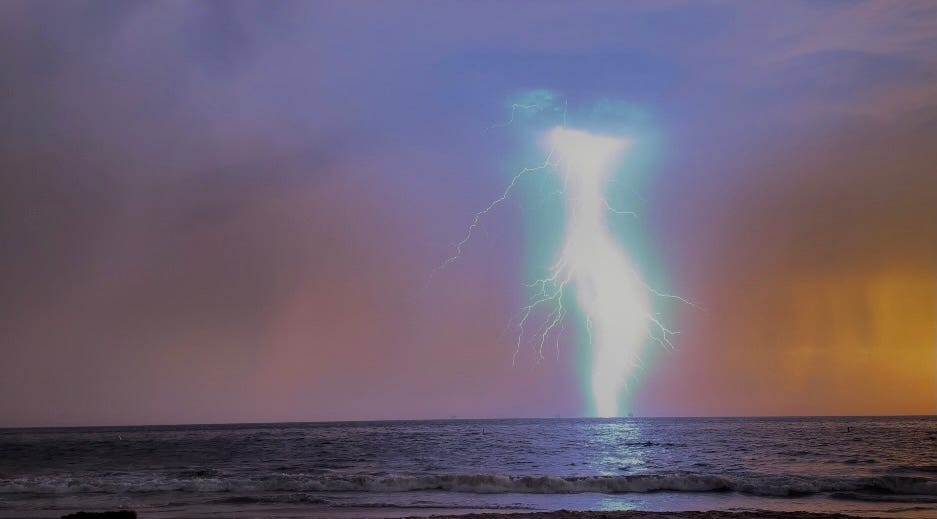
I took these photographs during a storm off the coast of Carpinteria. In the first frame, the bolt hits the water with enough force to blow the exposure open, teal-white light spreading across a sky that had been purple and gold a moment before. The ocean does not stop. The waves keep their interval. The storm moves with its own momentum, its own internal logic, and when it passes the beach is the same beach, rearranged at the margins.
That is one kind of storm.
This morning, on Easter, the President of the United States posted the following on social media:
“Today will be Power Plant Day, and Bridge Day, all wrapped up in one, in Iran.”
Power plants. Bridges. Civilian infrastructure. These are not military targets under international law. Their deliberate targeting is a war crime under the Geneva Conventions. This is not ambiguous. It is the plain text of the rules the United States helped write after earlier storms that did not end cleanly.
The tone of the post matters. It was cheerful. It used exclamation points. It read like an announcement.
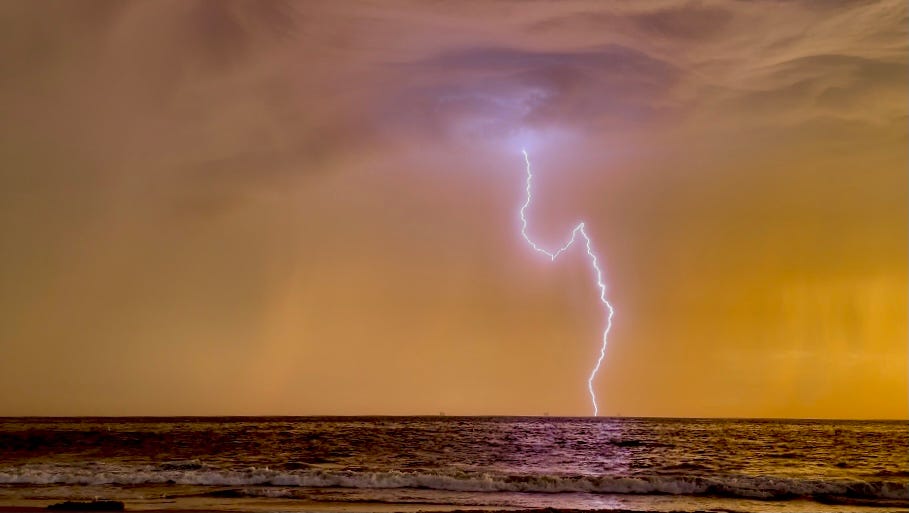
The storm I photographed had a logic. It moved, discharged, and passed. What came after was altered but still legible. Systems can absorb disruption and reorganize.
But not all disruption reorganizes.
Some force does not create the conditions for emergence. It removes them.
Today is today. The lights in Tehran may or may not go out. If they do, there is no guarantee of a next shape waiting on the other side. There is only the dark, and the people in it, and the record of what was chosen.
We do not need to defend the Iranian leadership to refuse this. The ground for refusal is already there: law, precedent, and the distinction between military action and the targeting of civilian life.
I think, too, about the people asked to carry this out. The distance between a decision and a body is never as wide as we pretend. Orders travel downward. Consequences travel outward.
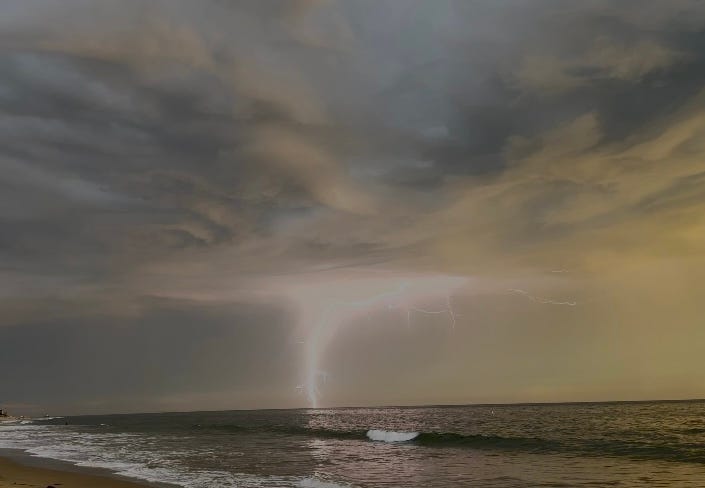
Storms pass. That is true.
But this is the part we forget.
Though we are schooled on Sundays to expect it, not every story of power ends in renewal.
Sometimes the grid stays down.
Sometimes the bridge is not rebuilt in a season or a year.
Sometimes the damage moves outward instead of resolving, into hospitals, into homes, into the quiet arithmetic of daily life that no longer adds up.
Some storms pass and leave the shoreline altered.
Some remove the shoreline altogether.
The distance between dates is a reader-supported publication. To receive new posts and support my work, consider becoming a free or paid subscriber.
Comments
Nothing yet. Say the first thing.
Sign in to join the conversation.