
On July 21st, Substack gave every reader a button.
Click it, and it tells you what percentage of what you just read was written by a machine.
Six days later, the Pope failed it.
Pangram — the detector Substack just built into its Reader — scored Pope Leo XIV’s speech at 46% AI-generated. Vatican officials, the theory goes, may have ghostwritten it. Nobody’s confirmed that. One journalist claims the Pope wrote it by hand, on paper.
Nobody has explained what “46%” means, either. Only that it’s a number, and the number sounds damning.
I don’t know if the Pope used AI.
Neither does Pangram.
What I know is that this is the same tool now running quietly under every post on this platform. Including this one.
Which brings me back to Steinbeck.
I’ve been feeding dead writers through AI detectors for months, long before the Pope had this problem. Not because I doubted the tools. Because I was curious what “sounds like AI” actually means, technically, underneath the accusation.
So I ran the experiment properly.
Vonnegut. Hemingway. Steinbeck. Didion. Carver. Stein.
Depending on the detector, all six could return elevated AI scores. Run the same passage through a different detector and it might come back confidently human. Change three paragraphs and the verdict flips entirely.
That’s because AI detectors don’t detect AI.
They detect statistical patterns.
Sentence length. Predictability. Lexical variety. Repetition. Parallel construction. Syntactic complexity. The formula changes from detector to detector because there’s no hidden fingerprint underneath. There’s a probabilistic guess about style, dressed up as a verdict.
Which raises the actual question.
If these six writers debuted anonymously on Substack in 2026, would we recognize them as human?
Vonnegut’s prose is economical to the point of self-parody. He repeats phrases. He favors declarative sentences. He circles the same ideas until they calcify into philosophy.
Those are exactly the habits a detector flags as machine-made.
Hemingway trained generations of students to imitate his short sentences, concrete nouns, restrained affect. Today those same qualities show up on internet lists of “AI tells.”
Steinbeck loved rhythmic repetition. Didion returned obsessively to the same phrases until they became incantation. Carver stripped his prose to the bone. Stein repeated language so relentlessly that readers still argue, decades later, about what she was doing.
Imagine any of them publishing under an anonymous username today.
How long before someone replied: “Nice ChatGPT”?
This isn’t new, and it isn’t limited to prose stylists. In 2023, ZeroGPT — a detector that briefly passed for state of the art — scored the Declaration of Independence between 95 and 100 percent AI-generated. It flagged the Constitution the same way. OpenAI eventually scrapped its own detector for low accuracy, which is one way of admitting the tool never worked.
Pangram is supposed to be the fix. And it still flagged the Pope. It still flagged the “Wear Sunscreen” column that people still read and feel something from. It still got a novel pulled from a major publisher days before release. A university study built entirely on Pangram’s own detector claimed nine percent of American news is AI-written — a study co-authored, in part, by four of Pangram’s own employees.
Better math. Same posture. The tool still tells you a number and lets you supply the verdict.
Thousands of writers now pay for “humanizers” — software that rewrites AI text specifically to survive detectors, by reintroducing the irregularity a machine strips out. Sam Illingworth tested this on himself: ran his own Substack post through a free humanizer, no edits, and watched Pangram’s verdict flip from 100% AI to 100% human on identical thinking. The score moved. He didn’t.
Think about the incentive structure we’ve built without meaning to.
The conscientious student who writes exactly the way composition courses have taught for fifty years may get flagged as a machine.
The student who runs AI output through a humanizer gets a clean bill of health.
We are not rewarding better thinking.
We are rewarding better camouflage.
None of this is really about software.
It’s about gatekeeping.
Every technological shift produces new rituals for separating the authentic from the counterfeit. Someone once claimed you could read criminality from the shape of a skull. Later it was handwriting. Now it’s sentence rhythm, transition words, the suspicious appearance of an em dash.
“I can spot AI” has become a cultural performance. It signals discernment. Taste. Membership in the club of people who still know what real writing looks like.
Whether the detector is right almost stops mattering.
Because once you’ve called something AI-generated, you don’t have to engage the argument.
You don’t have to explain why it fails.
You don’t have to produce a counterargument.
You don’t even have to read carefully.
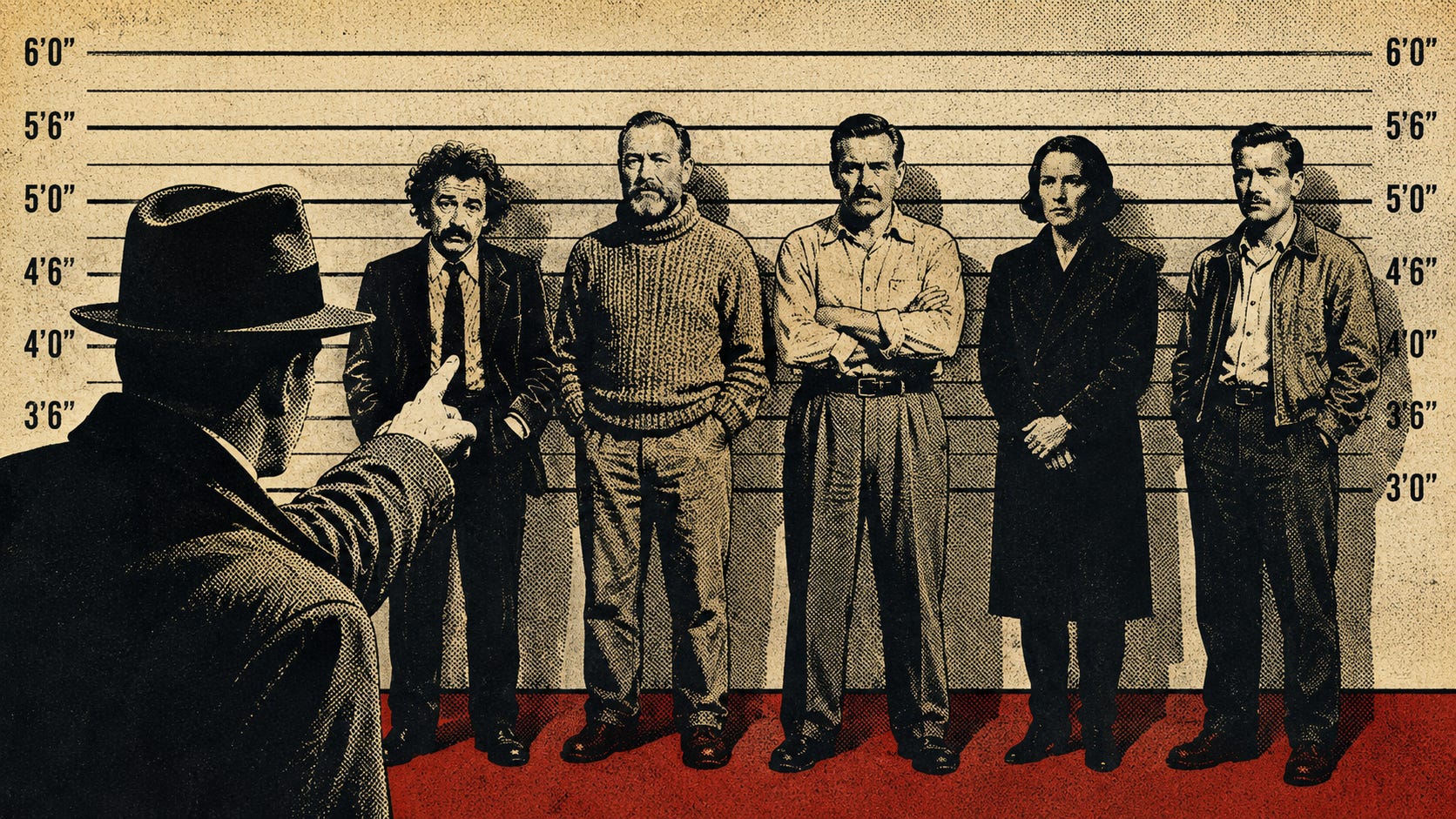
The detective in the lineup never asks if the suspects are guilty. Only if they look guilty enough.
Thanks for reading Andy Might! This post is public so feel free to share it.
Comments
Nothing yet. Say the first thing.
Sign in to join the conversation.