
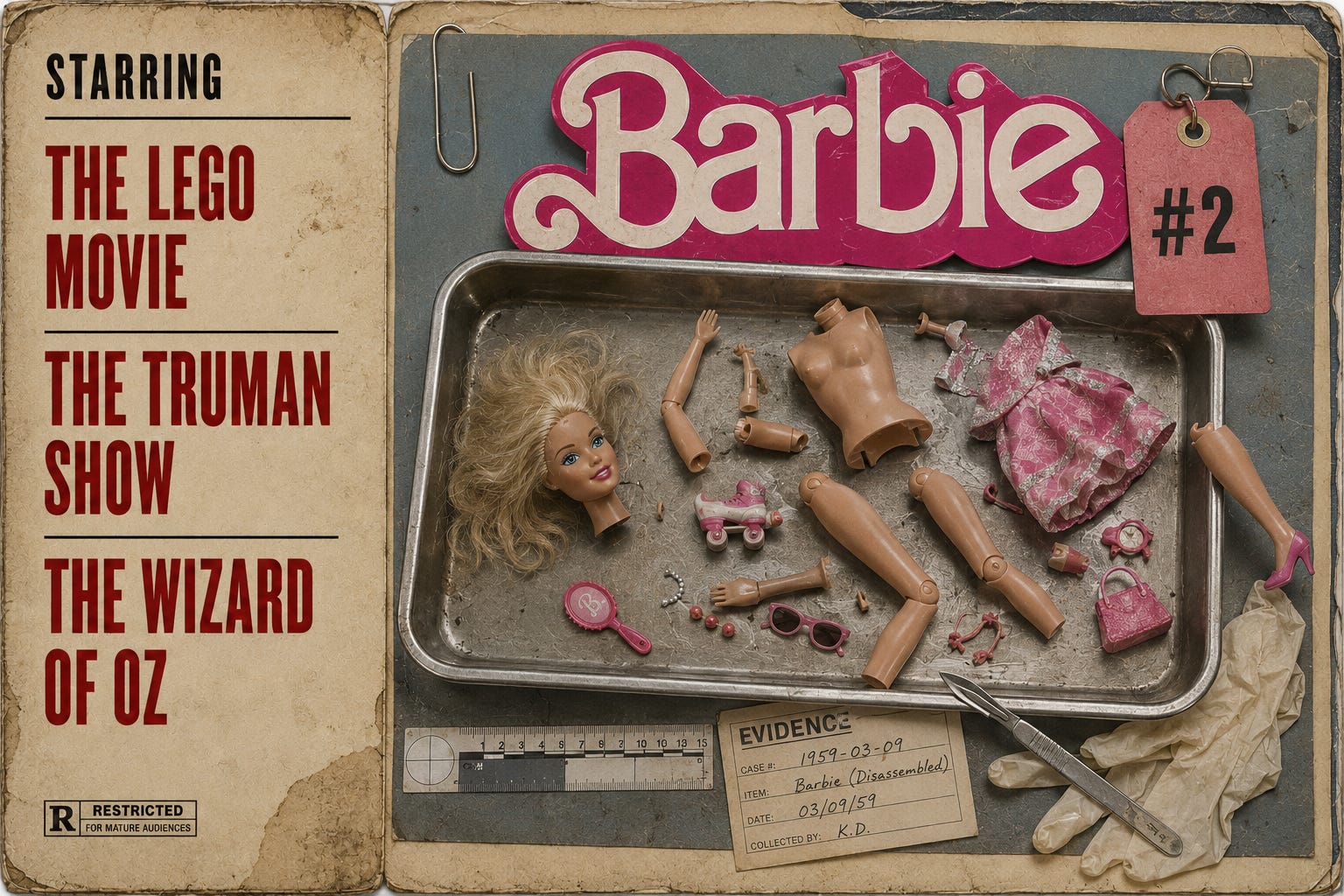
Greta Gerwig’s Barbie inspired an unusual critical reaction. Everyone seemed to agree it was “about feminism,” but no one could quite agree what kind of movie it actually was. Was it a comedy? A fantasy? A satire? A musical? A toy commercial having an existential crisis?
Perhaps the confusion comes from its anatomy.
After more than twenty years teaching film studies, I’ve noticed that students often run into the same problem. We know films are built from other films, but we rarely have satisfying language for describing how. We reach for shorthand. Die Hard on a bus. Jaws in space. The Breakfast Club with vampires. Those comparisons are useful, but they flatten influence into a slogan.
When I teach genre and adaptation, I often ask students to begin with a metaphor. Is cinema an ecosystem? A family tree? A recipe? A language? Every metaphor reveals something while hiding something else. Over the years, I’ve come to prefer anatomy. Films don’t simply quote their predecessors. They inherit skeletons, transplant organs, strengthen old muscles, and develop new nervous systems. By the time the operation is complete, the resulting body may feel entirely original even though many of its vital parts have lived previous lives.
Beneath all its hot pink plastic, Barbie is assembled from several remarkably familiar narrative machines. Strip away the glitter and you’ll find bones, muscles, and a brain audiences have encountered before, rearranged into something that somehow feels new.
Skeleton: The Lego Movie
![The LEGO Movie - Official Main Trailer [HD] : r/movies](https://substackcdn.com/image/fetch/$s_!bQ38!,f_auto,q_auto:good,fl_progressive:steep/https%3A%2F%2Fsubstack-post-media.s3.amazonaws.com%2Fpublic%2Fimages%2F06dca46e-6038-49a0-b6a4-727b0293b22d_1280x720.jpeg "The LEGO Movie - Official Main Trailer [HD] : r/movies")
Before Barbie, there was another film that transformed a toy aisle into an existential fable.
Like The Lego Movie, Barbie begins inside a perfectly ordered manufactured universe where every resident accepts the rules because they have never imagined an alternative. Their protagonists are model citizens. Emmet follows the instructions. Stereotypical Barbie wakes every morning convinced today will be another perfect day.
Neither protagonist chooses the adventure.
Both stories begin with a disruption.
Emmet discovers the Piece of Resistance.
Barbie suddenly wonders whether anyone ever thinks about dying. Soon afterward come the flat feet, the cellulite, and a body that no longer behaves according to Barbieland’s rules.
Only then do they decide to leave.
Both films also perform the same commercial magic trick. They begin as feature-length advertisements and gradually become critiques of the fantasies their brands were built to sell. Rather than protecting the mythology surrounding their products, they begin asking what those mythologies leave out.
Without The Lego Movie, it’s difficult to imagine a studio giving Barbie permission to become this strange..
Muscles: The Truman Show
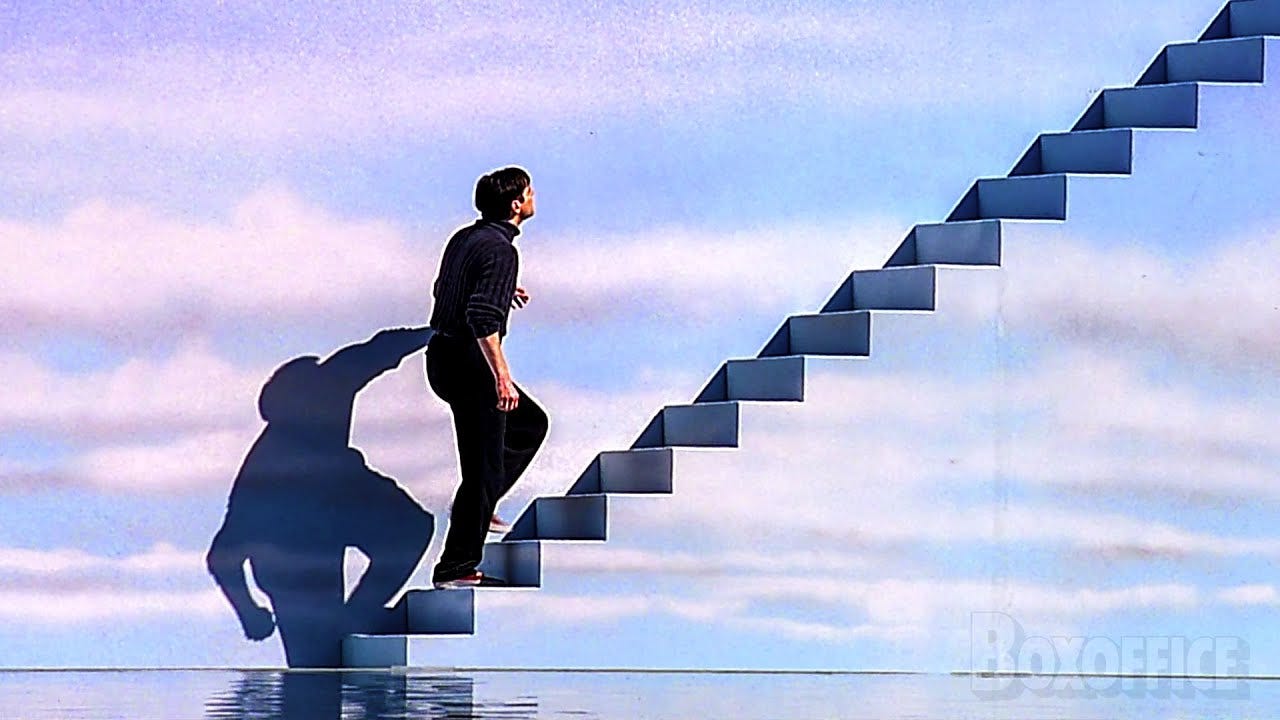
If The Lego Movie provides the skeleton, The Truman Show supplies the movement.
Both protagonists inhabit meticulously constructed realities that everyone around them accepts as perfectly ordinary. Every smiling face, every routine, every apparent freedom has been carefully designed.
The story begins when something interrupts that routine.
For Truman, it’s a stage light falling from the sky.
For Barbie, it’s the realization that something is wrong with her.
The distinction is revealing.
Truman’s world stops making sense.
Barbie’s body stops making sense.
Truman gradually realizes he has been watched his entire life.
Barbie gradually realizes she has been looked at her entire life.
Those are different discoveries. One is about surveillance. The other is about manufacture.
Neither film is really interested in escaping a simulation. Both are interested in what happens after an unquestioned reality becomes impossible to inhabit.
Brain: The Wizard of Oz
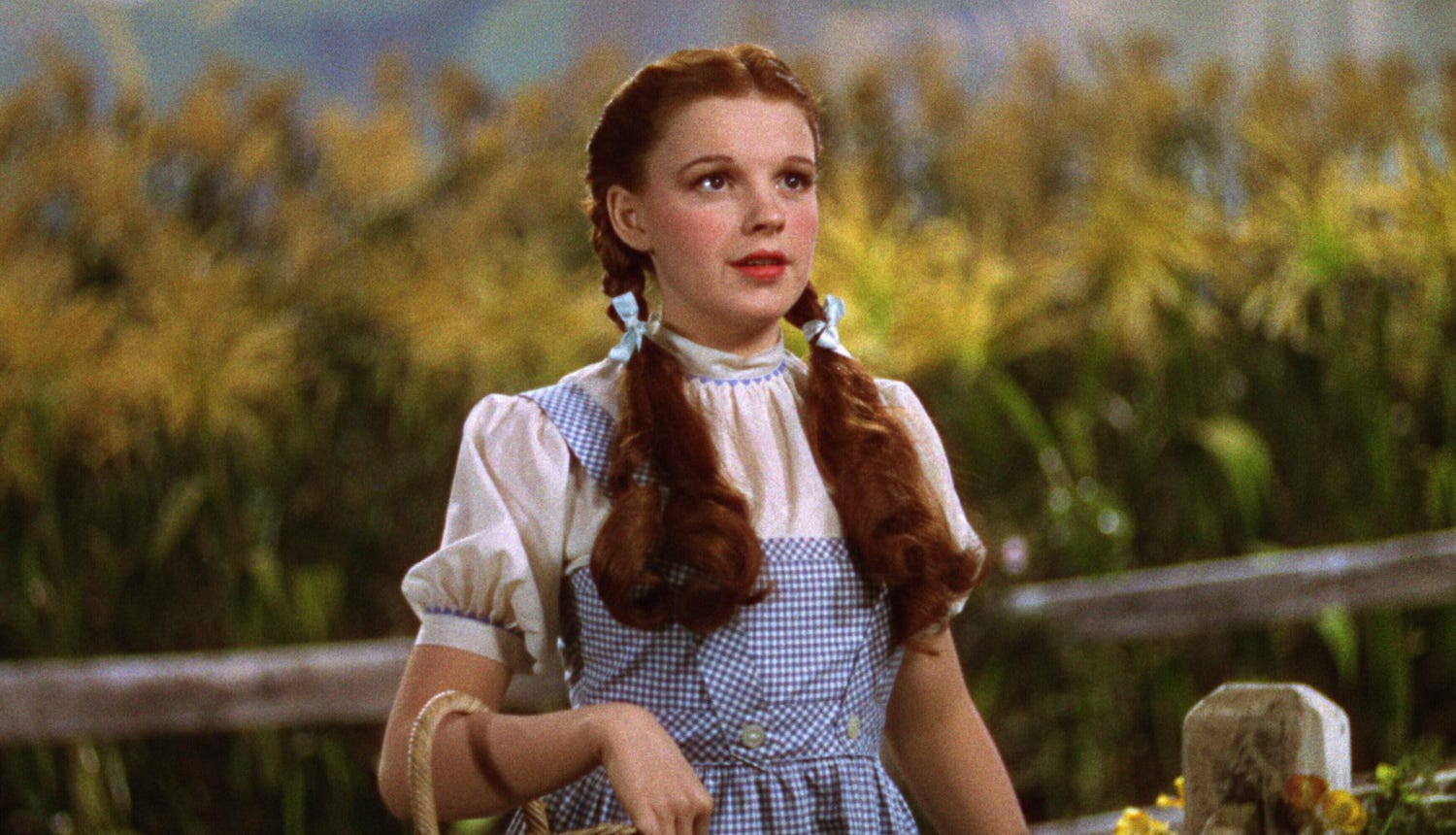
The deepest donor, however, isn’t about toys or television.
It’s The Wizard of Oz.
Both films begin in brightly colored fantasy worlds governed by simple rules before crossing into an America that proves more complicated than expected. Both populate those worlds with archetypes rather than psychologically realistic characters. Both use fantasy to make ordinary life appear newly strange.
There are smaller echoes as well.
Dorothy eventually meets the figure behind the curtain.
Barbie eventually meets the woman behind the doll.
The encounters could hardly be more different.
The Wizard is exposed as an illusion.
Ruth Handler offers no illusion at all.
Dorothy learns that authority can be fraudulent.
Barbie learns that perfection can never be.
Dorothy returns home.
Barbie chooses not to.
Soul: Greta Gerwig
This is where the autopsy ends.
Because none of these films arrives where Barbie does.
Emmet rebuilds his world.
Truman escapes his.
Dorothy returns to hers.
Barbie chooses another life entirely.
She chooses uncertainty over perfection.
A body that ages instead of plastic that doesn’t.
A future without guarantees.
The film’s final destination isn’t another fantasy.
It’s a gynecologist’s office.
After spending two hours among impossible bodies, impossible beauty, impossible certainty, and impossible worlds, Barbie ends with biology, bureaucracy, and an ordinary waiting room.
Plastic becomes flesh.
That transformation belongs to Greta Gerwig.
She understands something filmmakers have always known but audiences often overlook: originality is rarely the absence of influence. Cinema evolves through recombination. Genres exchange organs. Stories inherit skeletons. Every generation rearranges the anatomy it receives until familiar parts begin moving in unfamiliar ways.
Gerwig doesn’t hide her influences.
She trusts them.
Each donor contributes a vital organ, but the life that emerges belongs to an entirely different body.
Barbie may wear hot pink.
Underneath, it’s stitched together from some wonderfully familiar parts.
Thanks for reading Andy Might! This post is public so feel free to share it.
Comments
Nothing yet. Say the first thing.
Sign in to join the conversation.