
On the first day of my Breaking Bad class, I handed out the syllabus—and blue meth.
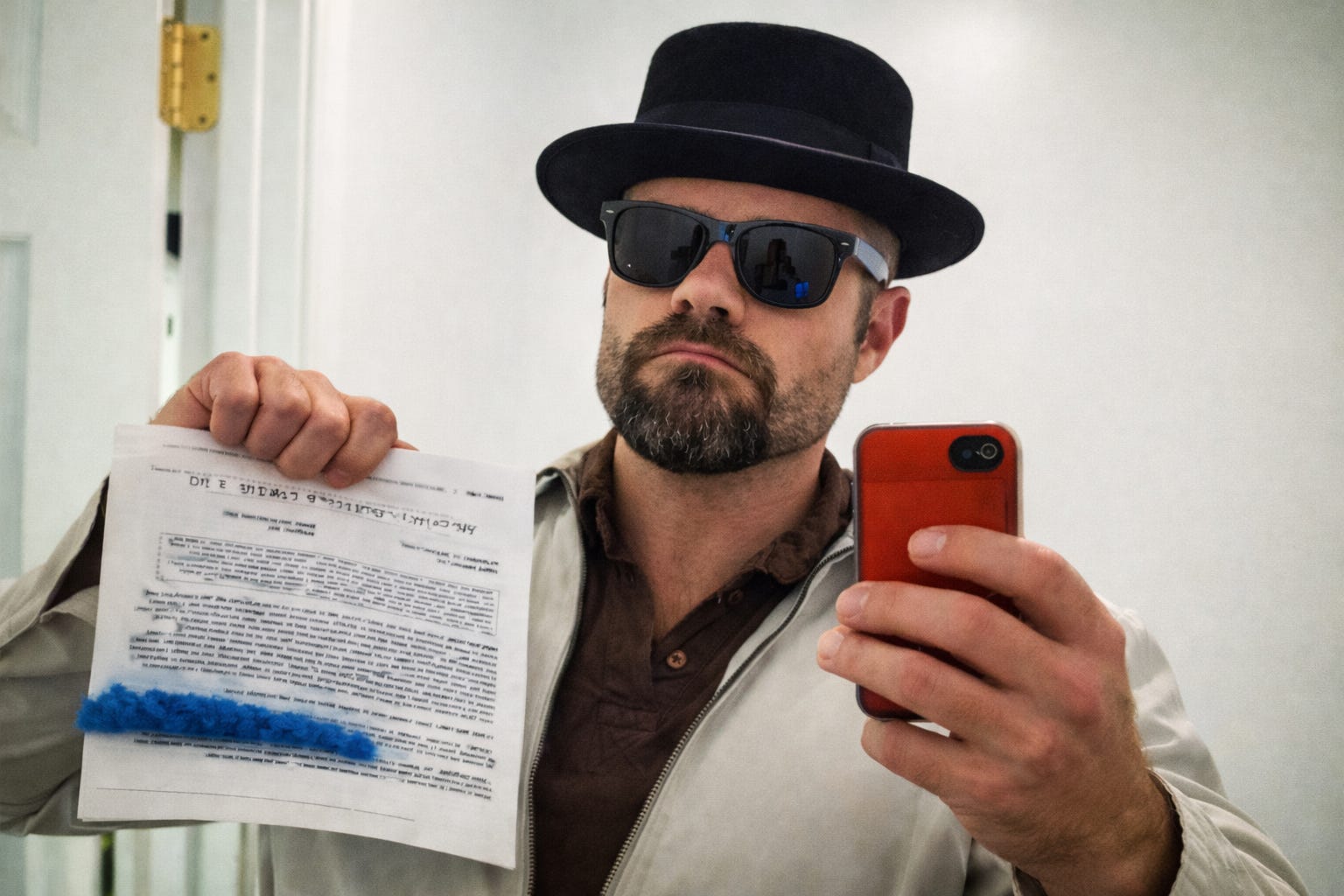
Not meth. Blue rock candy. Crushed, bagged, passed down the rows. A visual joke, a tone check. We were going to take the show seriously, but not reverently.
Students laughed. Some took photos. A few hesitated. The show had already trained them to treat objects as tests.
That moment set the terms of the semester. Breaking Bad would be something we handled, not something we admired from a distance.
The most important thing my students learned in that class wasn’t about meth, masculinity, or genre. It was about identification—how it works, where it breaks, and how long it can last once harm is no longer hypothetical.
We didn’t watch the show as a finished moral object. We watched Breaking Bad unfold, six episodes at a time, and something unexpected happened in the room. Students didn’t argue about whether Walter White was dangerous. They argued about whether danger was disqualifying.
That argument became the course.
Because the show arrived in chunks, there was no final judgment to hide behind. Each new block reopened the same quiet question: how much longer can I stay with him? Identification wasn’t a position students took once and defended. It was something they felt shifting—loosening, hardening, draining, intensifying—as the weeks went on.
By midsemester, the classroom had a rhythm.
One week, the guest was from health and human services. We talked about cancer care in America: employer-based insurance, deductibles, the fiction of choice inside constrained systems. In that frame, Walt still made sense to almost everyone. He was frightened, cornered, acting under pressure. Sympathy held because the analysis stayed structural.
Another week, math department. Money laundering. What it actually means to move large amounts of cash without triggering institutional detection. This was the week something shifted. Students became fascinated not with violence, but with elegance. Flow rates. Front businesses. The way money could be made to behave. Ethics didn’t disappear, but they receded as mechanics took center stage, almost without anyone noticing.
Then acting and performance. Masculinity, posture, voice, the way authority occupies space. Suddenly the discussion wasn’t about what Walt does, but how he carries himself when he does it. For some students, this was the breaking point. For others, it was the moment identification intensified.
Those guest lectures weren’t enrichment. They were controlled disruptions. Each one changed what counted as insight. Each one revealed who stayed with Walt when the lens shifted away from narrative sympathy and toward systems, labor, and embodied authority.
Over time, the debates began to break unevenly across the room. Not cleanly, not predictably, but often enough to matter. Many of the male students—especially early in the semester—experienced Walt’s arc as acceleration. They weren’t confused by his cruelty; they were impatient with delay. They wanted him to arrive. For many of the women students, and for others reading through care, containment, or relational damage, the same moments registered as warning signs rather than payoffs. Staying with Walt felt less like suspense and more like endurance.
What emerged wasn’t a disagreement about the facts of the show, but about what competence entitles you to do before it becomes disqualifying.
The classroom didn’t resolve that difference. It made it visible.
This is where the show’s famous promise—to take the audience from Mr. Chips to Scarface—takes on a different weight. Framed as a cautionary arc, the transformation is supposed to horrify. What the classroom revealed is that for a meaningful portion of viewers, Scarface isn’t the warning. It’s the payoff.
Some students weren’t bracing for Walt’s arrival there. They were waiting for it. They experienced the early seasons not as tragic foreshadowing but as narrative delay. Walt’s increasing cruelty didn’t register as disqualifying so long as it was paired with mastery, foresight, and control.
Other students experienced the same arc as exhaustion. For them, staying with Walt began to feel like a demand. Jesse’s suffering, Skyler’s containment, collateral damage—these weren’t narrative obstacles but moral alarms. Identification wasn’t thrilling; it was draining.
The student work makes this divide unmistakable. Again and again, students note how genre keeps rescuing Walt.
Melodrama frames his anger as justified.
The gangster genre aestheticizes his rise.
The western mythologizes his autonomy.
The superhero narrative exceptionalizes his intellect.
Genre, they learn, is not decorative. It is ethical infrastructure. It licenses behavior.
Several students independently arrive at the same insight: Walt remains legible as a protagonist not because his actions are defensible, but because the narrative keeps giving viewers reasons to stay. Even poisoning a child. Even letting Jane die. Even orchestrating mass murder. Genre doesn’t excuse these acts outright; it reclassifies them as necessary, transitional, or tragic rather than disqualifying.
They also learn something quieter and more unsettling about intelligence itself.
Early in the semester, cleverness reads as power. Walt’s meth purity. His negotiation tactics. His manipulation of legality. But as the weeks go on, intelligence begins to read as instability. One student argues that Walt’s downfall comes not from his enemies, but from excess: too much money, too much accumulation, too much proof. Intelligence scales faster than morality can metabolize it.
They learn that intelligence is not the opposite of harm. It can be its decoy.
Bodies in the show register this long before characters do. Walt’s cancer recedes as his moral sickness accelerates. Jesse’s body collapses under guilt long before he can articulate it. Hank’s injury forces a reckoning that masculinity alone cannot power through. The show’s ethics are not delivered through dialogue. They are registered somatically. The body becomes evidence.
Perhaps the most important thing my students learned is that spectatorship itself is a moral practice.
Watching Breaking Bad in real time forces a decision that cannot be outsourced to interpretation: how long will you stay? What will you excuse because the system is elegant, the protagonist compelling, the craft exceptional? The classroom didn’t answer that question. It exposed it.
What I understand now is that the most important thing the class revealed wasn’t when Walter White became unreadable. It was how unevenly that moment arrives—and how easy it is to mistake that unevenness for difference in opinion rather than difference in tolerance.
That matters beyond the classroom. We live among figures who resemble Walt not in spectacle but in structure: articulate, credentialed, aggrieved, fluent in systems, convinced their intelligence should count as mitigation. The danger in those figures is rarely chaos. It’s coherence. Harm doesn’t announce itself as collapse; it arrives as a solution that feels earned.
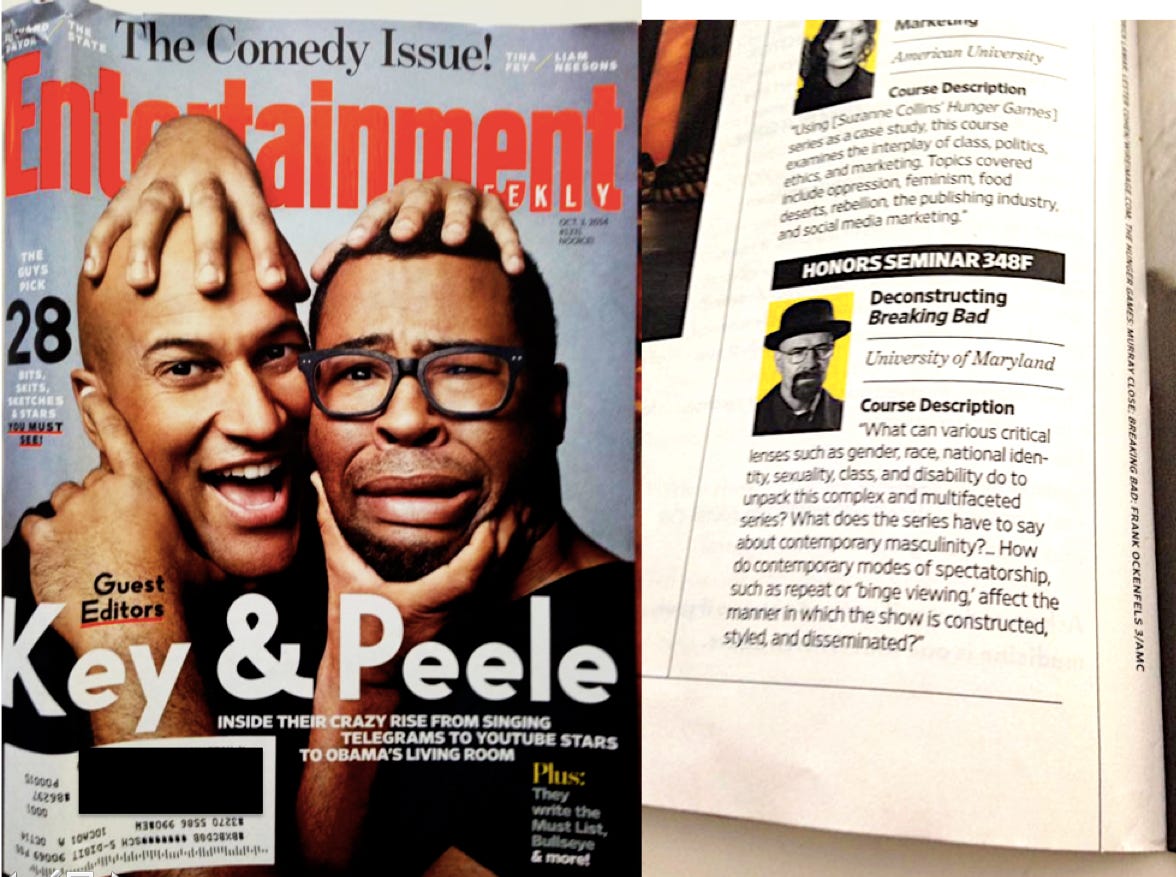
in 2014, Entertainment Weekly highlighted my course in a feature on how academia productively engaging with pop culture. Watching Breaking Bad together didn’t teach my students a single moral lesson. It taught them to notice when admiration turns into endurance, when competence begins to excuse damage, and when staying starts to feel like participation. The classroom didn’t settle those questions. It trained us to recognize them—first in fiction, and then, uncomfortably, everywhere else.
Comments
Nothing yet. Say the first thing.
Sign in to join the conversation.