
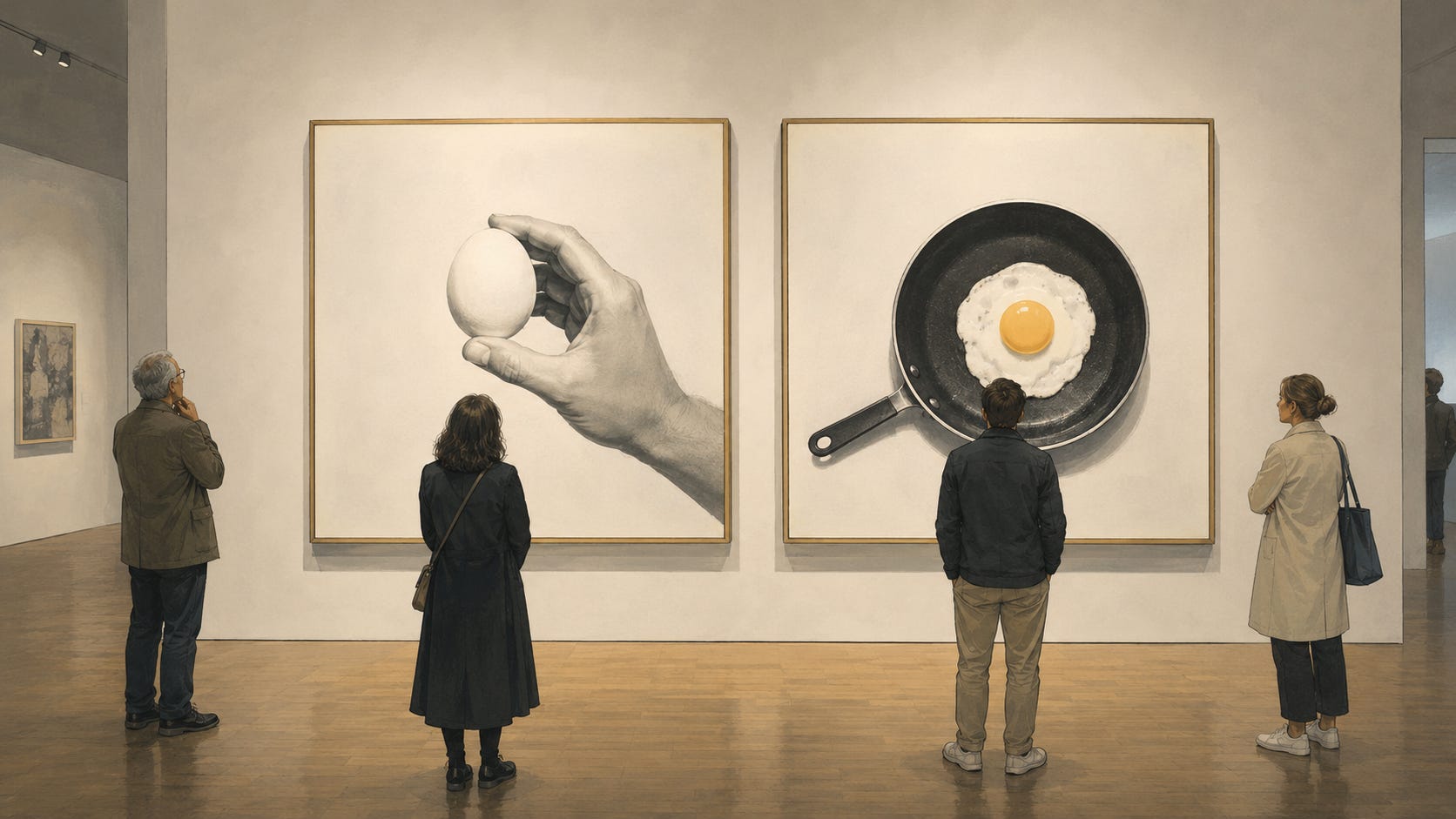
When I was a kid, anti-drug commercials possessed the kind of certainty adults only seem to have right before history proves them wrong. A man held up an egg. This is your brain. He cracked it into a frying pan. This is your brain on drugs. Sizzle. The lesson was beautifully simple. There was one correct brain. Drugs broke it.
Those commercials gave me more than a reason to avoid drugs. They gave me an ample metaphor for what I thought would happen if I ever tried them. My brain was an egg: intact but fragile, apparently one bad decision away from irreversible breakfast. This worked especially well on me because I’d had seizures as a child and already thought of my brain as a slightly temperamental appliance. Why introduce recreational chemicals when the factory settings had already produced embarrassing psychological shutdowns? So I spent years protecting the egg.
That certainty became harder to maintain after I was diagnosed with ADHD relatively late in life. The QbTest gave me something more useful than a label: a map of my particular brain. I scored extremely high in distractibility, but low in impulsivity—not the stereotypical ADHD brain so much as one whose attention drifts, searches, and then locks ferociously onto whatever happens to capture it. Adderall helped enormously. It helped me finish a PhD, focus, produce, and eventually get tenure. But after years of taking it, I consciously stopped, curious about what my brain actually did without the chemical assistance I had come to regard as normal. That experiment changed the way I thought about drugs more generally. If one substance could make my particular nervous system function better by changing its chemistry, why assume every other substance could be sorted neatly into “medicine” or “drug,” helpful or harmful?
I began wondering whether some substances might work particularly well with my strange neurological settings while others might work directly against them. In short, I began to question a narrative whose defining feature seemed to be that there were no questions to ask.
Eventually I realized the problem wasn’t the drugs. It was the egg. My brain isn’t an egg. It’s a museum.
A museum looks simple from the gallery floor: rooms full of objects. Behind that experience is an enormous apparatus most visitors barely notice. Someone decides what goes on display and what stays in storage. Someone controls the lighting. Someone watches the doors. Someone maintains the temperature and humidity. Conservators decide how fragile objects can be handled. Architects determine which rooms connect. Most of that machinery disappears when it’s working properly. You notice it when somebody changes a setting.
Cannabis, for me, changes the lighting. It doesn’t put new things in the museum so much as illuminate things I’ve been walking past. Small details become important. Connections between exhibits become obvious. One painting suddenly throws light onto another three rooms away. My mind does this sober—I can get from Spider-Man to medieval reliquaries without chemical assistance—but cannabis seems to make the distance between those objects matter less. It is very good at asking, What else does this connect to? It is considerably less interested in whether I have answered my email.
This is why I’ve become suspicious of the idea that cannabis makes me creative. I don’t think it gives me ideas. I have plenty. It changes what receives attention and seems to relax whatever part of me normally says, “That connection is probably irrelevant.” Sometimes that produces an idea worth keeping. Sometimes it produces forty-five minutes of extremely compelling nonsense. Either way, change the lighting and suddenly I can see that there was a lighting system all along.
Adderall reveals a different piece of machinery. Every museum owns vastly more than it can display, and mine apparently believes all of it belongs in the lobby. Adderall gives me a curator. One thing becomes the current exhibition. The others haven’t disappeared or become less interesting; they can remain in storage until later. “Attention deficit” has never quite described the problem from inside my head. There isn’t too little to look at. There is too much insisting on being looked at simultaneously. The curator’s job isn’t just choosing what deserves attention. It’s deciding what can wait.
Caffeine is the facilities manager. It turns on the lights, unlocks the doors and informs everyone that the museum opens at nine whether anybody feels inspired or not.
SSRIs are closer to climate control. They don’t change the collection so much as the atmospheric conditions in which you encounter it. Neither SSRIs nor caffeine are particularly glamorous alterations of consciousness, but museums need HVAC systems too.
Alcohol and MDMA make an interesting pair because from across the room they can look superficially similar. People become more social, affectionate, confessional. Inside my particular museum, though, they seem to be doing almost opposite things. My ADHD already comes with an unreliable curator: attention wanders, stimulation competes for priority, and executive function has to work harder to decide what gets through. Alcohol doesn’t correct any of that. It further weakens the very systems already doing the most expensive work. Security goes home. The velvet ropes become suggestions. Attention gets sloppier, working memory worse, inhibition weaker. For someone whose brain already has plenty of activity and not always enough regulation, alcohol mostly subtracts regulation. Its question is something like: What would I do if nobody stopped me?
MDMA seems more like a conservator working with a fragile object. The difficult thing is still there, but under controlled therapeutic conditions people can sometimes approach painful material with less fear and defensiveness. The conservator doesn’t pretend the object was never damaged or make it indestructible. The job is to create conditions under which something fragile can be safely handled.
MDMA asks something closer to: Can I look at this without being afraid of it?
Ketamine changes something else again. I haven’t tried it, but its use in depression treatment fascinates me because descriptions of the experience often sound less like changing the collection than changing where the visitor is standing. The museum gets an observation deck. Something that previously occupied the entire field of vision can suddenly be seen as one room in a larger building. Nothing necessarily disappears. You just aren’t standing inside it anymore.
Living in Denver gave me an unusually structured way to experiment with this. After Colorado legalized regulated access to psilocybin and decriminalized personal use, psychedelics became less like some illicit substance obtained from a guy who knows a guy and more like something I could approach deliberately. For several months, I received reliably dosed psilocybin capsules from a local microdosing club and took one or two at a time, which let me pay attention to effects without wondering quite so much what, exactly, I had ingested.
Then there are the classical psychedelics, where the renovations become considerably more ambitious. Psilocybin is the architect. Walls move. Doors appear between galleries you’d assumed were unrelated. People so often describe psychedelic experiences by saying I realized rather than I invented: something about their parents, their relationships, mortality, the way they’ve been living. Whether every revelation deserves to survive breakfast is another question, but the experience seems less like acquiring new information than discovering that the floor plan you’ve been using isn’t the only possible arrangement.
LSD seems like the architect’s mathematically obsessed cousin. Patterns become unusually insistent: repetition, symmetry, structures inside structures, connections ordinary consciousness might dismiss as coincidence.
Ayahuasca, from the research and accounts I’ve read, makes me think of an archaeologist. Instead of asking how the rooms connect, it asks what the museum was built on. Pull up the floorboards and there are family stories, childhood memories, recurring symbols and older narratives underneath the current ones. That doesn’t make every memory recovered under ayahuasca historically accurate. Memory is reconstructive even on a Tuesday afternoon. What interests me is the direction of attention: downward, toward foundations.
And then there’s DMT, which appears to have no respect for my metaphor whatsoever. Cannabis changes the lighting. Psilocybin moves the walls. Ayahuasca excavates the foundations. DMT blows up the museum.
Like psilocybin and LSD, DMT acts especially on serotonin 5-HT2A receptors, but brain imaging suggests something more interesting happens at the network level: regions that normally keep to their own departments start communicating more freely, while networks involved in maintaining a stable sense of self become less organized. That may help explain reports of impossible geometries, entities, entire environments, and the disappearance of the boundary between self and world.
The museum is still there. Someone has removed all the interior walls while every department is still open.
Comments
Nothing yet. Say the first thing.
Sign in to join the conversation.