
We already know how these stories end.
Norman Bates becomes a murderer. Hannibal Lecter becomes a monster with exquisite table manners. Saul Goodman becomes a hollowed-out survivor in a loud suit, performing confidence like a nervous tic. None of this is up for debate. These endings are among the most stabilized facts in contemporary popular culture.
And yet we watched the shows anyway. We committed days of our lives to Bates Motel, Hannibal, and Better Call Saul—shows that did not merely spoil themselves in advance, but depended on our foreknowledge to function at all.
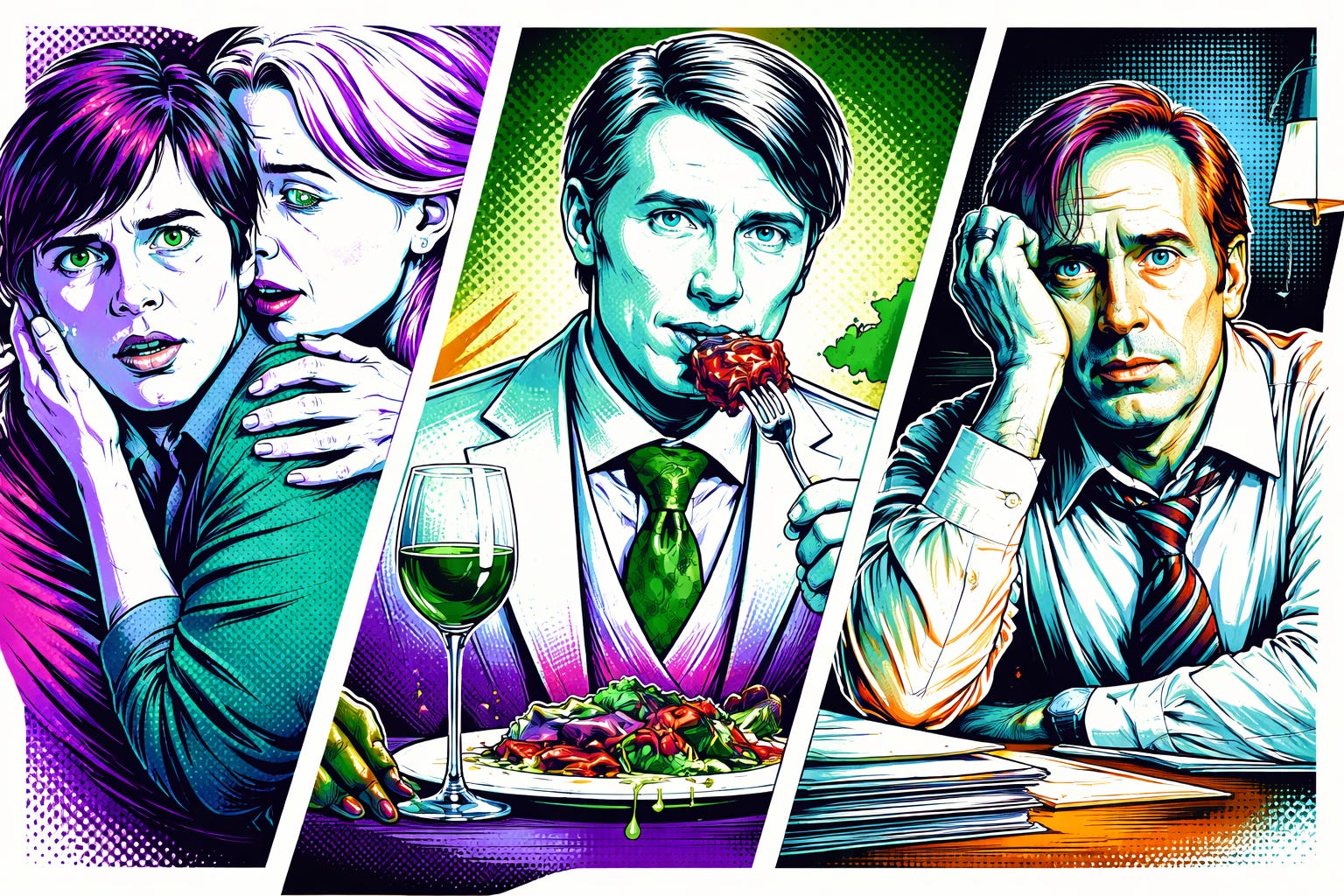
What kind of television asks us to watch characters move toward a future we already know will be bad—and asks us to find pleasure, intimacy, even beauty in that movement? The answer, I want to suggest, is that these series belong to a specific adaptive mode that we don’t yet have a good name for. I call it pre-boot television.
A pre-boot is not a prequel, reboot, sequel, or remake. It takes place chronologically before a canonical text, but remains ontologically subordinate to it. Psycho, The Silence of the Lambs, and Breaking Bad are the “true texts” in this relationship: closed, complete, culturally authoritative. Bates Motel, Hannibal, and Better Call Saul do not attempt to revise or replace those texts. They depend on them. Their suspense is calibrated around inevitability rather than surprise.
This temporal inversion—before in story, after in reception—produces a distinctive spectatorial structure. The viewer is not watching to find out what happens. The viewer is watching to understand how it becomes possible. Pre-boots transform narrative foreknowledge into an affective engine, replacing mystery with pressure.
Adaptation theory gives us part of this vocabulary. Linda Hutcheon famously describes adaptation as repetition without replication, arguing that recognition is a central source of pleasure. Pre-boots intensify that logic. They rely on recognition, but they rarely deliver it cleanly. Instead, familiar elements are delayed, distorted, or rendered incomplete. Jason Mittell’s notion of the “operational aesthetic” is useful here: viewers take pleasure in watching narrative machinery work. But in pre-boot television, the machinery does not aim toward surprise or reversal. It aims toward alignment with an ending that already exists.
What varies across these series is how that alignment is managed. Each organizes inevitability according to a distinct regulatory regime—one that shapes character psychology, pacing, and viewer affect. Taken together, they form a comparative triad: suffocation, consumption, and starvation.
Bates Motel is governed by suffocation. Its most striking move is not its expansion of Norman Bates’s backstory, but its inversion of Psycho’s moral geometry. Norma Bates, who functions in Hitchcock’s film as a repressive maternal ghost, is reimagined as fiercely loving, materially vulnerable, and emotionally present. Norman, rather than appearing monstrous from the outset, is framed as fragile, dissociative, and overwhelmed.
The show repeatedly stages situations that echo Psycho—body disposal, secrecy, surveillance—but reconfigures them to produce sympathy rather than shock. Norman is not deprived of care; he is engulfed by it. Love presses too closely. History refuses to release him. There is no breathable distance in which a stable self might form.
Violence, under this regime, is not an expression of appetite or ambition. It is a release of pressure. And the viewer, armed with knowledge of Norman’s future crimes, experiences each act of care as both necessary and lethal. The pleasure is tragic rather than suspenseful. We are invited not to excuse Norman, but to understand the conditions that make his transformation feel less like a choice than a collapse.
Hannibal, by contrast, operates through consumption. Here repetition is not inverted but incomplete. The series populates its world with figures who resemble their cinematic counterparts without fully becoming them: partial Clarices, early Hannibals, killers who imitate artistry without achieving mastery. Recognition is constantly teased, then withheld.
Consumption names the logic that organizes this system. Hannibal Lecter does not merely kill; he incorporates. Therapy, intimacy, mentorship—all are modes of ingestion. To be known by Hannibal is to be metabolized into his aesthetic and ethical system. Identity loss here is not caused by enclosure or deprivation, but by absorption.
Spectator pleasure mirrors this excess. Hannibal luxuriates in style, knowledge, and control. The show presents itself as an elaborate aperitif rather than a meal—an aesthetic rehearsal that never claims to replace The Silence of the Lambs. The film remains the final draft. The series exists to whet appetite. Inevitability takes the form of hunger.
Better Call Saul introduces a third regime: starvation. Unlike Bates Motel and Hannibal, it neither inverts nor withholds recognition. It subtracts. Jimmy McGill begins as warmer, funnier, and more ethically flexible than the Saul Goodman we already know. Over the course of the series, the narrative systematically removes the conditions that allow that fullness to survive.
Professional respect, familial connection, romantic partnership, moral play—all are rationed. Starvation is not accidental; it is managed. Jimmy is kept alive narratively, legally, financially—but only just. Saul Goodman emerges not as a triumphant alter ego, but as a metabolic adaptation: a self capable of surviving on minimal nourishment.
The pleasure economy of the show follows this logic. Long stretches of deprivation are punctuated by brief, euphoric bursts: a successful con, a legal win, a moment of intimacy with Kim. These moments feel intense precisely because they are rare. Cameos from Breaking Bad characters function not as nostalgic rewards but as solvents, accelerating Jimmy’s erosion rather than affirming his destiny.
Across these three series, inevitability is not a narrative weakness. It is the point. Suffocation, consumption, and starvation describe different failures of boundary regulation: boundaries that press too close, disappear entirely, or tighten until nothing can pass through. Pre-boot television is less interested in expanding story worlds than in managing proximity—to characters, to futures, to canonical texts.
In this sense, pre-boots function as diagnostic instruments. They reveal what must be compressed, absorbed, or denied for a familiar narrative universe to hold together. They ask us not whether a future can be avoided, but what it costs to arrive there.
Watching these shows is not about being surprised. It is about learning how inevitability feels. And that, increasingly, may be one of contemporary television’s most honest pleasures.
Comments
Nothing yet. Say the first thing.
Sign in to join the conversation.