
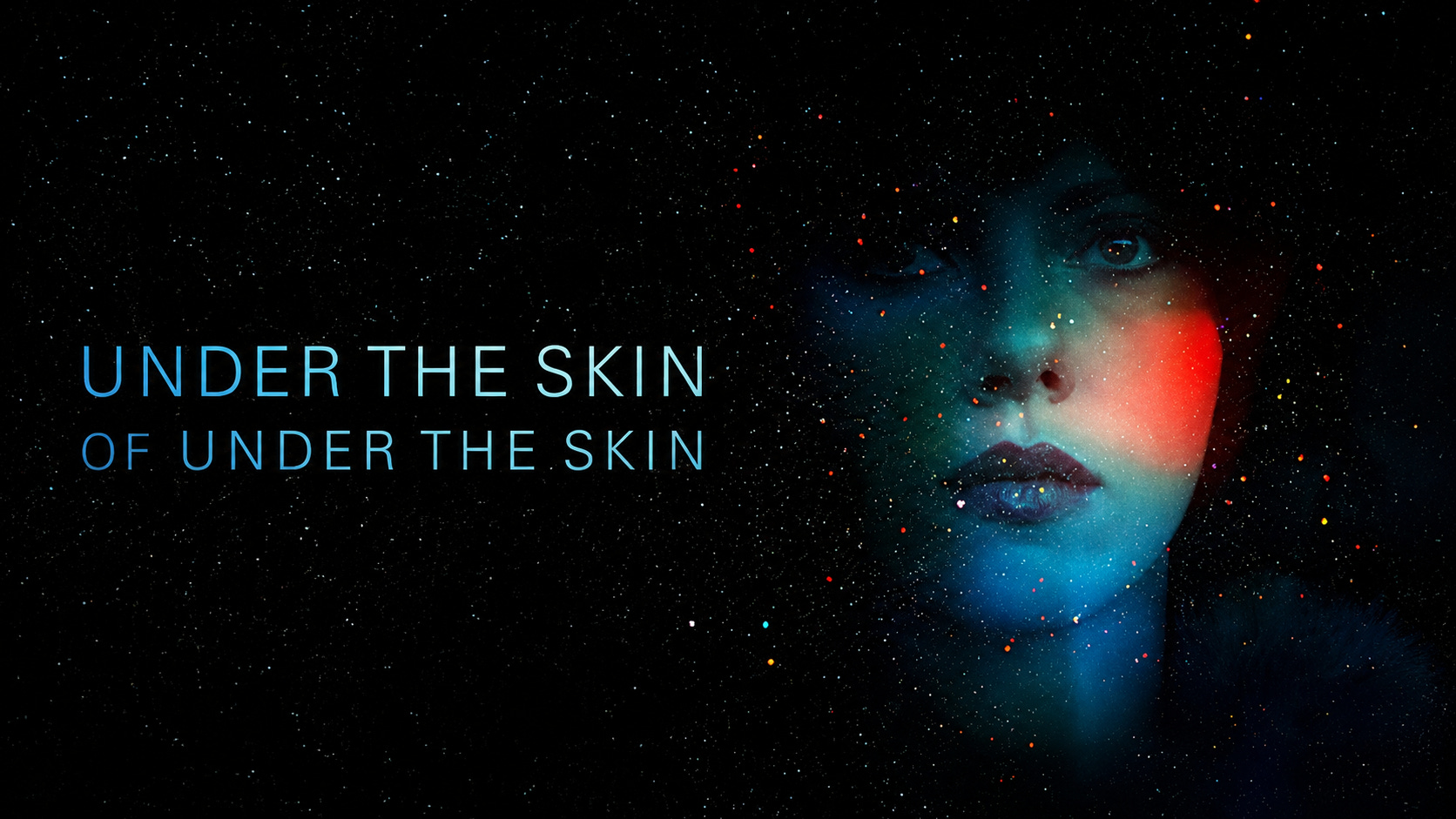
Strip the science fiction out of Jonathan Glazer’s Under the Skin and the story suddenly looks very old.
A beautiful stranger appears among men. She seems sexually available. Men follow her willingly. They discover too late that she isn’t really a woman.
That isn’t science fiction. That’s folklore.
For the first part of Under the Skin, Scarlett Johansson’s unnamed alien—the character is generally called Laura—is essentially a Siren. She drives around Glasgow looking for unattached men, determines whether anyone will miss them, and invites them home. They follow her into an impossible black room, undressing as they walk toward her, until they sink beneath the floor and disappear.
Laura barely has to hunt. Desire does the work for her.
The Siren belongs to an ancient family of stories organized around a particular fear: the beautiful woman is not what she appears to be. Her desirability is precisely what makes her dangerous. You think you are reading the signs correctly—beautiful woman, sexual invitation, possibility—and discover catastrophically that you have misunderstood what those signs mean.
Laura understands this system perfectly. She has hair, lipstick, clothes, a voice, a smile, Scarlett Johansson’s extraordinarily recognizable body. She learns which signals produce which responses in men without needing to know what any of them feel like from the inside.
Womanhood, initially, is something she knows how to operate.
Then she meets the man played by Adam Pearson.
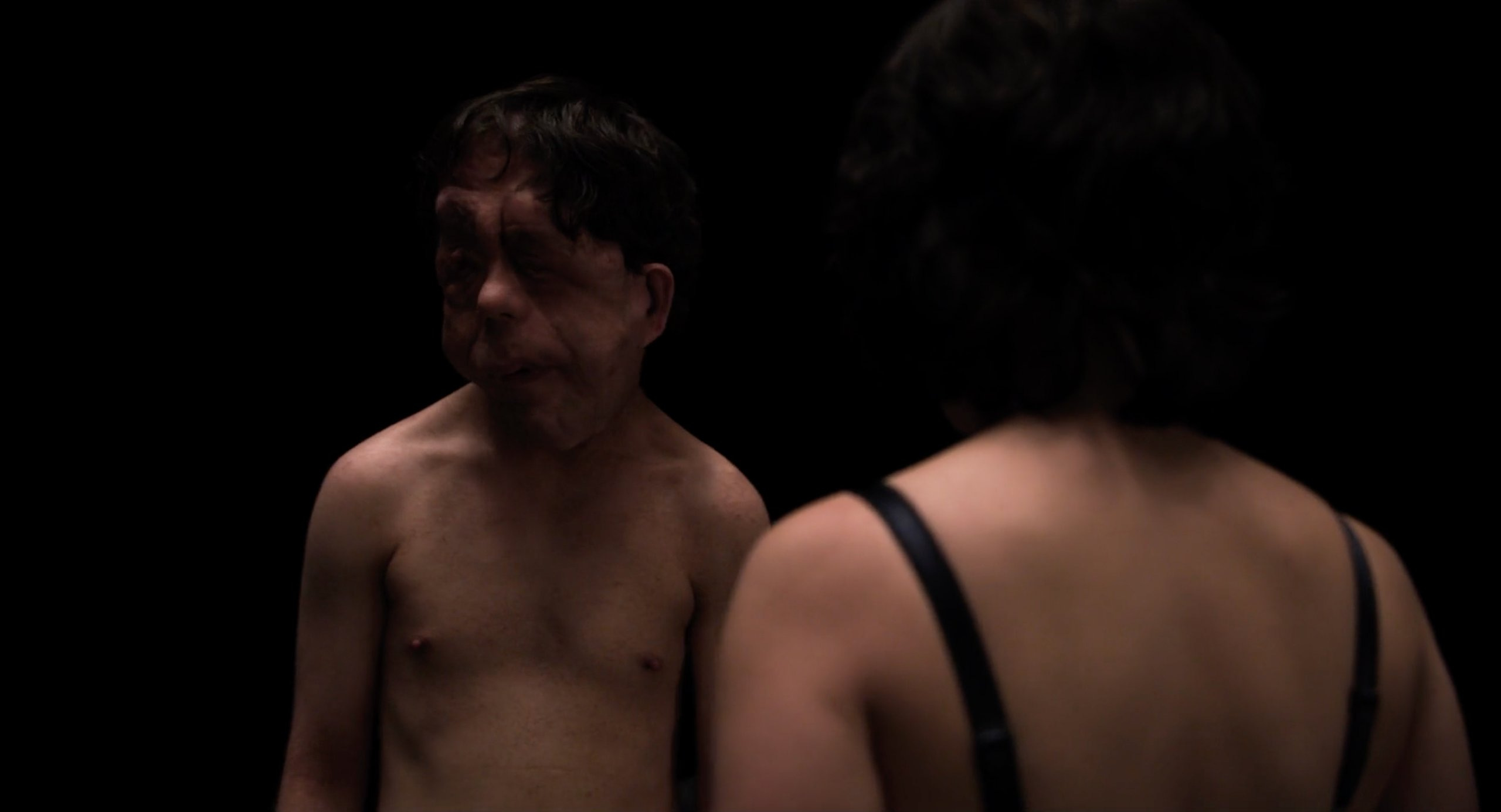
Pearson has neurofibromatosis, and his character has organized part of his life around avoiding other people’s gaze. He tells Laura he has never had a girlfriend. He shops late at night because fewer people are around. Laura looks directly at his face. She asks about it. She touches his hand and his cheek.
What is strange about the encounter is that Laura doesn’t yet possess the cultural codes that tell her what his difference is supposed to mean. She doesn’t politely pretend not to notice. She doesn’t recoil. She doesn’t know she is supposed to do either.
She takes him home. He enters the black room.
Then she lets him go.
The film never tells us exactly why, and explaining it too neatly diminishes what happens. What matters is the contradiction their bodies place beside one another.
Pearson’s character possesses an exterior that other people immediately read as different while concealing nothing about his humanity. Laura possesses an exterior that other people immediately read as familiar while concealing almost everything about what she actually is.
His difference is visible. Hers is invisible.
Neither body reliably tells you who is inside it.
After Laura releases him, she begins looking at herself differently.
And this is where Under the Skin quietly changes folktales.
Folklorist Stith Thompson catalogued the Swan Maiden motif as D361.1, part of a vast family of stories about supernatural women who cross between animal and human forms through a skin, feather garment, or similar covering. The Scottish selkie is a particularly appropriate relative: a seal woman comes ashore, removes her skin, and assumes human form. In the familiar selkie-wife story, a man hides the skin, trapping her in human life until she eventually recovers it and returns to the sea.
Film critic Anne-Katrin Titze noticed the resemblance and asked Glazer directly whether Laura’s fur coat invoked legends of seal maidens. “Was I thinking of seal maidens?” Glazer replied. “Who doesn’t?” He denied a specific conscious reference while acknowledging that the fur could function as another skin.
That almost makes the connection more interesting.
Glazer makes one of the strangest science-fiction films of the twenty-first century and somehow finds himself walking around inside a story people have been telling for centuries.
But Under the Skin reverses the old story.
The Swan Maiden or selkie wants her skin back because human existence has become the trap. Laura begins with human skin as camouflage.
Then she becomes curious about what it might mean to live inside it.
She studies herself in mirrors. She tries cake. She accepts the kindness of a man who gives her shelter. She attempts sex. The body that worked perfectly as an image begins failing as an experience. Looking human does not mean she can eat human food. Possessing a body other people understand sexually does not mean she understands how that body works.
The skin stops being merely a disguise.
It becomes a question.
And now the Swan Maiden begins shading into another supernatural woman: Hans Christian Andersen’s Little Mermaid.
Andersen did not simply record an oral folktale. His 1837 story belongs to a much older tradition of water spirits and supernatural brides, including Friedrich de la Motte Fouqué’s Undine. But Andersen makes a crucial change: his creature wants the crossing.
The Little Mermaid desires human existence. She alters her body to enter it and discovers that acquiring human form does not automatically produce human belonging. Embodiment hurts. The body makes her legible as human without granting her uncomplicated access to the life it seems to promise.
Melissa Kay has already noticed this connection in Fangoria, writing about the relationship between Under the Skin, The Lure, and Andersen’s tale. The resemblance isn’t that Laura is secretly Ariel. It is structural: a nonhuman female creature becomes fascinated by human existence, voluntarily moves toward human embodiment and intimacy, and discovers that transformation cannot simply make her belong.
This is where it becomes tempting to say Laura is “becoming a woman.”
But that is precisely the assumption the movie makes difficult.
Trans scholars have offered another way of understanding Laura’s estrangement from and experimentation with her body. Elena Gorfinkel, for instance, has discussed the film in relation to transgendered embodiment. That reading complicates any easy progression from alien to woman because the category “woman” exists before Laura has any apparent relationship to it herself.
Other people have already decided what her body means.
Laura learns to deploy that meaning. Then she becomes curious about what it means to inhabit the body carrying it.
The folklore we have been following can therefore be understood as a series of increasingly complicated relationships between bodies and meaning.
For the Siren, the female body is a false sign: I appear to be what you desire.
For the Swan Maiden, the body is a changeable sign: This skin determines which creature you think you are looking at.
For the Little Mermaid, the body is an insufficient sign: Looking human cannot make me belong among humans.
Laura inherits all three problems.
Then she acquires a fourth.
She discovers that whatever her body means to her, she cannot control what it means to someone else.
Glazer has cited Vertigo as an influence, but he reverses Hitchcock’s machinery. Vertigo turns a person into an image; Under the Skin lets the image become a subject.
And then she enters the forest.
The logger who encounters Laura there does not know she is an alien. He does not know what she has done. He sees a woman alone.
That is enough.
He attempts to rape her.
This distinction matters. Laura is not attacked because the logger discovers she is an alien. The violence begins while he still reads her body exactly as everyone else has.
Only during the assault does her human skin tear away.
The logger sees what is underneath.
And burns her.
At the beginning of Under the Skin, being looked at as a woman is Laura’s weapon. At the end, being looked at as a woman becomes her vulnerability.
But the film is doing something stranger than simply telling us that womanhood is dangerous.
Laura begins as a creature who understands the body as a sign. She learns to manipulate that sign, encounters another person whose body reveals how unreliable such signs can be, begins experiencing her own body from within, and develops something resembling a self inside a form the world has already interpreted for her.
She is looked at.
She looks at others.
She looks at herself.
And finally she discovers that she cannot control how she will be looked at.
That is what makes the folklore underneath Under the Skin so revealing. The Siren, Swan Maiden, selkie, and Little Mermaid are variations on an ancient narrative problem: the nonhuman female creature crossing the boundary into human embodiment. Traditionally, we encounter her from outside. A sailor hears the Siren. A man discovers the Swan Maiden. A fisherman steals the selkie’s skin.
The mystery is her.
What is this strange woman? What is underneath the beautiful surface?
Glazer moves the camera to the other side.
Now the supernatural woman gets to look at us.
The old story asks: What if the woman I’m looking at isn’t really what she appears to be?
Under the Skin asks the question from her side:
What happens to her when you decide she is?
Science fiction has not invented a new alien. It has taken one of our oldest strange women, placed us behind her eyes, and waited for the monster everybody has been looking at to look back.
Comments
Nothing yet. Say the first thing.
Sign in to join the conversation.