
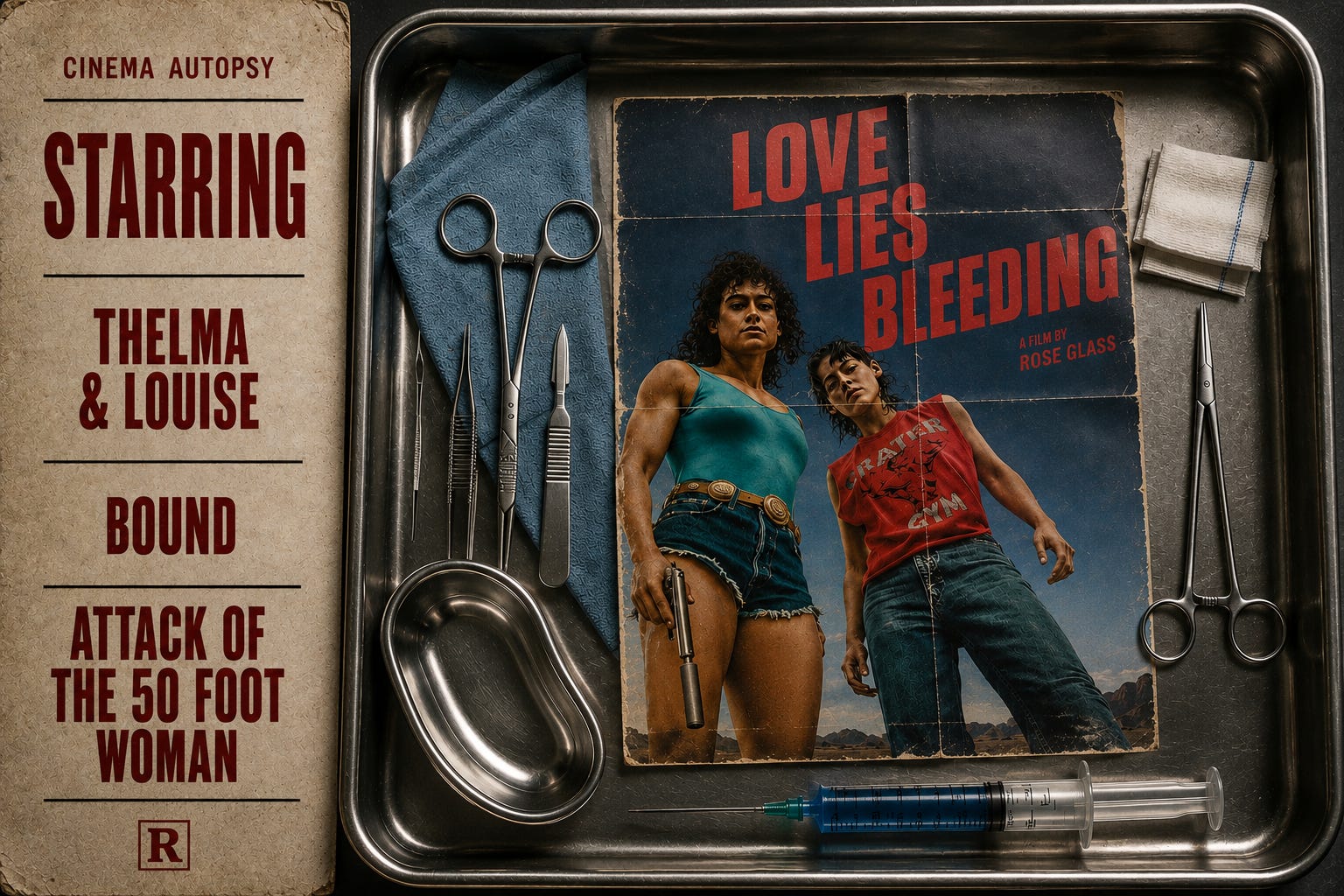
Bodybuilding has always occupied a strange place in the movies. A detective’s body solves crimes. A dancer’s body expresses emotion. A boxer’s body wins or loses. But a bodybuilder’s body doesn’t really do anything. It exists to be looked at, sculpted, turned into an idea rather than put to use — which is part of what makes Rose Glass’s Love Lies Bleeding (2024) so unsettling. It isn’t really interested in bodybuilding as a sport. It’s interested in bodybuilding as a form of mythology. The muscles aren’t the point so much as the miracle. Or maybe the curse.
The movie keeps slipping between genres. It begins as a romance, settles briefly into noir, erupts into body horror, and finally becomes something closer to the American mutation movies of the 1950s, changing shape underneath you every time you think you’ve pinned down what kind of movie you’re watching.
Film scholar Linda Williams once argued that horror, melodrama, and pornography belong to a family she called “body genres” — genres unified less by plot than by what they do to the viewer’s body. Horror wants you to recoil. Melodrama wants you to cry. Pornography wants you aroused. Love Lies Bleeding refuses to pick one; the same body becomes erotic, terrifying, triumphant, grotesque, and beautiful, sometimes within a single scene. Its organizing principle isn’t genre so much as flesh — every time the story reaches the limits of one kind of movie, the body mutates and carries it into the next.
Here’s the shape of it, for anyone walking in cold: 1980s New Mexico. Lou (Kristen Stewart) manages a gym and keeps a low profile, partly because her father runs the local gun-running operation and she wants no part of it. Jackie (Katy O’Brian) drifts into town on her way to a bodybuilding competition in Vegas, takes a job at a shooting range, and starts sleeping at Lou’s place. The two fall for each other fast, just as Lou’s family violence reaches into their lives and Jackie begins injecting steroids to prepare for competition. The film stops behaving like a normal crime picture at almost exactly the moment Jackie’s body stops behaving like a normal body.
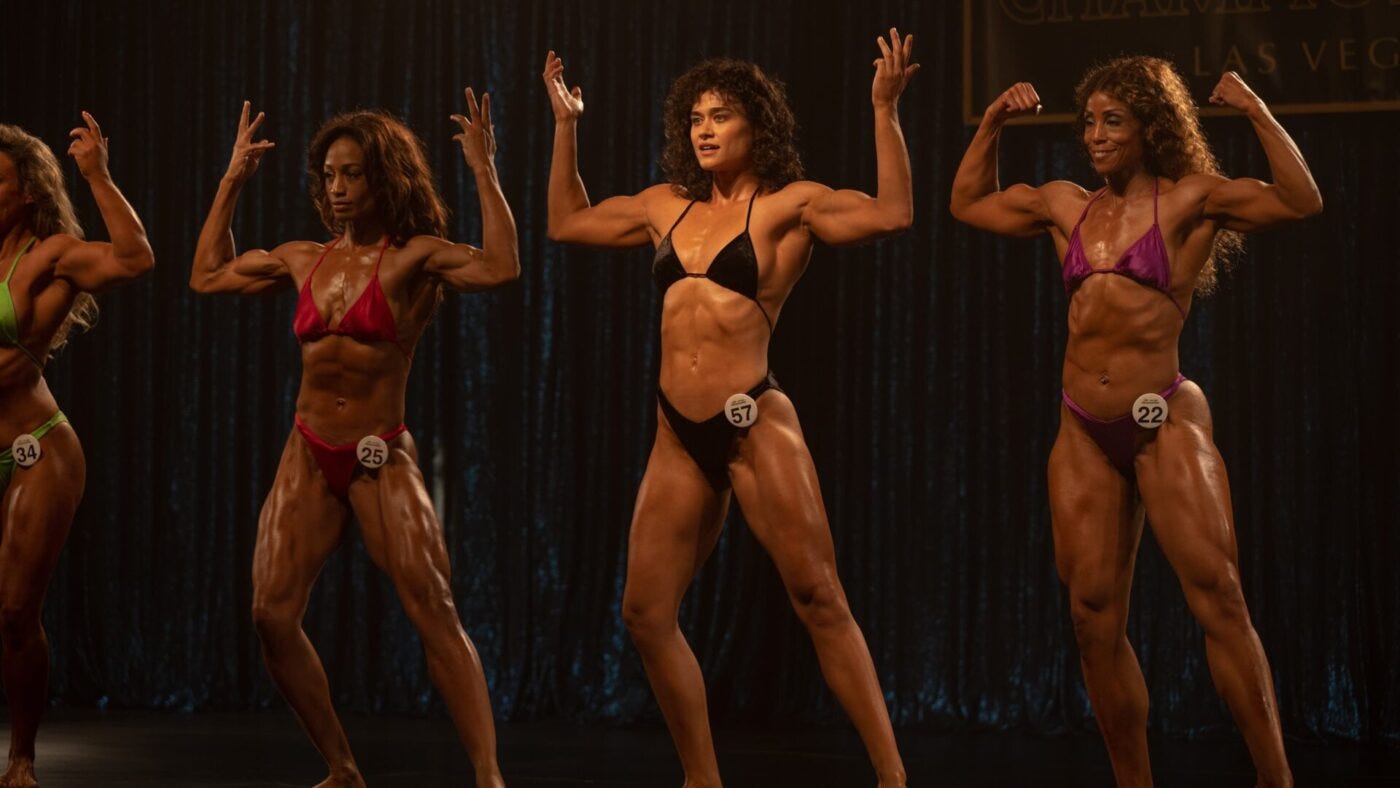

Love Lies Bleeding has the bones of another queer crime movie. The Wachowskis’ Bound begins with erotic recognition between two women and turns that recognition into a conspiracy against a criminal world controlled by men. Violet and Corky’s relationship isn’t something happening alongside the crime plot — it produces the crime plot. Their desire creates a private allegiance beneath a masculine structure that keeps misreading what’s actually happening between them, and that erotic specificity is worth naming on its own terms, not just as plot mechanics: Bound stays unapologetically hot even while the noir gears are turning, and that refusal to let heat and plot compete with each other is part of what Glass borrows along with the skeleton.
Strip away Love Lies Bleeding‘s steroids and impossible bodies and something remarkably similar remains. Two women meet through intense sexual attraction. One is already trapped inside the orbit of violent men. Their intimacy becomes an alliance. Male violence precipitates a crime, the crime demands concealment, concealment produces more violence, and suddenly the queer couple is trying to escape a criminal system whose men possess nearly every conventional form of power. Glass starts here. The skeleton just isn’t big enough for the body growing around it.
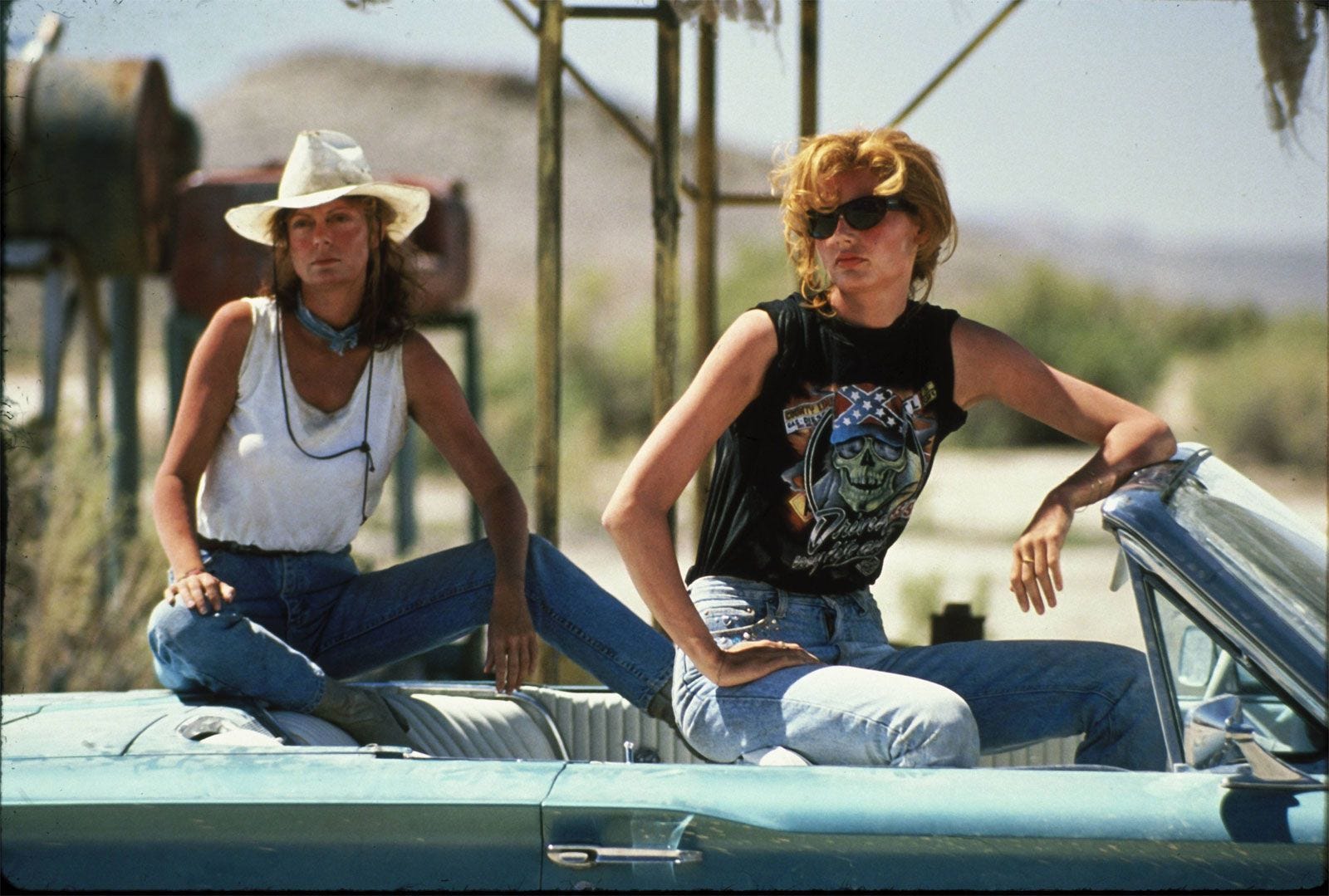
Underneath the crime story is a lovers-on-the-run movie. Like Thelma & Louise, nearly every catastrophic decision in Love Lies Bleeding grows out of intimacy rather than criminal ambition. Violence isn’t the engine. Love is. Once Lou and Jackie choose each other, the institutions surrounding them — family, law, patriarchy, respectability — gradually become obstacles rather than authorities, and the crimes don’t destroy the romance so much as the romance keeps producing the crimes.
Rose Glass has called the film an “anti-love story,” resisting precisely the idea that love automatically redeems the people experiencing it. Thelma & Louise trusts its central relationship enough to make choosing one another a kind of liberation, even in flight, even at the edge of a canyon. Glass is considerably more suspicious of that trust. Lou and Jackie lie to each other. They manipulate each other. Love makes them capable of extraordinary loyalty and extraordinarily bad decisions in roughly equal measure. The heart still drives everything here. Glass just refuses to promise that having one makes you good.
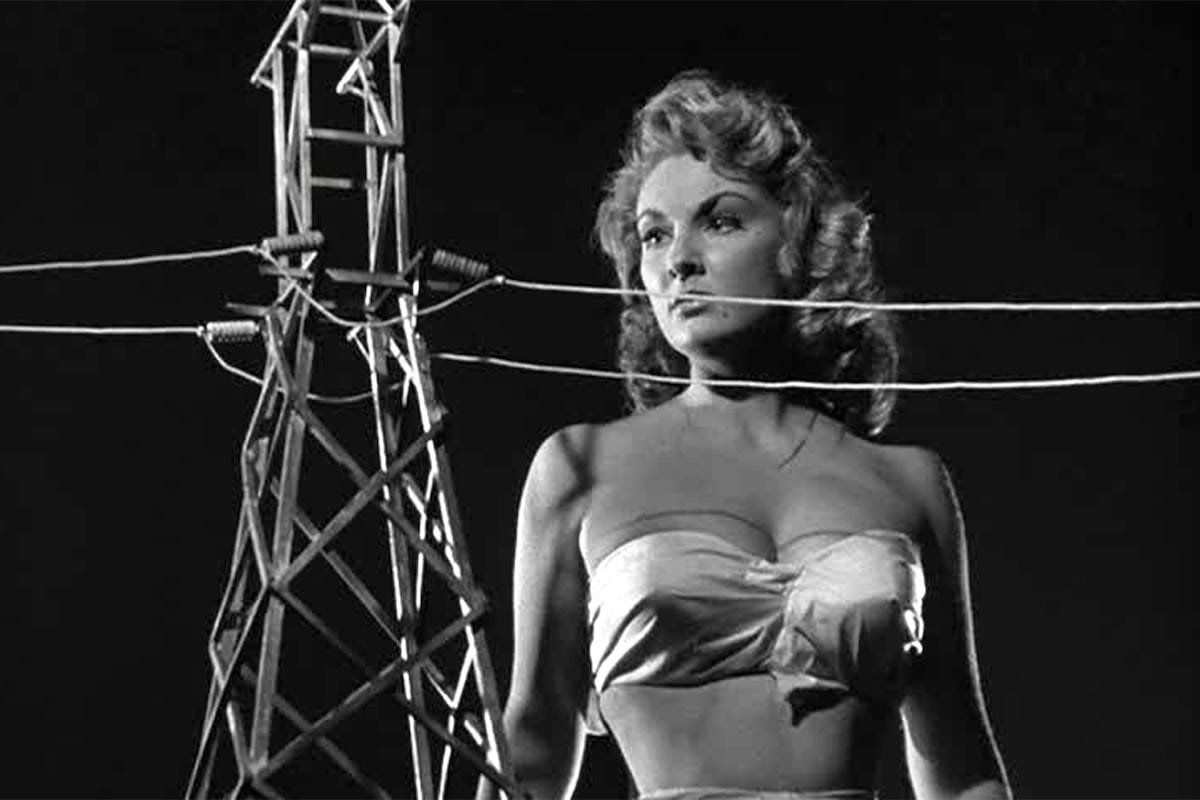
The obvious comparison is the Hulk: Jackie injects a chemical into her body, experiences increasingly uncontrollable rage, and begins swelling into something superhuman, complete with Glass’s little pre-echoes of the transformation — muscles expanding beyond physiological realism, bodily sensations turning into audiovisual events. The grammar is instantly recognizable. But the Hulk belongs to an older American tradition, the atomic-age mutation movie, where exposure or science or desire or violence makes the human body the wrong size — and Jackie has a more interesting ancestor in Attack of the 50 Foot Woman, with the Hulk sitting between them as the familiar, contemporary stand-in for a much older cinematic instinct.
In the 1958 film, Nancy Archer begins as a woman whose world is organized around male control — a cheating, scheming husband, doubtful authorities, doctors who restrain her — and then the movie makes the woman everyone has been trying to contain physically uncontainable. Nancy becomes enormous. It’s a wonderfully blunt piece of 1950s symbolism: female rage acquires scale.
Love Lies Bleeding takes that old image and rewrites it through bodybuilding. Jackie has spent the entire movie deliberately trying to become larger — more muscle, more strength, more control. Katy O’Brian, herself a former competitive bodybuilder, prepared for the role partly by seeking out Pumping Iron II: The Women, the 1985 documentary made when women’s bodybuilding was publicly negotiating how much muscle a female body could carry before judges stopped considering it appropriately feminine. Glass turns that cultural anxiety into fantasy. Jackie’s muscles gradually stop functioning as athletic achievement and begin functioning as emotion itself; desire becomes visible, rage becomes visible, ambition becomes visible, until the body doesn’t symbolize feeling anymore — it is the feeling. At the climax, metaphor gives up pretending to be metaphor. Jackie becomes gigantic.
The transformation solves a problem the crime movie can’t solve on its own terms. Lou’s father possesses the conventional powers of noir — guns, money, men, information, institutional protection — and within the realistic world Glass has constructed, Lou and Jackie cannot simply overpower him. The movie changes genres instead, and Jackie becomes physically too large for the system containing her. This is where Attack of the 50 Foot Woman turns out to be more useful than the Hulk: the Hulk transforms bodily rage into masculine superpower, while Nancy Archer transforms female containment into monstrous scale. Jackie inherits both traditions, but Glass changes their destination, letting the enormous woman keep the body that’s been coded as excessive, grotesque, chemically corrupted, unfeminine, even monstrous — and win with it, rather than being destroyed by it. Lou grows too, and the final image turns female gigantism from the spectacle of an aberrant woman into something closer to an image of queer intimacy, two women becoming too large for the world that was supposed to contain them.
Most movies in this series have a skeleton that stays visible once you strip everything else away. Glass’s movie begins with one — the queer criminal machinery of Bound — but keeps growing beyond it. Bound gives it bones. Thelma & Louise gives it a heart. Attack of the 50 Foot Woman gives it permission to become enormous. Bodybuilding turns out to be the perfect subject for a movie built this way, since the bodybuilder begins with the ordinary human skeleton and deliberately constructs something extraordinary around it — muscle accumulates, proportions change, the familiar body becomes unfamiliar without ever ceasing to be the same body underneath. That’s essentially what Rose Glass does with genre. She starts with a recognizable queer noir, adds romance, eroticism, body horror, steroids, mutation, until the movie becomes too large for the realistic crime story that once contained it.
At the start, Jackie’s muscles appear to exist primarily to be looked at. By the end, Glass has taken that spectacular body completely literally: if Jackie looks powerful, she is powerful; if rage makes her feel enormous, she becomes enormous; if love makes these women feel larger than the miserable little world they’ve inherited, the camera eventually lets them outgrow it. Love Lies Bleeding doesn’t ask what love does to the heart so much as what happens when love gets into the flesh and simply keeps going.
Thanks for reading Andy Might! This post is public so feel free to share it.
Comments
Nothing yet. Say the first thing.
Sign in to join the conversation.